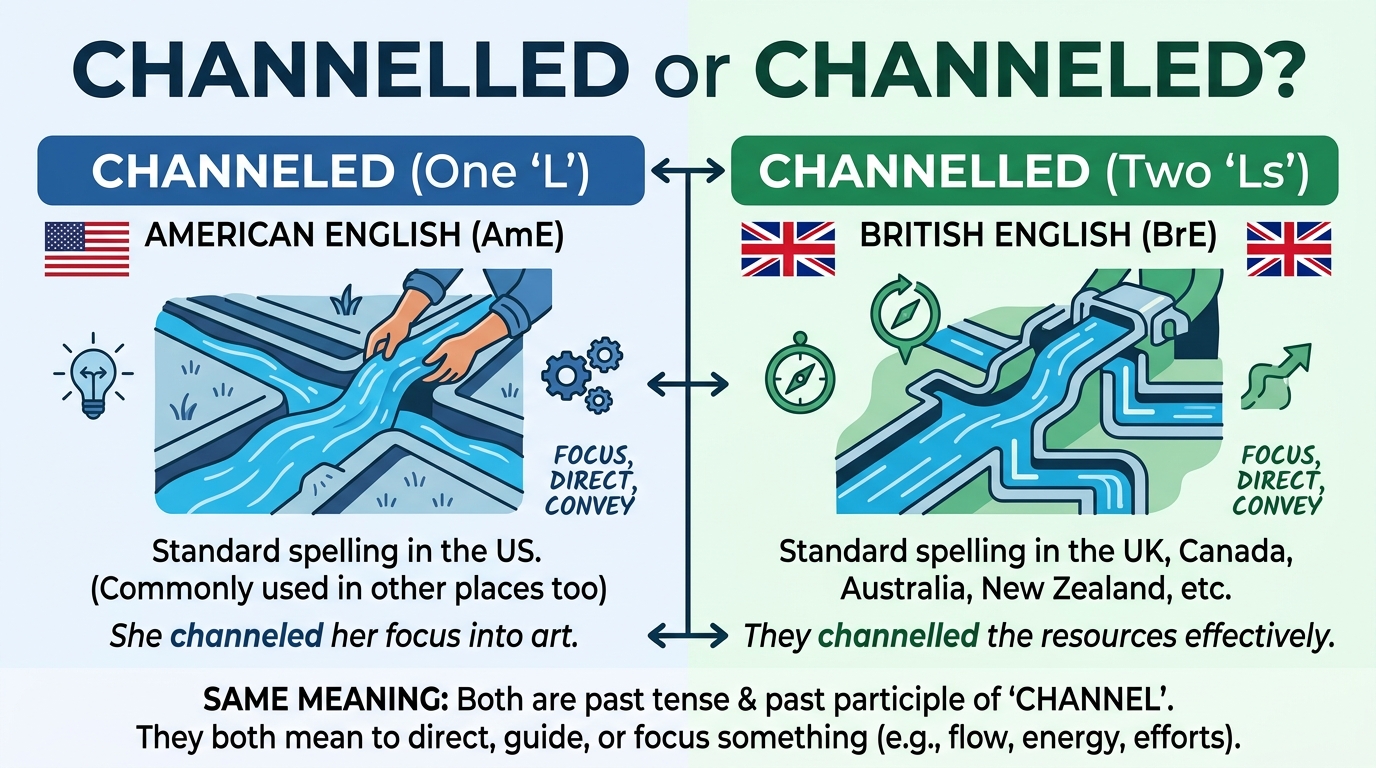
If you’ve written channelled and your spell checker changes it to channeled, you might wonder which version is actually correct.
The short answer is that both spellings are correct, but they belong to different varieties of English.
British English prefers channelled, while American English uses channeled. Knowing which form matches your audience helps you keep your writing clear, professional, and consistent.
Quick Answer
Channelled and channeled are both correct spellings of the past tense and past participle of channel.
| Spelling | Used In | Correct? |
|---|---|---|
| Channelled | British English | ✅ Yes |
| Channeled | American English | ✅ Yes |
Quick rule: If you’re writing for the UK, Australia, or New Zealand, use channelled. If your audience is in the United States, use channeled.
How to Spell and Pronounce Channelled and Channeled
Correct spelling
Choose the spelling based on the English variety you’re using.
- British English: Channelled
- American English: Channeled
Pronunciation
Both spellings are pronounced exactly the same:
IPA: /ˈtʃæn.əld/
Simple pronunciation: CHAN-uhld
The spelling changes, but the pronunciation does not.
What Does Channelled Mean?
Channelled (or channeled) is the past tense and past participle of the verb channel.
It means to direct, focus, or guide something toward a particular purpose.
Common meanings
- Direct energy toward a goal
- Focus emotions in a positive way
- Guide money or resources
- Send information through a specific route
Examples
- She channelled her creativity into painting.
- The coach channeled the team’s energy before the final.
- Most of the funding was channelled into research.
- He channeled his frustration into productive work.
Why Are There Two Correct Spellings?
The difference comes from regional spelling conventions, not grammar.
In British English, verbs ending in -el usually double the L before adding -ed.
- travel → travelled
- cancel → cancelled
- label → labelled
- channel → channelled
In American English, the second L is often dropped.
- travel → traveled
- cancel → canceled
- label → labeled
- channel → channeled
Neither spelling is more correct than the other. The right choice depends on your audience.
British English vs American English
| Feature | British English | American English |
|---|---|---|
| Preferred spelling | Channelled | Channeled |
| Double “L” | Yes | Usually no |
| Meaning | Same | Same |
| Pronunciation | Same | Same |
| Grammar | Correct | Correct |
Use channelled if you write for:
- United Kingdom
- Australia
- New Zealand
- Ireland
Use channeled if you write for:
- United States
- American businesses
- US schools and universities
- AP-style publications
The Double-L Rule Explained
Many English learners notice that British English often doubles the L, while American English does not. Channelled follows this broader spelling pattern.
Here are a few common examples:
| British English | American English |
|---|---|
| Channelled | Channeled |
| Travelled | Traveled |
| Cancelled | Canceled |
| Labelled | Labeled |
| Modelled | Modeled |
| Signalled | Signaled |
| Fuelled | Fueled |
This isn’t a special rule for the word channel. It’s part of a wider spelling difference between British and American English.
Which Spelling Should You Use?
The best spelling depends on who will read your writing.
Academic writing
Follow your institution’s style guide. British universities usually expect channelled, while American universities prefer channeled.
Business writing
Match the spelling used by your company or client. Consistency looks more professional than switching between both forms.
Websites and blogs
Use the spelling that matches your target audience. If your readers are mainly in the United States, channeled is the better choice. For a UK audience, use channelled throughout the article.
International writing
Either spelling is acceptable, but don’t mix them in the same document. Choose one style and stick with it.
Key takeaway: You don’t need to memorize two different meanings—only two different regional spellings. Both words mean exactly the same thing.
Everyday Examples of Channelled and Channeled
The meaning stays the same in every sentence. Only the spelling changes with the type of English you’re using.
British English (Channelled)
- She channelled her energy into starting a new business.
- The charity channelled donations to local families.
- He channelled his disappointment into hard work.
- Funds were channelled through the education program.
- The team channelled its efforts toward one goal.
American English (Channeled)
- She channeled her emotions into music.
- The company channeled more money into research.
- He channeled his experience into teaching others.
- The campaign channeled support through social media.
- The coach channeled the players’ confidence before the game.
Common Mistakes to Avoid
Even though both spellings are correct, writers often make these mistakes.
Mixing British and American spelling
❌ The company channelled funds and later channeled more resources.
✅ Choose one spelling style and use it throughout the document.
Assuming one spelling is wrong
Many people think channelled is incorrect because Microsoft Word or Grammarly flags it. In most cases, the software is simply using American English settings.
Following the spell checker blindly
Before accepting a spelling suggestion, check your document’s language setting. If you’re writing in British English, channelled is the correct choice.
Confusing it with channelling and channeling
The same regional rule applies to the -ing form.
| British English | American English |
|---|---|
| Channelling | Channeling |
| Channelled | Channeled |
Google Trends and Usage
Search interest shows a clear regional pattern.
- Channeled is searched more often in the United States.
- Channelled is more common in the United Kingdom, Australia, and New Zealand.
- Neither spelling is replacing the other. Each remains standard in its own variety of English.
If your content targets a U.S. audience, using channeled usually matches reader expectations. For UK readers, channelled feels more natural.
Channelled vs Channeled Comparison Table
| Feature | Channelled | Channeled |
|---|---|---|
| Correct spelling | ✅ Yes | ✅ Yes |
| English variety | British | American |
| Meaning | Same | Same |
| Pronunciation | Same | Same |
| Part of speech | Past tense & past participle | Past tense & past participle |
| Formal writing | ✅ Yes | ✅ Yes |
| Academic writing | Preferred in UK | Preferred in US |
| Business writing | UK companies | US companies |
| Dictionaries | Oxford, Cambridge | Merriam-Webster |
| Should you use it? | For UK audiences | For US audiences |
FAQs
Is channelled a correct spelling?
Yes. Channelled is the standard British English spelling.
Is channeled an American spelling?
Yes. American English normally uses channeled with one L before -ed.
Which spelling should I use?
Use the spelling that matches your audience. Choose channelled for British English and channeled for American English.
Why does my spell checker mark channelled as incorrect?
Most spell checkers follow the language setting of your document. If it’s set to American English, channelled may be flagged even though it is correct in British English.
Do both words have the same meaning?
Yes. They both mean to direct, guide, or focus something toward a particular purpose.
How do you pronounce channelled and channeled?
Both are pronounced the same: /ˈtʃæn.əld/ (CHAN-uhld).
Is channeling or channelling correct?
Both are correct. Channelling is British English, while channeling is American English.
Conclusion
The choice between channelled and channeled isn’t about right or wrong—it’s about writing for the right audience.
Channelled is the preferred spelling in British English, while channeled is the standard form in American English. Their meaning, pronunciation, and grammar are identical.
Whether you’re writing an essay, business document, or blog post, pick the spelling that matches your audience and use it consistently from start to finish.
Read More Blogs:
- Weather or Whether? The Homophone That Trips Up Fast Writers
- Your or You’re? The Apostrophe Trick That Fools Everyone

Hi, I am Anne Seaton, a professional content writer working on wordssensei.com.
I create engaging and SEO-friendly articles that inform, inspire, and connect with readers.