You probably use its and it’s every day without thinking about them. Then, suddenly, you are writing an email, checking a school assignment, or posting online, and the apostrophe makes you pause.
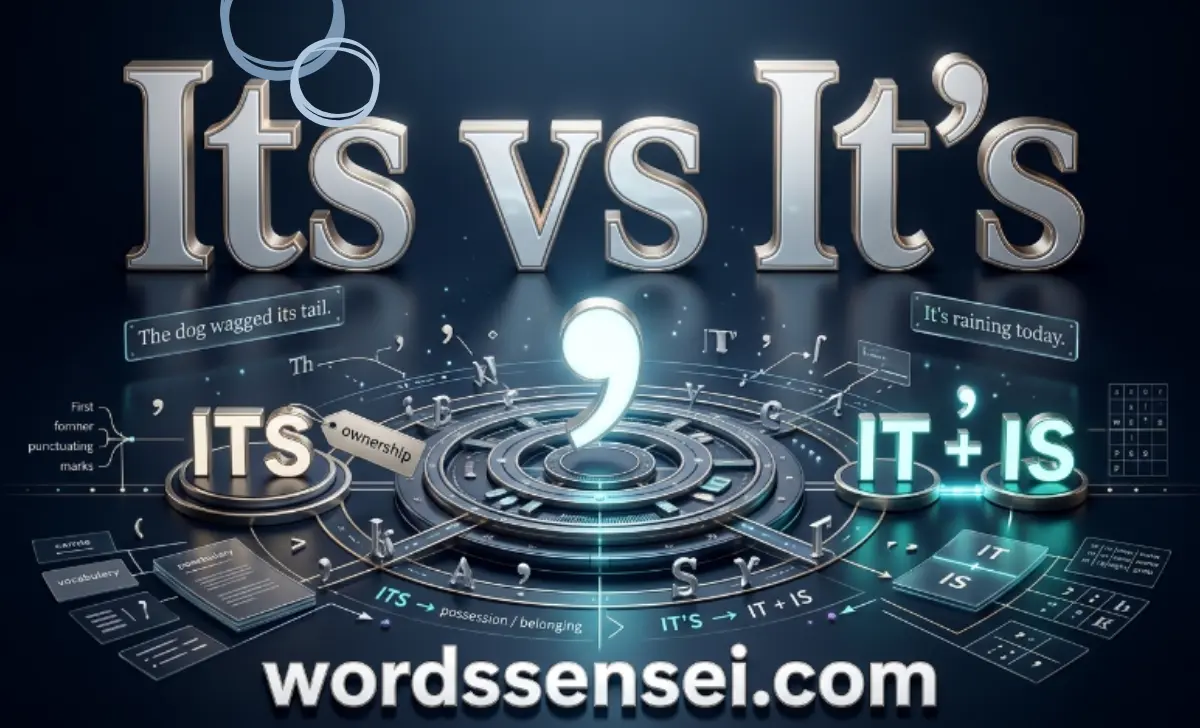
Which one belongs in the sentence? The difference is small, but the rule is clear. Its shows possession or a connection to something, while it’s is short for it is or it has.
Once you learn one simple test, choosing between them becomes much easier in texts, emails, essays, and everyday writing.
Quick Answer
Its and it’s are both correct, but they do different jobs.
Use its when you are talking about something that belongs to or is connected with something else.
The dog was carrying its favorite toy.
The toy belongs to the dog, so its is correct.
Use it’s when you can replace it with it is or it has.
It’s getting late.
This means:
It is getting late.
Another example:
It’s been a busy morning.
Here, it’s means it has been a busy morning.
A Quick Test
When you are unsure, replace it’s with it is or it has.
If the sentence still sounds right, use it’s.
If you are showing possession, use its.
| If you mean… | Use |
|---|---|
| belonging to it | its |
| it is | it’s |
| it has | it’s |
Why Are Its and It’s So Easy to Mix Up?
The problem is not pronunciation. In normal speech, its and it’s usually sound the same.
The problem appears when you write them.
English also trains us to associate apostrophes with possession:
- Sarah’s phone
- the teacher’s desk
- the dog’s collar
So it feels natural to write it’s when something belongs to “it.” But that is where the mistake happens.
Its is already the possessive form.
The company updated its website.
Not:
The company updated it’s website.
The apostrophe in it’s has a different job. It shows that letters have been left out of it is or it has.
When Do You Use Its?
Use its when you want to show possession, ownership, association, or a connection.
It often appears directly before a noun.
Real-Life Examples of Its
Imagine your friend sends you a photo of their new puppy.
You might say:
The puppy is playing with its ball.
The ball belongs to the puppy.
At work, you might write:
The company changed its meeting time.
The meeting time is connected with the company.
While talking about a phone, you could say:
My phone lost its signal on the train.
The signal is associated with the phone.
You could also write:
The restaurant changed its menu last week.
The menu belongs to or is associated with the restaurant.
Common Phrases With Its
You will often see its in phrases such as:
- its name
- its color
- its size
- its shape
- its purpose
- its owner
- its location
- its price
- its website
- its customers
- its members
- its own
For example:
The store changed its opening hours.
The phone is known for its camera.
Every business has its own challenges.
When Do You Use It’s?
Use it’s when it means it is or it has.
That is the whole rule.
It’s Means “It Is”
Here are some natural examples you might actually say:
It’s too late to order pizza now.
Expand it:
It is too late to order pizza now.
Another everyday example:
It’s really hot outside today.
That means:
It is really hot outside today.
You might text a friend:
It’s your turn to choose the movie.
Again:
It is your turn to choose the movie.
It’s Means “It Has”
It’s can also mean it has.
For example:
It’s been a long day.
Expand it:
It has been a long day.
Or:
It’s already started.
This means:
It has already started.
You might say this while waiting for a meeting, class, match, or movie.
Another example:
It’s changed a lot since last year.
That means:
It has changed a lot since last year.
Its vs It’s in Real Conversations
One of the best ways to learn the difference is to see how these words naturally appear in everyday life.
At Home
The washing machine has finished its cycle.
Here, its shows a connection with the washing machine.
It’s time to hang the clothes.
Here, it’s means it is.
At Work
The company announced its new holiday policy.
Its shows association with the company.
It’s important that everyone reads the update.
It’s means it is.
At School
The school changed its exam schedule.
The schedule belongs to or is connected with the school.
It’s difficult to finish the project in one day.
It’s means it is.
While Shopping
The store has lowered its prices.
The prices belong to or are associated with the store.
It’s much cheaper this week.
It’s means it is.
On Your Phone
My phone lost its connection.
The connection is associated with the phone.
It’s working again now.
It’s means it is.
These are the kinds of situations where the difference matters in real writing. The grammar rule stays the same even when the context changes.
Its Own or It’s Own: Which One Is Right?
This is one of the most common questions about its vs it’s.
The correct phrase is:
its own
For example:
The restaurant has its own delivery service.
Why?
Because you are showing a connection between the restaurant and the delivery service.
Another natural example:
The company has its own office downtown.
And:
The phone comes with its own charger.
You should not write:
The phone comes with it’s own charger. ❌
Remember:
its own = belonging to it
it’s = it is / it has
Can It’s Mean It Has?
Yes, but there is an important detail.
It’s can mean it has when has is helping form a verb phrase.
For example:
It’s been raining all morning.
This means:
It has been raining all morning.
You could also say:
It’s already happened.
That means:
It has already happened.
However, it’s does not mean “it has” in every situation where the word “has” appears.
The safest method is still to look at the complete sentence and expand the contraction.
How to Tell Its and It’s Apart in Seconds
When proofreading, use the expansion test.
Step 1: Find “It’s”
Suppose you wrote:
The weather is changing because it’s getting colder.
Ask:
Can I say “it is”?
The weather is changing because it is getting colder.
Yes.
So it’s is correct.
Now try:
The dog lifted it’s paw.
Replace it:
The dog lifted it is paw.
That makes no sense.
So you need:
The dog lifted its paw.
The Three-Question Rule
Ask yourself:
1. Does it mean “it is”?
Use it’s.
2. Does it mean “it has”?
Use it’s.
3. Does it show belonging or association?
Use its.
That simple check handles most cases.
Common Its vs It’s Mistakes
These errors show up often in emails, schoolwork, social posts, and business content.
Mistake 1: Using It’s for Possession
Wrong:
The dog is wagging it’s tail.
Correct:
The dog is wagging its tail.
The tail belongs to the dog.
Mistake 2: Removing the Apostrophe From It’s
Wrong:
Its going to rain tonight.
Correct:
It’s going to rain tonight.
Why?
It’s = It is
It is going to rain tonight.
Mistake 3: Writing It’s Own
Wrong:
The shop has it’s own website.
Correct:
The shop has its own website.
The website is associated with the shop.
Mistake 4: Writing Its When You Mean It Is
Wrong:
Its hard to explain.
Correct:
It’s hard to explain.
Expand it:
It is hard to explain.
That confirms it’s.
Its vs It’s: Side-by-Side Examples
| Sentence | Correct word | Why? |
|---|---|---|
| The cat cleaned _ paws. | its | The paws belong to the cat. |
| _ getting dark. | it’s | It is getting dark. |
| The shop changed _ hours. | its | The hours are connected with the shop. |
| _ been three weeks already. | it’s | It has been three weeks. |
| The laptop lost _ charge. | its | The charge is associated with the laptop. |
| _ too expensive for me. | it’s | It is too expensive. |
| The school updated _ website. | its | The website belongs to the school. |
| _ already finished. | it’s | It has already finished. |
Is It’s Correct Grammar?
Yes.
It’s is completely correct when it is used as a contraction of it is or it has. Its is also correct, but it has a different grammatical role as the possessive form of it.
So neither spelling is “wrong” by itself.
The mistake happens when you use the wrong one for the meaning.
Compare:
It’s a new phone.
Correct.
The phone has its own case.
Also correct.
But swapping them changes the grammar.
Is There a Difference in British and American English?
No major regional difference exists for this rule.
American English and British English both use:
its for possession
it’s for it is or it has
So you do not need to change the spelling based on whether your reader is in the United States, United Kingdom, Canada, Australia, or another English-speaking region.
The important thing is the meaning of the sentence.
How Do You Pronounce Its and It’s?
In normal English speech, its and it’s are usually pronounced the same way.
That is one reason they are so easy to confuse.
You cannot always hear the difference in conversation.
For writing, however, the distinction matters.
Consider:
The dog hurt its leg.
and:
It’s hurt.
They may sound similar around the word it, but they perform different grammatical jobs.
So when proofreading, rely on the meaning and sentence structure rather than pronunciation.
Its vs It’s and Other Confusing Words
If you understand its vs it’s, you already understand a useful pattern found in other English word pairs.
Your vs You’re
Your shows possession:
Is this your jacket?
You’re means you are:
You’re late.
Their vs They’re
Their shows possession:
They forgot their keys.
They’re means they are:
They’re waiting outside.
Whose vs Who’s
Whose asks about possession:
Whose phone is this?
Who’s means who is:
Who’s calling?
The same idea helps with its vs it’s:
No apostrophe → possessive form
Apostrophe → contraction
There are exceptions to that broad shortcut with other words, so the safest method remains checking the actual meaning.
When to Use Its in Formal Writing
Use its whenever you need to show possession or association.
This is common in:
- academic writing
- reports
- business emails
- news articles
- product descriptions
- website content
- school assignments
For example:
The study explains the method and its limitations.
The company published its annual report.
The product is known for its simple design.
These sentences sound natural because its clearly connects the noun with the subject.
When to Use It’s in Everyday Writing
It’s is common in everyday communication because contractions make English sound natural and conversational.
You might write:
It’s great to hear from you.
It’s almost time.
It’s been a busy week.
It’s not working properly.
It’s a good idea.
In formal writing, some style guides may prefer fewer contractions. Still, whenever it’s is used, the same grammar rule applies.
A Simple Way to Remember Its vs It’s
Here is the easiest memory trick:
If you can say “it is” or “it has,” choose it’s.
Otherwise, if you are showing possession or association, choose its.
Think of the apostrophe as a clue.
it’s → it is / it has
its → belonging to it
For example:
It’s raining.
→ It is raining.
But:
The tree lost its leaves.
You cannot say:
The tree lost it is leaves.
So its is the only sensible choice.
Its vs It’s: A Final Cheat Sheet
| Question | Answer |
|---|---|
| Does it show possession? | its |
| Does it mean “it is”? | it’s |
| Does it mean “it has”? | it’s |
| Is “its own” correct? | Yes |
| Is “it’s own” correct for possession? | No |
| Does its need an apostrophe? | No |
| Does it’s need an apostrophe? | Yes |
| Do British and American English use the same rule? | Yes |
FAQs
Where do I use its vs it’s?
Use its for possession or association. Use it’s when you mean it is or it has.
Where is its used?
Use its before a noun when something belongs to or is connected with “it.”
The dog found its ball.
Where can I use it’s?
Use it’s when it can be expanded to it is or it has.
It’s getting late.
It’s been a long day.
What is the rule for using its?
Its is the possessive form of it. It does not need an apostrophe.
The company changed its name.
Can I say it’s instead of it is?
Yes. It’s is a contraction of it is.
It’s cold. = It is cold.
Is “it’s” or “its” okay?
Both are correct. The right choice depends on the meaning of your sentence.
How do we say “its”?
Its and it’s normally sound the same in speech. The difference becomes important in writing.
How do I use it’s in a sentence?
Use it’s when it means it is or it has.
It’s a beautiful morning.
What should I say instead of its?
Usually, you do not need to replace its. It is the normal possessive form of it.
How do I use it and it’s?
It is a pronoun. It’s is a contraction meaning it is or it has.
It is ready.
It’s ready.
What is a sentence with its?
The restaurant is known for its homemade bread.
Here, its connects the bread with the restaurant.
How do I explain its vs it’s?
The shortest explanation is: its shows possession, while it’s means it is or it has.
Do I use it’s for it has?
Yes, when has is part of the verb phrase.
It’s been raining.
= It has been raining.
Which is correct: “its own” or “it’s own”?
Its own is correct when you mean something belongs to or is associated with “it.”
The business has its own website.
When can I use it’s?
Use it’s whenever it means it is or it has.
Is it’s correct grammar?
Yes. It’s is correct grammar when it is used as a contraction of it is or it has.
Is it correct to say it is?
Yes. It is is completely correct. In fact, replacing it’s with it is is a useful way to check your sentence.
What does its mean?
Its is the possessive form of it. It shows possession, belonging, or another connection.
The company changed its policy.
What does “its/its” mean?
If you mean its vs its, the two forms are visually identical when both are written without capitalization. The key comparison is normally its vs it’s: its shows possession, while it’s means it is or it has.
Conclusion
The easiest way to remember its vs it’s is to stop thinking about the apostrophe as a possession mark.
Its already shows possession, while it’s is a contraction of it is or it has. When you are unsure, expand it’s in your head.
If “it is” or “it has” works, keep the apostrophe. If you are talking about something belonging to or connected with “it,” choose its.
Once this quick test becomes a habit, the difference becomes much easier to spot in everyday writing.
Read More Blogs:

Hi, I am Anne Seaton, a professional content writer working on wordssensei.com.
I create engaging and SEO-friendly articles that inform, inspire, and connect with readers.