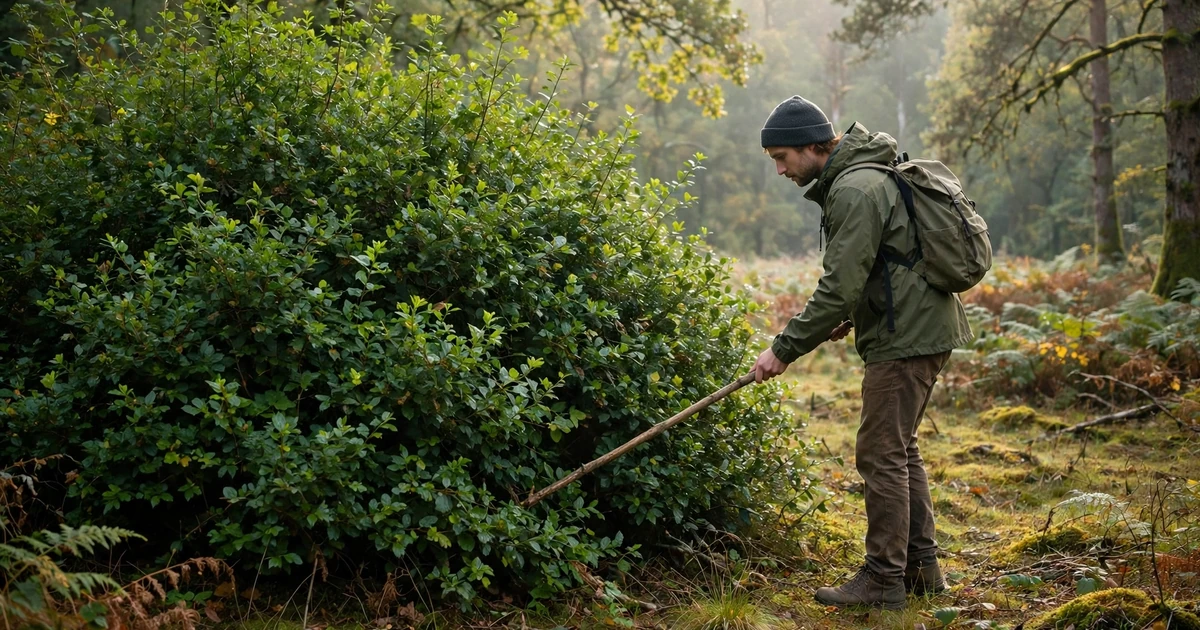
The meeting had been running for forty minutes and nobody had said the actual thing. The budget was blown, everyone in the room knew it, and the manager was still circling it with euphemisms and throat-clearing. Finally someone said, “Stop beating around the bush — are we over budget or not?” English has had a name for that circling for five hundred years.
Beat Around the Bush: The Short Answer
Merriam-Webster defines “beat about the bush” — the variant “beat around the bush” is the everyday form — as “to fail or refuse to come to the point in discourse,” with a first known use in 1520. It means avoiding the main point: circling a subject with hints, preambles, and evasions instead of saying the thing directly.
What Does It Mean?
The idiom is about avoidance, not confusion. Someone beating around the bush knows (or senses) the point and won’t land on it — padding a difficult message, delaying bad news, or talking around a sensitive topic. A doctor beating around the bush won’t deliver the diagnosis; a friend beating around the bush won’t ask the favor outright.
It is almost always used as a criticism or a self-aware admission. “Sorry, I’m beating around the bush” is a common preface to finally saying the thing. The idiom names the behavior so precisely that invoking it usually ends the behavior — which is why it survives, above all, as an imperative.
The 1520 Dating and the Hunting Story
Merriam-Webster attests the phrase from 1520, making it one of the oldest idioms in continuous English use — five centuries and counting. George Gascoigne used it in 1572: “He bet about the bush, whyles others caught the birds.” The commonly told origin is medieval hunting: “beaters” would strike bushes with sticks to flush out game for the hunters, working around the edges rather than going straight in.
As with many old idioms, the hunting story is the commonly told explanation, not a confirmed fact — Merriam-Webster attests only the 1520 dating. But the image is suggestive either way: in Gascoigne’s line, the one who “bets about the bush” is the one who doesn’t catch the birds. The avoider loses; the direct win. That reading has held for 450 years.
How to Use It
The idiom appears most often as a verb phrase, frequently in the imperative.
- “Stop beating around the bush and tell me what happened.”
- “He beat around the bush for ten minutes before mentioning the price.”
- “Don’t beat around the bush — do we have the funding or not?”
- “I know I’m beating around the bush, but this is hard to say.”
Note the typical company it keeps: “stop,” “don’t,” “quit” — the idiom invites interruption. It also pairs naturally with its antonym, which deserves its own section.
The Antonym: “Cut to the Chase”
“Beat around the bush” has a direct opposite: cut to the chase — to get straight to the point. The pair functions as a matched set in English: one names the avoidance, the other names the cure. Merriam-Webster’s own example sentence for the idiom is “Stop beating around the bush” — the dictionary itself reaches for the imperative, which tells you how the phrase lives in real speech: as a nudge toward directness. Where beating around the bush is evasion, cutting to the chase is the bite the bullet moment of just saying it — and like its sibling idiom bark up the wrong tree, it turns a physical image into a permanent piece of conversational furniture.
When Not to Use It (Register)
The imperative “Stop beating around the bush!” is direct but not rude among equals — friends, peers, and familiar colleagues hear it as brisk, not hostile. With strangers, clients, or superiors, it can sound impatient or presumptuous; telling a hiring manager to stop beating around the bush is a fast way to end an interview. In those settings, softer forms work better: “Could you walk me through the key point?” or “I want to make sure I understand — what’s the bottom line?”
Also worth noting: the idiom criticizes the speaking style, not the content. Using it against someone delivering genuinely difficult news — a layoff, a diagnosis — can read as callous. Read the room before you deploy the imperative.
Why the Image Sticks
Five hundred years is a long run for a metaphor, and this one earns it. The physical picture — someone literally circling a bush, making noise at the edges, never stepping to the center — maps perfectly onto conversational evasion. Everyone has watched someone do it, and everyone has done it themselves. The idiom’s age is part of its authority: when you say someone is beating around the bush, you’re using a phrase that predates Shakespeare’s birth, and it still describes the modern meeting perfectly.
Frequently Asked Questions
It means to avoid the main point — “to fail or refuse to come to the point in discourse,” per Merriam-Webster. Someone beating around the bush circles a topic with hints and preambles instead of stating it directly.
The commonly told origin is medieval hunting, where “beaters” struck bushes with sticks to flush out game. Merriam-Webster attests the phrase from 1520 but does not confirm the origin; the earliest cited use is George Gascoigne’s 1572 line, “He bet about the bush, whyles others caught the birds.”
“Cut to the chase” — to get directly to the point. The two idioms form a matched pair: one names evasion, the other names directness.
Among equals it is brisk but not rude. With strangers, clients, or superiors it can sound impatient — use a softer phrasing like “What’s the bottom line?” instead.
They are variants of the same idiom. “Beat about the bush” is the older form (and the one Merriam-Webster lists as the headword); “beat around the bush” is the everyday modern form. They mean the same thing.
Merriam-Webster’s first known use is 1520, making it one of the oldest idioms still in everyday English — over five centuries of continuous use.