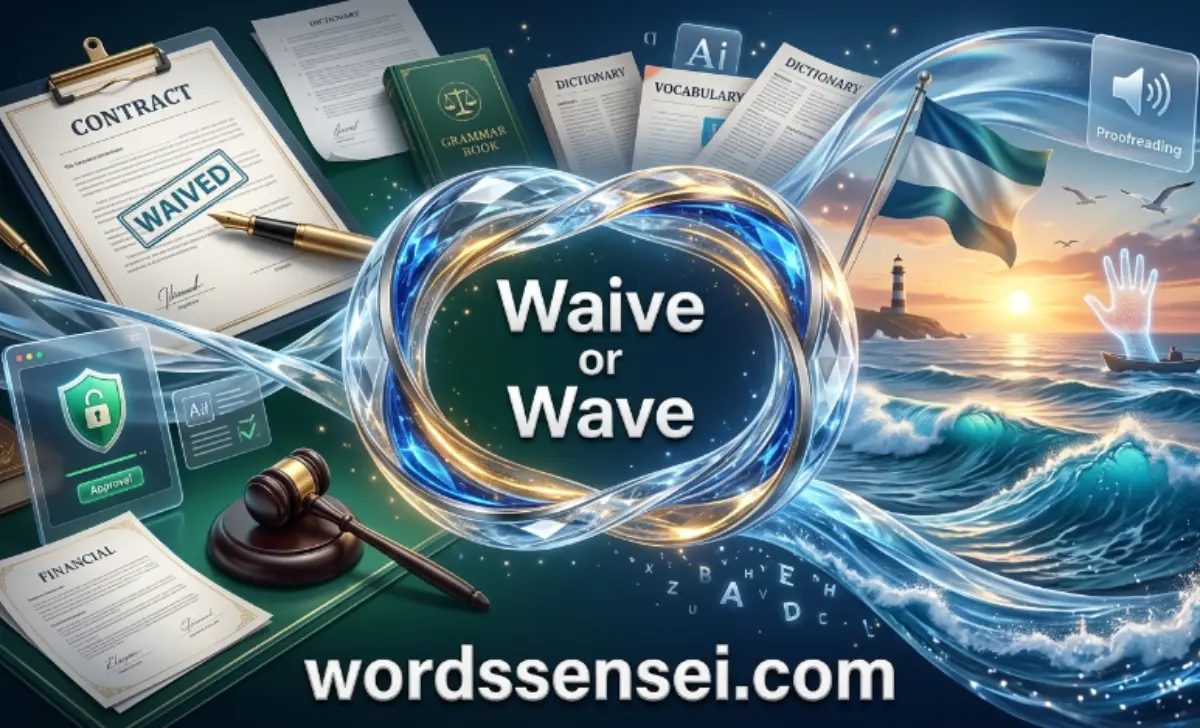
A referee raises both arms and signals that a disputed goal won’t count, an action sports journalists sometimes describe as being “waved off” and other times as being “waived off.” Meanwhile, a university announces it will “waive” application fees for students from low-income families, a sentence where only one spelling could ever be correct. This inconsistency isn’t a simple mistake at all. According to Merriam-Webster, “wave” and “waive” occupy a genuinely unusual position among commonly confused word pairs, since in certain specific contexts, both spellings are actually considered acceptable synonyms, differing mainly in formality rather than meaning.
This makes “waive vs wave” different from nearly every other pair explored in this series. According to Merriam-Webster’s own research, both words gained the sense of “to disregard” or “to dismiss” during the 19th century, developing this shared meaning independently rather than through simple confusion. Consequently, this guide breaks down both core meanings clearly, explores the specific overlap where usage genuinely “waves back and forth,” as Merriam-Webster puts it, and shares reliable tips for choosing correctly in the situations where only one spelling truly fits.
Quick Answer
Waive is a verb meaning to voluntarily give up a right, claim, or privilege, typically used in legal, formal, or administrative contexts. Wave, meanwhile, functions as both a noun and a verb, referring to a hand gesture, the movement of water, or a broader surge of activity or emotion.
According to Grammarly, waive means to relinquish voluntarily, such as surrendering a right or privilege, typically in legal contexts, while wave refers to moving one’s hand to and fro or the undulating movement of water. Similarly, Vocabulary.com notes that to waive is to give up one’s right to do something, while wave describes an undulating motion or shape.
Overall, a helpful test exists: if your sentence involves giving up a right or requirement, use waive. If it involves physical motion, gesture, or water, use wave instead.
Correct Example
- She agreed to waive her right to a jury trial.
- He gave a friendly wave as their car pulled away.
- The college decided to waive the application fee this year.
- Powerful waves crashed against the rocky shoreline.
Incorrect Example
- She agreed to wave her right to a jury trial. (Wrong — should be “waive.”)
- He gave a friendly waive as their car pulled away. (Wrong — should be “wave.”)
What Does Waive Mean?
Waive is a verb meaning to voluntarily surrender, relinquish, or set aside a right, claim, privilege, or requirement, most commonly appearing in legal, formal, or administrative writing.
Common Meanings
- Legal Right Surrender — giving up a formal legal right or claim.
- Fee or Requirement Removal — setting aside a fee, rule, or requirement.
- Formal/Administrative Use — common in contracts, policies, and official documentation.
- Related Noun: Waiver — a document or formal act of waiving something.
Simple Usage Examples
- Legal: “The defendant chose to waive his right to remain silent.”
- Fees: “The bank agreed to waive the overdraft fee as a courtesy.”
- Requirements: “Students with prior experience can waive the introductory course.”
- Formal: “By signing this form, you waive any claims against the company.”
What Does Wave Mean?
Wave functions as both a noun and a verb, referring to a hand gesture, the movement of water, or more broadly, any undulating motion or widespread surge of activity, emotion, or trend.
Common Meanings
- Hand Gesture (Noun/Verb) — moving one’s hand back and forth as a greeting or signal.
- Water Movement (Noun) — the rising and falling motion of the sea or ocean.
- Figurative Surge — describing widespread trends, emotions, or events, as in “a wave of support.”
- Physics/Science Context — describing energy movement, such as sound or radio waves.
Simple Usage Examples
- Gesture: “She gave a warm wave as she spotted her friend across the room.”
- Water: “The surfers waited patiently for the next big wave.”
- Figurative: “A wave of relief washed over the exhausted team.”
- Science: “Radio waves travel at the speed of light.”
Waive vs. Wave: Comparison Table
| Word | Part of Speech | Core Meaning | Example |
|---|---|---|---|
| Waive | Verb only | To give up a right or requirement | “Waive the fee.” |
| Wave | Noun / Verb | Hand gesture, water motion, surge | “Wave goodbye.” |
Quick Decision Guide
| Your Sentence Involves… | Use |
|---|---|
| Giving up a legal right | Waive |
| Removing a fee or requirement | Waive |
| A hand gesture or greeting | Wave |
| Ocean or water movement | Wave |
| A widespread trend or surge | Wave |
| Signing a formal document | Waive (waiver) |
The Rare Genuine Overlap: When Both Words Work
Unlike nearly every other pair in this series, “waive” and “wave” share a documented, legitimate area of overlap. According to Merriam-Webster, both words independently developed the meaning “to disregard” or “to dismiss” during the 19th century, particularly in phrases like “wave off” or “waive off.” Consequently, a referee can be described as either “waving off” or “waiving off” a disallowed goal, and both versions appear in professionally edited sports journalism.
Formality as the Deciding Factor
Merriam-Webster’s own usage guidance suggests that context, particularly formality, offers the clearest way to choose between them in this overlapping sense. “Wave” tends to appear in more casual, everyday writing, while “waive” remains the preferred choice in legal or highly formal contexts. However, Merriam-Webster itself acknowledges that actual usage “waves back and forth,” meaning careful writers can reasonably choose either spelling in this specific, narrow context without being definitively wrong.
Where This Overlap Does NOT Apply
Importantly, this flexibility applies only to the narrow “dismiss or disregard” sense. In every other context, such as giving up a legal right, describing ocean movement, or greeting someone with your hand, only one spelling remains correct. Consequently, writers should not assume general interchangeability beyond this specific, documented overlap.
British English vs. American English
Since “waive” and “wave” are spelled identically in both American and British English, this pair doesn’t carry a genuine regional spelling divide. Still, a few usage nuances exist worth understanding between the two regions.
Comparison Table
| Feature | American English (US) | British English (UK) |
|---|---|---|
| Spelling of both words | Identical | Identical |
| “Waive” in legal contexts | Very common | Very common |
| “Wave off” in sports journalism | Common, especially hockey/football | Common, especially football/rugby |
| “Waiver” (noun) usage | Standard legal term | Standard legal term |
| Formality distinction | Generally maintained in formal writing | Generally maintained in formal writing |
A Shared Transatlantic Pattern
Unlike many word pairs explored in this series, “waive” and “wave” show remarkably consistent usage patterns across both American and British English, with neither region showing a strong preference for blurring the distinction more than the other. This consistency likely reflects the pair’s relatively lower overall confusion rate compared to more frequently mistaken pairs.
Is This Actually a “Commonly Confused” Pair?
Interestingly, not every source agrees that “waive” and “wave” belong among English’s most frequently confused words. According to research referenced by Holistic SEO, Oxford Dictionaries’ own analysis of the most commonly misused English words highlights pairs like “affect” and “effect,” “accept” and “except,” and “its” and “it’s” as far more frequent sources of error. “Waive” and “wave,” by contrast, appear less often on these definitive lists, suggesting the confusion, while real, may be somewhat less widespread than other homophone pairs covered elsewhere in this series.
Why the Confusion Still Persists
Despite not topping the most-confused lists, plenty of writing instructors and grammar resources still report seeing this mistake regularly, particularly among students and non-native English speakers first encountering the legal sense of “waive.” Therefore, while perhaps not the single most notorious pair in English, the confusion remains genuine and worth understanding clearly.
Waive in Legal and Business Writing
Common Legal Waiver Phrases
Legal documents rely heavily on “waive” within specific, recurring phrases: “waive the right to,” “waive liability,” and “sign a waiver” all appear constantly across contracts, medical consent forms, and liability releases. Understanding these phrases precisely matters significantly, since a waiver often carries binding legal consequences once signed.
Waiving Fees in Everyday Business
Beyond formal legal contexts, businesses frequently “waive” fees as a customer service gesture, such as waiving a late payment fee or an application charge. This everyday business usage remains firmly in “waive” territory, never appearing correctly as “wave” despite the more casual context.
Wave in Science, Nature, and Culture
Waves in Physics and Science
Beyond ocean water, “wave” carries significant scientific meaning, describing energy patterns like sound waves, radio waves, and light waves. This technical usage remains entirely separate from any legal or formal meaning, firmly rooted in physics and natural science terminology.
The Cultural “Wave” at Sporting Events
The stadium “wave,” where fans stand and sit in sequence to create a visual ripple effect, represents one of the more playful cultural uses of this word, entirely unrelated to its water-based origins yet clearly borrowing the same undulating, rolling imagery.
The “Legal I” Memory Trick
A dependable way to remember this pair: “waive” contains a hidden “i,” which some writers connect to “legal issues,” since waiving something almost always involves a formal, legal, or administrative decision. “Wave,” without that extra letter, stays simple and physical, matching its connection to straightforward motion, whether a hand gesture or ocean water. Additionally, remembering that “waiver,” the noun form, always relates to legal documents reinforces the connection between “waive” and formal, rights-related contexts.
The Historical Development of Both Words
Understanding how “waive” and “wave” evolved separately, before briefly converging in meaning during the 19th century, offers valuable context for this unusual word pair.
The Origin of Wave
“Wave” traces back to Old English wafian, related to moving back and forth, originally describing physical motion long before any connection to legal terminology existed. Over centuries, this straightforward physical meaning expanded naturally to describe ocean movement, hand gestures, and eventually broader figurative uses like “a wave of enthusiasm” sweeping through a crowd.
The Origin of Waive
“Waive,” by contrast, entered English through Anglo-French legal vocabulary, related to the Old French waiver, meaning to abandon or relinquish. This distinctly legal origin explains why “waive” retained its formal, rights-related meaning throughout its history, rarely straying into casual, everyday usage the way “wave” eventually did.
Why Their Paths Crossed in the 19th Century
According to Merriam-Webster’s research, both words independently developed the sense of “dismissing” or “disregarding” something during the same historical period, likely influenced by their shared homophony rather than any direct linguistic borrowing between them. This parallel development, occurring simultaneously rather than one word borrowing from the other, makes their overlap particularly interesting from a linguistic perspective, since it represents genuine convergent evolution rather than a simple historical merger. Few other commonly confused word pairs in English can claim this same kind of documented, independent development toward a shared meaning, making “waive” and “wave” a genuinely unique case study in how homophones sometimes drift toward, rather than away from, each other over time.
Practical Guidance for Writers and Editors
When to Play It Safe
For writers uncertain about which spelling to choose in ambiguous “dismissal” contexts, defaulting to “wave” for casual writing and “waive” for formal, legal, or professional writing offers the safest general approach. Sports journalists, in particular, benefit from establishing consistent house style guidelines, since both spellings appear across different, equally reputable publications covering identical situations.
Building Confidence Through Context
Ultimately, distinguishing between “waive” and “wave” becomes considerably easier once writers focus on the broader context of their sentence rather than trying to memorize an exhaustive list of exceptions. Legal, financial, and administrative writing should almost always default to “waive,” while descriptions of physical movement, gestures, and natural phenomena should almost always default to “wave,” reserving genuine uncertainty for that narrow, well-documented overlap involving dismissal or disregard.
Frequent Errors
- Writing “wave” when describing giving up a legal right, where “waive” is correct.
- Writing “waive” when describing a simple hand gesture, where “wave” is correct.
- Assuming general interchangeability beyond the narrow “dismiss” context Merriam-Webster identifies.
- Confusing “waiver” (the noun) with “wavier,” an unrelated comparative adjective describing something with more waves or curves.
Corrected Examples
- Incorrect: “Please wave your right to appeal within thirty days.”
- Correct: “Please waive your right to appeal within thirty days.”
- Incorrect: “She gave a friendly waive before driving away.”
- Correct: “She gave a friendly wave before driving away.”
Waive and Wave in Everyday Examples
Emails
“We’re pleased to inform you that your application fee has been waived, and we look forward to waving hello at orientation next month.”
Social Media
“Caught the most incredible wave while surfing this morning, best session in weeks.”
News Writing
“The court ruled that the defendant knowingly waived his right to legal representation.”
School Writing
“The physics lesson explained how sound waves travel differently through air versus water.”
Business Writing
“Our team has agreed to waive the standard processing fee for all first-time customers this quarter.”
Why This Keyword Gets Searched
Writers search “waive vs wave” constantly while drafting legal documents, contracts, or formal correspondence involving fees and rights. Students, meanwhile, search it while studying commonly confused words for grammar exams, even if this particular pair ranks lower on official confusion lists than others. Sports fans and journalists search it specifically after encountering the genuinely ambiguous “wave off” versus “waive off” usage in game commentary. Additionally, non-native English speakers search it while learning the specific legal vocabulary surrounding rights and formal agreements.
Related Homophone-Adjacent Confusions
Similar Legal-Versus-Casual Word Pairs
- Council vs. Counsel — another pair involving formal, legal terminology.
- Ensure vs. Insure vs. Assure — a comparable trio with genuine shared history.
- Affect vs. Effect — the quintessential commonly confused pair, appearing far more often on official lists.
Helpful Grammar Tips
Whenever uncertain, remember that “waive” almost always involves rights, fees, or formal agreements, while “wave” almost always involves physical motion, gestures, or water, except in the narrow, documented “dismiss” overlap Merriam-Webster identifies.
FAQs
What is the difference between “waive” and “wave”?
“Waive” means to voluntarily give up a right or requirement, typically in legal contexts, while “wave” refers to a hand gesture, water movement, or general undulating motion.
What does “waive your rights” mean?
“Waiving your rights” means voluntarily giving up a legal right or claim, such as the right to a trial or the right to sue.
What is a “waiver”?
A “waiver” is a formal document or act through which someone voluntarily gives up a legal right, claim, or requirement.
Can “wave” and “waive” ever mean the same thing?
Yes, in the specific context of dismissing or disregarding something, such as “waving off” or “waiving off” a decision, both words function as accepted synonyms, differing mainly in formality.
Why do “waive” and “wave” get confused?
They are homophones with historically overlapping meanings in certain contexts, though they generally serve distinct grammatical roles and meanings elsewhere.
What does “wave off” mean?
“Wave off” means to dismiss or signal against something, often used in sports when an official disallows a play or score.
Is “waive” always related to legal matters?
Primarily yes, though it can also apply to everyday situations like waiving a fee or requirement outside strictly legal contexts.
How do you pronounce “waive”?
“Waive” is pronounced /weɪv/, rhyming with “cave” and “brave,” identical to the pronunciation of “wave.”
Conclusion
“Waive” and “wave” occupy a genuinely unusual place among English’s commonly confused word pairs, since unlike nearly every other pair explored in this series, these two words share a documented, legitimate area of overlap rather than a strict right-or-wrong distinction throughout. In most contexts, the difference remains crystal clear: “waive” belongs to the formal world of rights, fees, and legal agreements, while “wave” belongs to the physical world of gestures, ocean water, and broader cultural or scientific phenomena. Yet within that narrow, specific sense of dismissing or disregarding something, Merriam-Webster itself acknowledges that usage genuinely “waves back and forth,” making room for either spelling depending largely on how formal the surrounding context happens to be.
This nuance matters because it reflects something refreshingly honest about how language actually works in practice, rather than the tidier, more rule-bound picture grammar guides often present. Real usage, tracked across decades of edited prose, doesn’t always split neatly into one correct answer and one mistake; sometimes, as with “wave off” and “waive off,” two spellings genuinely coexist, each carrying a slightly different register without either being definitively wrong. Recognizing this rare flexibility, while still respecting the clear, non-negotiable distinction everywhere else these words appear, offers a more complete and honest understanding of how “waive” and “wave” actually function in real, published English.
Whether you’re waiving a legal right, waving hello to a friend, or navigating that rare gray area where a referee waves, or waives, off a disputed call, keeping the core distinction in mind, rights and formality on one side, motion and physicality on the other, will serve you well in the vast majority of situations you’ll ever encounter with these two deceptively simple-looking words.
Read More Blogs:
- Personalized or Personalised: Which One Should You Use?
- Authorization or Authorisation? Correct Spelling Guide

Hi, I am Anne Seaton. I am a writer and educator working with Wordssensei.com to help students learn English easily.