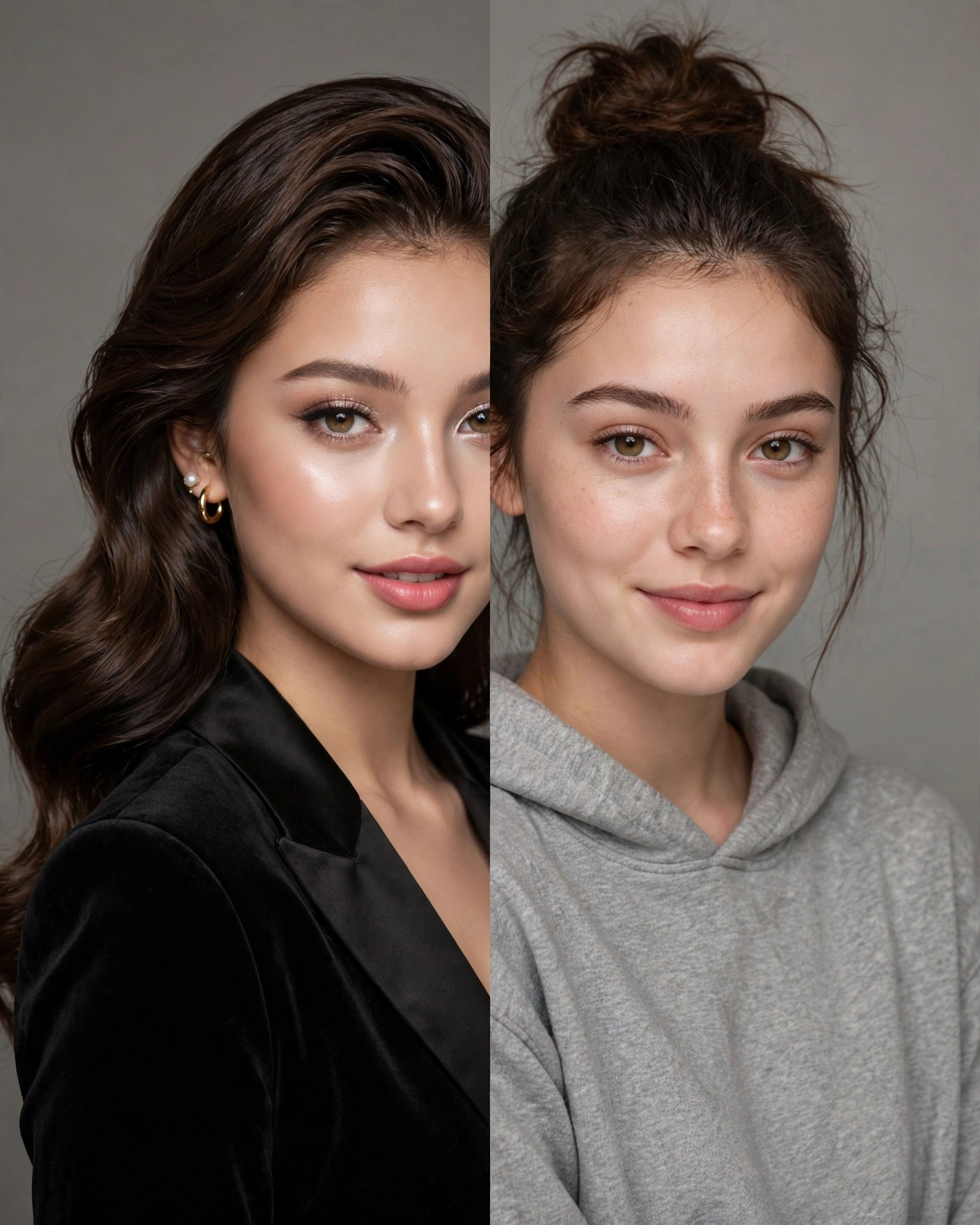
Every glow-up montage has an evil twin: the side-by-side where the “after” is somehow worse than the “before.” The internet has a word for that particular tragedy — the glow down. It started as the disappointing opposite of a glow-up, then picked up a second, surprisingly positive meaning along the way.
Glow Down: The Short Answer
A glow down is a disappointing or undesirable transformation in appearance, talent, power, or status — the opposite of a glow-up. Wiktionary defines the slang noun as “a disappointing or undesirable transformation in appearance, talent, power, etc.” Note the spelling: Wiktionary hyphenates it as glow-down, while the unhyphenated “glow down” is the common variant online — you will see both, and both are understood.
What Does “Glow Down” Mean?
In its original sense, a glow down is a decline that everyone can see. The classic usage is celebrity and influencer culture: a star who looked effortlessly radiant three years ago now looks exhausted, overworked, or just different in a way fans read as a fall. But it is not only about looks — Wiktionary’s definition deliberately covers talent, power, and status too, so a beloved show’s terrible final season or an athlete’s lost season can be a glow down.
The word does most of its work in comparison posts: a split image, a “then vs. now,” a comment section voting on whether the glow down is real or imagined. Bored Panda leaned into exactly that format with a January 2026 gallery, “67 Glow-Downs People Weren’t Afraid To Show Online,” collecting volunteers’ own before-and-after declines.
Used carefully, it is observational humor. Used carelessly, it is just mocking someone’s appearance — and the main character energy of posting your own glow down is very different from assigning one to a stranger.
Where Did “Glow Down” Come From?
The etymology is refreshingly honest: per Wiktionary, glow down was “modelled after glow-up.” The glow-up — a dramatic positive transformation — was already one of the internet’s favorite formats when someone realized the vocabulary needed an antonym for the failures. Language abhors a vacuum, and comedy abhors an asymmetry.
The newer, second sense has a fashion-world pedigree. Vogue has described a glow-down as a “deliberate regression to one’s natural, unenhanced state” — the celebrity who ditches the fillers, the glam, and the filters and posts the bare face instead. In that telling, the glow down is not a decline at all; it is a choice, and arguably the braver one.
The Two Senses of “Glow Down”
So the term now carries two meanings, and context decides which one you are hearing:
- The decline (original): an unwanted, disappointing transformation — burnout visible on someone’s face, a breakup glow-down, a franchise losing its magic. This is the Wiktionary sense, and still the dominant one.
- The deliberate reset (newer): embracing the natural, unfiltered look as a rejection of the glow-up treadmill. Vogue’s framing. Here the “down” is ironic — the person looks happier, not worse.
When someone says “she had a glow down,” they almost always mean sense one. When a magazine writes about “the glow-down trend,” it usually means sense two. If you are writing about it, a quick clarifier saves everyone confusion.
How to Use “Glow Down” in a Sentence
- “No offense, but his post-breakup era was a total glow down.”
- “The show’s final season was a glow down nobody asked for.”
- “She posted her glow down herself — stress, no sleep, and a bad dye job.”
- “Honestly? Her glow-down to the natural look suits her better.”
- “Comparing my 2021 selfies to now is a certified glow down.”
It is the direct antonym of glow-up — if you know one, you already understand the other.
Common Mistakes When Using “Glow Down”
First, don’t confuse it with a glow-up. This sounds obvious, but the two get mixed up by people encountering the term for the first time — a glow-up is the improvement, a glow down is the decline (or the deliberate de-glamming).
Second, be careful who you assign it to. Declaring that a real person “had a glow down” is a judgment on their appearance, and it lands very differently than posting your own. The Bored Panda gallery worked because people volunteered.
Third, watch the spelling. Wiktionary’s entry hyphenates (glow-down); online usage mostly doesn’t (“glow down”). Neither is wrong in casual use, but the hyphenated form is the dictionary form.
A glow down is a disappointing or undesirable transformation in appearance, talent, power, or status — the opposite of a glow-up. Wiktionary documents the slang sense; online it is usually written without the hyphen.
A glow-up: a dramatic positive transformation. Glow down was modelled after glow-up (per Wiktionary) specifically to name the reverse.
It was modelled after “glow-up” to fill the missing antonym — the internet needed a word for transformations that go the wrong way. The deliberate-natural-look sense was later articulated in fashion coverage, including Vogue.
Vogue has used “glow-down” for a deliberate regression to one’s natural, unenhanced state — ditching heavy glam and filters. In this newer sense, the glow down is a choice, not a decline.
Wiktionary hyphenates the entry as “glow-down,” but the common online variant “glow down” (two words) is more widespread. Both are understood; the hyphenated form is the dictionary form.
It depends on the target. Posting your own glow down is self-deprecating humor; declaring that someone else had one is a judgment on their appearance. Keep it to yourself — or to volunteers.