
Have you ever typed stoping and wondered whether it should actually be stopping? This is a surprisingly common spelling question among students, writers, English learners, and professionals.
The confusion happens because English spelling rules often require certain letters to be doubled before adding endings such as -ing.
While most people encounter stopping as the present participle of the verb stop, some are surprised to learn that stoping is also a real word with a completely different meaning used in the mining industry.
Understanding the distinction is important because using the wrong spelling can change the meaning of a sentence and affect writing accuracy.
This guide explains the meanings, grammar rules, origins, examples, and correct usage of stopping and stoping.
Quick Answer
For most writers, stopping is the correct spelling.
- Stopping is the present participle and gerund form of the verb stop.
- Stoping is a specialized mining term related to extracting ore from underground deposits.
Correct Examples
- The bus is stopping at the next station.
- She is stopping work early today.
- Engineers are stoping the underground ore body. (mining context)
Incorrect Examples
- The train is stoping here. ❌
- We are stoping for lunch. ❌
Quick Rule
When adding -ing to the verb stop, double the final p and write stopping.
What Does Stopping Mean?
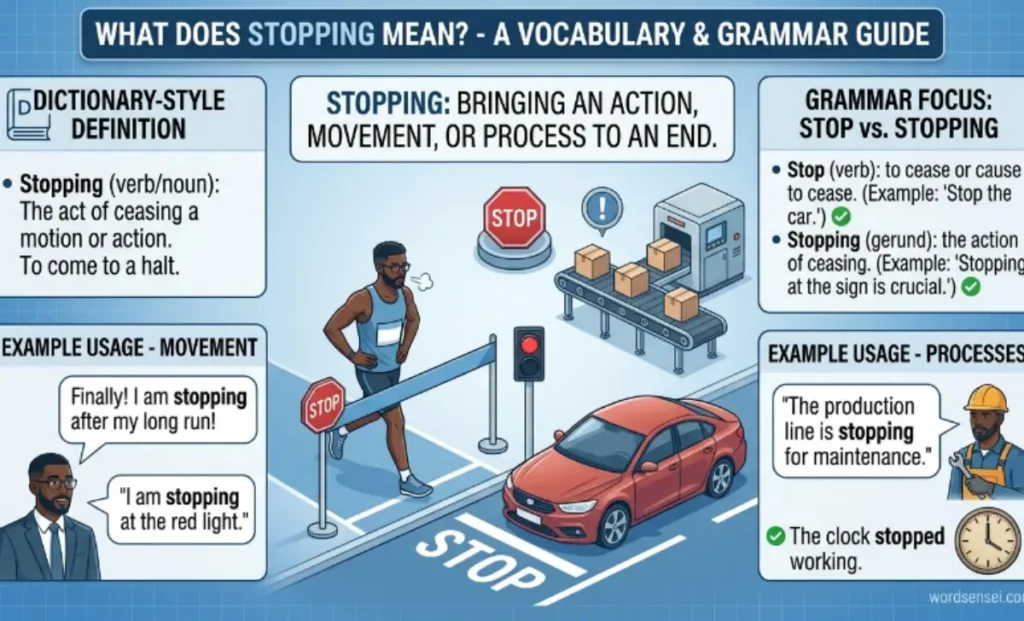
The word stopping comes from the verb stop and refers to ending, halting, pausing, or ceasing an action.
Common Meanings
- Halting movement
- Ending an activity
- Pausing progress
- Preventing continuation
- Bringing something to a halt
Simple Usage Examples
- The driver is stopping the vehicle.
- Rain is stopping the outdoor event.
- We are stopping at a hotel tonight.
- The company is stopping production temporarily.
Stopping is widely used in everyday English and appears in speech, writing, education, business, and media.
What Does Stoping Mean?
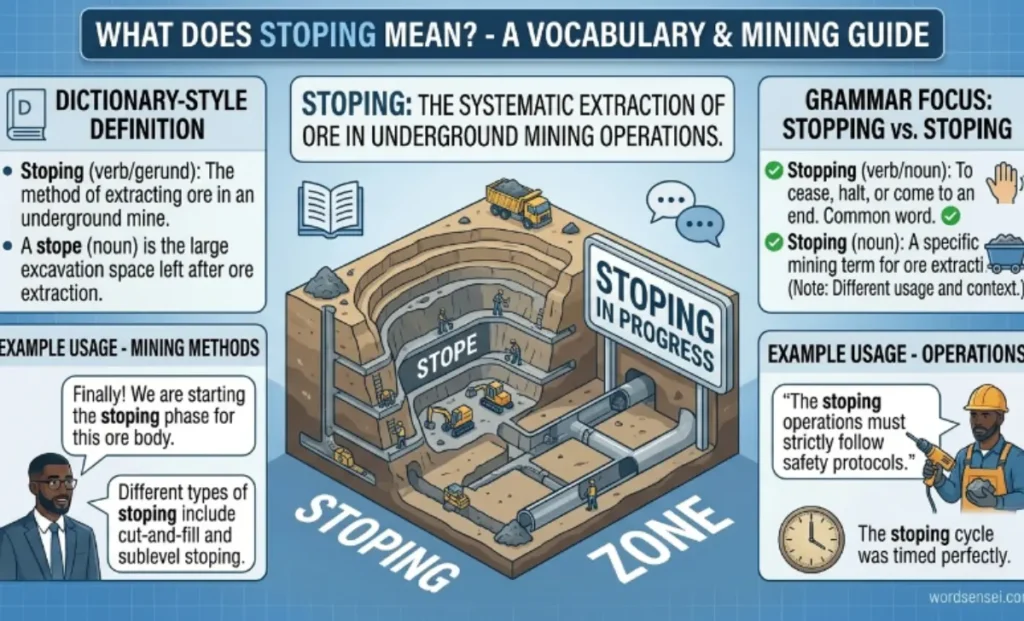
The word stoping is a technical term used in mining and geological engineering.
Common Meanings
- Underground ore extraction
- Mining excavation process
- Mineral removal method
- Resource extraction technique
Simple Usage Examples
- The company uses stoping methods to extract ore.
- Engineers studied several stoping techniques.
- Modern stoping improves mining efficiency.
- Stoping operations continued throughout the project.
Outside the mining industry, most people rarely encounter this word.
The Origin of Stopping and Stoping
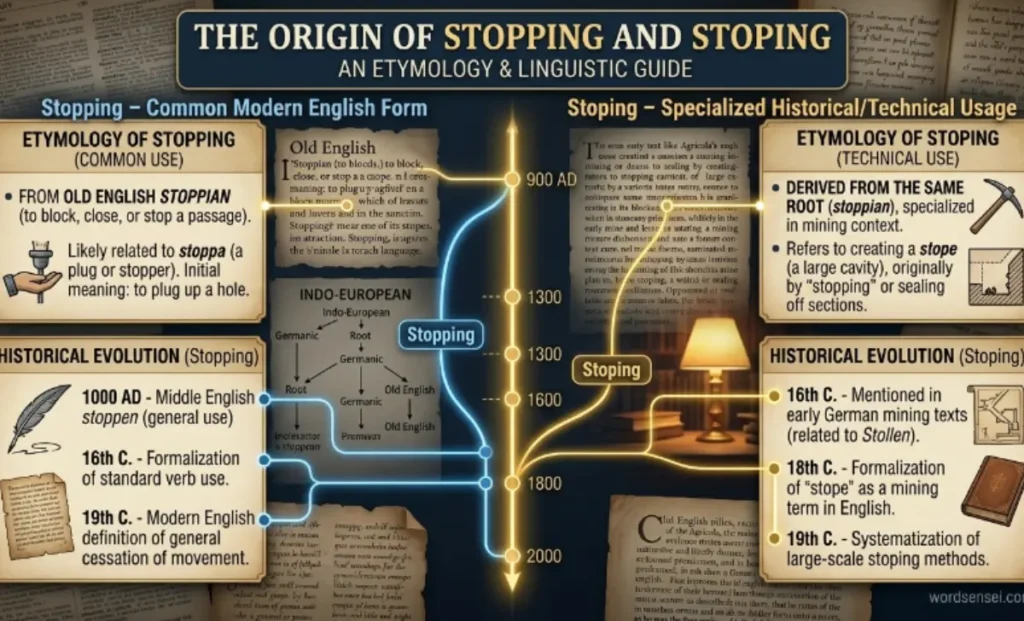
The history of these words explains why they look similar but mean different things.
Word History
The verb stop comes from older Germanic language roots and has been part of English for centuries.
As English grammar evolved, spelling conventions required doubling certain consonants before adding suffixes such as -ing.
The term stoping developed separately within the mining industry and refers to underground excavation methods.
Why the Confusion Happens
People often confuse these words because:
- They differ by only one letter.
- Most writers know the word stop.
- Few people are familiar with mining terminology.
- English spelling rules can be difficult to remember.
British English vs American English
Unlike many spelling disputes, both British and American English follow the same rule.
Comparison Table
| Feature | Stopping | Stoping |
| British English | Standard | Mining Term |
| American English | Standard | Mining Term |
| Everyday Use | Common | Rare |
| Grammar Usage | Yes | No |
| Technical Usage | No | Yes |
The distinction remains consistent across major English-speaking regions.
Stopping vs Stoping
Spelling Comparison Table
| Word | Meaning | Usage Type | Correct in Everyday Writing |
| Stopping | Halting or ending an action | Grammar | Yes |
| Stoping | Mining excavation process | Technical Industry | No |
Quick Summary
If you mean ending or pausing something, use stopping.
If you are discussing underground mining operations, stoping may be correct.
Why Does Stopping Have Two P’s?
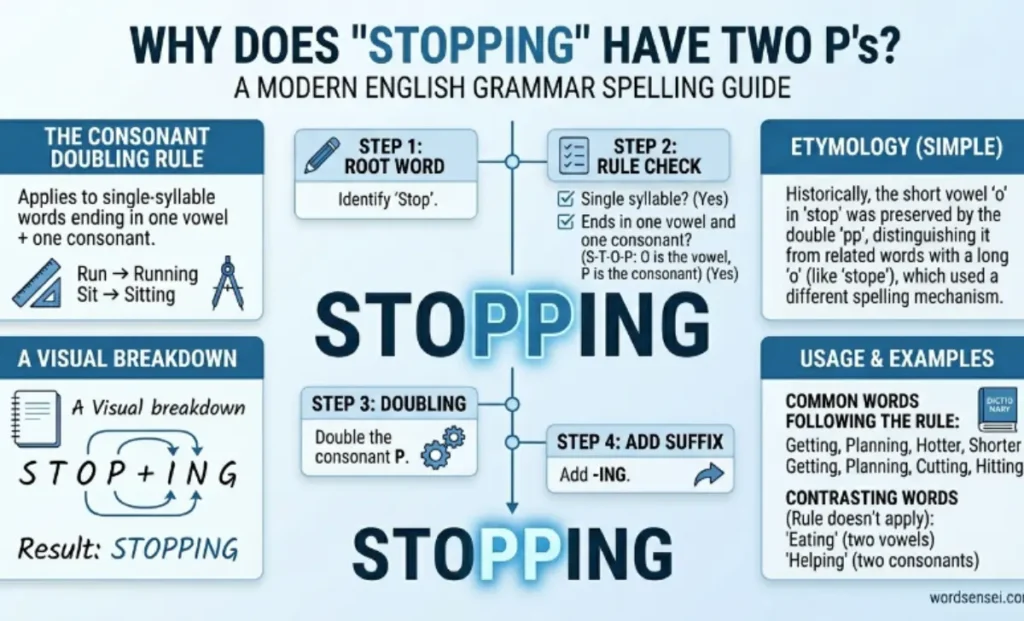
Many spelling questions involve the double-consonant rule.
The Double-Consonant Rule
When a short vowel is followed by a single consonant, the final consonant is often doubled before adding -ing.
Examples
| Base Verb | Correct Form |
| Stop | Stopping |
| Run | Running |
| Sit | Sitting |
| Hop | Hopping |
| Swim | Swimming |
Because stop ends with a short vowel followed by a single consonant, the p doubles before adding -ing.
Which Spelling Should You Use?
Students
Use stopping for school assignments unless discussing mining.
Business Writing
Professional communication almost always requires stopping.
Academic Writing
Most academic fields use stopping.
Mining-related disciplines may use stoping in technical contexts.
Journalism
News articles generally use stopping except when reporting on mining operations.
Everyday Communication
In emails, text messages, reports, and conversations, stopping is usually the correct choice.
Common Mistakes with Stopping and Stoping
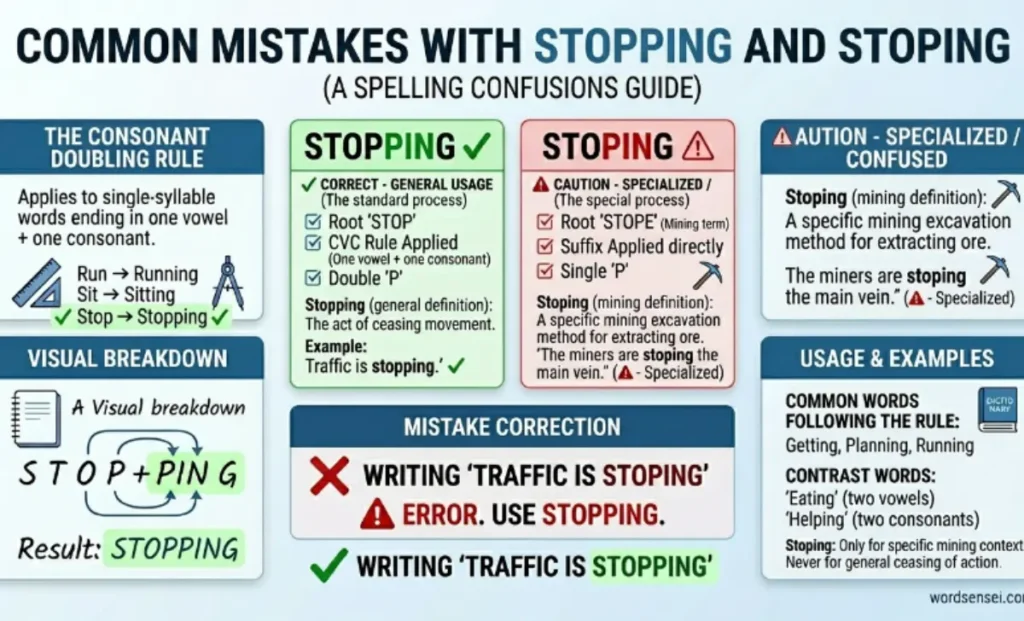
Many writers accidentally omit one of the letters.
Frequent Errors
- Writing stoping instead of stopping.
- Forgetting the double-consonant rule.
- Assuming stoping is simply a misspelling.
- Using technical mining terminology incorrectly.
Corrected Examples
| Incorrect | Correct |
| The bus is stoping here. | The bus is stopping here. |
| We are stoping for lunch. | We are stopping for lunch. |
| She is stoping work today. | She is stopping work today. |
| The vehicle is stoping suddenly. | The vehicle is stopping suddenly. |
Stopping and Stoping in Everyday Examples
Emails
- We are stopping operations for maintenance.
- Production is stopping temporarily.
Social Media
- Stopping by to say hello.
- The rain isn’t stopping today.
News Writing
- Authorities are stopping traffic due to weather conditions.
- Officials announced plans for stopping illegal activities.
School Writing
- The teacher is stopping the lesson briefly.
- Students discussed the importance of stopping pollution.
Mining Industry
- Engineers selected a stoping method for ore extraction.
- Stoping operations increased mineral recovery.
Google Trends and Usage Data
Popular Countries
Searches for “stopping or stoping” commonly originate from:
- United States
- United Kingdom
- Canada
- Australia
- India
Why People Search This Keyword
Users often want to know:
- Which spelling is correct.
- Why stopping contains two p’s.
- Whether stoping is a real word.
- English spelling rules.
- Present participle formation.
- Mining terminology definitions.
Related Grammar Rules
Similar Double-Consonant Confusions
Writers frequently search for:
- running vs runing
- sitting vs siting
- hopping vs hoping
- beginning vs begining
- planned vs planed
- occurred vs occured
Helpful Grammar Tips
- Learn the short-vowel doubling rule.
- Proofread verbs ending with consonants.
- Check dictionary definitions.
- Consider sentence context.
- Watch for technical vocabulary.
FAQs
Is stopping or stoping correct?
Stopping is correct for the verb stop. Stoping is a mining term.
Why does stopping have two p’s?
It follows the English double-consonant spelling rule.
Is stoping a real word?
Yes. It is a technical mining term.
What does stoping mean?
It refers to extracting ore from underground deposits.
Can I use stoping in everyday writing?
Usually no, unless discussing mining.
Is stopping a gerund?
Yes. It can function as both a gerund and a present participle.
What is the rule for adding -ing to stop?
Double the final consonant and add -ing.
How can I remember the correct spelling?
Think of similar words such as running, sitting, and hopping.
Conclusion
The difference between stopping and stoping comes down to grammar and context. Stopping is the standard form of the verb stop and follows the English double-consonant rule, making it the correct choice for everyday writing, professional communication, academic work, and casual conversation.
Stoping, while often mistaken for a spelling error, is actually a legitimate technical term used in mining to describe underground ore extraction methods.
Because most people rarely encounter mining terminology, stopping is almost always the word they need.
Understanding the consonant-doubling rule and recognizing the specialized meaning of stoping can help you avoid common spelling mistakes and improve writing accuracy. When referring to halting an action, movement, or process, always choose stopping.
Read More Blogs:
- Cognisant vs Cognizant: British vs American English Explained
- Now or Later: Avoid This Common English Usage Mistake

Norman Coe is a contributing writer at Wordssensei.com, covering English grammar, vocabulary, and commonly confused words.