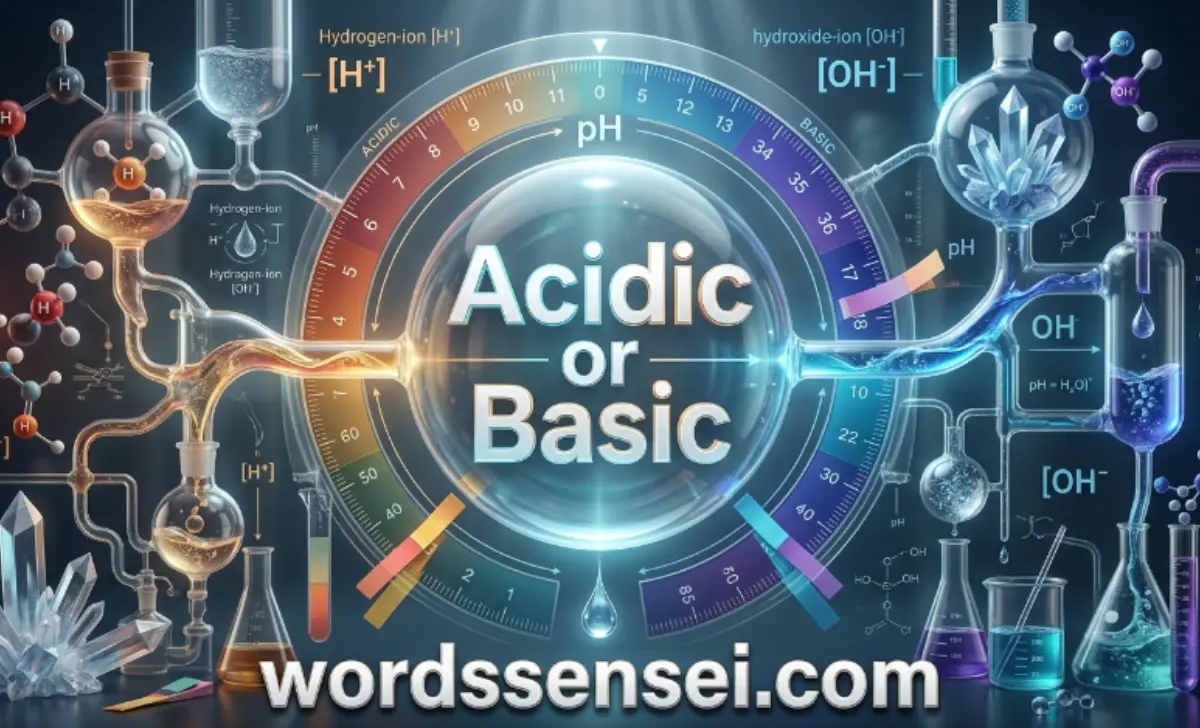
Acidic or basic is a common chemistry question, especially when comparing substances by their pH, hydrogen ions, and chemical properties.
The two terms describe opposite sides of the pH scale. An acidic substance has a pH below 7, while a basic substance has a pH above 7.
Knowing the difference is useful beyond the classroom. Lemon juice, vinegar, stomach acid, soap, baking soda, and many cleaning products can all be described as acidic or basic.
Once you understand the pH scale and a few simple examples, telling them apart becomes much easier.
Quick Answer
An acidic substance has a pH below 7, while a basic substance has a pH above 7. A substance with a pH of exactly 7 is neutral.
| Property | Acidic | Basic |
|---|---|---|
| pH | Below 7 | Above 7 |
| Main characteristic | Increases H⁺ in water | Increases OH⁻ or accepts H⁺ |
| Common examples | Lemon juice, vinegar | Soap, baking soda |
| Litmus test | Blue litmus turns red | Red litmus turns blue |
| Taste | Often sour | Often bitter |
| Typical feel | May be irritating/corrosive | Often slippery |
A simple rule to remember is:
Acidic = below 7
Neutral = 7
Basic = above 7
What Does Acidic Mean?
Acidic describes a substance that has acidic properties. In an aqueous solution, acids increase the concentration of hydrogen ions (H⁺).
Common acidic substances include:
- Lemon juice
- Vinegar
- Orange juice
- Carbonated drinks
- Tomato juice
- Stomach acid
For example, the citric acid in lemons gives lemon juice its characteristic sour taste.
Common Acidic Examples
| Substance | Approximate pH |
|---|---|
| Battery acid | Very low |
| Stomach acid | Around 1–3 |
| Lemon juice | Around 2 |
| Vinegar | Around 2–3 |
| Orange juice | Around 3–4 |
| Pure water | 7 |
Actual pH can vary depending on concentration and conditions, so these numbers are useful as general examples rather than fixed values.
What Does Basic Mean?
Basic describes a substance with properties opposite to those of an acid. In the Arrhenius model, a base increases hydroxide ions (OH⁻) in water. Under the broader Brønsted–Lowry definition, a base is a substance that accepts a proton.
Common basic substances include:
- Baking soda
- Soap
- Household ammonia
- Some antacids
- Many alkaline cleaners
For example, sodium bicarbonate, commonly called baking soda, is mildly basic.
Common Basic Examples
| Substance | General pH |
|---|---|
| Baking soda solution | Mildly basic |
| Soap solution | Basic |
| Ammonia solution | Basic |
| Some household cleaners | Strongly basic |
The exact pH depends on concentration and formulation.
Acidic vs. Basic on the pH Scale
The pH scale is the easiest way to compare acidic and basic substances.
It is commonly shown from 0 to 14:
0 ← Acidic — 7 Neutral — Basic → 14
- pH below 7: acidic
- pH 7: neutral
- pH above 7: basic
The pH scale is logarithmic. That means a change of one pH unit represents a tenfold change in hydrogen ion concentration.
For example, a solution with pH 3 has a hydrogen ion concentration ten times greater than a solution with pH 4.
This is why even a small change in pH can represent a significant chemical difference.
Acidic or Basic: What Is the Difference?
The biggest difference is how the substances behave in terms of protons, hydrogen ions, and hydroxide ions.
Acids
Acids generally:
- Donate protons in Brønsted–Lowry chemistry
- Increase H⁺ concentration in water
- Have a pH below 7
- Turn blue litmus paper red
Bases
Bases generally:
- Accept protons in Brønsted–Lowry chemistry
- Increase OH⁻ concentration in water in the Arrhenius model
- Have a pH above 7
- Turn red litmus paper blue
The terms acidic and basic therefore describe chemical behavior, not simply whether something tastes sour or feels slippery.
Acidic vs. Basic: Litmus Test
A litmus test is a simple way to identify whether a solution is acidic or basic.
Acidic Solution
An acid turns:
Blue litmus → Red
For example, an acidic solution such as vinegar can turn blue litmus paper red.
Basic Solution
A base turns:
Red litmus → Blue
A basic solution such as diluted soap solution can turn red litmus paper blue.
Litmus is useful for a quick indication, but it does not give an exact pH value.
For more precise measurements, scientists commonly use pH indicators, pH paper, or a pH meter.
Acidic or Basic: Strong vs. Weak
Another important point is that acidic does not automatically mean strong, and basic does not automatically mean strong.
Chemistry distinguishes between strong and weak acids and strong and weak bases.
Strong Acids
Strong acids ionize essentially completely in water.
Examples include:
- Hydrochloric acid (HCl)
- Nitric acid (HNO₃)
- Perchloric acid (HClO₄)
Weak Acids
Weak acids only partially ionize in water.
Examples include:
- Acetic acid
- Carbonic acid
- Citric acid
Strong Bases
Common strong bases include:
- Sodium hydroxide (NaOH)
- Potassium hydroxide (KOH)
Weak Bases
Examples include:
- Ammonia (NH₃)
- Many organic bases
So a solution can be acidic but weakly acidic, or basic but weakly basic.
Acidic or Basic: Everyday Examples
You encounter acids and bases every day.
Lemon Juice
Lemon juice is acidic because it contains citric acid.
Vinegar
Vinegar is acidic because it contains acetic acid.
Baking Soda
A solution of baking soda is basic.
Soap
Many traditional soaps produce basic solutions.
Stomach Acid
Stomach fluid is strongly acidic, largely because it contains hydrochloric acid.
These examples show that acidic and basic substances are not limited to laboratory experiments.
Acidic or Basic: How Do You Tell?
If you need to determine whether a solution is acidic or basic, the pH is the most direct starting point.
Check the pH
- Below 7 → Acidic
- Exactly 7 → Neutral
- Above 7 → Basic
Use an Indicator
Indicators change color depending on pH.
Common indicators include:
- Litmus
- Phenolphthalein
- Methyl orange
- Universal indicator
A universal indicator provides a broader color range and can give an approximate indication of pH.
Use a pH Meter
A pH meter provides a more precise measurement than litmus paper or a simple color indicator.
Acidic vs. Basic in the Human Body
The human body maintains different pH levels in different places.
For example, stomach acid is highly acidic, which helps with digestion and creates an environment that supports certain digestive processes.
Blood, however, is maintained within a much narrower and slightly basic pH range, normally around 7.35–7.45.
This difference shows why the word acidic or basic only makes sense when we consider the particular substance or body fluid being discussed.
Acidic or Basic: What About Neutral?
Not every substance is acidic or basic.
A neutral solution has a pH of approximately 7 under the usual reference conditions.
Pure water at around room temperature is commonly used as the standard example of a neutral substance.
So the three categories are:
Acidic → pH below 7
Neutral → pH 7
Basic → pH above 7
This simple three-part model is the foundation for understanding the pH scale.
Common Mistakes About Acidic and Basic
Mistake 1: Thinking Every Acid Is Dangerous
Some acids can be highly corrosive, but many acids are found naturally in foods and biological systems.
For example, citric acid occurs naturally in citrus fruits.
Mistake 2: Assuming Every Base Is Safe
Strong bases such as sodium hydroxide can be highly corrosive. A substance being basic does not automatically make it harmless.
Mistake 3: Thinking pH 6 Is Only Slightly Different From pH 7
Because the pH scale is logarithmic, a one-unit change represents a tenfold difference in hydrogen ion concentration.
Mistake 4: Confusing Strong With Concentrated
Strength refers to how extensively an acid or base ionizes, while concentration refers to how much solute is present in a given amount of solution.
These are related concepts, but they are not the same.
Acidic or Basic: Easy Memory Trick
Use the number 7 as your anchor:
Below 7 = Acidic
7 = Neutral
Above 7 = Basic
For everyday examples, remember:
Lemon → acidic
Vinegar → acidic
Baking soda → basic
Soap → basic
This quick pattern makes the pH scale much easier to remember.
Final Answer
Acidic and basic describe opposite chemical properties.
An acidic solution has a pH below 7 and is associated with increased hydrogen ion concentration in water.
A basic solution has a pH above 7 and, in the Arrhenius model, increases hydroxide ion concentration.
The easiest rule is:
Acidic < 7
Neutral = 7
Basic > 7
Lemon juice and vinegar are familiar acidic examples, while baking soda and many soaps are basic. However, the strength of an acid or base is a separate issue from whether a substance is simply acidic or basic.
FAQs
Is acidic below or above 7?
An acidic solution has a pH below 7.
Is basic above or below 7?
A basic solution has a pH above 7.
Is pH 7 acidic or basic?
A pH of 7 is neutral under the usual reference conditions.
Is lemon juice acidic or basic?
Lemon juice is acidic because it contains citric acid.
Is baking soda acidic or basic?
A solution of baking soda is mildly basic.
What is the easiest way to remember acidic and basic?
Remember: acidic is below 7, neutral is 7, and basic is above 7.
Are strong acids and weak acids different?
Yes. A strong acid ionizes much more extensively in water, while a weak acid only partially ionizes. Strength should not be confused with concentration.
Read More Blogs:

Gerald Nelson is a contributing writer at Wordssensei.com, covering English grammar, vocabulary, and commonly confused words.