
Have you ever come across the words tepee and teepee and wondered which spelling is correct? Many students, writers, history enthusiasts, and English learners encounter both versions and become confused about whether they refer to different structures or simply represent alternative spellings of the same word.
The confusion is understandable because both terms appear in dictionaries, educational materials, travel content, and historical discussions.
In reality, tepee and teepee describe the same traditional cone-shaped dwelling associated with several Indigenous peoples of the Great Plains. However, one spelling has become more common in modern usage.
Understanding the difference can help you write accurately, respect cultural terminology, and choose the most appropriate spelling for your audience. This guide explains the meanings, history, spelling differences, cultural importance, construction methods, and proper usage of tepee and teepee.
Quick Answer

Both tepee and teepee are correct spellings.
However:
- Teepee is the more common modern spelling.
- Tepee is an accepted alternative spelling.
- Both words refer to the same traditional Indigenous dwelling.
Correct Examples
- Families gathered around the teepee during the celebration.
- The museum displayed a traditional tepee.
- The documentary explained how a teepee was constructed.
- Visitors learned about life inside a tepee.
Quick Rule
If you’re unsure which spelling to use, teepee is generally the safer choice because it appears more frequently in modern publications.
What Does Teepee Mean?
A teepee is a portable, cone-shaped dwelling traditionally used by several Indigenous peoples of the Great Plains region of North America.
The structure was designed for mobility, making it ideal for communities that moved frequently while following buffalo herds and seasonal resources.
Common Characteristics
- Cone-shaped design
- Wooden support poles
- Animal hide coverings
- Portable structure
- Durable construction
- Weather-resistant design
Simple Example
- The tribe assembled the teepee before nightfall.
- A large teepee stood in the center of the camp.
What Does Tepee Mean?
The word tepee carries exactly the same meaning as teepee.
There is no difference in definition, design, or cultural significance.
Common Uses
- Historical writing
- Cultural studies
- Educational materials
- Anthropological discussions
- Traditional architecture references
Example Sentences
- The tepee provided shelter during harsh weather.
- Historians documented how a tepee was constructed.
The choice between the two spellings is usually based on style preference rather than meaning.
The Origin of the Word Teepee
The history of the word helps explain why both spellings exist today.
Linguistic Origins
The word originated from languages spoken by Indigenous peoples of the Great Plains.
It is commonly traced to terms used by the Lakota and related groups that referred to a dwelling or place of residence.
As European settlers and scholars documented Indigenous cultures, different English spellings emerged.
Over time, both tepee and teepee became accepted.
Why Do Both Spellings Exist?

Many English words develop alternative spellings as they move between languages and cultures.
Reasons for Variation
- Transliteration differences
- Historical documentation practices
- Regional publishing preferences
- Dictionary conventions
- Language evolution
Comparison Table
| Feature | Tepee | Teepee |
| Correct Spelling | Yes | Yes |
| Same Meaning | Yes | Yes |
| Dictionary Recognition | Yes | Yes |
| Modern Popularity | Lower | Higher |
| Educational Usage | Common | More Common |
Tepee vs Teepee
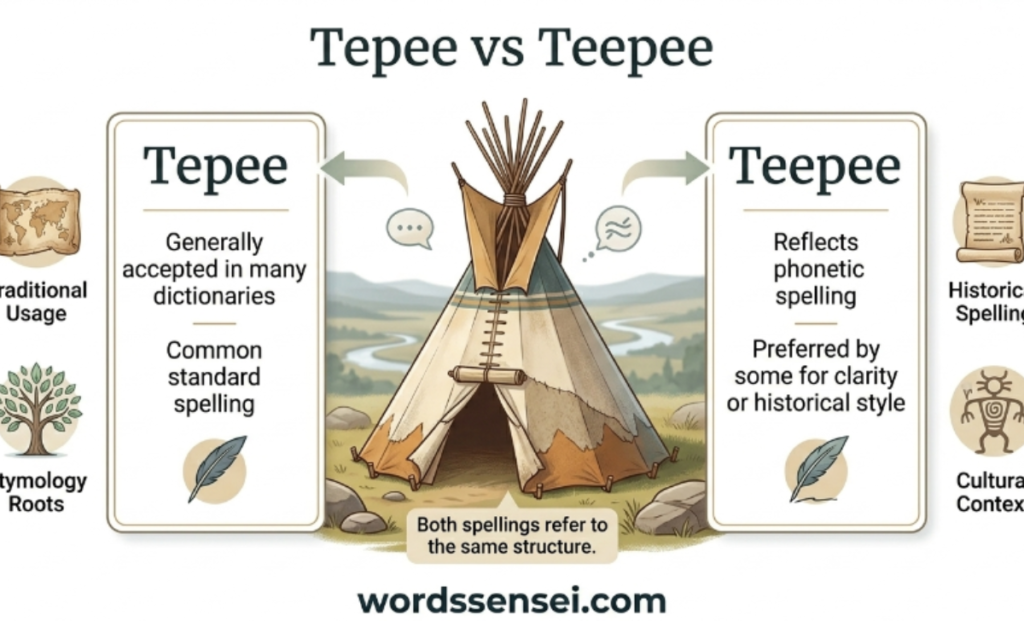
Side-by-Side Comparison
| Feature | Tepee | Teepee |
| Meaning | Traditional Indigenous dwelling | Traditional Indigenous dwelling |
| Pronunciation | Same | Same |
| Modern Usage | Less Common | More Common |
| Historical Validity | Yes | Yes |
| Accepted Spelling | Yes | Yes |
Quick Summary
Both words are correct, but teepee is generally preferred in modern English.
Which Spelling Should You Use?
The answer depends largely on your audience and style guide.
Academic Writing
Many educational resources prefer teepee because it is more familiar to readers.
Professional Writing
Teepee is often the safer choice for general audiences.
Historical Research
Either spelling may be appropriate if used consistently.
Cultural Discussions
Writers should focus on respectful and accurate representation regardless of spelling choice.
Online Content
Most publishers use teepee because it aligns with contemporary search behavior.
Who Lived in Teepees?
Several Indigenous peoples of the Great Plains used teepees as their primary form of housing.
Notable Groups
- Lakota
- Dakota
- Nakota
- Cheyenne
- Arapaho
- Blackfoot
- Crow
- Comanche
- Kiowa
These communities developed sophisticated methods for constructing, transporting, and maintaining their homes.
How Were Teepees Built?
The design of a teepee reflected practicality, mobility, and environmental adaptation.
Main Components
| Component | Purpose |
| Wooden Poles | Structural support |
| Animal Hides | Exterior covering |
| Smoke Flaps | Ventilation |
| Entrance Flap | Access |
| Ground Stakes | Stability |
Construction Process
- Arrange long poles into a cone shape.
- Secure the poles together.
- Cover the frame with animal hides or canvas.
- Create a doorway.
- Adjust smoke flaps for airflow.
This design allowed families to assemble and dismantle their homes quickly.
Why Were Teepees So Effective?
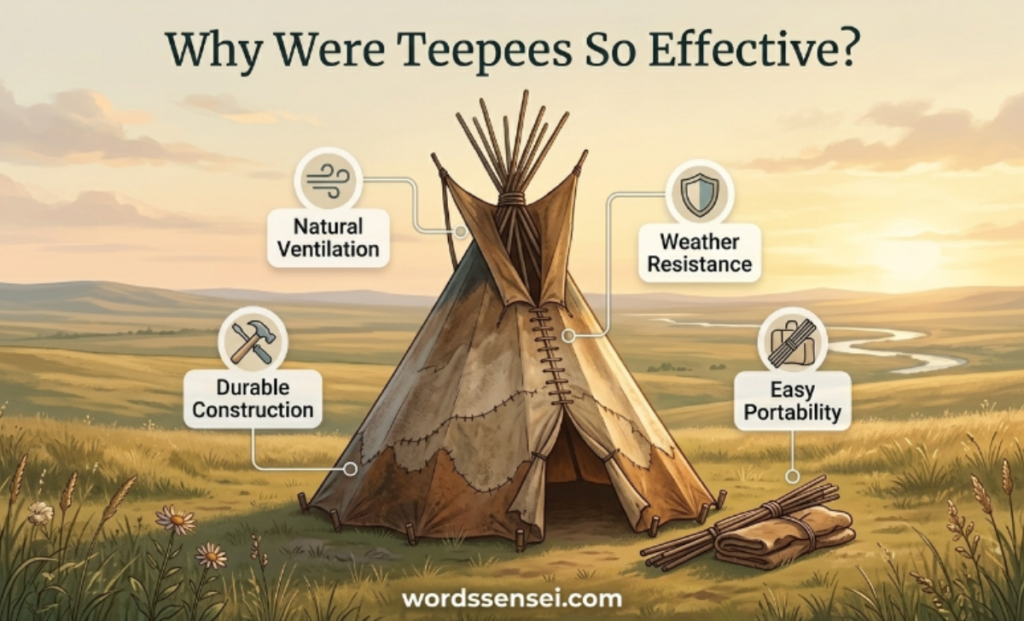
The structure offered several practical advantages.
Benefits
- Easy transportation
- Excellent ventilation
- Weather resistance
- Fast assembly
- Adaptability
- Durability
Real-Life Example
When following buffalo migrations across the Great Plains, communities needed housing that could move efficiently with them. The teepee provided exactly that flexibility.
Common Misconceptions About Teepees
Many myths surround Indigenous housing.
Misunderstandings
| Myth | Reality |
| All Indigenous peoples lived in teepees | Different groups used different homes |
| Teepees were temporary shelters only | Many served as long-term homes |
| Teepees lacked engineering design | They were highly sophisticated structures |
| Tepee and teepee have different meanings | They are the same structure |
Understanding these facts helps preserve historical accuracy.
Tepee and Teepee in Modern Culture
Today, teepees remain important cultural symbols.
Modern Uses
- Educational programs
- Cultural exhibitions
- Museums
- Historical reenactments
- Tourism experiences
- Cultural preservation initiatives
Respectful Representation
Writers and educators should recognize that teepees are not merely historical artifacts but part of living Indigenous cultural heritage.
Google Trends and Search Behavior
People search for “tepee or teepee” for several reasons.
Common Questions
- Which spelling is correct?
- Is tepee a real word?
- What is a teepee?
- Who lived in teepees?
- How were teepees made?
- Which spelling should I use?
Popular Countries Searching This Topic
- United States
- Canada
- United Kingdom
- Australia
Related Traditional Dwellings
Teepees are only one type of traditional dwelling.
Similar Structures
| Structure | Associated Culture |
| Wigwam | Various Indigenous peoples |
| Longhouse | Northeastern Indigenous groups |
| Hogan | Navajo communities |
| Yurt | Central Asian cultures |
| Lodge | Various Indigenous traditions |
Each structure reflects unique cultural and environmental needs.
FAQs
Is tepee or teepee correct?
Both spellings are correct.
Which spelling is more common?
Teepee is more commonly used in modern English.
Do tepee and teepee mean different things?
No. Both refer to the same traditional dwelling.
Is tepee a real word?
Yes. Dictionaries recognize tepee as an accepted spelling.
Who lived in teepees?
Several Indigenous peoples of the Great Plains used teepees.
Why were teepees portable?
Their design allowed quick assembly and transportation.
Are teepees still used today?
Some communities continue to use them for cultural, educational, and ceremonial purposes.
Which spelling should I use in professional writing?
Teepee is usually the preferred modern spelling.
Conclusion
The debate between tepee and teepee is primarily a matter of spelling preference rather than meaning. Both terms refer to the same cone-shaped portable dwelling traditionally used by several Indigenous peoples of the Great Plains.
While teepee has become the more common spelling in modern publications, educational materials, and online content, tepee remains a valid alternative recognized by dictionaries and historians.
Understanding this distinction helps writers communicate more accurately while respecting the cultural significance of these traditional structures. Beyond spelling, the teepee represents remarkable engineering, mobility, and adaptation to the environment.
Whether you choose tepee or teepee, using the term correctly and acknowledging its historical and cultural context is far more important than the spelling variation itself.
Read More Blogs:
- Sees or See’s? The Grammar Mistake Thousands of Writers Make
- Organising vs Organizing: Which Spelling Is Actually Correct?

Anne Seaton is a contributing writer at Wordssensei.com, covering English grammar, vocabulary, and commonly confused words.