
Many English learners get confused when they write “deer” or “deers,” especially in exams, essays, and daily conversation.
At first glance, it looks like a simple plural rule problem, because most English words just add “s” or “es.” So people naturally assume “deers” should be correct. However, English has special irregular nouns that do not follow normal rules, and “deer” is one of the most common examples.
This confusion becomes stronger when learners see wildlife content, documentaries, or social media posts.
In this guide, you will clearly understand the correct usage of deer or deers, why only “deer” is correct, real examples, grammar rules, and how to avoid this mistake forever in writing and speaking.
Quick Answer
The correct form is “deer.” The word “deers” is not correct in standard English grammar.
“Deer” is an irregular noun, which means it stays the same whether it is singular or plural. You do not add “s” at the end.
So you say:
- one deer
- five deer
- many deer
This rule is the same in British English, American English, academic writing, and professional communication.
Correct Example
- I saw a deer in the forest.
- We saw ten deer near the river.
Incorrect Example
- I saw two deers in the forest. ❌
- There are many deers in the park. ❌
What Does Deer Mean in English Grammar?
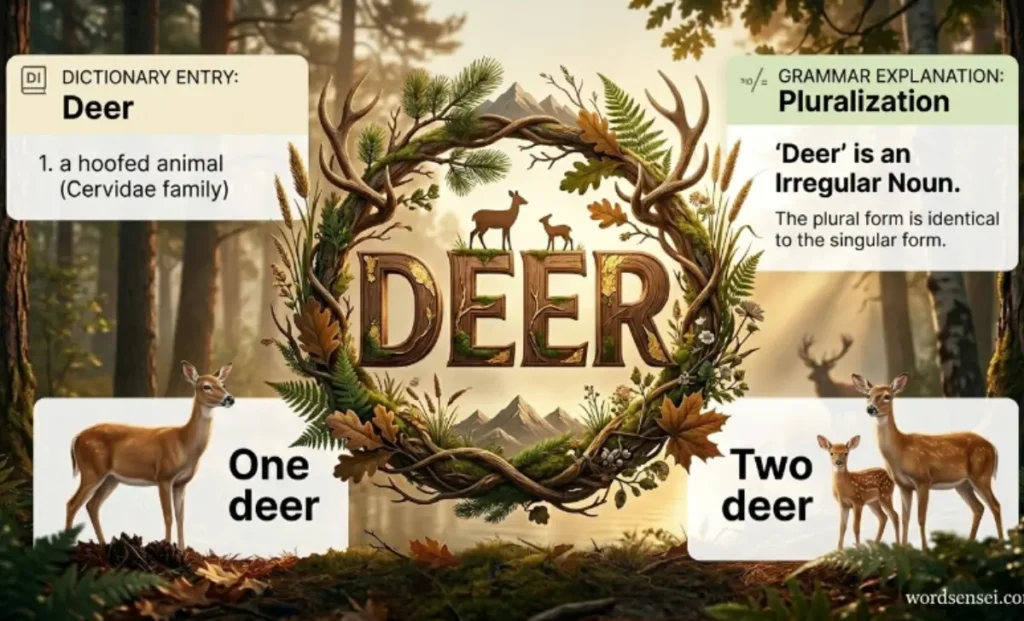
Meaning of Deer
A deer is a wild animal belonging to the family Cervidae. It is known for its graceful body, fast running speed, and antlers (in males). Deer are commonly found in forests, mountains, and grasslands.
In English grammar, “deer” is classified as an irregular countable noun.
Key Characteristics of Deer
- Wild herbivorous animal
- Found in natural habitats like forests
- Males often have antlers
- Lives in herds or groups
- Important in wildlife ecosystems
Simple Usage Examples
- A deer crossed the road suddenly.
- The forest is full of deer.
- We spotted three deer near the lake.
The Origin and History of the Word Deer
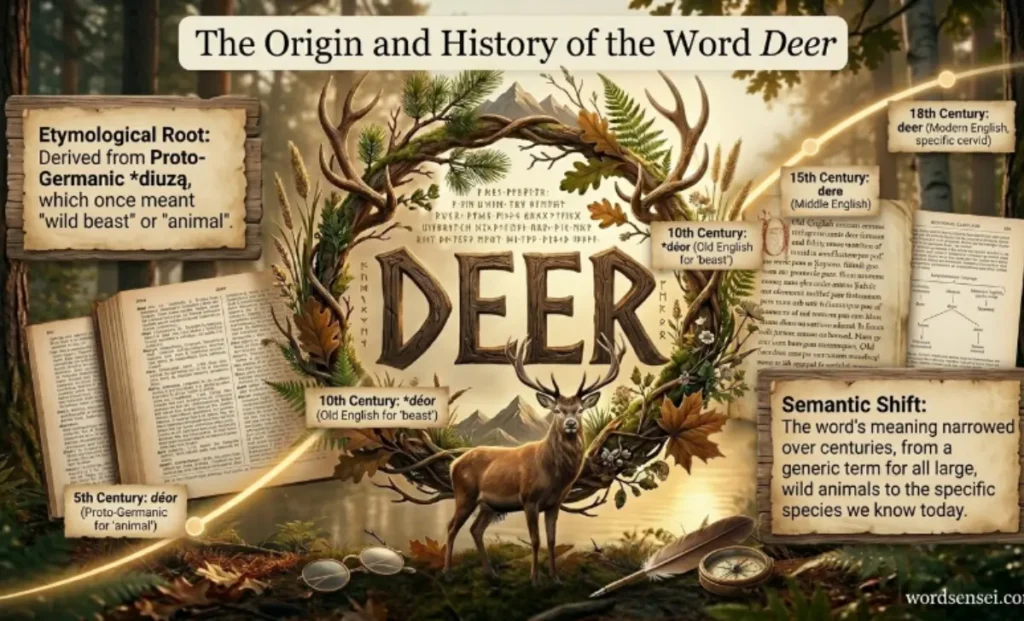
Word History
The word “deer” comes from Old English “dēor,” which originally meant any wild animal. Over time, its meaning became more specific and referred only to animals in the deer family.
During Middle English, the spelling evolved into “deer,” and it became fixed as both singular and plural without change.
Why People Get Confused
The confusion between deer and deers happens because:
- Most English nouns form plurals by adding “s”
- Learners apply normal grammar rules incorrectly
- People assume “deer” should behave like “dog → dogs”
- Social media mistakes spread incorrect usage
- Lack of awareness about irregular nouns
This is one of the most common grammar mistakes in English learning.
British English vs American English Usage of Deer
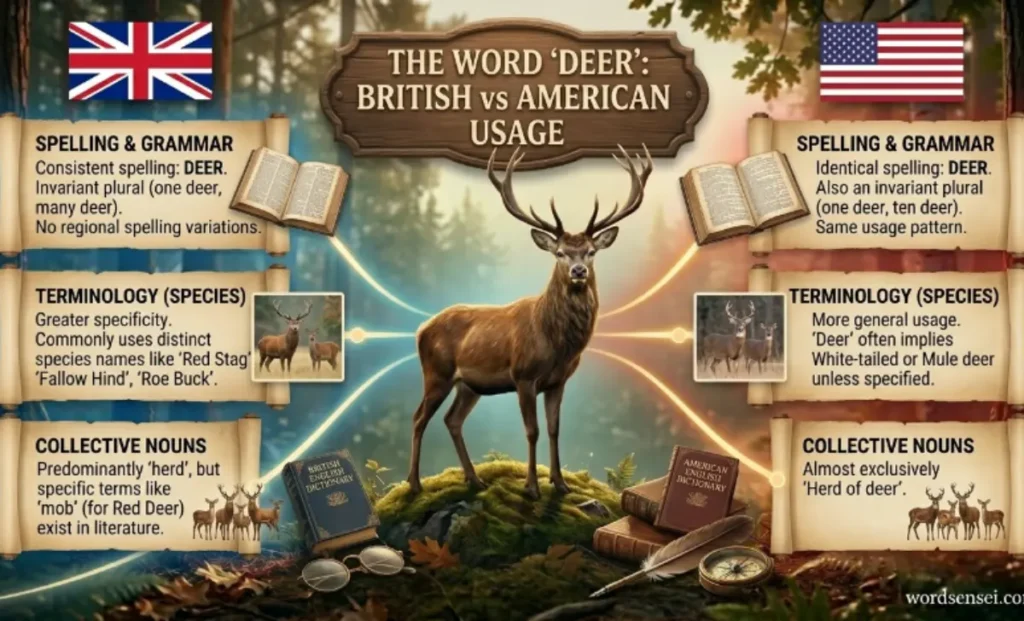
There is no difference between British and American English when it comes to the word “deer.”
Both varieties follow the same rule:
- Singular: deer
- Plural: deer
Comparison Table
| Feature | British English | American English |
|---|---|---|
| Singular form | deer | deer |
| Plural form | deer | deer |
| Incorrect form | deers ❌ | deers ❌ |
| Usage type | formal + informal | formal + informal |
Deer vs Deers – Grammar Comparison Explained
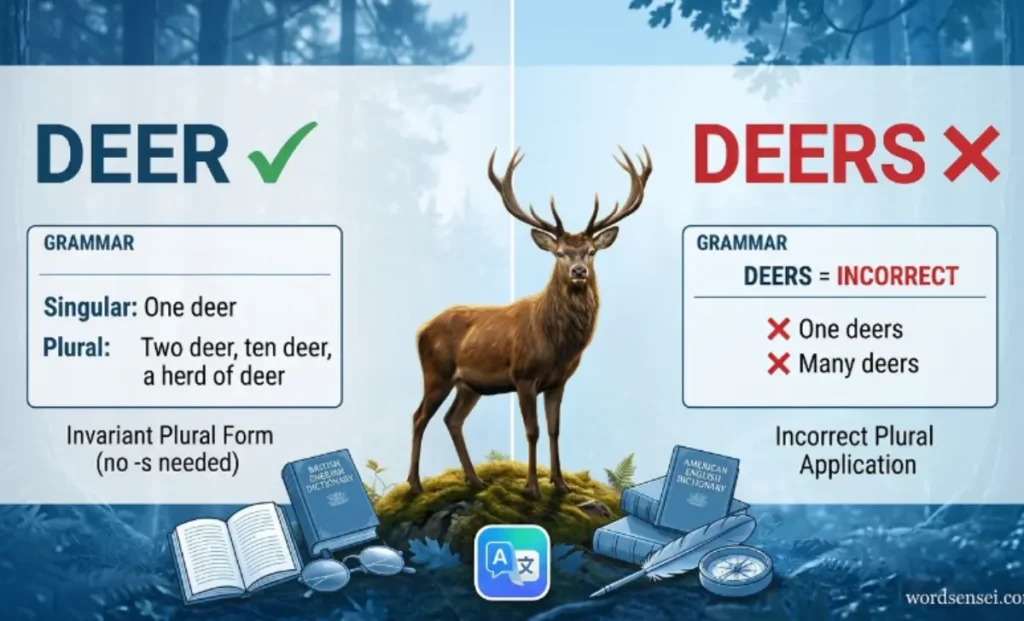
Spelling and Usage Table
| Word Form | Correct or Incorrect | Usage | Example |
|---|---|---|---|
| deer | Correct | singular/plural animal | one deer, many deer |
| deers | Incorrect | not used in standard English | ❌ deers in forest |
Which Spelling Should You Use in Real Life?
US Audience
Always use “deer” in all types of writing, including school, business, and casual communication.
UK Audience
Same rule applies. “Deer” is standard and correct.
International Writing
Use only “deer” for clarity and global understanding.
Academic Writing
Strictly use “deer” in biology, English grammar, wildlife studies, and research papers.
Social Media Usage
Many people mistakenly write “deers,” but correct grammar still requires “deer.”
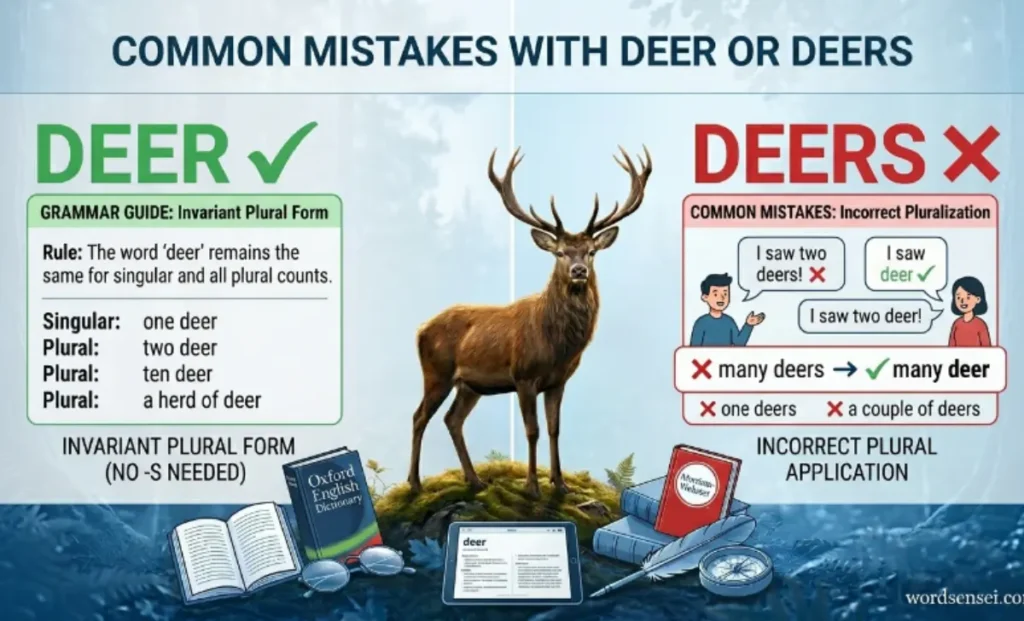
Common Mistakes with Deer or Deers
Frequent Errors
Students and writers often make these mistakes:
- Adding “s” to make plural (deers)
- Treating deer like regular nouns
- Using incorrect plural in essays
- Copying wrong social media usage
- Ignoring irregular noun rules
Corrected Examples
- ❌ There are many deers in the forest
- ✔ There are many deer in the forest
- ❌ I saw two deers near the lake
- ✔ I saw two deer near the lake
- ❌ Deers are beautiful animals
- ✔ Deer are beautiful animals
Deer in Everyday English Usage
Emails
- Wildlife reports show deer movement in the area.
Social Media
- Saw a beautiful deer in the forest today.
News Writing
- Deer population has increased this year due to conservation efforts.
School Writing
- Deer is an animal that lives in forests and grasslands.
Business Writing
- Environmental studies include deer habitat monitoring.
Google Trends & Global Usage Insights

Popular Countries Searching This Keyword
- United States: Wildlife education and grammar learning
- United Kingdom: School grammar and writing rules
- Canada: Environmental studies and English learning
- Australia: Wildlife tourism and nature content
- India: English grammar exams and competitive tests
Why People Search “Deer or Deers”
People search this keyword because:
- They assume normal plural rules apply
- They see confusion in online posts
- They are writing essays or exams
- They are learning English grammar basics
- They encounter wildlife content in media
Related Grammar Rules You Should Know
Similar Irregular Nouns
English has many words like “deer” that do not change in plural form:
- Sheep → sheep
- Fish → fish (sometimes fishes in scientific context)
- Moose → moose
- Aircraft → aircraft
Helpful Grammar Tips
- Do not assume all words take “s” in plural
- Learn irregular noun lists
- Practice real-life sentence examples
- Use dictionaries for confirmation
- Read English wildlife content for context
FAQs About Deer or Deers
Is “deers” a correct word?
No, “deers” is incorrect in standard English grammar.
What is the correct plural of deer?
“Deer” is both singular and plural.
Why don’t we say deers?
Because “deer” is an irregular noun that does not change.
Can I use deers in any case?
No, it is always wrong in formal and informal English.
Is deer countable or uncountable?
It is a countable noun with no plural change.
What is a group of deer called?
A group of deer is called a herd.
Is deer used in scientific writing?
Yes, “deer” is commonly used in biology and wildlife studies.
What is a correct sentence with deer?
I saw many deer in the forest.
Conclusion (120+ words)
The correct and standard form is always “deer,” not “deers.” This is because deer is an irregular noun in English grammar, meaning its singular and plural form remain the same.
Many learners make this mistake because they apply normal plural rules like adding “s,” but English has several exceptions like sheep, fish, and deer.
Understanding this rule is important for exams, writing, communication, and professional English. Once you remember that “deer” works for both single and multiple animals, you will avoid one of the most common grammar errors.
Always use correct forms in writing to improve clarity, accuracy, and confidence in English communication.
Read More Blogs:
- Interstate or Intrastate: What’s the Difference? (Complete Guide)
- Cerebus or Cerberus: Meaning, Origin, and Correct Usage

Hi, I am Anne Seaton, a professional content writer working on wordssensei.com.
I create engaging and SEO-friendly articles that inform, inspire, and connect with readers.