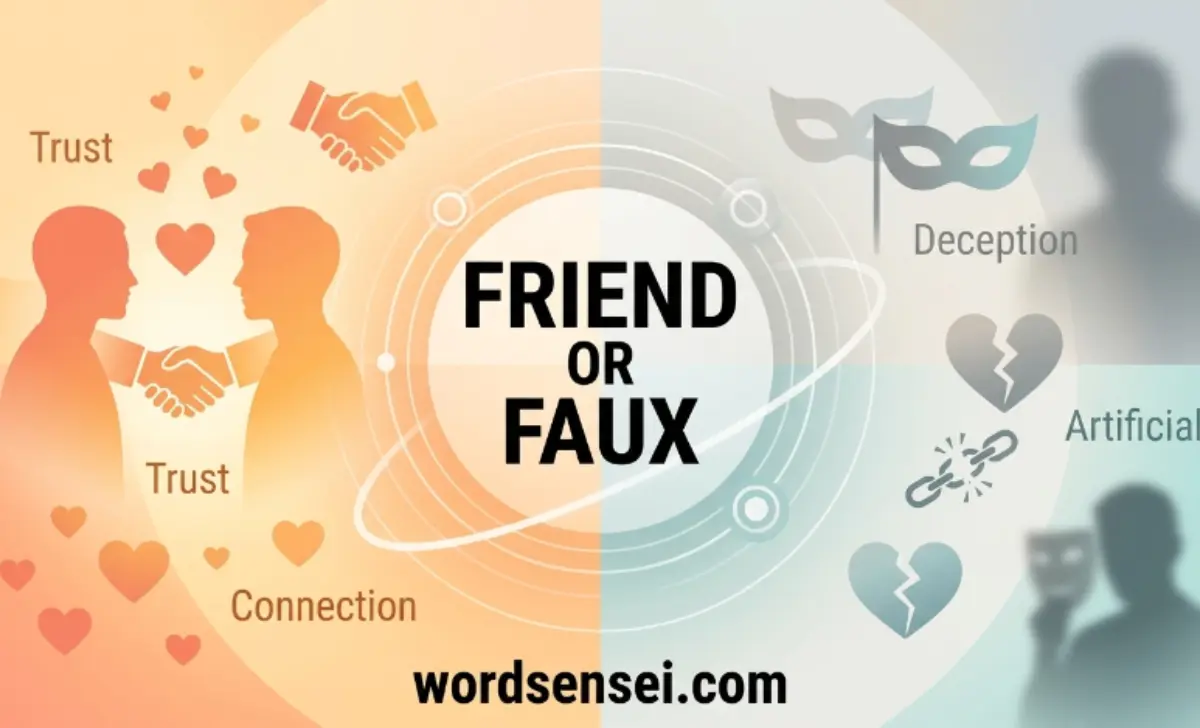
People often struggle to understand whether someone in their life is a genuine friend or simply pretending to care. The phrase Friend or Faux captures this exact confusion.
It refers to the difference between real friendship based on trust, loyalty, and emotional support, and fake friendship driven by selfish motives, manipulation, or convenience.
In today’s world of social media and large online networks, identifying true relationships has become more difficult. Many users search for this keyword because they want clarity about friendship red flags, toxic behavior, and emotional safety.
This guide explains the meaning, pronunciation, origin, and practical signs of real and fake friendships in a simple and easy way.
Quick Answer
Friend or Faux means deciding whether someone is a real friend or a fake friend.
A true friend usually shows:
- Trust and honesty
- Loyalty and support
- Emotional understanding
- Respect for boundaries
- Consistent behavior
A faux friend may show:
- Jealousy or manipulation
- Gossip or betrayal
- Self-centered behavior
- Inconsistency in attitude
- Lack of real support
In simple terms, the phrase helps you understand whether a relationship is authentic or based on fake intentions.
Pronunciation of Friend or Faux
The phrase is pronounced as:
Friend or Faux → /frend ɔːr foʊ/
It sounds exactly like:
“Friend or Foe”
Breakdown:
| Word | Sound |
|---|---|
| Friend | frend |
| Or | or |
| Faux | foe |
The word faux comes from French and means “fake” or “false,” which often confuses learners because of its spelling.
Why People Confuse Friend or Faux
This phrase is commonly misunderstood for several reasons.
The biggest reason is pronunciation. The word faux sounds like foe, which makes people think the phrase is “Friend or Foe.” However, the meaning is completely different.
Another reason is the French origin of the word “faux,” which does not follow normal English spelling rules. This creates confusion for readers and learners.
Social media usage also adds to the confusion, because both versions of the phrase are often seen in memes, posts, and discussions about relationships and trust issues.
Easy Trick to Remember Friend or Faux
A simple trick can help you remember it forever:
Faux = Fake
Both start with the letter F.
So:
Friend or Faux = Friend or Fake Friend
Another memory shortcut:
- Faux → False
- False → Fake behavior
- Fake → Not a real friend
Whenever you see “Friend or Faux,” just think: Is this friendship real or fake?
The Origin of Friend or Faux
The phrase is a combination of English and French.
The word friend comes from Old English and represents someone who provides trust, companionship, and support.
The word faux comes from French, meaning:
- Fake
- False
- Artificial
It is commonly used in English expressions like:
- Faux leather
- Faux fur
- Faux finish
Over time, writers and content creators combined these words to describe fake friendships in a modern and relatable way. Today, it is widely used in psychology discussions, social media content, and relationship advice.
British English vs American English Usage
Unlike words such as “color/colour,” the phrase Friend or Faux remains the same in both British and American English.
However, surrounding vocabulary may differ:
| Concept | American English | British English |
|---|---|---|
| Behavior | Behavior | Behaviour |
| Favorite | Favorite | Favourite |
| Organization | Organization | Organisation |
| Friend or Faux | Friend or Faux | Friend or Faux |
Since “faux” is a borrowed French word, its spelling does not change.
Which Version Should You Use?
Your choice depends on your audience.
For American readers, use standard US spelling in supporting content while keeping the phrase unchanged.
For British readers, use UK spelling rules in surrounding text.
For global audiences, Friend or Faux works universally because it is widely recognized and understood across regions.
Common Mistakes with Friend or Faux
Many people misuse or misunderstand this phrase.
A common mistake is writing “Friend or Foe,” which changes the meaning completely. “Foe” refers to an enemy, while “faux” means fake.
Another mistake is assuming that a fake friend is always an enemy. In reality, fake friends may not be enemies—they may simply be unreliable or self-interested.
People also make the mistake of judging friendships too quickly without understanding communication, context, or emotional behavior.
Lastly, some confuse social media followers with real friends, even though online connections do not always reflect true emotional bonds.
Friend or Faux in Everyday Life
This phrase is commonly used in daily conversations and online content.
In emails or advice messages, it may appear when discussing trust and communication.
On social media, it is often used in posts about toxic friendships or relationship lessons.
In workplaces, it can describe colleagues who are supportive on the surface but not genuinely helpful.
In schools, it helps students understand peer pressure, gossip, and friendship dynamics.
Overall, it is a simple way to talk about emotional intelligence and social awareness.
Friend or Faux – Usage Trends and Popularity
Interest in this phrase has increased due to growing awareness of mental health, toxic relationships, and emotional well-being.
People frequently search for:
- Fake friend signs
- Toxic friendship
- Trust issues
- Friendship red flags
- Relationship advice
It is especially popular among younger audiences who actively engage in social media discussions and self-improvement content.
Countries with high interest include the US, UK, Canada, Australia, and India.
Comparison of Friendship Types
| Type | Meaning | Example |
|---|---|---|
| True Friend | Loyal and supportive | Stays during hard times |
| Fake Friend | Self-interested | Only appears when needed |
| Frenemy | Friend + rival | Friendly but competitive |
| Toxic Friend | Emotionally harmful | Creates stress and negativity |
| Friend or Faux | Relationship check | Is this real or fake friendship? |
Signs of a True Friend
A real friend shows consistent positive behavior.
They are honest even when the truth is difficult. They support your goals and respect your boundaries. They communicate openly and value emotional trust.
A true friend also stands by you during difficult times instead of disappearing when life becomes challenging.
These qualities create strong and long-lasting relationships.
Signs of a Fake Friend
Fake friends often display negative patterns.
They may gossip, show jealousy, or behave differently depending on what benefits them. They may ignore your feelings or only contact you when they need something.
They often lack emotional support and may not respect personal boundaries.
Recognizing these signs early helps protect your emotional well-being and avoid toxic relationships.
FAQs About Friend or Faux
What does Friend or Faux mean?
It means identifying whether someone is a real friend or a fake friend.
Is Friend or Faux the same as Friend or Foe?
No, “foe” means enemy while “faux” means fake.
How do you pronounce faux?
It is pronounced like “foe.”
Why is faux used instead of fake?
Because faux is a French word meaning false or artificial.
Can fake friends change?
Yes, if they improve their behavior and communication.
What is the main sign of a true friend?
Trust and consistent support are the strongest signs.
Conclusion
Understanding the concept of Friend or Faux helps you identify the difference between real and fake friendships. True friends provide trust, loyalty, emotional support, and respect, while fake friends may show jealousy, manipulation, or inconsistency.
The word “faux,” meaning fake, highlights the importance of recognizing authenticity in relationships. In a world where social connections are often complex, being able to evaluate friendships protects your emotional health and builds stronger bonds.
Focus on people who genuinely support your growth, respect your boundaries, and stay consistent in their actions. Real friendships are based on honesty, understanding, and long-term trust.
Read More Blogs:
- Nobodies or Nobody’s: Most People Get It Wrong
- Wintry or Wintery: Which Spelling Is Correct? (Complete Guide)

Norman Coe is a contributing writer at Wordssensei.com, covering English grammar, vocabulary, and commonly confused words.