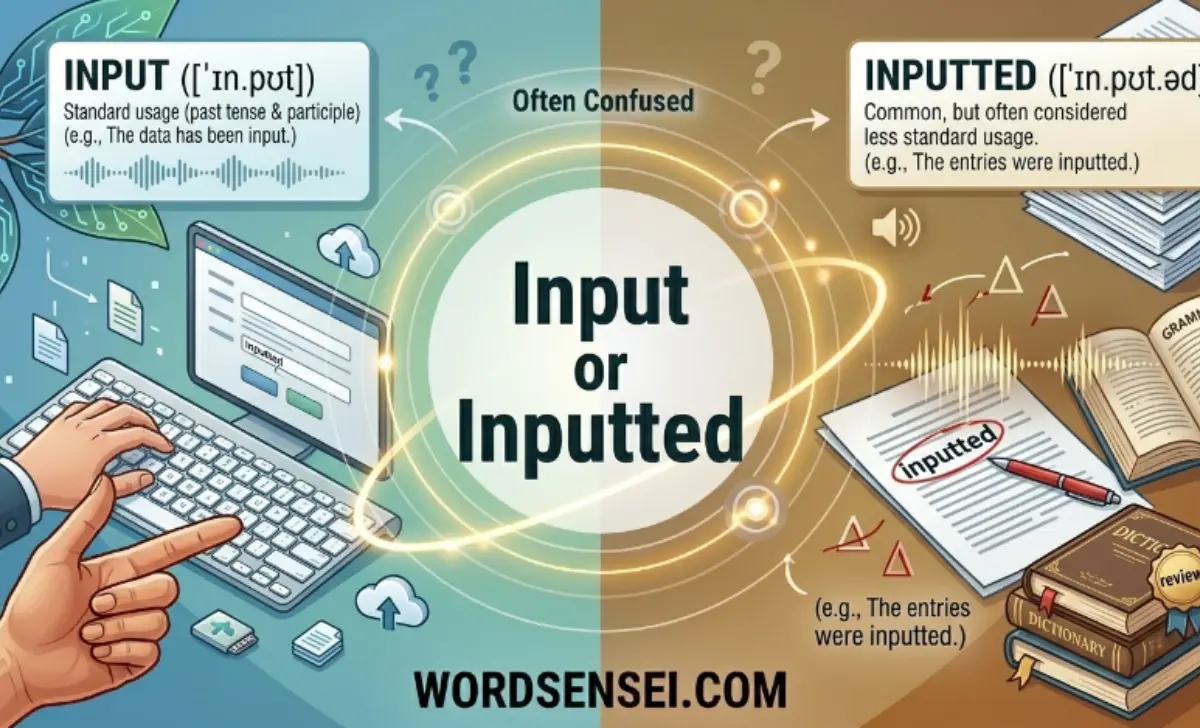
Many English learners, business professionals, writers, and technical users often wonder whether they should write “inputted” or “input.”
Both words appear in emails, software documentation, databases, reports, and workplace communication, which creates confusion about the correct grammar and usage. Some style guides prefer input as both the present and past tense, while others accept inputted as a standard past-tense form.
People search for Inputted or Input because they want to avoid grammar mistakes, improve professional writing, and follow proper English conventions. The confusion becomes even greater in technical writing, data entry, software development, and business communication where these terms are used frequently.
This guide explains pronunciation, grammar rules, origins, style guide preferences, examples, and practical advice so you can confidently choose the right word.
Quick Answer
The short answer is:
Both “input” and “inputted” are correct.
However, usage depends on context and writing style.
Input
Often used as:
- Present tense
- Past tense
- Past participle
Examples:
- I input the data yesterday.
- The information was input into the database.
Inputted
Used as:
- Past tense
- Past participle
Examples:
- She inputted the customer details.
- The records were inputted into the system.
In modern business English and technical writing, input is often preferred because it sounds simpler and more professional.
Pronunciation of Inputted or Input
Understanding pronunciation helps avoid confusion in conversation.
Input
Pronunciation:
/ˈɪnpʊt/
Sounds like:
IN-put
Inputted
Pronunciation:
/ɪnˈpʊtɪd/
Sounds like:
in-PUT-ed
Spoken Form
Most professionals naturally use “input” in conversation because it is shorter and easier to say.
However, “inputted” is still commonly heard in offices, data management teams, and administrative environments.
Why People Confuse Inputted or Input
Several factors contribute to the confusion.
Multiple Accepted Forms
Unlike many verbs, both versions are accepted by dictionaries.
Style Guide Differences
Some editorial guidelines recommend “input.”
Others accept “inputted.”
Technical Usage
Software developers, database administrators, and IT professionals often encounter both forms.
Grammar Expectations
Many English learners assume every verb must take “-ed” in the past tense.
Because of this, they naturally form “inputted.”
Language Variation
American English, British English, corporate writing, and technical documentation sometimes follow different conventions.
Easy Trick to Remember Inputted or Input
A simple rule can help.
Use “Input” When
You want:
- Cleaner writing
- Professional communication
- Technical documentation
- Business reports
Example:
“The data was input into the system.”
Use “Inputted” When
You prefer:
- Traditional regular verb structure
- Extra clarity in sentence construction
Example:
“The employee inputted the information yesterday.”
Memory Formula
Input = Modern and concise
Inputted = Traditional and explicit
The Origin of Inputted or Input
The word input originally entered English through technology, engineering, and information systems.
It combines:
- In
- Put
Meaning:
“To put information into a system.”
As computer systems, databases, and software applications became common, the word spread into everyday business communication.
Over time, two past-tense forms developed:
- Input
- Inputted
This happens with several English verbs where speakers create both irregular and regular versions.
Today, both forms remain widely recognized.
British English vs American English Spelling
Unlike words such as colour and color, there is no spelling difference.
| Form | British English | American English |
|---|---|---|
| Input | Input | Input |
| Inputted | Inputted | Inputted |
Usage Differences
American business writing often favors:
Input
British usage may accept both forms more evenly.
However, neither version is considered incorrect.
Which Spelling Should You Use?
Your audience should guide your decision.
For Business Communication
Preferred:
Input
Example:
“The sales figures were input into the reporting system.”
For Technical Writing
Preferred:
Input
Example:
“Data is input through the user interface.”
For Academic Writing
Both forms are acceptable if used consistently.
For Everyday Communication
Use whichever sounds more natural to your audience.
The key is consistency throughout the document.
Common Mistakes with Inputted or Input
Mistake: Thinking Inputted Is Wrong
Many people assume “inputted” is incorrect.
In reality, major dictionaries recognize it.
Mistake: Mixing Forms
Incorrect:
- I inputted the file and later input another record.
Better:
- I inputted both records.
- I input both records.
Mistake: Ignoring Style Guidelines
Organizations often have preferred writing standards.
Always check editorial guidelines.
Mistake: Overcomplicating Technical Documentation
Most technical manuals prefer shorter, cleaner language.
This usually favors “input.”
Inputted or Input in Everyday Examples
Business Communication
“The financial data was input into the reporting platform.”
“The assistant inputted customer information into the database.”
Emails
“Please verify that all records have been input correctly.”
“The requested information was inputted this morning.”
Technical Documentation
“User input is processed by the application software.”
“Data is input through the interface before processing.”
Administrative Tasks
“The employee input the records into the information system.”
“The forms were inputted and stored successfully.”
Software Development
Developers often discuss:
- User input
- Data processing
- Database entry
- Information management
These contexts frequently use both forms.
Inputted or Input – Google Trends & Usage Data
Search interest remains high because people frequently encounter both forms in professional environments.
Popular searches include:
- Input or inputted
- Is inputted correct
- Past tense of input
- Input grammar rules
- Inputted meaning
- Business writing examples
- Technical writing grammar
- Input in sentences
Common audiences include:
- ESL learners
- Students
- Business professionals
- Technical writers
- Database administrators
- Software developers
The keyword remains relevant because digital systems, information technology, and data management continue to grow.
Input vs Inputted Comparison Table
| Feature | Input | Inputted |
|---|---|---|
| Part of Speech | Verb / Noun | Verb |
| Past Tense | Yes | Yes |
| Past Participle | Yes | Yes |
| Technical Writing | Preferred | Less common |
| Business Writing | Preferred | Accepted |
| Professional Tone | Strong | Acceptable |
| Modern Usage | Very common | Common |
Alternative Words for Input and Inputted
Depending on context, you may also use:
- Entered
- Recorded
- Submitted
- Added
- Logged
- Registered
- Uploaded
- Captured
- Stored
- Documented
Examples:
- The data was entered into the database.
- The records were logged successfully.
- Information was uploaded to the system.
These alternatives often improve clarity in professional communication.
FAQs About Inputted or Input
Is inputted a real word?
Yes. Major dictionaries recognize inputted as a correct word.
What is the past tense of input?
Both “input” and “inputted” can function as the past tense.
Which form is more professional?
Most business and technical writing prefers “input.”
Is input an irregular verb?
Yes. Many writers treat input similarly to verbs like put, where the past tense remains unchanged.
Can I use inputted in formal writing?
Yes, provided it matches your style guide and remains consistent.
What is user input?
User input refers to information entered into a software application, database, or computer system.
Which form is more common in technology?
Technical documentation typically favors “input.”
Conclusion
The debate over Inputted or Input exists because both forms are accepted in modern English. While “inputted” follows the traditional pattern of adding “-ed” to create the past tense, many professionals prefer the shorter form “input” in business communication, technical writing, software development, and documentation.
Neither option is grammatically wrong. The best choice depends on your audience, style guide, and writing purpose. Whether you are managing databases, processing information, entering records, or creating technical reports, consistency is more important than choosing one form over the other.
Understanding the difference helps improve grammar accuracy, professional communication, and overall writing quality.
Read More Blogs:
- Ally or Alley? Stop Making This Common English Mistake!
- Dressing or Stuffing? Learn the Difference With Simple Examples

Anne Seaton is a contributing writer at Wordssensei.com, covering English grammar, vocabulary, and commonly confused words.