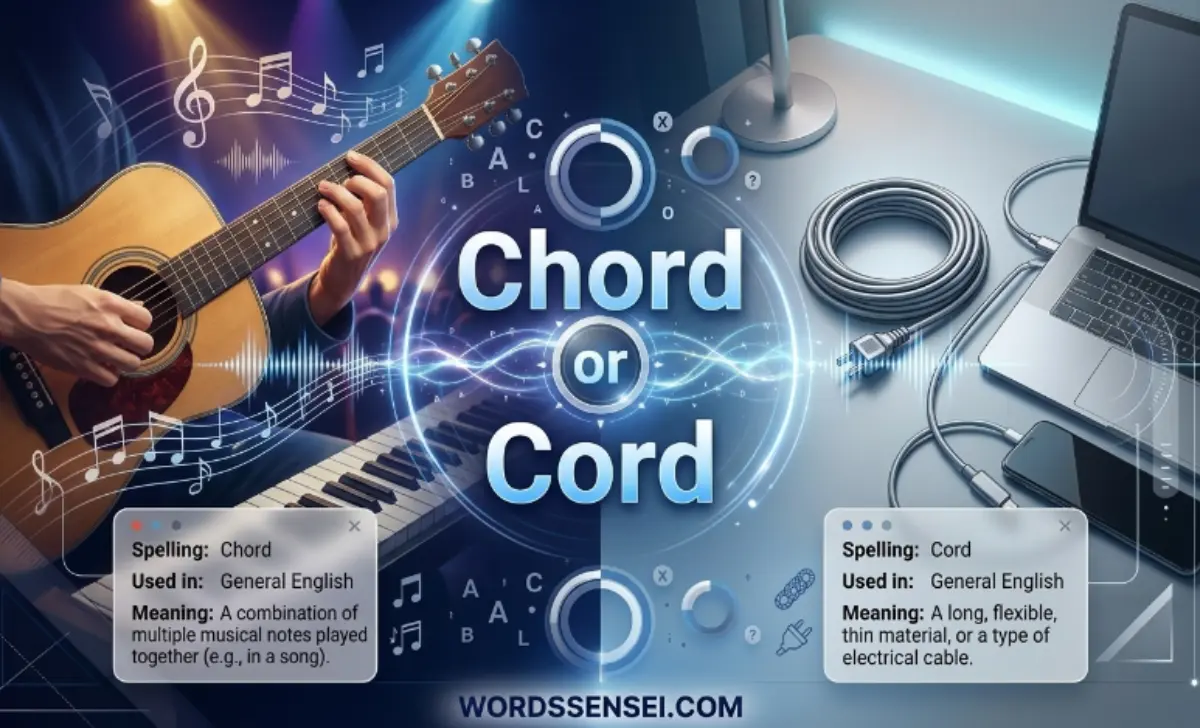
You typed “chord” and then “cord” and then paused to wonder — is that actually right? If so, you are definitely not alone. In fact, thousands of musicians, students, and writers search this exact question every single day.
The confusion is completely understandable because both words sound exactly the same when spoken. However, the answer is actually very simple and clear. Both spellings exist, but they mean completely different things.
Therefore, this complete guide will explain everything you need to know: the correct meaning, the word history, the reason for the confusion, and real usage examples. By the end, you will write both words with complete confidence every single time.
Quick Answer

Both “chord” and “cord” are correct spellings. However, they are not interchangeable, since each one has its own specific meaning.
Music, for instance, always uses “chord,” a group of musical notes played together at the same time. Furthermore, guitarists and piano players use this word constantly.
Rope, wire, string, and certain body parts, on the other hand, always use “cord.” Moreover, this includes everyday objects like an extension cord and anatomical terms like the spinal cord.
So, the word starts with “ch-” for music and simply “c-” for everything else. Ultimately, the correct choice depends entirely on meaning, not on region or grammar rules.
✅ Correct Examples
“She played a beautiful chord on the piano.”
“Plug the lamp into the cord near the wall.”
“The guitarist strummed three chords in a row.”
“Doctors examined her vocal cords carefully.”
❌ Incorrect Examples
~~”She played a beautiful cord on the piano.”~~
~~”Plug the lamp into the chord near the wall.”~~
~~”The guitarist strummed three cords in a row.”~~
~~”Doctors examined her vocal chords carefully.”~~
Never mix these two words up. After all, meaning always decides the correct spelling, not the sound.
What Does “Chord” or “Cord” Mean?
Both “chord” and “cord” are common English nouns. Moreover, they appear constantly in music, medicine, technology, and everyday conversation. Each word, however, refers to something entirely different.
| Feature | Chord | Cord |
|---|---|---|
| Word Type | Noun | Noun |
| Meaning | Musical notes played together | Rope, wire, or body part |
| Syllables | 1 — chord | 1 — cord |
| Pronunciation | /kɔːrd/ | /kɔːrd/ |
| Plural Form | Chords | Cords |
| Related Field | Music theory | Anatomy, electronics |
Common Meanings
According to the Cambridge Dictionary{:target=”_blank” rel=”noopener noreferrer”}, a chord is a group of three or more musical notes played at the same time. Meanwhile, “cord” describes a piece of string, rope, or wire, and it can also refer to certain structures inside the body.
In addition, several everyday situations use these words in slightly different ways:
A musical chord, for example, is the most common meaning, referring to notes played together on a guitar or piano
Meanwhile, an electrical cord powers a device or appliance
Similarly, a spinal cord or vocal cord describes an anatomical structure inside the body
Finally, a cord of wood is an older measurement term for a stack of firewood
Simple Usage Examples
“The chord progression in this song feels very emotional.”
“Meanwhile, the charger’s cord got tangled in my bag.”
“Medical training, therefore, often includes detailed study of the vocal cords.”
“Eventually, a final chord brought the performance to a close.”
The Origin of “Chord” or “Cord”
Knowing where these words come from helps explain exactly why they are spelled differently today. Additionally, it shows why both spellings have existed side by side for centuries.
Word History
Both words, in fact, trace back to the same Greek root, “khorde,” meaning a string or gut. From there, this root passed into Latin and then into Old French as “corde,” which simply meant rope or string.
When the word entered English, it kept the simple spelling “cord” for physical objects. During the 16th century, however, scholars revived the Greek spelling for the musical meaning, adding an “h” to create “chord.” Essentially, that change deliberately connected the musical term back to its Greek origin.
As a result, English ended up with two spellings from one shared ancestor: one for music, and one for everything else.
Why the Confusion Happens
Both words sound identical when spoken aloud. In addition, they also share the exact same root word, which makes the connection even more confusing for many writers. Because of this shared history, people often assume there should be only one correct spelling.
That assumption, though, is incorrect. So, here is the key difference:
| Word | Correct Spelling | Meaning |
|---|---|---|
| Chord | Chord | Musical notes played together |
| Cord | Cord | Rope, wire, or body part |
Even though these two words share the same ancient root, they have used different spellings for hundreds of years. Therefore, remembering the meaning is the easiest way to choose correctly.
British English vs American English
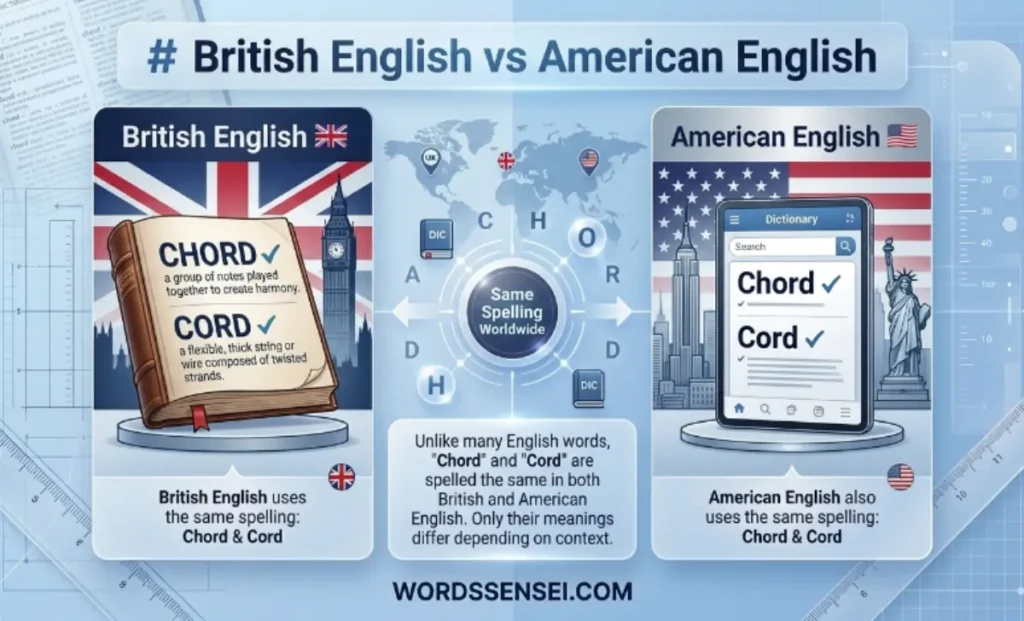
Good news: both British and American English completely agree on these words. As a result, there is no regional spelling difference to worry about here.
Comparison Table
| Feature | American English | British English | Australian English | Indian English |
|---|---|---|---|---|
| Musical term | Chord ✅ | Chord ✅ | Chord ✅ | Chord ✅ |
| Rope/wire term | Cord ✅ | Cord ✅ | Cord ✅ | Cord ✅ |
| Pronunciation | /kɔːrd/ | /kɔːrd/ | /kɔːrd/ | /kɔːrd/ |
| Dictionary | Merriam-Webster | Oxford | Macquarie | Oxford Indian |
No matter where you are writing, whether the United States, the United Kingdom, Canada, Australia, India, or Pakistan, the rule never changes. Overall, music uses “chord,” and everything else uses “cord.”
Chord vs Cord — Full Comparison
Now, let us look at every related term people sometimes confuse, and clear things up completely.
Complete Comparison Table
| Form | Meaning | Field | Recommended? |
|---|---|---|---|
| Chord | Musical notes together | Music theory | ✅ Use for music only |
| Cord | Rope, wire, string | General, electronics | ✅ Use for objects |
| Vocal Cord | Throat structure | Anatomy | ✅ Always “cord” |
| Spinal Cord | Nerve bundle in spine | Anatomy | ✅ Always “cord” |
| Power Chord | Loud guitar technique | Music | ✅ Correct musical term |
| Accord | Agreement | General writing | ✅ Different word entirely |
Which Spelling Should You Use?
The answer always depends on meaning, not on your audience’s location. Below, then, is a clear breakdown by writing situation.
US Audience
American writers, for instance, should always follow the meaning-based rule, confirmed by Merriam-Webster{:target=”_blank” rel=”noopener noreferrer”} as the standard for both spellings. Consequently, all American medical, technical, and music publications follow this exact pattern.
UK Audience
British writers, similarly, follow the same rule, confirmed by the Oxford English Dictionary. Likewise, British music and medical writing has used this exact distinction for centuries without variation.
International Writing
Overall, global English keeps this rule fully consistent, with no regional exception anywhere in the world.
Academic Writing
In academic contexts, music theory essays and papers should use “chord.” Conversely, medical, technical, or general academic writing, especially anatomy topics, should use “cord.”
Social Media Usage
Musicians often post about “chords,” while tech users mention “cords” for chargers and cables. As a result, getting the spelling right makes your content look far more credible and professional.
Common Mistakes with “Chord” or “Cord”
Even confident writers make these errors. So, here is exactly what to watch for, and how to fix each mistake quickly.
Frequent Errors
First, writing “vocal chord” instead of “vocal cord” remains the most common mistake by far
Second, writing “spinal chord” instead of “spinal cord” happens almost as often
Additionally, confusing “extension cord” with “extension chord” trips up many casual writers
Meanwhile, using “power cord” when referring to a guitar sound instead of “power chord”
Finally, misspelling “accord” as “achord” or confusing it with either word
Corrected Examples
| ❌ Wrong | ✅ Right | Why |
|---|---|---|
| She strained her vocal chords. | She strained her vocal cords. | Anatomy always uses “cord” |
| The doctor checked his spinal chord. | The doctor checked his spinal cord. | Anatomy always uses “cord” |
| I need a new extension chord. | I need a new extension cord. | Wires always use “cord” |
| He played a power cord on stage. | He played a power chord on stage. | Music always uses “chord” |
| The two countries signed an achord. | The two countries signed an accord. | Different word entirely |
“Chord” or “Cord” in Everyday Writing Examples
Here, then, is how these words work naturally across different real-world writing situations. Overall, these examples will help you use both words with much more confidence going forward.
Emails
“Please bring the extension cord for the presentation setup. In addition, we will also need a spare charging cord in case the projector battery runs low. So, let me know if you need anything else before the meeting.”
Social Media
“Just learned three new guitar chords today and I already feel like a rockstar! 🎸 Honestly, practicing every day is finally starting to pay off. #GuitarPractice #Chords”
News Writing
“Doctors confirmed damage to the patient’s spinal cord after the accident. As a result, the medical team began an extensive treatment plan immediately, and specialists now expect a gradual recovery over the coming months.”
School Writing
“In music class, we learned how to build a major chord using three notes. Furthermore, our teacher explained how chords create the foundation for most popular songs, and we practiced switching between chords on the guitar.”
Business Writing
“Our product warranty does not cover damage to the power cord. Therefore, customers should handle the cord carefully to avoid unnecessary replacement costs. Meanwhile, our support team is happy to help with any related questions.”
Google Trends and Usage Data
Search data clearly confirms that both “chord” and “cord” are searched heavily, but for very different reasons depending on the audience.
Popular Countries
| Country | Most Searched Term | Search Volume | Notes |
|---|---|---|---|
| United States | Chord vs Cord | Very High | Music and anatomy searches combined |
| United Kingdom | Chord vs Cord | High | Consistent with US usage |
| Canada | Chord vs Cord | High | Follows North American pattern |
| Australia | Vocal Cord | Medium-High | Mostly medical searches |
| India | Chord vs Cord | High | Large ESL population — more confusion |
| Pakistan | Chord vs Cord | High | ESL learners — spelling confusion |
Why People Search This Keyword
Overall, most searches for “chord or cord” come from these specific groups:
First, music students learning guitar or piano chords for the first time
Second, medical students studying vocal cords or spinal cord anatomy
Additionally, ESL learners confused by the identical pronunciation of both words
Meanwhile, content writers avoiding embarrassing errors in music or health articles
Finally, shoppers checking spelling before searching for extension cords or chargers online
Related Grammar Rules
Similar Spelling Mistakes
Other word pairs, similarly, cause the same kind of confusion, since they sound alike but carry completely different meanings. So, here are a few similar examples worth knowing:
| Related Pair | Correct Forms | Note |
|---|---|---|
| Complement / Compliment | Complement, Compliment | Different meanings, similar sound |
| Affect / Effect | Affect, Effect | Verb vs noun confusion |
| Stationary / Stationery | Stationary, Stationery | Easy to confuse visually |
Helpful Grammar Tips
Tip 1 — Remember the “h” for harmony. “Chord” has an “h,” just like the word “harmony.” Consequently, this connection helps you remember the musical spelling every time.
Tip 2 — Think of “cord” as a physical object. If you can touch it, tie it, or plug it in, it is almost always “cord.” So, if you find yourself typing “chord” for a wire or rope, stop and double-check.
Tip 3 — Anatomy always uses “cord.” Both “vocal cord” and “spinal cord” never include the “h,” so this rule has zero exceptions in medical writing.
Tip 4 — Check compound terms carefully. “Power chord” is a real guitar term, while “power cord” refers to an electrical cable. Ultimately, context always decides which one to use.
💡 Pro Tip: Whenever you are not sure about any spelling, check Merriam-Webster{:target=”_blank” rel=”noopener noreferrer”} online. Best of all, it is completely free and gives the correct answer instantly.
“Chord” and “Cord” — Common Phrases and Modern Usage
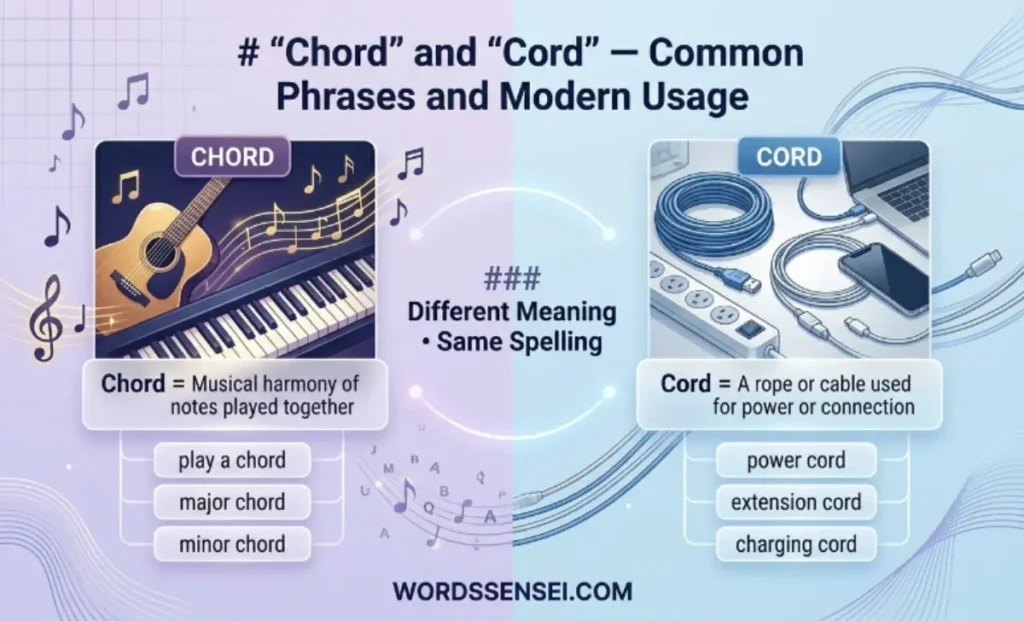
Both words appear in many common phrases today, far beyond just their basic definitions. Moreover, understanding these different uses helps you use each word naturally in any context.
Common Phrases
| Phrase | Meaning | Example |
|---|---|---|
| Power chord | A loud, simple guitar sound | “The song opens with a heavy power chord.” |
| Power cord | An electrical cable | “The laptop’s power cord stopped working.” |
| Vocal cord | Throat structure used for speech | “Singers must protect their vocal cords.” |
| Spinal cord | Nerve bundle in the spine | “The injury affected his spinal cord.” |
| Strike a chord | To evoke strong emotion (idiom) | “Her story really struck a chord with the audience.” |
| Umbilical cord | Connects a baby to the placenta | “The umbilical cord was cut after birth.” |
Internal Link Suggestions
📌 (Add These Links When Related Articles Are Ready)
The term “homophones” can link to your article on commonly confused English words.
Similarly, “guitar chords for beginners” can link to your article on basic music theory.
For anatomy-related content, “vocal cord health” can link to your article on voice care and speech tips.
Finally, “commonly confused words” can link to your article on English spelling mistakes.
Author Bio
About the Author [Your Name] is an English language writer and grammar teacher with [X] years of experience. Additionally, [he/she/they] helps students, bloggers, and ESL learners write better and more confidently every day. Connect on LinkedIn | View All Posts
FAQs
Is “cord” ever used for music?
No. Instead, “cord” is never used for music, since the musical spelling is always “chord,” with an “h.” Therefore, using “cord” for a musical term is incorrect in every context.
Why do people confuse chord and cord?
Both words are pronounced exactly the same way and share the same ancient Greek root, “khorde.” Since the sounds are identical, therefore, many writers assume the spelling should also match, which leads to frequent mistakes.
What is the correct spelling — vocal chord or vocal cord?
The correct spelling is “vocal cord.” Since this refers to a body part rather than music, it never includes the “h” found in “chord.”
What is the difference between “chord” and “cord”?
“Chord” refers to musical notes played together, while “cord” refers to a rope, wire, or certain body parts. Ultimately, these are two completely different words with two completely different meanings.
Is “power cord” or “power chord” correct?
Both are correct, but they mean different things. Specifically, “power cord” refers to an electrical cable, while “power chord” refers to a loud, simple guitar technique used in rock music.
What is the adjective or related form of “chord”?
There is no common adjective form for “chord.” However, related musical terms include “chordal,” which describes something related to chords in music theory.
Is “spinal chord” ever correct?
No. In fact, “spinal chord” is always incorrect, since the only correct spelling is “spinal cord,” as it refers to a body part, not a musical term.
How do I remember the correct spelling of chord and cord?
Try this simple memory trick: “chord” has an “h,” just like “harmony.” So, if the word relates to music, keep the “h.” Otherwise, if it relates to anything physical, drop it.
Conclusion
After reading through this complete guide, the answer is now absolutely clear. Both “chord” and “cord” are correct spellings, but they mean completely different things. Specifically, “chord” always relates to music, while “cord” always relates to rope, wire, or body parts like the vocal cord and spinal cord.
The confusion happens because both words sound identical and share the same ancient root. Nevertheless, they have used different spellings for centuries. Ultimately, “chord” always keeps the “h,” just like “harmony,” while “cord” never does.
So, the next time you sit down to write, whether it is a music blog, a medical note, a business email, or a product description, choose your spelling based on meaning, not sound. Overall, you now have the full picture: the correct meaning, the word history, and practical tips to remember it forever.
Read More Blogs
- Beemer or Beamer? The BMW Nickname Most People Get Wrong
- Dysregulated or Disregulated? Most Writers Get This Wrong

Hi, I am Anne Seaton, a professional content writer working on wordssensei.com.
I create engaging and SEO-friendly articles that inform, inspire, and connect with readers.