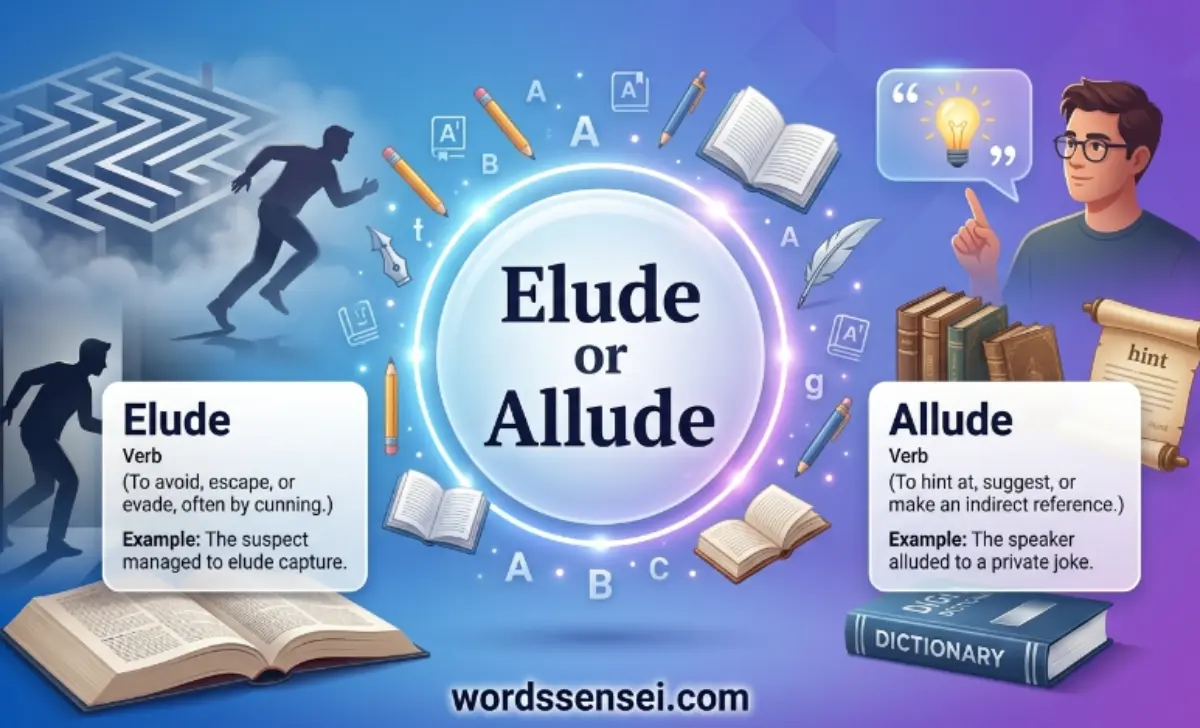
Have you ever stopped while writing a literary analysis or a police report, wondering if you should type elude or allude? If so, you are definitely not alone. This is one of the most common homophone-like dilemmas in the English language today. Because these two words sound very similar, it is very easy to mix them up. However, getting this right is very important for your credibility.
Consequently, using the wrong word can make your writing look less professional to your readers. This guide is designed to solve this mystery once and for all. Therefore, by the time you finish reading this detailed article, you will be an expert on the correct spelling, the distinct meanings, and the everyday usage of these two essential terms.
Furthermore, understanding the difference between these two spellings is not just about grammar; it is about showing attention to detail. In the worlds of literature, law enforcement, and psychology, every small detail matters.
Therefore, we will dive deep into the word’s history, explore the different contexts for each term, and provide you with foolproof tricks to remember the right version. As a result, you will be able to write with absolute confidence in any professional setting.
Quick Answer
The correct word depends entirely on the meaning you want to convey in your sentence. If you are talking about escaping, avoiding, or evading something, you should use elude (with an “e”). On the other hand, if you are talking about making an indirect reference or hinting at something, you must use allude (with an “a”). In modern English, these two words share a common Latin root but have evolved to have very different functions. You can verify these distinct entries on Merriam-Webster or the Cambridge Dictionary. Therefore, whether you are in the United States or the United Kingdom, you must choose the word that matches your intent.
Additionally, a helpful trick is to think of the “e” in elude as standing for “Escape.” Conversely, think of the “a” in allude as standing for “About” (referring to something). Consequently, if you want to be correct, you should always double-check whether you are running away from something or pointing toward it.
Correct Example
- The thief managed to elude the police for three days. (Escape)
- The speaker alluded to a secret agreement during the meeting. (Hint)
- Success seems to elude him no matter how hard he tries. (Evade/Unattained)
- The novel alludes to several historical events from the 1920s. (Reference)
Incorrect Example
- He tried to allude the security guards. (Wrong – should be elude)
- She eluded to her past mistakes in the interview. (Wrong – should be allude)
- The answer alluded me for a long time. (Wrong – should be eluded)
What Does Elude Mean?
The word elude is a verb that describes the act of escaping or avoiding something, often through cleverness or speed. In other words, it is about being hard to catch or understand.
Common Meanings
- To Evade: To escape from capture or pursuit.
- To Avoid: To stay away from a difficult situation or question.
- To Baffle: When a concept or answer remains out of reach for your mind.
- To Be Unattained: When a goal or success is not achieved despite effort.
Simple Usage Examples
- Law Enforcement: “The suspect eluded the high-speed chase by turning into a narrow alley.”
- Sports: “The star player was so fast that he could elude any defender on the field.”
- Psychology: “The name of his old friend continued to elude his memory.”
- Daily Life: “I tried to elude the extra work, but my boss found me anyway.”
What Does Allude Mean?
The word allude is a verb that describes the act of referring to something indirectly or making a subtle hint. It is almost always followed by the word “to.”
Common Meanings
- Indirect Reference: Mentioning something without saying it directly.
- Hinting: Giving a suggestion about a topic or secret.
- Literary Device: Using an “allusion” to connect a story to another work or event.
- Insinuation: Suggesting something negative in a quiet way.
Simple Usage Examples
- Literature: “In his poems, T.S. Eliot often alludes to classical Greek myths.”
- Politics: “The candidate alluded to her opponent’s scandals without naming them.”
- Social: “Stop alluding to the surprise party; you’re going to ruin it!”
- Business: “The CEO alluded to upcoming layoffs during the town hall meeting.”
The Origin of Elude and Allude
The history of these words shows how they developed from the same Latin root into different concepts.
Word History
Both words come from the Latin word ludere, which means “to play.” The word allude comes from ad-ludere (meaning “to play with” or “to mock”), which evolved into making a playful or indirect reference. On the other hand, elude comes from ex-ludere (meaning “to play out of” or “to finish playing”), which evolved into the idea of “playing one’s way out of a trap” or escaping. Consequently, the spellings evolved to help distinguish the “hinting” from the “escaping.” Therefore, we now have two distinct words that share a playful origin but serve very different purposes in modern English.
Why the Confusion Happens
The confusion happens because the two words sound very similar and both deal with things that are not “direct.” For instance, an allusion is an indirect mention, and an elusive thing is hard to grasp directly. As a result, when we are writing, our brain might pick the wrong one because they both feel “subtle.” Consequently, people often misspell these words by failing to identify whether the action is “hinting” or “escaping.”
British English vs. American English
Interestingly, the spelling of both elude and allude remains the same in all major versions of English.
Comparison Table
| Feature | American English (US) | British English (UK) |
|---|---|---|
| To Escape | Elude | Elude |
| To Hint | Allude | Allude |
| Pronunciation | ɪˈluːd | əˈluːd |
| Common Error | Mixing them up | Mixing them up |
Whether you are in London or New York, the rules are the same. Therefore, you do not need to worry about regional differences when using these terms.
Elude vs. Allude: Comparison Tables
It is helpful to see how these words compare in different professional and daily life settings.
Spelling Comparison Table
| Correct Spelling | Meaning | Usage | Category |
|---|---|---|---|
| Elude | To Escape / Evade | “Elude capture” | Verb |
| Allude | To Hint / Refer | “Allude to a fact” | Verb |
| Allusion | Indirect mention | “Literary allusion” | Noun |
| Elusive | Hard to catch | “Elusive goal” | Adjective |
Elude vs. Allude in Different Industries
| Industry | Term Used | Context |
|---|---|---|
| Literature | Allude | Referencing other books or myths |
| Law | Elude | Evading arrest or police |
| Sports | Elude | Dodging a tackle or opponent |
| Psychology | Elude | Memories or concepts that are hard to grasp |
| Politics | Allude | Hinting at policies or scandals |
Common Phrases and Idioms
| Phrase | Correct Spelling | Meaning |
|---|---|---|
| Allude to | Allude | To mention something indirectly |
| Elude capture | Elude | To avoid being caught |
| Elude memory | Elude | To be forgotten or hard to recall |
| Allude to a secret | Allude | To drop a hint about a secret |
| Elude the law | Elude | To escape legal consequences |
The “E” for Escape Rule
To truly understand why we spell it this way, you must understand the mnemonic tricks.
How the Rule Works
In English, the starting letter often gives a clue to the meaning. For elude, the “e” is the key. You can remember that Elude starts with E for Escape. Conversely, for allude, the “a” is the key.
You can remember that Allude starts with A for About (you are talking “about” something indirectly). Therefore, if you are running away, use the “e” word. If you are pointing at something, use the “a” word. Consequently, if you can link the letter to the action, you will never fail.
Helpful Grammar Tips
Always remember the “Direction Test.” If the action is moving away from someone (like a thief running), use elude. If the action is moving toward a topic (like a hint), use allude. Therefore, the “e” version is for the “away.” Consequently, your writing will always be accurate.
Which Spelling Should You Use?
You should always use the spelling that matches the specific action in your sentence. There is no setting where the two are interchangeable.
US Audience
In the US, the term elude is extremely common in crime reporting (e.g., “eluding police”). Therefore, using “alluding” in these contexts would be a major error.
UK Audience
In the UK, the term allude is frequently used in literary criticism and political debate. Consequently, British writers must be careful to use the “a” spelling when analyzing a Shakespearean play or a speech in Parliament.
International Writing
For global business and international law, elude is the universal term for avoiding regulations. Therefore, using the correct spelling ensures your documents are recognized everywhere.
Academic Writing
In university papers or research journals, mixing up these terms is a significant error. As a result, students should always double-check their work for the “escape vs. hint” difference.
Social Media Usage
Even on LinkedIn or Twitter, using the correct spelling shows that you are a professional. Consequently, it helps you build a better brand identity.
Common Mistakes with Elude and Allude
Avoid these frequent errors to keep your writing professional.
Frequent Errors
- The Escape Hint: Writing “he alluded the police” instead of “eluded.”
- The Hint Escape: Writing “she eluded to the secret” instead of “alluded.”
- Missing the ‘To’: Writing “he alluded the fact” (allude needs “to”).
- Spelling with ‘I’: Writing “illude” (which is a different, rare word).
Corrected Examples
- Incorrect: “The answer alluded me.”
- Correct: “The answer eluded me.”
- Incorrect: “He eluded to his new job.”
- Correct: “He alluded to his new job.”
Elude and Allude in Everyday Examples
Let’s look at how these words are used in different professional contexts.
Emails
“Dear Team, I don’t want to elude the difficult questions, but I must allude to the fact that our budget is limited.”
Social Media
“Success can be elusive, but if you keep working, it won’t elude you forever! #Motivation #Success #StayFocused”
News Writing
“The suspect was charged with eluding a peace officer after a chase that lasted for two hours.”
School Writing
“The poet alludes to the theme of mortality throughout the second stanza of the work.”
Business Writing
“While we cannot name the client, we can allude to their recent success in the tech industry.”
Google Trends & Usage Data
The data shows that both words have consistent search volume, with “allude” being slightly more common in academic searches.
Popular Countries
- United States: High volume for “eluding police charge” and “allude to definition.”
- United Kingdom: Frequent searches for “literary allusion” and “elude capture.”
- India: Large number of searches for “allude meaning in Hindi” and “elude vs evade.”
- Australia: Common searches for “allude to a secret” and “elusive definition.”
- Canada: High volume for “allude vs elude” and “eluding the law.”
Why People Search This Keyword
Most people search these words because they are reading literature or news and want to be sure of the meaning. However, a large number of searches also come from people checking the spelling before writing a formal report. Consequently, it is a vital keyword for anyone interested in sinf-e-talmih (allusion) and grammar.
Related Grammar Rules
Spelling is easier when you understand the patterns of related words in English.
Similar Homophone-like Mistakes
- Elicit vs. Illicit: Another “E vs. I” confusion.
- Emigrate vs. Immigrate: The “Exit vs. In” distinction.
- Accept vs. Except: A very common daily error.
- Affect vs. Effect: The classic verb vs. noun dilemma.
Helpful Grammar Tips
Always remember the “Ludere Rule.” Since both come from “to play,” think of them as two different games. Elude is like “Hide and Seek” (hiding/escaping). Allude is like “Charades” (hinting/pointing). Therefore, the “e” version is for hiding. Consequently, you will never get it wrong again.
FAQs
Is it elude or allude?
It depends. Use elude for escaping and allude for hinting.
What does ‘allude to’ mean?
It means to mention something indirectly without saying it explicitly.
What is an elusive person?
A person who is hard to find, catch, or understand.
Can I say ‘he eluded to the truth’?
No, the correct verb for hinting is alluded.
Why are they so similar?
Because they both come from the Latin word ludere, meaning “to play.”
How do I remember the ‘E’?
Remember: Elude starts with E for Escape.
Is ‘illude’ a word?
Yes, but it is very rare and means to trick or deceive. You should almost always use elude or allude.
What is a literary allusion?
It is a brief and indirect reference to a person, place, thing, or idea of historical, cultural, literary, or political significance.
Conclusion
In conclusion, the spelling of elude and allude is a small but vital detail in the world of professional writing and communication. While the mistake of mixing them up is common due to their similar sound and shared history, the correct version depends entirely on whether you are escaping a pursuer or hinting at a secret.
Throughout this guide, we have seen that elude is a specific verb used in law enforcement, sports, and psychology, while allude is a versatile term used in literature, politics, and social interaction.
Furthermore, by understanding the mnemonic tricks and the importance of the “E for Escape” distinction, you can avoid this spelling trap forever. Consequently, your business documents, academic papers, and social media posts will always look professional and credible.
Remember, attention to detail is what separates a good communicator from a great one. Therefore, keep the “e” in your elude when avoiding capture and the “a” in your allude when dropping a hint, and your professional reputation will continue to grow. Your commitment to accuracy is the foundation of your success in any field!
Read More Blogs:
- Ally or Alley? Stop Making This Common English Mistake!
- Dam or Damn? Most People Get This Wrong
- Dressing or Stuffing? Learn the Difference With Simple Examples

Anne Seaton is a contributing writer at Wordssensei.com, covering English grammar, vocabulary, and commonly confused words.