A children’s book author sits down to describe a cartoon character’s outrageous, over-the-top personality and pauses at the keyboard, fingers hovering, genuinely unsure whether to type “wacky” or “whacky.” It’s a strange moment of hesitation for such a playful, lighthearted word — a word whose entire purpose is to describe something silly, offbeat, or delightfully absurd, yet here it is, causing a small flicker of spelling anxiety.
This confusion isn’t rare. Search engines see this exact question typed in constantly, from comedy writers, marketing copywriters, children’s content creators, and casual social media users alike, all wondering which version of this cheerful word actually belongs on the page.
Unlike more clear-cut British-versus-American spelling divides, or Latin-plural grammar debates, “wacky vs whacky” occupies a strange little corner of English where one spelling is overwhelmingly preferred, dictionary-confirmed, and stylistically standard, while the other persists purely through informal habit, visual association with a completely different word, and repeated exposure across casual writing.
This guide dives deep into exactly which spelling is correct, why the confusion exists in the first place, where “whacky” likely came from, how the word is used across different contexts and industries, and why understanding this tiny spelling choice actually says something interesting about how English absorbs and standardizes playful, informal vocabulary over time.
Quick Answer
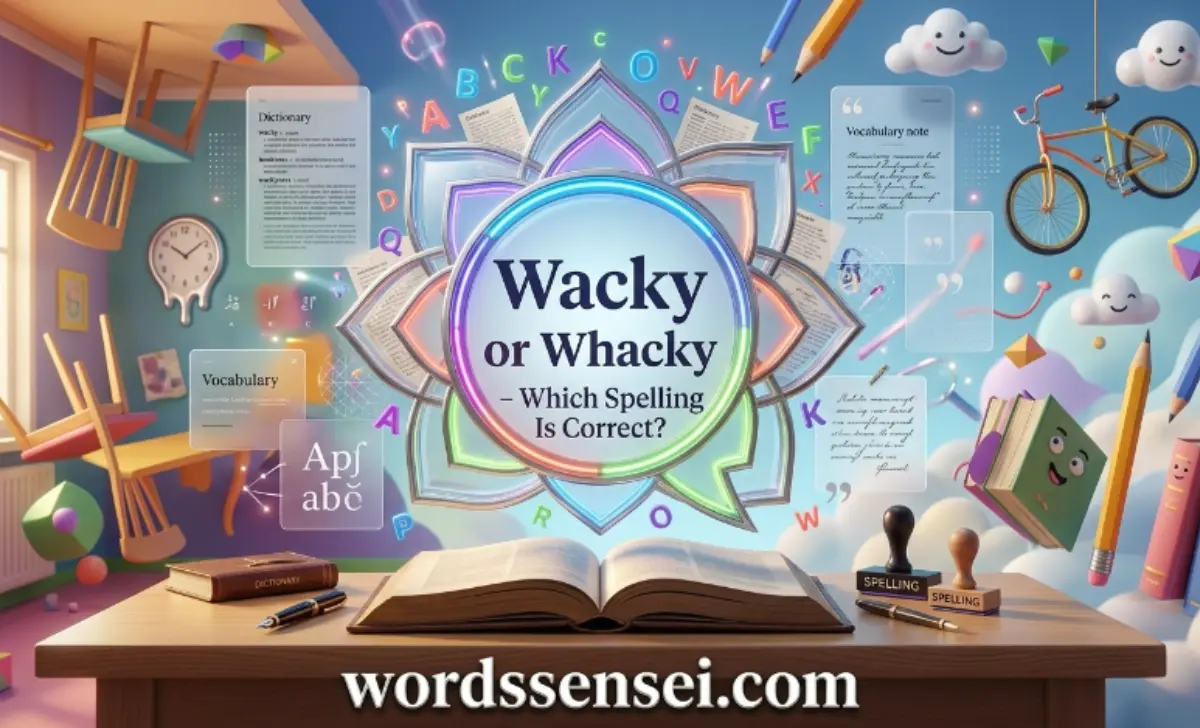
Wacky is the standard, dictionary-preferred spelling in both American and British English. Whacky is a commonly seen variant spelling, but it is not the standard form recognized by major dictionaries and style guides, even though it appears frequently in casual writing.
According to Merriam-Webster, “wacky” is listed as the standard spelling, defined as absurdly or amusingly eccentric. The Cambridge Dictionary similarly lists only “wacky” as the recognized entry, without listing “whacky” as an accepted alternate form. This puts “wacky vs whacky” in a slightly different category than pairs like “mosquitoes vs mosquitos,” where both spellings are formally accepted — here, one spelling clearly dominates as the correct standard.
A simple way to decide: always default to wacky. It’s the version you’ll find in dictionaries, style guides, published books, and professional writing, while “whacky” remains a widespread but technically nonstandard variant.
Correct Example
- The comedian’s wacky sense of humor had the whole audience laughing.
- She wore a wacky costume made entirely of recycled materials.
- The show is known for its wacky, over-the-top plot twists.
- His wacky ideas somehow always seem to work out.
Nonstandard / Widely Seen But Not Preferred
- The comedian’s whacky sense of humor had the whole audience laughing. (Common in casual writing, but not the dictionary-standard spelling.)
What Does Wacky Mean?
Wacky is an adjective describing something or someone that is absurdly eccentric, playfully odd, or amusingly unconventional, typically in a lighthearted, non-threatening way.
Common Meanings
- Playfully Absurd — silly, comical, or eccentric in an entertaining way.
- Unconventional — departing from normal expectations in a whimsical fashion.
- Zany Personality — describing a person’s offbeat, energetic, or quirky character.
- Informal/Casual Tone — used almost exclusively in casual, conversational, or entertainment-focused writing rather than formal contexts.
Simple Usage Examples
- Personality: “Her wacky personality made every family gathering more entertaining.”
- Entertainment: “The cartoon is famous for its wacky sound effects and slapstick humor.”
- Everyday speech: “That’s a pretty wacky idea, but it might actually work.”
- Fashion: “He showed up to the party in a wacky outfit covered in mismatched patterns.”
Where Does “Whacky” Come From?
Since “whacky” isn’t the dictionary-standard spelling, it’s worth understanding exactly why it shows up so frequently despite not being technically correct.
The Influence of “Whack”
The most likely explanation for “whacky” traces back to visual and phonetic association with the completely unrelated word “whack,” meaning to hit something forcefully, as in “whack a piñata.” Since “whack” is spelled with a “wh,” and “wacky” sounds nearly identical when spoken aloud, many writers instinctively assume “wacky” should follow the same “wh” spelling pattern, even though the two words have entirely separate origins and no actual etymological connection.
A Case of Mistaken Pattern-Matching
English contains many “wh” words describing sudden, forceful, or exclamatory actions and sounds — “whack,” “whip,” “whir,” “whiz” — which may unconsciously prime writers to expect a “wh” spelling for a word that sounds similarly punchy and energetic. “Wacky,” despite its lively tone, simply never adopted this pattern, remaining spelled with a plain “w” throughout its history.
Wacky vs. Whacky: Comparison Table
| Spelling | Status | Dictionary Recognition | Common Context |
|---|---|---|---|
| Wacky | Standard, correct spelling | Merriam-Webster, Cambridge, Oxford | All writing, formal and informal |
| Whacky | Nonstandard variant | Not listed as primary entry in major dictionaries | Casual writing, social media, informal contexts |
Frequency Comparison Across Different Sources
| Source Type | Preferred Spelling |
|---|---|
| Published books and journalism | Wacky |
| Dictionary entries | Wacky |
| Casual blogs and social media | Mixed, “whacky” appears frequently |
| Children’s entertainment/marketing | Wacky |
| Academic and formal writing | Wacky |
Synonyms for “Wacky” and Their Shades of Meaning
| Synonym | Shade of Meaning |
|---|---|
| Zany | Emphasizes clownish, performative silliness |
| Quirky | Emphasizes unusual personal habits or style, often more subtle |
| Eccentric | Emphasizes unconventional behavior, sometimes more formal in tone |
| Goofy | Emphasizes lighthearted, playful silliness, often physical |
| Offbeat | Emphasizes unconventional style or taste, less about behavior |
| Kooky | Very close synonym, similarly informal and playful |
The Origin of Wacky
Word History
“Wacky” emerged in American slang during the early 20th century, believed to derive from the older British dialect word “whacky,” itself possibly connected to “whack” in a very different sense — describing someone who seemed like they’d been struck on the head, hence acting strangely or foolishly. Interestingly, this means the word’s history does contain a genuine, distant connection to “whack” after all, even though the modern standard spelling dropped the “h” entirely as the word became popularized in American English throughout the 1930s and 1940s, particularly in entertainment and comedic slang.
Why the Spelling Settled on “Wacky”
As “wacky” spread through mainstream American English, particularly through comic strips, radio comedy, and later television and film, publishers and dictionary editors standardized the spelling without the “h,” likely favoring simplicity and matching the word’s playful, casual tone with an equally simple, uncomplicated spelling. Once major dictionaries and style guides settled on “wacky,” it became the entrenched standard, while “whacky” persisted mainly through informal writing and the lingering phonetic association with “whack.”
Wacky in Pop Culture and Common Phrases
Because “wacky” is such a casual, entertainment-oriented word, it appears constantly in specific recurring phrases and pop culture references worth knowing.
Common Phrases Using “Wacky”
| Phrase | Meaning |
|---|---|
| Wacky races | Describing a chaotic, comedic competition (popularized by the classic cartoon of the same name) |
| Wacky idea | An unconventional, sometimes impractical but amusing suggestion |
| Wacky humor | Comedy style relying on absurdity, exaggeration, and silliness |
| Wacky character | A fictional or real personality known for eccentric, comedic behavior |
| Wacky inventions | Unusual, often impractical gadgets designed more for amusement than function |
Why This Word Thrives in Entertainment Writing
“Wacky” carries an inherently lighthearted, non-serious tone that makes it a natural fit for describing cartoons, comedy sketches, children’s entertainment, novelty products, and playful marketing campaigns. Its short, punchy sound mirrors the very quality it describes, which likely contributes to why it remains so popular in casual and entertainment-focused writing despite rarely appearing in formal or academic contexts.
Is “Whacky” Ever Acceptable?
While “wacky” remains the standard, dictionary-preferred spelling, “whacky” isn’t considered a glaring error in the same way a true misspelling would be, largely because it’s so widely recognized and understood despite its nonstandard status. In highly casual writing — texts, social media captions, informal blog posts — “whacky” will rarely confuse a reader or seriously undermine credibility. However, in any professional, published, edited, or formal context, sticking with “wacky” is the safer, more polished choice, since style guides and editors consistently favor it as correct.
Which Spelling Should You Use?
Professional and Published Writing
Always use “wacky” in professional writing, journalism, published books, and any context where dictionary-standard spelling matters for credibility.
Marketing and Branding
Marketing copy, especially for children’s products, comedy content, or novelty items, should use “wacky” to align with standard spelling expectations, even though the tone of the content itself is playful and informal.
Casual and Conversational Writing
In texts, casual social media posts, or informal conversation, either spelling will likely be understood without confusion, though “wacky” remains the safer, more universally recognized default even here.
Academic Writing
While “wacky” is inherently an informal word rarely used in strict academic writing, if it does appear — for instance, when analyzing comedic literature or pop culture — the standard spelling “wacky” should always be used.
SEO and Content Writing
Content creators writing about comedy, entertainment, or lifestyle topics should default to “wacky” for search engine consistency and to match dictionary-standard spelling, which search engines and readers alike will recognize as correct.
Common Mistakes with Wacky and Whacky
Frequent Errors
- Assuming “whacky” is an equally valid, dictionary-recognized alternate spelling, similar to true dual-accepted pairs like “mosquitoes/mosquitos.”
- Confusing “wacky” with the unrelated verb “whack,” leading to the mistaken “wh” spelling.
- Using “whacky” in formal, professional, or published writing where “wacky” is expected.
- Inconsistently switching between both spellings within the same piece of writing.
Corrected Examples
- Incorrect: “The show is known for its whacky humor and wacky characters.”
- Correct: “The show is known for its wacky humor and wacky characters.”
- Incorrect: “That’s a whacky idea, but it might work.”
- Correct: “That’s a wacky idea, but it might work.”
Wacky in Everyday Examples
Emails
“We’re planning a wacky theme for this year’s office party, complete with mismatched costumes and silly games.”
Social Media
“This is the most wacky thing I’ve seen all week, and I honestly can’t stop laughing.”
News Writing
“The town’s annual festival features a wacky parade of homemade floats, each stranger than the last.”
School Writing
“The short story uses wacky, exaggerated characters to satirize everyday office life.”
Business Writing
“Our new ad campaign leans into a wacky, playful tone to stand out from more traditional competitors.”
Why This Keyword Gets Searched
People search “wacky vs whacky” mostly while writing casually and pausing to double-check which spelling looks correct, especially in comedic, entertainment, or marketing content where the word appears frequently. Content writers and copywriters search it while confirming dictionary-standard spelling before publishing. Parents and children’s content creators search it while writing playful, kid-friendly material where the word shows up constantly. A smaller group searches it purely out of curiosity after noticing “whacky” used inconsistently across websites, packaging, or social media captions.
Related Spelling Confusions
Similar Informal Word Spelling Mix-Ups
- Goofy vs. Goofey — another informal word where only one spelling is standard.
- Zany vs. Zaney — a comparable playful adjective with a single correct form.
- Kooky vs. Kookey — a similar informal word facing occasional spelling uncertainty.
Helpful Tips
Whenever an informal, playful-sounding word seems to invite a “wh” spelling due to phonetic association with an unrelated word, it’s worth double-checking a dictionary rather than trusting instinct alone, since English doesn’t always apply spelling patterns consistently across similar-sounding words.
FAQs
Is “whacky” a real word?
“Whacky” is widely recognized and understood, but it is not the standard, dictionary-preferred spelling; “wacky” is the correct form.
What is the correct spelling: wacky or whacky?
“Wacky” is the correct, standard spelling recognized by major dictionaries including Merriam-Webster and Cambridge.
Is “whacky” British spelling?
No, “whacky” is not an official British spelling variant; British and American English both recognize “wacky” as the standard form.
What does “wacky” mean?
“Wacky” describes something or someone absurdly or amusingly eccentric, playful, or unconventional in a lighthearted way.
Is “whack” related to “wacky”?
Historically, yes, some etymologists trace “wacky” back to an older dialect connection with “whack,” though the modern standard spelling dropped the “h” entirely.
Which spelling do dictionaries prefer?
All major dictionaries, including Merriam-Webster, Cambridge, and Oxford, list “wacky” as the standard, correct spelling.
Can I use “whacky” in casual writing?
Yes, “whacky” will generally be understood in casual writing without causing confusion, though “wacky” remains the safer, more universally correct choice.
Why do people spell it “whacky” so often?
Likely due to phonetic and visual association with the unrelated word “whack,” leading many writers to instinctively add an “h” that doesn’t belong in the standard spelling.
Conclusion
Unlike many of the word pairs explored elsewhere in this series, “wacky vs whacky” isn’t really a case of two equally valid regional or dictionary-accepted spellings — it’s a case of one clearly standard form, “wacky,” coexisting alongside a widespread but technically nonstandard variant that persists mainly through habit, phonetic association, and the word’s inherently playful, informal nature.
The confusion traces back to an understandable, almost charming mix-up with the unrelated word “whack,” reinforced by a pattern of “wh” words in English that describe sudden, energetic actions and sounds, even though “wacky” itself never officially adopted that spelling convention.
For anyone writing comedy, entertainment content, marketing copy, or simply trying to describe something delightfully absurd, defaulting to “wacky” will always be the correct, dictionary-backed choice, safe for both casual and professional writing alike. Understanding why “whacky” shows up so often, despite not being the standard form, adds a small but genuinely interesting layer of insight into how English words settle into their accepted spellings, often through nothing more than repetition, popular use, and the quiet decisions of early dictionary editors. The next time this playful little word crosses your keyboard, you’ll know exactly which version deserves the spot on the page.
Read More Blogs:
- Lesser or Lessor? The Complete Guide to Getting It Right
- Bug or Insect? The Complete Guide to Getting It Right

Hi, I am Gerald Nelson, a professional content writer working on wordssensei.com.
I create engaging and SEO-friendly content that informs and inspires readers.