Picture this: you’re finalizing a rental contract at midnight, and suddenly you freeze on one word. Is it “the lesser shall provide 30 days’ notice” or “the lessor shall provide 30 days’ notice”? This single-letter mix-up trips up even experienced writers, and it happens for a good reason — the words look nearly identical and sound almost the same out loud.
Yet in a legal document, swapping them can genuinely confuse who owns the property and who is renting it. This guide breaks down exactly when to use each word, why the confusion exists in the first place, and how to remember the difference permanently. You’ll walk away knowing the correct spelling, the legal weight behind it, and real examples from contracts, comparisons, and everyday writing.
This isn’t just a grammar footnote. In real estate, finance, and law, one misplaced letter can change the entire meaning of a sentence. A property manager who writes “lesser” instead of “lessor” in a lease clause isn’t just making a typo — they’re technically describing something smaller, not naming the property owner.
Below, we’ll cover the word origins, side-by-side comparisons, industry-specific usage, and the most reliable memory tricks so you never second-guess yourself again.
Quick Answer
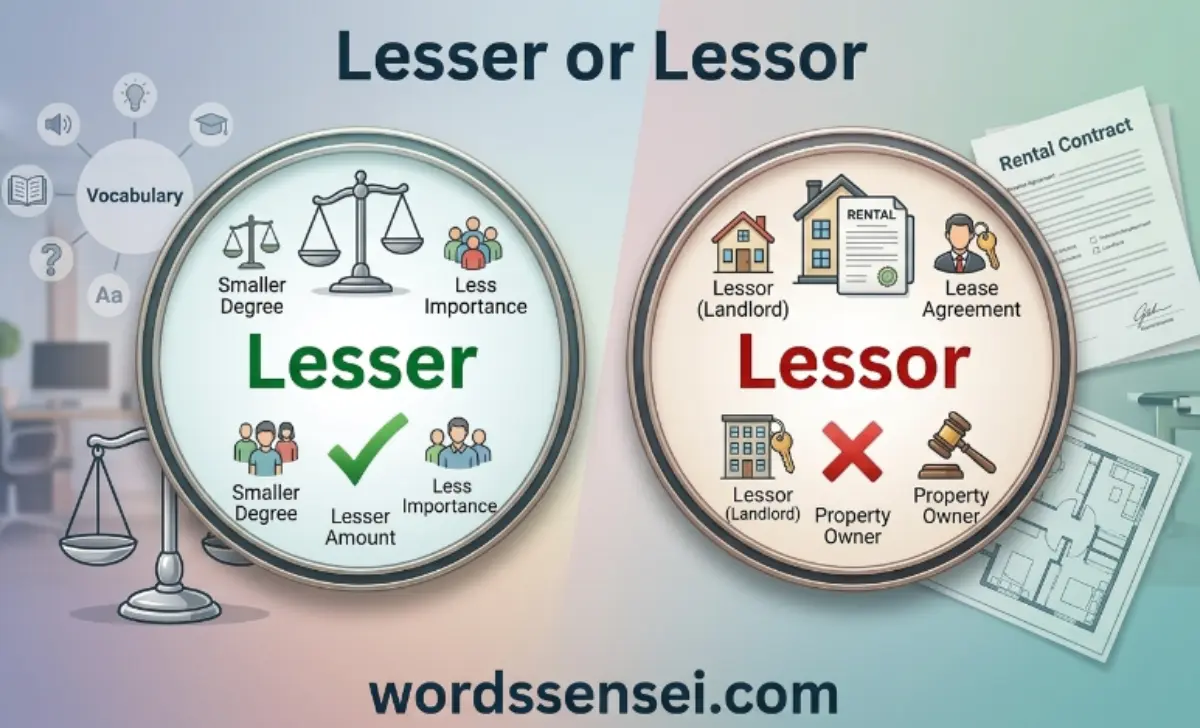
Lesser is an adjective meaning smaller, lower, or less significant. Lessor is a legal noun referring to the person or company that owns property and grants a lease to someone else. They are unrelated in meaning despite looking alike on the page.
Legal reference sites such as the define a lessor as the party who conveys property under a lease. Standard dictionaries like Merriam-Webster define “lesser” simply as “of less size, quality, or significance.” One word belongs in a contract; the other belongs in a comparison sentence.
A quick way to separate them: if your sentence could be rewritten using “smaller” or “less important,” you need lesser. If your sentence names a party in a lease or rental agreement, you need lessor.
Correct Example
- She chose the lesser of the two evils.
- The lessor agreed to renew the lease for another year.
- This model has a lesser storage capacity than the previous version.
- As the lessor, the company retains ownership of the building.
Incorrect Example
- The lessor of two evils is still a bad choice.
- The lesser signed the rental agreement yesterday.
- This phone has lessor features than the flagship model.
What Does Lesser Mean?
Lesser functions as an adjective describing something smaller in size, degree, rank, or importance. It’s the word you reach for whenever you’re comparing two things and one comes out on the losing end.
Common Meanings
- Smaller in Degree — a lower amount or intensity of something.
- Less Important — lower in rank, significance, or priority.
- Inferior Quality — not as good as an available alternative.
- Reduced Scale — a smaller version of something larger.
Simple Usage Examples
- Comparison: “Between the two plans, he chose the one with the lesser cost.”
- Idiom: “She picked the lesser of two evils when forced to decide.”
- Quality: “The store sells a lesser grade of fabric at a discount.”
- General: “His contribution, though lesser in scale, was still valuable to the project.”
- Formal writing: “The report focuses on the lesser-known risks of the merger.”
What Does Lessor Mean?
Lessor is a noun used almost exclusively in legal, financial, and real estate writing. It names the party that owns an asset — property, equipment, or a vehicle — and grants another party the right to use it through a lease.
Common Meanings
- Property Owner — the individual or company that owns the leased asset.
- Legal Party — the party named in a lease agreement who grants usage rights.
- Landlord Equivalent — often interchangeable with “landlord” in residential contracts.
- Contract Signatory — responsible for upholding lease terms as the asset provider.
Simple Usage Examples
- Real Estate: “The lessor requires a security deposit before handing over the keys.”
- Business: “Under the agreement, the lessor retains the right to inspect the property twice a year.”
- Legal: “Both the lessor and the lessee must sign the contract for it to take effect.”
- Finance: “The equipment lessor charges a fixed monthly fee for usage.”
- Automotive: “In a car lease, the dealership or finance company acts as the lessor.”
Lessor vs. Lessee: Who Is Who?
Since “lessor” is confused with both “lesser” and its own legal counterpart, “lessee,” it helps to lay both terms side by side.
The Two Parties in a Lease
| Term | Who They Are | Role in the Agreement |
|---|---|---|
| Lessor | The owner of the property or asset | Grants the right to use the property |
| Lessee | The person or company renting the asset | Pays for and uses the property |
A Simple Way to Remember
Words ending in “-or” (lessor, vendor, creditor) typically describe someone who provides or grants something. Words ending in “-ee” (lessee, employee, payee) typically describe someone on the receiving end. The confirms this pattern: the lessor owns the asset, and the lessee is the party granted use of it under the lease agreement.
Lesser or Lessor Examples
Seeing lesser and lessor in the same article can make them seem interchangeable, but they have completely different meanings. The easiest way to remember the difference is that lesser describes something that is smaller, lower, or less important, while lessor refers to a person or company that grants a lease.
Examples of Lesser
Use lesser when you are comparing things, people, amounts, levels, or importance.
- The company chose the lesser of the two costs.
- This option has a lesser impact on the environment.
- She accepted the lesser responsibility.
- The second problem was of lesser importance.
- He chose the lesser of two evils.
- The new model has a lesser risk of damage.
In each example, lesser describes something as smaller, lower, or less significant.
Examples of Lessor
Use lessor when referring to the person or company that grants a lease. The lessor allows another party, called the lessee, to use property, equipment, a vehicle, or another asset under a lease agreement.
- The lessor signed the rental agreement.
- The lessor agreed to extend the lease for another year.
- The lessor is responsible for following the terms of the lease.
- The car lessor provided the vehicle under a three-year agreement.
- The lessor requested that the lessee make the monthly payment on time.
- The property owner acted as the lessor in the agreement.
Lesser vs. Lessor in Sentences
Here is a quick way to see the difference:
| Word | Example | Meaning |
|---|---|---|
| Lesser | This is the lesser of the two risks. | Smaller or less important |
| Lessor | The lessor signed the lease. | Person or company granting a lease |
| Lesser | The second issue is of lesser importance. | Lower in importance |
| Lessor | The lessor owns the building being leased. | Party granting the lease |
A Simple Trick to Remember
If you are talking about comparison or degree, use lesser.
If you are talking about a lease agreement, use lessor.
For example:
- Lesser = a smaller or less important amount, level, or thing
- Lessor = the person or company that grants a lease
This simple distinction can help you choose the correct word when writing about rental agreements, property, vehicles, equipment, or general comparisons.
The Origin of Lesser and Lessor
Word History
“Lesser” traces back to Old English læssa, meaning “smaller,” and has functioned as a comparative adjective for over a thousand years. “Lessor,” by contrast, arrives through Anglo-French legal vocabulary from the verb “to lease,” itself rooted in Latin laxare — “to loosen” or “to release.” One word grew out of everyday comparison; the other grew out of medieval property law. That’s why, despite sounding alike today, they never shared a common ancestor.
Why the Confusion Happens
Most people encounter “lesser” constantly in daily speech but rarely encounter “lessor” outside of legal paperwork. When a less familiar word looks and sounds like a familiar one, the brain often autocorrects toward the word it knows better. This is the same reason people write “loose” when they mean “lose,” or “definately” when they mean “definitely” — familiarity overrides accuracy under time pressure.
British English vs. American English
Both words are spelled identically across major English-speaking regions. Neither the UK nor the US uses an alternate spelling for either term.
Comparison Table
| Feature | American English (US) | British English (UK) |
|---|---|---|
| Comparative Adjective | Lesser | Lesser |
| Property Owner (Legal) | Lessor | Lessor |
| Pronunciation | ˈlɛsər | ˈlɛsə(r) |
| Common Error | Mixing them up | Mixing them up |
Lesser vs. Lessor: Comparison Tables
Spelling Comparison Table
| Correct Spelling | Meaning | Example Usage | Category |
|---|---|---|---|
| Lesser | Smaller in degree or importance | “Lesser of two evils” | Adjective |
| Lessor | Property owner in a lease | “The lessor signed the contract” | Noun (legal) |
| Lessee | Person renting the property | “The lessee pays monthly rent” | Noun (legal) |
| Less | Base comparative word | “Less money, less time” | Adjective/Adverb |
Usage Across Industries
| Industry | Term Used | Typical Context |
|---|---|---|
| Real Estate | Lessor | Property owner granting a lease |
| Law | Lessor | Contractual party in lease agreements |
| Finance/Leasing | Lessor | Company leasing out equipment or vehicles |
| Publishing/General Writing | Lesser | Comparing size, quality, or importance |
| Literature | Lesser | Describing minor characters or secondary themes |
Common Phrases and Idioms
| Phrase | Correct Spelling | Meaning |
|---|---|---|
| Lesser of two evils | Lesser | Choosing the less harmful of two bad options |
| Lesser known | Lesser | Less famous or recognized |
| Lesser extent | Lesser | A smaller degree or amount |
| The lessor’s rights | Lessor | Legal rights of the property owner |
| Lessor-lessee agreement | Lessor | A formal lease contract between two parties |
A Real-World Lease Clause Example
To see why the distinction matters in practice, look at how a typical commercial lease clause reads:
“The Lessor shall maintain the structural elements of the building, while the Lessee shall be responsible for interior repairs. Rent shall not exceed the lesser of the market rate or the amount specified in Schedule A.”
Notice how both words can appear in the same paragraph, each doing a completely different job. The first use names who is responsible for the building. The second use compares two possible rent amounts and picks the smaller one. Reading contracts with this distinction in mind makes legal documents far easier to parse.
The “OR for Owner” Rule
How the Rule Works
The ending of a word often signals its function. “Lessor” ends in “-or,” the same ending found in “vendor,” “creditor,” and “investor” — all words describing someone who provides, grants, or supplies something. “Lesser” ends in “-er,” the same ending found in “smaller,” “bigger,” and “faster” — all comparison words. Match the ending to the job the word is doing, and the correct spelling follows automatically.
Helpful Grammar Tips
Run a quick contract test before you type either word. If your sentence involves a lease, rental agreement, or property ownership, reach for lessor. If your sentence compares size, quality, or importance, reach for lesser. The “or” version belongs to legal parties; the “er” version belongs to comparisons.
Which Spelling Should You Use?
US Audience
American real estate and legal documents use “lessor” constantly — for example, “the lessor shall provide 30 days’ notice before entry.” Substituting “lesser” here is a factual error, not just a style slip.
UK Audience
British tenancy agreements and commercial leases follow the same convention. Solicitors drafting UK lease paperwork rely on “lessor” just as consistently as their American counterparts.
International Writing
Global leasing contracts, whether for office space or equipment financing, use “lessor” as the standard term for the party granting the lease, regardless of country.
Academic Writing
Law students and business students should treat this distinction as a baseline literacy check — mixing up “lesser” and “lessor” in a case brief or contract analysis paper is one of the fastest ways to lose credibility with a grader.
Social Media and Professional Profiles
Real estate agents, property managers, and leasing consultants who write “lessor” correctly on LinkedIn or in listing descriptions signal genuine industry fluency to clients and colleagues.
What Does Lessors Mean?
Lessors is the plural form of lessor. It refers to two or more people, companies, or organizations that grant leases to other parties.
A lessor is the party that provides the property, vehicle, equipment, or other asset under a lease agreement. When there is more than one lessor, the plural form lessors is used.
Examples of Lessors
- The lessors agreed to renew the lease for another year.
- Several lessors attended the property management meeting.
- The lessors reviewed the new rental terms.
- The company works with multiple lessors to provide vehicles to customers.
- The lessors signed the agreement before the property was rented.
Lessor vs. Lessors
The difference is simple:
| Word | Meaning | Example |
|---|---|---|
| Lessor | One person or company granting a lease | The lessor signed the agreement. |
| Lessors | Two or more people or companies granting leases | The lessors signed the agreements. |
Remember that lessors does not mean tenants or people renting a property. The people or businesses receiving the right to use the property are called lessees.
So, the basic relationship is:
Lessor → grants the lease
Lessee → receives the lease
When there is more than one party granting a lease, use lessors.
Common Mistakes with Lesser and Lessor
Frequent Errors
- Writing “the lesser agrees to lease the property” instead of “the lessor agrees to lease the property.”
- Writing “a lessor amount of work” instead of “a lesser amount of work.”
- Confusing “lessor” (the owner) with “lessee” (the renter) in contract clauses.
- Defaulting to “lesser” simply because it’s the more familiar everyday word.
Corrected Examples
- Incorrect: “The lesser must maintain the property during the lease term.”
- Correct: “The lessor must maintain the property during the lease term.”
- Incorrect: “This option has a lessor impact on the budget.”
- Correct: “This option has a lesser impact on the budget.”
Lesser and Lessor in Everyday Examples
Emails
“Dear Tenant, as the lessor, we would like to remind you that a lesser rate applies for early renewal.”
Social Media
“Choosing the lesser of two evils again today. #AdultingProblems”
News Writing
“The court ruled in favor of the lessor, finding that the tenant had violated the lease terms.”
School Writing
“The essay argues that the character’s flaws are of lesser importance compared to his overall heroism.”
Business Writing
“Under this agreement, the lessor shall retain full ownership rights throughout the lease period.”
Why This Keyword Gets Searched
Search interest in “lesser vs lessor” spikes whenever people draft or review lease paperwork, since the legal term is far less familiar than the everyday comparative word. Law students preparing case briefs, first-time landlords writing their own lease templates, and business owners signing equipment-financing agreements make up much of this search traffic.
A smaller share comes from students and general writers simply double-checking grammar before submitting formal work. Countries with active commercial real estate and equipment-leasing markets — including the United States, the United Kingdom, India, Canada, and Australia — tend to show the most consistent search demand for this exact comparison.
Related Grammar Rules
Similar Spelling Mistakes
- Advice vs. Advise — a common noun vs. verb confusion.
- Principal vs. Principle — another frequently confused legal-sounding pair.
- Affect vs. Effect — the classic verb vs. noun dilemma.
- Lessee vs. Licensee — similar legal terms often mixed up in contracts.
Helpful Grammar Tips
Words ending in “-or” (lessor, vendor, creditor) usually describe the person granting or providing something. Words ending in “-ee” (lessee, employee, payee) usually describe the person receiving something. Once this pattern clicks, dozens of similar legal word pairs become easier to untangle on sight.
FAQs
Is it lesser or lessor in a lease agreement?
It’s “lessor.” The lessor is the property owner who grants the lease.
What does lessor mean in real estate?
A lessor is the person or company that owns a property and leases it to a tenant.
Who is the lessor and who is the lessee?
The lessor is the property owner; the lessee is the person or company renting the property.
What is the difference between lesser and lessor?
“Lesser” is an adjective meaning smaller or less important. “Lessor” is a legal noun referring to the party that owns and leases out property.
Is lessor the landlord or tenant?
The lessor functions like a landlord, since they own and lease out the property.
Is “lesser” the correct comparative of “less”?
Yes. “Lesser” compares two things by size, degree, or importance, though it’s used in slightly different sentence positions than “less.”
Can a company be a lessor?
Yes. Businesses in equipment leasing, vehicle financing, and commercial real estate are frequently listed as the lessor in contracts.
What is a lesser charge in legal terms?
In criminal law, a “lesser charge” refers to a less serious offense than the one originally filed.
Conclusion
The gap between “lesser” and “lessor” comes down to one letter carrying two completely different jobs — one compares, the other names a legal party.
“Lesser” belongs wherever you’re weighing size, quality, or importance. “Lessor” belongs wherever a lease, contract, or property agreement is in play.
Once you connect the “-or” ending to ownership and the “-er” ending to comparison, the choice becomes automatic rather than a guessing game.
Whether you’re drafting a commercial lease, writing a comparison essay, or reviewing a rental agreement before signing, getting this one letter right protects both your credibility and the clarity of the document itself.
Read More Blogs:
- Uncapable vs Incapable: What’s the Difference?
- Kneck or Neck? 99% of People Don’t Know the Real Answer
- Cancelling or Canceling:Here’s Which One You Should Use
- Leveled or Levelled: Which Spelling Is Correct?

Hi, I am Anne Seaton, a professional content writer working on wordssensei.com.
I create engaging and SEO-friendly articles that inform, inspire, and connect with readers.