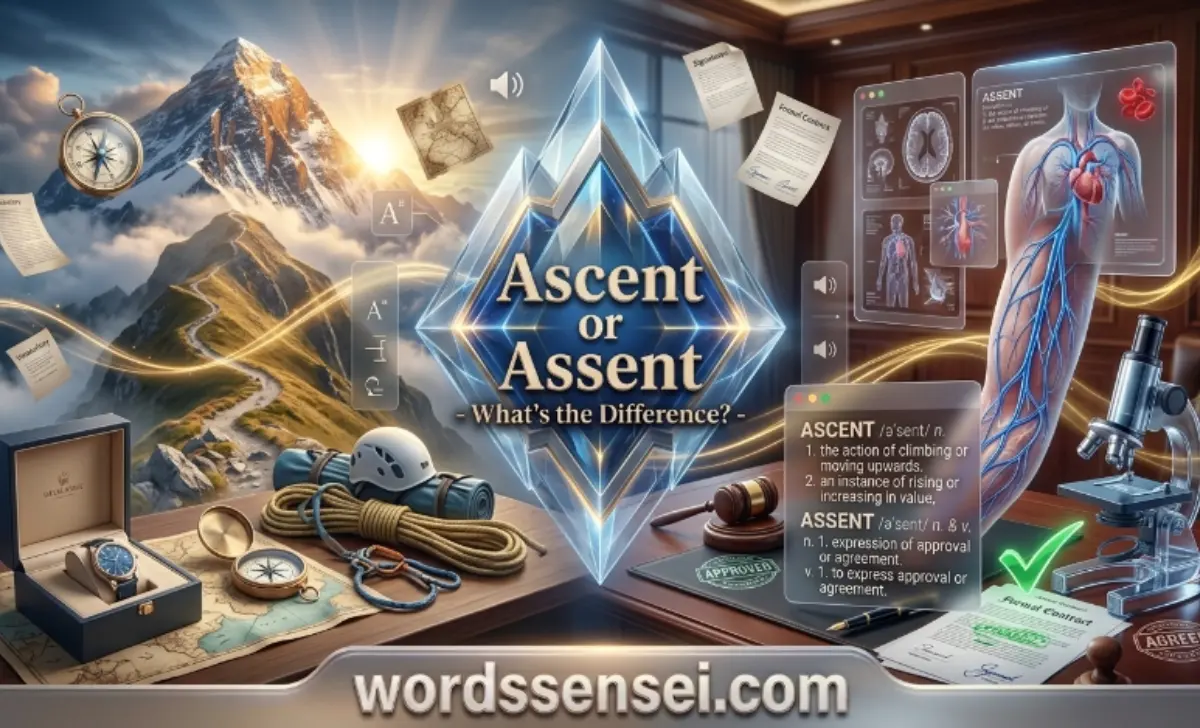
A mountaineer describes her team’s grueling “ascent” to the summit, battling thin air and steep terrain for nearly twelve hours, while in an entirely different setting, a company’s board of directors gives its formal “assent” to a new merger agreement during a routine meeting. Both words sound completely identical when spoken aloud, and both frequently show up in serious, high-stakes writing — outdoor adventure journalism, legal contracts, corporate governance, and constitutional law — yet they describe two entirely unrelated concepts. One is about moving upward, whether literally up a mountain or figuratively up a career ladder.
The other is about agreement, approval, and consent. “Ascent” and “assent” rank consistently among the most cited commonly confused word pairs across major language reference sites, including Merriam-Webster, Grammarly, and Dictionary.com, precisely because the identical pronunciation offers no auditory clue to guide the correct spelling.
What makes this particular pair especially worth understanding carefully is how frequently it appears in formal, professional, and legal writing, where a mistake carries real weight. “Royal assent,” for instance, is a specific constitutional term referring to a monarch’s formal approval of legislation, and swapping in “ascent” would create a genuinely confusing, nonsensical phrase in an otherwise serious legal document. This guide breaks down exactly what each word means, walks through the formal and legal contexts where precision matters most, and offers a memory trick, drawn directly from how major dictionaries themselves teach this distinction, to help you choose correctly every time.
Quick Answer
Ascent is a noun referring to the act of moving or climbing upward, whether literally, as in climbing a mountain, or figuratively, as in rising through the ranks of a career. Assent functions as both a noun and a verb, referring to formal agreement or approval, often used in legal, political, and official contexts.
According to Merriam-Webster, “ascent” means “the act of rising or mounting upward,” with its associated verb being “ascend,” while “assent” functions as both a noun (“an act of agreeing to something”) and a verb (“to agree to or approve of something”). Dictionary.com confirms this same distinction, noting that “ascent” always relates to upward movement, while “assent” indicates agreement or approval, with “dissent” serving as its natural opposite.
A simple way to separate them: if your sentence involves climbing, rising, or moving upward, use ascent. If your sentence involves agreement, approval, or consent, use assent.
Correct Example
- The climbers completed their ascent just before sunset.
- The board gave its unanimous assent to the proposal.
- Her rapid ascent through the company surprised her colleagues.
- He nodded in assent, agreeing to the terms without hesitation.
Incorrect Example
- The climbers completed their assent just before sunset. (Wrong — should be “ascent.”)
- The board gave its unanimous ascent to the proposal. (Wrong — should be “assent.”)
What Does Ascent Mean?
Ascent is a noun describing the act of rising, climbing, or moving in an upward direction, whether that movement is physical, such as climbing a mountain, or figurative, such as rising through professional ranks or social status.
Common Meanings
- Physical Climbing — the literal act of climbing upward, especially associated with mountaineering and hiking.
- Aerospace/Flight Context — the upward path of an aircraft, balloon, or rocket.
- Figurative Rise in Status — describing career advancement, social mobility, or increasing influence.
- Spiritual/Moral Elevation — used in religious or philosophical writing to describe moving closer to a higher state of being.
Simple Usage Examples
- Mountaineering: “The team’s ascent of the mountain took nearly three days.”
- Aviation: “The rocket’s ascent into orbit was flawless.”
- Career: “His ascent to CEO happened faster than anyone expected.”
- Figurative: “The novel traces her ascent from poverty to political power.”
What Does Assent Mean?
Assent functions as both a noun and a verb, referring to formal agreement, approval, or consent, often implying thoughtful consideration rather than simple, casual agreement.
Common Meanings
- Formal Agreement (Noun) — an official act of agreeing to something.
- To Agree (Verb) — typically followed by “to,” as in “assent to a proposal.”
- Legal/Constitutional Context — used in formal governmental and legal processes, such as “royal assent.”
- Nonverbal Agreement — often implied through gestures, such as nodding “in assent.”
Simple Usage Examples
- Formal noun use: “The committee’s assent was required before the plan could proceed.”
- Verb use: “She assented to the terms after careful consideration.”
- Legal context: “The bill received royal assent and officially became law.”
- Nonverbal: “He simply nodded in assent, saving his objections for later.”
Ascent vs. Assent: Comparison Table
| Word | Part of Speech | Core Meaning | Example |
|---|---|---|---|
| Ascent | Noun only | Upward movement or climb | “The plane’s ascent was smooth.” |
| Assent | Noun / Verb | Agreement or approval | “They assented to the plan.” |
Quick Decision Guide
| Your Sentence Involves… | Use |
|---|---|
| Climbing or moving upward | Ascent |
| Rising in rank, status, or career | Ascent |
| Agreeing or approving something | Assent |
| A formal or legal act of consent | Assent |
| A nod or gesture showing agreement | Assent |
Ascent, Assent, and a Third Related Word: Accent
While not a true homophone of the other two, “accent” is frequently grouped alongside “ascent” and “assent” in language reference guides due to its similar spelling and the same “-cent/-sent” ending pattern. “Accent” refers to a distinctive way of pronouncing words, often associated with a particular region, country, or language background.
Quick Comparison
| Word | Meaning | Example |
|---|---|---|
| Accent | A distinctive manner of pronunciation | “She spoke with a slight French accent.” |
| Ascent | Upward movement | “They began their ascent at dawn.” |
| Assent | Agreement or approval | “He gave his assent immediately.” |
Since “accent,” “ascent,” and “assent” share a similar visual pattern despite not sounding identical, keeping their distinct meanings clear alongside one another helps prevent a broader category of related spelling mistakes.
British English vs. American English
Since “ascent” and “assent” are spelled and pronounced identically in both American and British English, this pair doesn’t carry a genuine regional spelling divide. Still, it’s worth examining how the specific legal and formal usage of “assent” differs between the two regions.
Comparison Table
| Feature | American English (US) | British English (UK) |
|---|---|---|
| Spelling of both words | Identical | Identical |
| “Royal assent” | Not applicable (no monarchy) | A specific, actively used constitutional term |
| Legislative approval terminology | “Signed into law” (presidential signature) | “Royal assent” (monarch’s formal approval) |
| “Ascent” in mountaineering writing | Common | Equally common |
| Formal/legal use of “assent” | Common in contracts, less in daily political language | Common in both contracts and constitutional processes |
Why “Royal Assent” Matters Specifically in the UK
“Royal assent” is a uniquely British (and Commonwealth) constitutional term, referring to the formal approval a monarch gives to a bill passed by Parliament before it becomes law. According to UK parliamentary process, this step is now largely ceremonial, since the monarch has not refused royal assent to a bill in centuries, but the term itself remains an active, essential piece of constitutional vocabulary. American English has no direct equivalent term, since the U.S. president’s approval of legislation is simply described as “signing” a bill into law, making “royal assent” a specifically British and Commonwealth phrase worth understanding in its proper context.
The “Climb Has a C” Memory Trick
Multiple major dictionaries, including Merriam-Webster and Vocabulary.com, recommend the exact same memory device for this word pair: remember that “ascent” contains the letter C, just like the word “climb.” Since both “ascent” and “climb” share that same starting sound and letter, linking them together offers a fast, reliable way to recall that “ascent” relates to upward movement. By contrast, “assent” contains a double S, which some guides link to the word “sure,” as in agreeing readily — “sure” and “assent” both beginning with that same agreeable “s” sound.
Ascent in Mountaineering and Adventure Writing
Since “ascent” appears so frequently in outdoor adventure and mountaineering contexts, it’s worth understanding the specific vocabulary that surrounds it in this field.
Types of Ascents
Mountaineers and climbers often distinguish between different categories of ascent based on style and difficulty. A “first ascent” refers to the very first time a particular route or peak has ever been successfully climbed, a term carrying significant historical weight in climbing communities. A “solo ascent” describes a climb completed by a single person without teammates, while an “alpine-style ascent” refers to a lightweight, fast climbing approach without the fixed ropes and established camps used in more traditional expedition climbing.
Ascent Rate in Aviation and Diving
Beyond mountaineering, “ascent” carries specific technical meaning in aviation, where an aircraft’s “rate of ascent” describes how quickly it gains altitude, and in scuba diving, where divers must carefully control their “ascent rate” to avoid decompression sickness, a serious medical condition caused by surfacing too quickly.
Assent in Legal and Political Writing
Just as “ascent” carries specialized meaning in adventure writing, “assent” carries important nuance within legal, political, and contractual contexts.
Assent vs. Signature
In contract law, “assent” often refers to the underlying agreement between parties, sometimes called a “meeting of the minds,” which may or may not require a physical signature depending on the type of agreement involved. A signature typically serves as evidence of assent, but the legal concept of assent itself refers to the actual state of agreement between the parties.
Tacit vs. Express Assent
Legal writing sometimes distinguishes between “express assent,” where agreement is clearly and directly stated, and “tacit assent,” where agreement is implied through conduct or silence rather than explicit statement. Understanding this distinction matters significantly in contract disputes, where the nature of someone’s assent can determine whether a binding agreement actually exists.
Outdoor, Adventure, and Aviation Writing
Use “ascent” consistently when describing mountaineering, hiking, flight paths, or any literal upward movement through physical space.
Legal, Political, and Formal Writing
Use “assent” when describing formal agreement, approval, or consent, especially in contracts, legislative processes, or official correspondence requiring documented approval.
Career and Business Writing
Use “ascent” when describing someone’s rise through a company’s ranks or a general increase in status, influence, or success.
Everyday Conversational Writing
Use “assent” when describing simple agreement in conversation or correspondence, keeping in mind that it carries a slightly more formal tone than casual alternatives like “agree” or “okay.”
Common Mistakes with Ascent and Assent
Frequent Errors
- Writing “assent” when describing physical or figurative upward movement, where “ascent” is correct.
- Writing “ascent” when describing formal agreement or approval, where “assent” is correct.
- Confusing “royal assent” with “royal ascent,” which would incorrectly describe a monarch climbing rather than approving legislation.
- Forgetting that “assent” can function as a verb, while “ascent” functions only as a noun, with “ascend” serving as its verb form.
Corrected Examples
- Incorrect: “The bill received royal ascent before becoming law.”
- Correct: “The bill received royal assent before becoming law.”
- Incorrect: “Her assent through the company ranks was remarkable.”
- Correct: “Her ascent through the company ranks was remarkable.”
Ascent and Assent in Everyday Examples
Emails
“Please provide your written assent to the proposed changes by end of day Friday.”
Social Media
“Watching the hot air balloon’s slow ascent over the valley this morning was breathtaking.”
News Writing
“The legislation is expected to receive royal assent within the coming weeks.”
School Writing
“The essay traces the political leader’s ascent to power throughout the early twentieth century.”
Business Writing
“The merger cannot proceed without the shareholders’ formal assent.”
Why This Keyword Gets Searched
People search “ascent vs assent” mostly while writing formal documents, legal correspondence, or narrative content involving mountaineering or career advancement, and pausing to confirm which spelling fits their sentence. Students and writers researching British constitutional processes search it specifically while trying to understand and correctly spell “royal assent.” Editors and proofreaders search it while catching this exact, frequently cited error during content review. A smaller group searches it purely out of curiosity after encountering both spellings and wanting to understand the distinction clearly.
Related Homophone Confusions
Similar Sound-Alike Word Pairs
- Vain vs. Vein — another classic homophone pair frequently grouped with a third related word.
- Alter vs. Altar — a comparable pair involving a verb-like concept and a formal noun.
- Aisle vs. Isle — another commonly confused pair, often cited alongside ascent/assent in grammar guides.
Helpful Grammar Tips
Whenever you’re unsure whether to use “ascent” or “assent,” apply the trick recommended by major dictionaries themselves: look for the “C” in “ascent” and connect it to “climb,” and look for the double “S” in “assent” and connect it to “sure” or agreement.
FAQs
What is the difference between “ascent” and “assent”?
“Ascent” refers to upward movement or climbing, while “assent” refers to formal agreement or approval.
What does “royal assent” mean?
“Royal assent” is the formal approval a monarch gives to a bill passed by Parliament, making it official law, primarily used in the UK and Commonwealth countries.
What is the opposite of “ascent”?
The opposite of “ascent” is “descent,” referring to downward movement.
What is the opposite of “assent”?
The opposite of “assent” is “dissent,” referring to disagreement or a difference of opinion.
Why do “ascent” and “assent” sound the same?
They are true homophones, sharing identical pronunciation despite having entirely different meanings and no connection in modern usage beyond their coincidental sound.
What’s the difference between “assent” and “consent”?
“Assent” typically implies formal agreement after consideration, often in official or legal contexts, while “consent” more broadly refers to giving permission, often in personal, medical, or legal situations.
Can “ascent” be used as a verb?
No, “ascent” functions only as a noun; its associated verb form is “ascend.”
Can “assent” be used as a verb?
Yes, “assent” functions as both a noun and a verb, as in “she assented to the proposal.”
Conclusion
“Ascent” and “assent” might share an identical sound, but the ideas behind them couldn’t sit further apart — one describing the physical or figurative act of climbing upward, the other describing the formal, often weighty act of agreeing to something. This distinction carries real consequences in the specific contexts where each word tends to appear most: mountaineering and career narratives lean on “ascent,” while legal contracts, corporate approvals, and constitutional processes like “royal assent” depend entirely on “assent” being spelled correctly to make any sense at all.
Relying on the same memory trick major dictionaries themselves recommend — the “C” in “ascent” standing in for “climb,” and the double “S” in “assent” echoing the agreeable sound of “sure” — offers a fast, dependable way to choose correctly every time you reach for either word. Whether you’re describing a mountaineer’s triumphant climb to the summit, a company’s formal approval of a new policy, or a bill’s final step toward becoming law, getting “ascent” and “assent” right keeps your writing precise, professional, and exactly as clear as the moment you’re describing deserves.
Read More Blogs:
- Cuando or Quando? Solving the Language Mix-Up
- Everybodies or Everybody’s? Why One of These Isn’t Even a Word

Hi, I am Anne Seaton, a professional content writer working on wordssensei.com.
I create engaging and SEO-friendly articles that inform, inspire, and connect with readers.