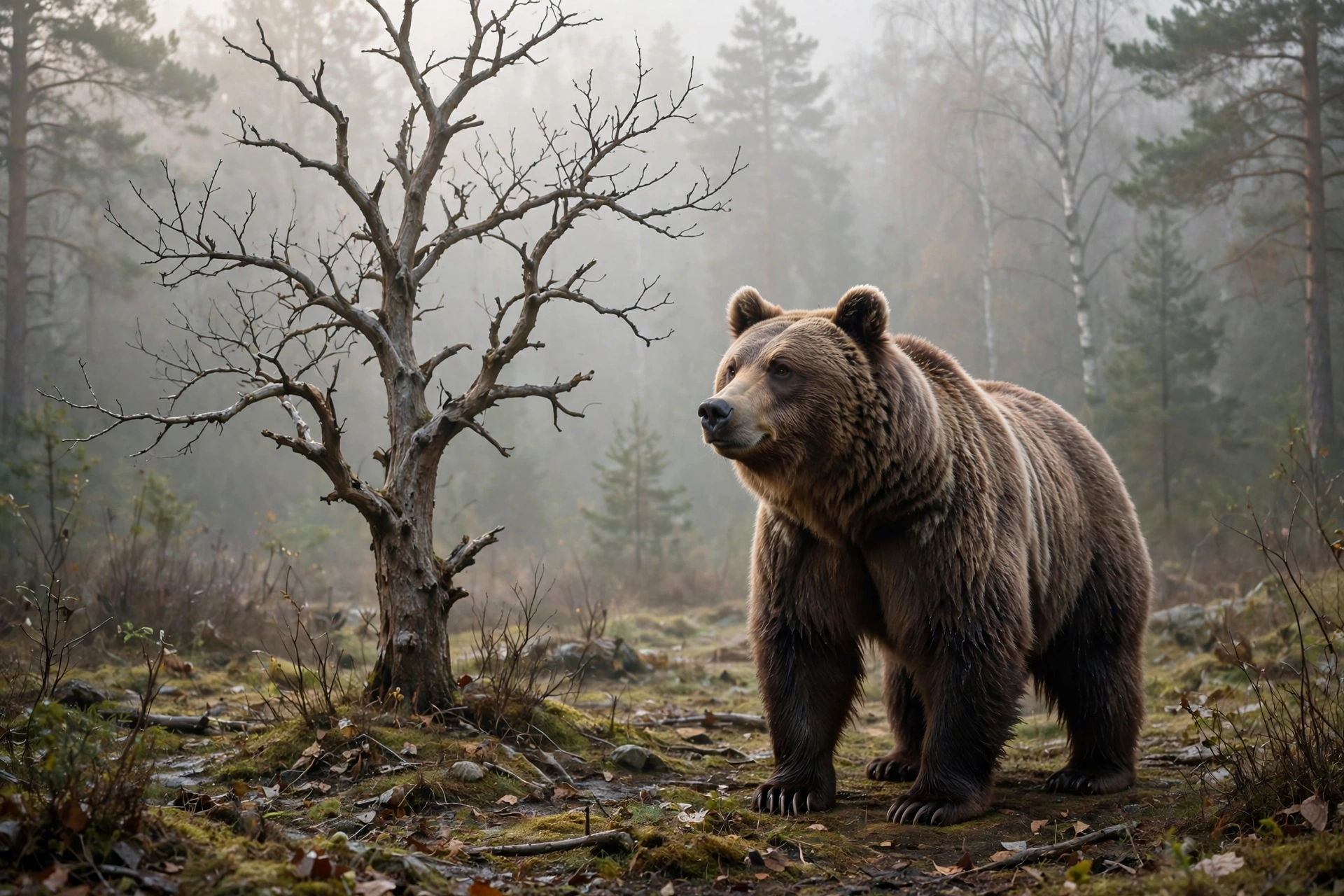
“The hiker walked through the forest with bear arms.” Read that again. Did the hiker have arms like a bear — or arms with no sleeves? The sentence is a classic trap, and it comes from one of English’s most persistent homophone pairs: bare and bear. They sound identical, look almost identical, and mean completely different things. Fortunately, the rule that separates them is one of the simplest in the language.
Bare vs Bear: The Short Answer
“Bare” means uncovered or naked (“bare feet,” “the bare essentials”); “bear” as a verb means to carry, endure, or produce (“bear arms,” “bear the weight,” “bear fruit”) — and as a noun it’s the animal. Merriam-Webster’s one-rule test: as a verb, bare has only one meaning — “to uncover” (“bare your shoulders,” “a dog baring its teeth”). Every other verb use is bear. If your sentence isn’t about uncovering something, it’s bear.
What Do “Bare” and “Bear” Mean?
Bare (adjective) is about absence of covering. Merriam-Webster: “lacking a natural, usual, or appropriate covering” / “lacking clothing” (bare feet); also “open to view: exposed” (laying bare their secrets); “having nothing left over or added” (the bare necessities). As a verb, it has exactly one job — “to uncover”: you bare your soul, a dog bares its teeth, spring bares the branches.
Bear (verb) is the workhorse — carry, support, endure, produce, give birth to. The canonical examples: “bearing children,” “the right to bear arms,” “bearing up under the stress,” “can’t bear the thought,” “it bears repeating.” Bear (noun) is the animal, and Merriam-Webster adds a sharp adjective caution: “‘bear’ is properly a noun and only used like an adjective in the financial phrase bear market. All other uses refer to the state of being uncovered or naked and should therefore be bare: ‘bare necessities,’ ‘bare essentials,’ ‘bare arms,’ ‘bare bones,’ ‘bare-knuckle.'”
So: bare arms = arms with no sleeves. Bear arms = either carrying weapons or having ursine limbs. The hiker sentence at the top is a genuine ambiguity — which is exactly why the rule matters.
This is the same family of confusion as flair or flare — sound-alike words where one letter changes everything — and the triple-homophone drama of rain vs rein vs reign.
The One-Rule Test
Merriam-Webster’s own guidance (“Bare vs. Bear, Things to Bear in Mind”) reduces the whole problem to a single question: does the verb mean “to uncover”? If yes, it’s bare. If no, it’s bear.
Run it on the hard cases:
- “She couldn’t ___ the suspense.” → Not uncovering → bear (“couldn’t bear the suspense” = couldn’t endure it).
- “The committee decided to ___ its findings.” → Uncovering, revealing → bare (“lay bare the findings”).
- “The tree will ___ fruit in spring.” → Producing → bear.
- “He ___ his teeth at the intruder.” → Uncovering the teeth → bare (“baring its teeth” is Merriam-Webster’s own example).
- “___ with me while I explain.” → Endure → bear (“bear with me” — one of the most misspelled phrases in English; “bare with me” is an invitation to undress).
The noun test is even simpler: if you mean the animal, it’s always bear. No exceptions, no tricks.
Common Mistakes to Avoid
“Bare with me.” This is the single most common bare/bear error in professional writing, and it’s an accidental obscenity — “bare with me” asks someone to get naked with you. The phrase is “bear with me”: endure with me, be patient with me. If you’ve typed “bare with me” in a work email, you’re in large company, but fix it.
“Bear essentials” / “bear minimum.” The phrases are “bare essentials” and “bare minimum” — the absolute minimum, stripped of everything extra. Merriam-Webster’s adjective list includes “bare necessities” and “bare essentials” explicitly. A “bear minimum” would be the smallest acceptable bear.
“Bearfoot.” It’s “barefoot” — uncovered feet. This one survives because the compound hides the boundary, but the rule still holds: uncovered → bare.
“The right to bare arms.” Merriam-Webster uses this exact joke to teach the distinction: “the right to bear arms” means the right to carry weapons; “the right to bare arms” would mean the right to wear short sleeves. Both are grammatical — they just mean wildly different things, which is precisely the danger.
The Memory Trick
Two mnemonics, pick the one that sticks. Trick one: bare = bare skin — the word “bare” is inside “barely covered.” If it’s about nakedness or exposure, it’s bare. Trick two (Merriam-Webster’s own): the verb bare has ONE meaning (uncover), while bear has MANY (carry, endure, produce, give birth). One meaning, one letter difference from “bear” — the rarer the use, the shorter the word. Uncover = bare; everything else = bear.
For the animal, no trick needed: if it has fur and claws, it’s a bear, full stop.
Tricky Cases and Edge Notes
“Bear market” vs “bare market.” The financial term is “bear market” — a market that’s mauling downward, named for the animal’s downward swipe. A “bare market” would be an uncovered one. Merriam-Webster explicitly sanctions “bear market” as the one legitimate adjectival use of bear.
“Bear fruit” vs “bare fruit.” Trees bear fruit (produce it). Fruit that is bare is uncovered — peeled, perhaps. “The orchard bears fruit” (correct) vs “the bare fruit on the table” (peeled fruit, also correct, completely different).
“Can’t bear it” vs “can’t bare it.” “I can’t bear this movie” = I can’t endure it. “I can’t bare it” = I can’t uncover it — which is rarely what anyone means.
British vs American? No difference here — bare/bear is spelled and distinguished identically in all major varieties of English. Unlike practice vs practise, where the Atlantic Ocean changes the spelling, this pair is universal.
Frequently Asked Questions
Bare means uncovered or naked (“bare feet,” “the bare minimum”). Bear as a verb means to carry, support, endure, or produce (“bear arms,” “bear the weight,” “bear fruit”); as a noun, it’s the animal. Merriam-Webster’s rule: as a verb, bare means only “to uncover” — every other verb use is bear.
“Bear with me” — it means “be patient with me” (endure with me). “Bare with me” would mean “get naked with me,” which is presumably not the request. This is the most common bare/bear mistake in professional writing.
“Bare minimum” — the absolute minimum, stripped of everything extra. “Bare” here means “having nothing left over or added” (Merriam-Webster). A “bear minimum” would be the smallest acceptable bear.
No. The animal is always “bear.” Merriam-Webster notes that “bear” is properly a noun and is only used adjectivally in the financial phrase “bear market.” Every “uncovered/naked” use is bare: bare arms, bare bones, bare-knuckle, bare essentials.
It means to uncover your teeth in a snarl or grin — a dog baring its teeth is Merriam-Webster’s own example of the verb bare’s single meaning, “to uncover.” Don’t confuse it with “bear,” which as a verb never means to uncover.
No. Unlike some spelling pairs, bare and bear are distinguished identically in American, British, and all other major varieties of English. The one-rule test (uncover = bare, everything else = bear) works everywhere.