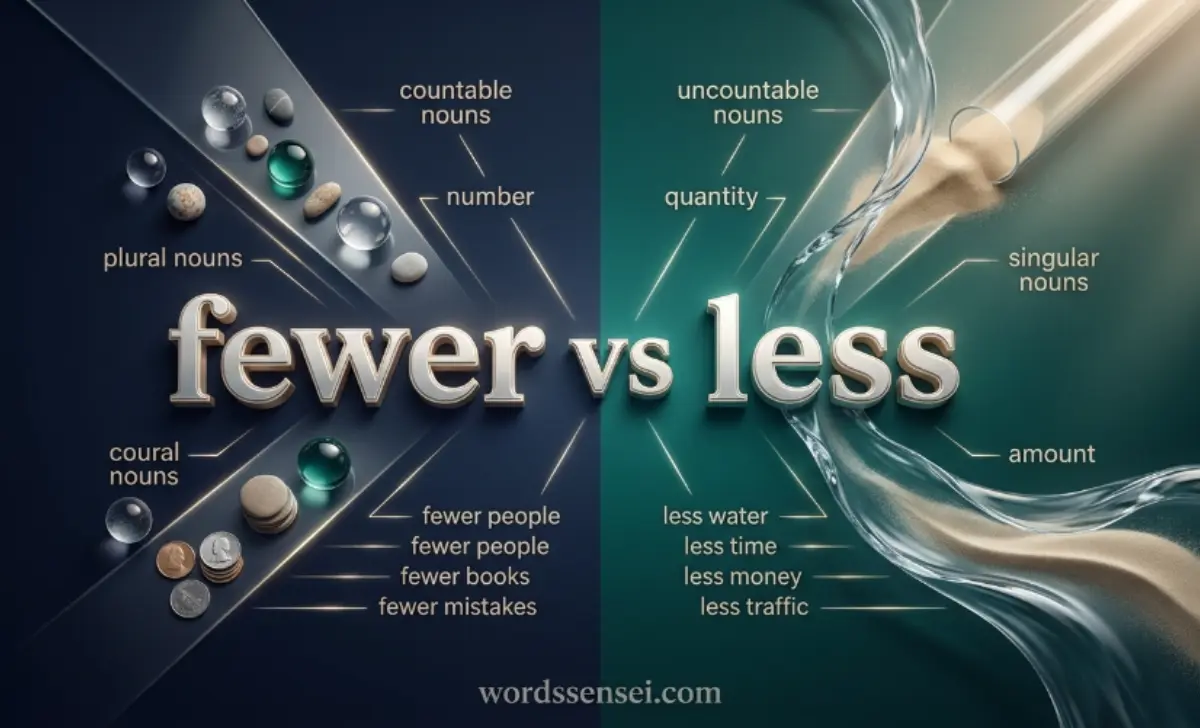
Have you ever stopped at a sentence and wondered, “Should I use fewer or less?” You are not alone.
These two words both show a smaller quantity, but they work with different types of nouns. The basic rule is simple: use fewer with plural countable nouns and less with uncountable nouns.
So, you have fewer books but less time. However, phrases involving time, money, measurements, and numbers can make the rule feel confusing.
This guide explains fewer vs less with clear rules, real-life examples, common mistakes, and quick tips you can remember.
Quick Answer
The easiest rule is this:
- Fewer is normally used with plural countable nouns.
- Less is normally used with uncountable nouns.
A countable noun is something you can count as separate units. For example, you can have three books, five people, or ten questions.
An uncountable noun describes something that is usually treated as a whole amount. Examples include time, money, water, information, advice, traffic, and work.
| Word | Use it with | Example |
|---|---|---|
| Fewer | Plural countable nouns | Fewer people came today. |
| Less | Uncountable nouns | I have less time today. |
This rule is also reflected in standard English grammar guidance: fewer normally goes with plural nouns, while less normally goes with uncountable nouns.
Correct Example
There are fewer students in the class today.
“Students” refers to separate people, so they can be counted: one student, two students, three students, and so on.
Another example is:
I made fewer mistakes this time.
You can count the mistakes, so fewer is the natural choice.
Incorrect Example
I have fewer time today.
This is incorrect in standard usage because time is normally uncountable.
The better sentence is:
I have less time today.
Likewise:
- Less money
- Less information
- Less traffic
- Less water
- Less advice
What Does Fewer vs Less Mean?
Both fewer and less express a smaller quantity. They are comparative words, but the noun that follows them usually determines which word you need.
Common Meanings
Fewer means a smaller number of people or things that can be counted.
Examples:
- Fewer cars are on the road.
- Fewer employees work on Fridays.
- Fewer questions appeared on the test.
- Fewer customers visited the store.
- Fewer emails arrived this morning.
Less means a smaller amount or degree of something that is not normally counted as separate units.
Examples:
- I need less water.
- She has less patience today.
- We spent less money.
- He has less free time.
- There is less traffic after midnight.
Cambridge describes less as referring to a smaller amount or degree and fewer as the comparative form used with plural nouns.
Simple Usage Examples
Think about your normal day.
You might say:
I have fewer meetings this week.
You can count the meetings.
But you would say:
I have less work this week.
You usually treat “work” as an amount rather than separate pieces.
The same idea works here:
- Fewer exercises
- Less exercise
- Fewer people
- Less noise
- Fewer days
- Less time
- Fewer dollars
- Less money
- Fewer mistakes
- Less stress
This quick test can help:
Can I count the noun as separate things? Use fewer. Can I measure or describe it as an amount? Use less.
The Origin of Fewer and Less
The difference between these words is not a modern invention. Both have very old roots in English.
Word History
Few comes from Old English feawe, meaning “not many” or “a small number.” It traces further back to the Proto-Germanic language family. Fewer developed as the comparative form associated with this idea of a small number.
Less comes from Old English forms such as læs and læssa, with meanings connected to “less,” “smaller,” or “fewer.” It also has Proto-Germanic roots.
Today, the words have clear grammatical roles:
- Few → fewer → fewest
- Little → less → least
So, fewer connects with few, while less connects with little.
Why the Confusion Happens
The confusion is understandable because both words can describe a reduction.
Compare:
I have fewer books.
I have less time.
In both sentences, the amount has gone down. The difference is the noun.
“Books” are separate countable objects.
“Time” is normally treated as an uncountable amount.
That small distinction causes many everyday mistakes.
British English vs American English
There is no simple British-versus-American spelling difference between fewer and less. Both varieties use both words.
The main issue is grammar and everyday usage.
Comparison Table
| Usage | Standard choice | Example |
|---|---|---|
| Plural countable noun | Fewer | Fewer people arrived. |
| Uncountable noun | Less | Less traffic was expected. |
| Countable items | Fewer | Fewer than 10 items |
| Uncountable amount | Less | Less than $10 |
| Time as an amount | Less | Less than two weeks |
| Separate days | Fewer | Fewer days |
| Money as an amount | Less | Less money |
| People as individuals | Fewer | Fewer people |
Many English speakers do use less with plural countable nouns in informal speech. However, traditional and formal grammar generally prefers fewer in those cases, especially in careful writing and exams.
Fewer vs Less in Numbers, Time, and Measurements
This is where many otherwise careful writers get confused.
Less Than 2 Weeks or Fewer Than 2 Weeks?
Both can appear depending on what you mean.
If you mean a period of time, less than two weeks is natural:
The project will take less than two weeks.
Here, “two weeks” describes one amount of time.
But if you are counting separate weeks as units, fewer can be appropriate:
The course has fewer than two weeks of scheduled classes remaining.
The first sentence focuses on duration. The second focuses more directly on the number of weeks.
Fewer Days or Less Days?
Use fewer days when “days” means separate countable units.
We need fewer days to finish the project.
The trip will take fewer days than expected.
“Less days” is generally not the best choice when you are directly counting days.
However, less can work when the phrase describes a broader amount or duration:
It took less than five days.
This is one reason phrases involving measurements need context.
Is Time Less or Fewer?
Usually, less time is correct.
Examples:
- I need less time.
- She spends less time online.
- We have less time to finish.
- The new system saves time and requires less time to manage.
Time is normally an uncountable noun when it means duration.
However, when you count separate occasions or units, fewer may apply:
We had fewer times when the system failed.
Here, “times” means separate occasions.
Is It 10 or Less or 10 or Fewer?
When talking about countable items, 10 or fewer is the traditional grammatical choice:
Please answer 10 or fewer questions.
Bring 10 or fewer items.
The group must have 10 or fewer members.
You will also see 10 or less, especially in signs, advertising, and everyday speech. It is widely understood, but 10 or fewer is the safer choice when you want formal, precise grammar.
Fewer vs Less vs Few vs Little
These words are connected, but they are not interchangeable.
Fewer vs Few
Few describes a small number.
Fewer compares one number with another.
- Few people attended.
- Fewer people attended this year than last year.
The same pattern applies to countable nouns:
- Few mistakes
- Fewer mistakes
- Few students
- Fewer students
- Few questions
- Fewer questions
There is also an important difference between few and a few.
Few often suggests that the number is very small or not enough.
A few simply means some.
For example:
I have few options.
This suggests that my options are limited.
I have a few options.
This simply tells you that I have some options.
Less vs Little
Little and less normally work with uncountable nouns.
- Little money
- Less money
- Little time
- Less time
- Little information
- Less information
Again, the difference is often about comparison.
I have little money.
This means I have not much money.
I have less money than I had last month.
This compares two amounts.
So remember:
few → fewer → fewest
little → less → least
Less Money or Fewer Money?
The correct standard phrase is:
less money
Money is treated as an uncountable amount.
Examples:
- I need less money for this trip.
- She spends less money on clothes.
- We have less money available this month.
Do not normally say:
fewer money
If you want to count money as separate units, change the noun:
fewer dollars
fewer coins
fewer bills
That gives you a useful trick:
Less money, but fewer dollars.
Less People or Fewer People?
The traditional standard choice is:
fewer people
Example:
Fewer people attended the meeting this morning.
“People” refers to individual people, so it is treated as a plural countable noun.
You may hear less people in casual speech, and it is common enough to appear in everyday English. Still, fewer people is the safer choice for formal writing, academic work, exams, and professional communication.
Is “Much Fewer” Correct?
Yes.
Much fewer is correct when fewer modifies a plural countable noun and you want to emphasize the size of the difference.
Examples:
- Much fewer people attended this year.
- We made much fewer mistakes.
- The new process caused much fewer problems.
- There were much fewer complaints after the change.
You can also use:
far fewer
many fewer
For example:
The new system has far fewer errors.
Do not use much fewer with an uncountable noun. For that, use much less:
We have much less time.
She spends much less money now.
Fewer vs Less in Everyday Examples
The best way to learn the rule is to see it in real situations.
Emails
Correct:
We received fewer emails this week.
Correct:
I have less time to review the documents today.
The first sentence counts emails. The second describes an amount of time.
Social Media
Correct:
I want to spend less time on social media.
Correct:
I follow fewer accounts now.
“Time” is an amount, while “accounts” are countable.
News Writing
Correct:
Fewer people visited the area after the storm.
Correct:
The city reported less traffic during the morning.
News writing often uses both forms in the same paragraph because the nouns determine the choice.
School Writing
Correct:
Students made fewer spelling mistakes on the second test.
Correct:
The second test required less preparation time.
This is a useful example for students because it shows the rule clearly.
Business Writing
Correct:
The company received fewer complaints this quarter.
Correct:
The new process requires less paperwork.
“Complaints” can be counted. “Paperwork” is treated as an uncountable amount.
Common Mistakes with Fewer vs Less
Frequent Errors
Here are some common mistakes to watch for:
| Incorrect or less-preferred | Better choice |
|---|---|
| Less people came. | Fewer people came. |
| Fewer money was spent. | Less money was spent. |
| Fewer time is needed. | Less time is needed. |
| Less questions were asked. | Fewer questions were asked. |
| Fewer information was available. | Less information was available. |
| Less mistakes were made. | Fewer mistakes were made. |
| Fewer traffic was reported. | Less traffic was reported. |
The pattern is clear: plural countable nouns usually take fewer, while uncountable nouns usually take less.
Corrected Examples
Wrong: We have less employees this year.
Better: We have fewer employees this year.
Wrong: She needs fewer advice.
Better: She needs less advice.
Wrong: There was fewer traffic today.
Better: There was less traffic today.
Wrong: I made less errors this time.
Better: I made fewer errors this time.
Fewer and Less with “Of”
Sometimes of is needed.
Use fewer of with plural nouns, pronouns, or noun phrases:
Fewer of the students passed the test.
Fewer of them arrived on time.
Use less of with singular uncountable nouns:
Less of the water was used.
I want less of the cake.
This structure is different from simply placing the word before a noun. Cambridge specifically notes the use of of before articles, demonstratives, possessives, and pronouns.
Fewer vs Less: The Easy Memory Trick
If you forget the rule, ask one question:
Can I count it?
If yes, use fewer for plural nouns.
- Fewer books
- Fewer people
- Fewer cars
- Fewer questions
- Fewer mistakes
If no, use less.
- Less time
- Less money
- Less water
- Less information
- Less traffic
A second trick is even shorter:
Number → fewer
Amount → less
There are some special cases, especially measurements and fixed expressions, but this rule works for most everyday sentences.
Fewer vs Less: Google Search Interest and Usage
People search for this topic because the difference is small but appears constantly in everyday English.
Popular English-Learning Markets
Questions about fewer vs less are especially useful for learners and writers working with English in:
- United States
- United Kingdom
- Canada
- Australia
- India
The topic is relevant across these markets because English learners regularly encounter both forms in school, work, media, and online writing.
Why People Search This Keyword
Common search questions include:
- Fewer vs less examples
- Fewer vs less people
- Fewer vs less exercises
- Fewer vs less worksheet
- Fewer vs less quiz
- Fewer vs less grammar examples
- Is it less people or fewer people?
- Is it less than 5 or fewer than 5?
- Is it 10 or less or 10 or fewer?
- Is it 3 or less or 3 or fewer?
- Is time less or fewer?
- Is it much fewer?
- Is it less money or fewer money?
These searches show that people usually do not need a complicated grammar lesson. They want to know which word sounds correct in a specific sentence.
Related Grammar Rules
Similar Usage Patterns
The same countable-versus-uncountable idea appears with other quantifiers.
| Countable | Uncountable |
|---|---|
| Many people | Much money |
| Few questions | Little information |
| A few books | A little time |
| Fewer mistakes | Less stress |
| Few employees | Little patience |
| Fewer cars | Less traffic |
Many normally refers to a large number of countable things, while much is associated with uncountable amounts.
Helpful Grammar Tips
Remember these pairs:
- Many people → fewer people
- Much money → less money
- Many questions → fewer questions
- Much time → less time
- Many cars → fewer cars
- Much traffic → less traffic
Also remember that more works with both countable and uncountable nouns:
- More books
- More people
- More money
- More time
So the basic comparison is:
Countable: more → fewer → fewest
Uncountable: more → less → least
FAQs
Is it fewer people or less people?
Fewer people is the standard choice because “people” refers to individual, countable persons. “Less people” is common in informal speech, but fewer is safer in formal writing.
Is it less than 2 weeks or fewer than 2 weeks?
Less than two weeks is natural when you mean a period or amount of time. Use fewer when you are clearly counting separate weeks as units.
Is it fewer days or less days?
Use fewer days when you are counting days as separate units. For example, “The project needs fewer days than expected.”
Is it less money or fewer money?
Use less money. Money is normally uncountable. If you count the units, say fewer dollars, fewer coins, or fewer bills.
Is it 10 or less or 10 or fewer?
For countable items, 10 or fewer is the traditional formal choice. For example, “Bring 10 or fewer items.”
Is it 3 or less or 3 or fewer?
When the number refers to countable things, 3 or fewer is the safer formal choice. For example, “Choose 3 or fewer answers.”
Is time less or fewer?
Usually, less time is correct because time is normally an uncountable amount. However, fewer can be used when “times” means separate occasions.
Is it correct to say “much fewer”?
Yes. Much fewer is correct with plural countable nouns. For example, “Much fewer people attended the event.” With an uncountable noun, use much less, as in “much less time.”
What does fewer mean?
Fewer means a smaller number of people or things that can be counted. For example, “There are fewer cars on the road today.”
Is “little money” correct?
Yes. Little money is grammatically correct and means not much money. For example, “He has little money left.” Less money is used when comparing amounts.
Is it correct to say “3 people” or “3 persons”?
Three people is the normal choice in everyday English. Persons is more formal and appears in some legal, official, or specific contexts.
Conclusion
The simplest way to remember fewer vs less is to focus on the noun. Use fewer with plural countable nouns, such as people, books, questions, and mistakes.
Use less with uncountable nouns, such as time, money, water, information, and traffic. So write “fewer people,” but “less money.”
For numbers and measurements, check whether you are counting separate units or describing one amount.
When in doubt, ask: Can I count it? If you can, choose fewer; if not, choose less.
Read More Blogs:
- Plus or Minus Symbol (±): Complete Guide to Meaning and Usage
- Mayfield or Love: Which Spelling Is Correct? Find Out Fast
- Emperor or Orpheus: What’s the Difference?
- Jamaica or Bahamas: Which Caribbean Escape Is Better?

Hi, I am Anne Seaton. I am a writer and educator working with Wordssensei.com to help students learn English easily.