They look almost identical on the page, they sound exactly the same, and they cause some of the most common mistakes in English writing: “peace” and “piece.” One means calm or the end of war, the other means a part of something — and once you know the simple pie mnemonic, you will never confuse peace and piece again.
Peace vs Piece: The Short Answer
“Peace” is a noun meaning the absence of war or conflict, or a state of calm — think “a wish for world peace,” “looking for some peace and quiet,” or “peace of mind” (Merriam-Webster’s Most Commonly Confused Words). “Piece” is a noun (and sometimes a verb) meaning a part, amount, or type of something — as in “a piece of pie” — and as a verb it usually appears with “together,” as in “piecing together scraps for the quilt.” Peace is always about calm or harmony; piece is always about parts.
What Does “Peace” Mean?
“Peace” is a noun with several related meanings, all of them circling the idea of calm or the end of conflict. Merriam-Webster lists the core senses: the end of war or fighting (a treaty that finally brought peace), a state of personal calm (“peace of mind,” “rest in peace”), and the absence of disturbance (“a little peace and quiet”). The word also appears in fixed phrases: “hold your peace” (stay silent — the wedding-ceremony line “speak now or forever hold your peace”), and “make peace with” (come to accept something or reconcile with someone). Every sense of peace has to do with stillness, harmony, or the stopping of conflict. Nothing about peace is ever about parts.
What Does “Piece” Mean?
“Piece” is most commonly a noun meaning a part, portion, amount, or type of something. Merriam-Webster’s example is deliciously convenient: “a piece of pie.” You also see it in “a piece of furniture” (a single item within a category), “a piece of cake” (something easy — an idiom with its own story), and “a piece of the action” (a share of something valuable). Less commonly, “piece” is a verb, and when it is, it almost always appears with the word “together”: “piecing together scraps for the quilt,” “piecing together the clues,” “the detectives pieced the story together.” That pairing is a useful tell — if you see “piece” near “together,” you’re almost certainly looking at the verb. Peace never takes “together” after it.
The Pie Mnemonic: Never Mix Them Up Again
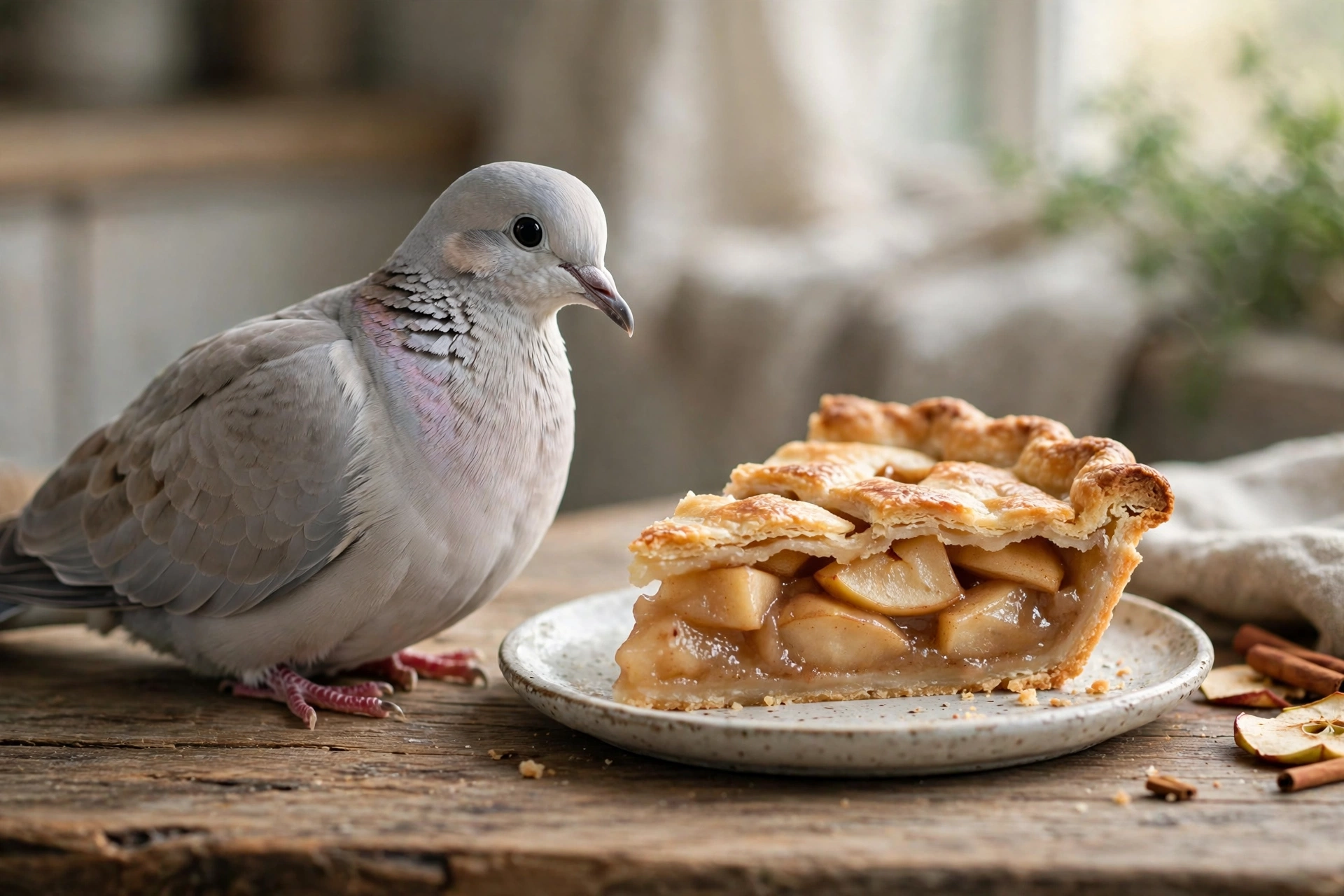
Here is the memory hook that makes this pair stick for good. The word “piece” shares its first three letters with the word “pie”: P-I-E. And what is a piece of pie? Exactly the meaning of “piece” — a part of something. So when you’re deciding which spelling to use, ask yourself: can I connect it to pie? If the sentence is about a part or portion, the spelling with “pie” in it is the right one. A piece of pie. A piece of cake. Piece together the evidence.
“Peace,” on the other hand, is the spelling without pie — and pie has nothing to do with calm. No one ever served peace at a dinner table. The absence of the pie letters matches the absence of parts in the meaning: peace is wholeness, stillness, the opposite of being in pieces. Some learners prefer the dove test instead: if a dove or an olive branch would feel at home in the sentence, it’s peace. Either mnemonic works — the pie version just happens to be the stickiest.
“Say One’s Piece” vs “Hold Your Peace”
This pair of idioms is where even confident writers stumble, so learn them as a matched set. “Say one’s piece” means to speak one’s mind — to give your opinion on a matter. The noun here is “piece” in the sense of a part: you’re contributing your part, your share of the conversation. “The board member said her piece and sat down.”
“Hold your peace” means to keep quiet — the opposite. It’s the wedding vow formula (“speak now or forever hold your peace”) and the sense Merriam-Webster cites for the noun: a state of calm, silence. Here is the twist that confuses everyone: the two idioms use different spellings because they mean different things. You “say your piece” (your portion of the talk) but “hold your peace” (your calm, your silence). Mixing them produces sentences that say the reverse of what you intend.
One more honest note for learners: you will increasingly see “say one’s peace” with the calm-spelling in the wild. That eggcorn — substituting “peace” where “piece” belongs — has become widespread among younger speakers, and language observers have noted it for years. It is still non-standard in edited English, though, and in exams, job applications, and published writing, “say one’s piece” is the correct form. If you want your own usage flagged in the same family of confusions, the passed vs past guide covers a spelling pair where one wrong letter changes the word entirely — the same careful-spelling muscle applies here.
Peace vs Piece: Common Mistakes
The classic swap sentences are worth seeing corrected once so your eye learns the pattern. “World piece” is wrong; “world peace” is right — the planet is not a slice of anything. “A piece of mind” is wrong; “peace of mind” is right — tranquility is not a portion. “Rest in piece” is a common typo on sympathy messages; “rest in peace” is correct — and getting this one wrong in a condolence note is the most embarrassing version of the error.
The tricky one is “give me a piece of your mind” — this is correct with “piece,” because the idiom means “a portion of what you’re thinking,” usually a scolding. The logic is identical to “say one’s piece”: it’s your part, your share. A good check: if you could replace the word with “part” and the sentence still makes sense, you need “piece.” If you could replace it with “calm” or “quiet,” you need “peace.” That single substitution test resolves nearly every instance.
Quick Memory Tricks
Beyond the pie mnemonic, a few more aids will lock this pair down. First, “peace” has the word “pea” in it — peas are small, calm, garden-quiet things, nothing violent about them. It’s a stretch, but stretches stick. Second, “piece” has an “ie” pair like “pie” has an “ie” pair — same vowel team, same spelling family. Third, think of the grammar: “piece” can follow “a” as a countable noun (“a piece of paper”), while “peace” rarely takes “a” in its calm sense (you don’t say “a peace of mind”). Finally, remember that “piece” is the only one of the two that can be a verb — “peace” never takes an -ing form, but people routinely “piece together” puzzles, plans, and evidence. If the word is doing something to other words, it’s “piece.”
If spelling pairs like this one interest you — and they should, because they’re high-frequency in tests — the flout vs flaunt guide covers another lookalike where one wrong letter changes everything, and the advice or advise article tackles the noun/verb spelling split that trips learners the same way.
Frequently Asked Questions
“Peace” means the absence of war or conflict, or a state of calm — “world peace,” “peace of mind,” “peace and quiet.” “Piece” means a part, portion, or amount of something — “a piece of pie,” “a piece of paper.” The pie mnemonic makes it stick: “piece” shares its first three letters with “pie,” and both are about parts.
The standard form is “say your piece” — you’re speaking your part, your share of the opinion. “Hold your peace,” with the calm-spelling, means the opposite: stay silent. The eggcorn “say one’s peace” is widespread among younger speakers, but it remains non-standard in edited English.
Use the pie mnemonic: “piece” = “pie” plus extra letters, and both are about parts. If the sentence is about a part or portion, you want the pie spelling. If it’s about calm or the end of conflict, you want “peace.” The substitution test also works: replace the word with “part” (piece) or “calm” (peace) and see which one fits.
No. The correct phrase is “peace of mind,” meaning mental calm and freedom from worry. “A piece of mind” would literally mean a slice of someone’s brain — one of the most common and most amusing versions of this confusion.
Yes. “Piece” is a verb meaning to assemble or join parts, and it almost always appears with “together”: “piecing together the evidence,” “pieced together from scraps.” “Peace” is never a verb — you can’t “peace together” anything.
“Rest in peace” is correct — it’s the traditional phrase wishing calm for the departed. “Rest in piece” is a typo worth catching before it goes into a condolence message, where it would read as flippant at exactly the wrong moment.