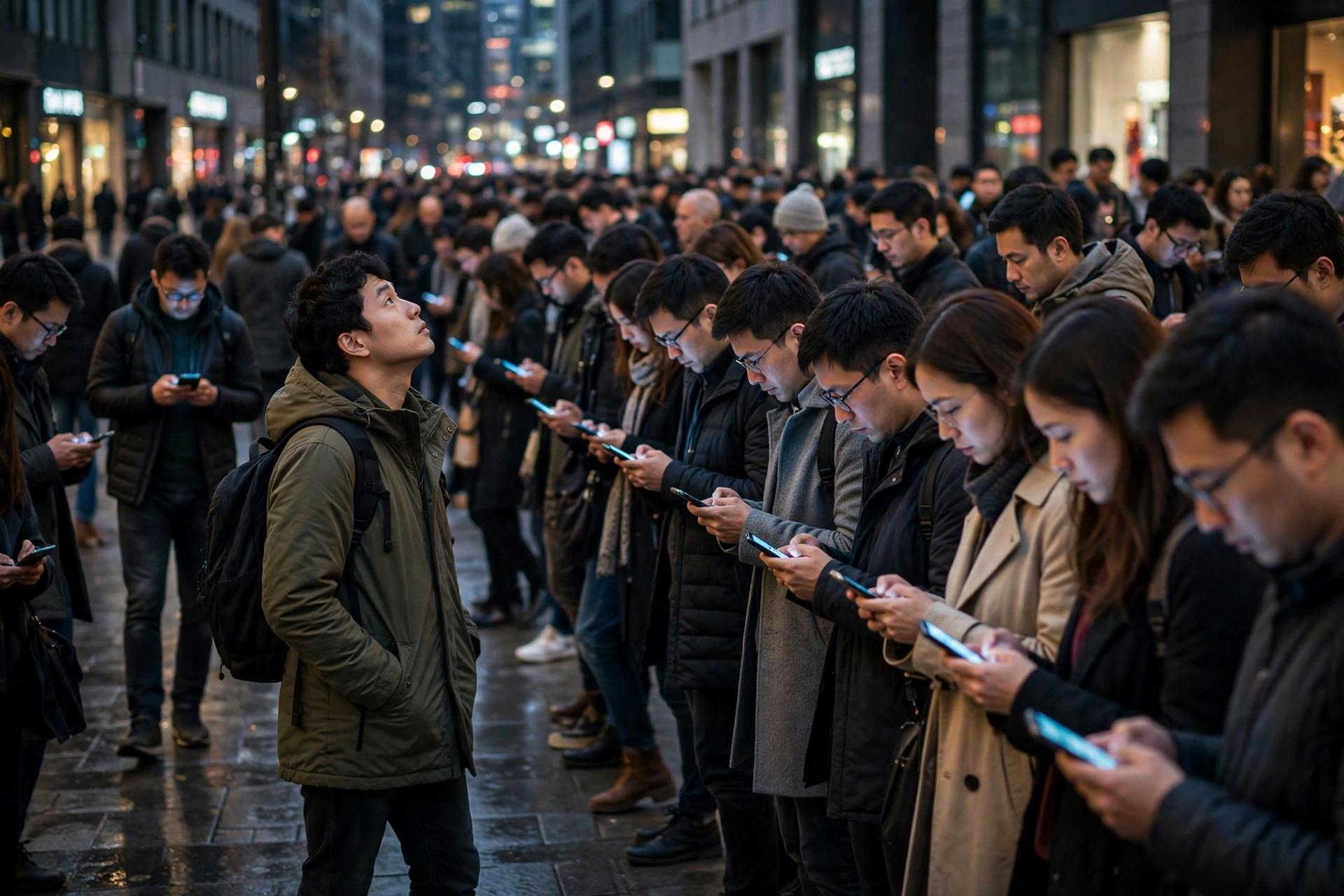
Every morning he lines up at the same coffee spot, orders the same drink, walks the same route, and recites the same two opinions he has heard a hundred times. Scroll through a certain corner of the internet and someone will call him an NPC — a non-player character, a background figure in someone else’s game. It is one of the most recognizable insults of the social-media era, but here is the part learners need to know first: calling a real person an NPC is genuinely insulting, not a compliment.
NPC: The Short Answer
Wiktionary defines NPC as an initialism of non-player character — a character in a video game not controlled by the player — and, in internet slang, figuratively “a person with no ability to think for themselves; a sheeple,” with that figurative sense dated to 2016. In gaming, NPCs are the shopkeepers, quest-givers, and background pedestrians who exist to fill the world while you play the hero. As an insult, it suggests someone who behaves predictably, blandly, or repetitively, as though they are simply following a script.
What Does “NPC” Mean?
Start with the literal sense, because it carries the whole metaphor. In a role-playing or open-world video game, most of the people on screen are not being played by anyone — they are NPCs, characters run by the game’s code. They stand behind counters, repeat the same dialogue lines, and walk the same loops forever. The player is the protagonist; everyone else is scenery.
The internet slang keeps that picture and aims it at real people. To call someone an NPC is to imply they are “unable to think objectively” (Capital FM’s TikTok slang guide) — someone who repeats talking points they heard elsewhere, follows trends without reflection, and behaves like scripted dialogue on a loop. Teen-slang guides describe it as behavior that is “predictably, blandly, repetitively” scripted.
It also appears as a mood or aesthetic rather than a label. “NPC energy” means acting like a background character. “We are all NPCs in this economy” is self-deprecating gallows humor about feeling powerless. And on TikTok, “NPC streamers” became a whole genre: creators performing repetitive, robotic reactions to viewers’ digital gifts — literally acting like game characters, on purpose, for entertainment.
The Origin of the NPC Meme
The word’s slang life began on 4chan in July 2016, where the NPC image — a grey, featureless cartoon face — was used as a political jab implying that opponents could not think for themselves (this history is documented in Wikipedia’s dedicated “NPC (meme)” article). The meme broke into the mainstream in October 2018, drawing coverage from The New York Times, The Verge, and the BBC. The political use is part of the term’s baggage, worth knowing but not worth repeating: the meme’s function was always to dehumanize the other side.
A second wave arrived in 2022 on TikTok, where “NPC Streamer” content — creators frozen in stiff, looping poses, reacting to tips with canned lines — turned the concept into performance. That wave made NPC vocabulary familiar to people who had never set foot on 4chan and never played a role-playing game. The slang is now established enough that Cambridge Dictionary is cited in TikTok explainers for the underlying term “non-playable character.”
How to Use “NPC”
The grammar is straightforward. NPC is a noun (“He acted like an NPC”), pluralized as NPCs (“a room full of NPCs”), and frequently used as an adjective-like modifier (“NPC energy,” “an NPC take,” “NPC behavior”).
- “Everyone in the comments is just repeating the same NPC talking points.”
- “The meeting was all NPCs nodding along to the presentation.”
- “She walked through the party like an NPC, same script every time.”
- “That’s peak NPC energy — did he even watch the video?”
Notice where it sits: at the start of a sentence for emphasis, or attached to another noun as a modifier. It is almost never affectionate toward the target. Even “I’m such an NPC today” is self-mockery, not pride — the joke is that the word stings.
An Important Caveat: It Is an Insult
Here is the part that matters most for learners. Wiktionary’s figurative sense — “a person with no ability to think for themselves; a sheeple” — is derogatory. The companion dictionary entry for “non-player character” explicitly marks this internet sense as derogatory, and it should be treated that way.
The harm is literal, not abstract. An NPC is a character without agency, without an inner life, without a point of view. Aiming that word at a real person denies their personhood — it says “you do not really think.” Among friends who game together, it can be playful: two players joking that they are both just NPCs in each other’s stories is a shared bit. Aimed at a stranger, a coworker, or a group of people with opinions you dislike, it is dehumanizing, full stop.
For learners, the practical rule is simple: understand the word, recognize it when you see it, but do not deploy it against people. Reading comprehension, yes; usage, almost never.
NPC in the Bigger Internet-Slang Picture
NPC belongs to a cluster of terms that all orbit the same anxiety: what the screen does to the mind. If you have been reading about compulsive scrolling, brain rot covers the content side of that same screen-time culture — the sludge that allegedly fries your attention — while NPC describes the person it supposedly produces. The two terms often appear together in “the internet is making us all NPCs” doom-posting.
It also runs alongside skibidi in the absurdist-slang wave of the 2020s — both born from meme culture, both incomprehensible to outsiders, both functioning partly as generational passwords. And in usage, NPC frequently collides with truth-claim slang: an “NPC take” is often followed by someone saying no cap about their own supposedly independent opinion. Learning these terms together gives you the full map of how internet arguments sound in 2026.
Why Did the NPC Meme Catch On?
The metaphor is unusually visual and complete. Everyone who has played a video game has watched an NPC loop the same three sentences, and the image transfers instantly to real-life repetition — the coworker with the same complaints, the comment section with the same takes. It compresses a complex accusation (you are not thinking for yourself) into three letters.
There is also a genuine fear underneath the joke. The NPC insult works because many people quietly worry it might be true of them — that their opinions are borrowed, their routines are loops, their personality is downloaded content. The TikTok NPC streamers literalized that fear as comedy, and comedy is how slang survives. A term that was born as a political weapon in 2016 became a performance genre by 2022 because the core image — the human reduced to a script — is flexible enough to mean many things and sharp enough to sting every time.
Frequently Asked Questions
In internet slang, NPC (non-player character) is used figuratively for a person who seems unable to think for themselves — someone who behaves predictably, repetitively, or as if following a script. Wiktionary dates this figurative sense to 2016. It is a derogatory term, not a neutral description.
It originated on 4chan in July 2016 as a political insult, using a grey cartoon face to imply opponents could not think independently. It surged into mainstream attention in October 2018 with coverage from The New York Times, The Verge, and the BBC, and had a second wave on TikTok in 2022 with “NPC Streamer” performance content.
Yes. The figurative dictionary sense is marked derogatory: it denies the person’s agency and inner life. Among close friends who share gaming culture it can be playful self-mockery, but aimed at strangers or people you disagree with, it is dehumanizing. Learners should recognize it without using it against others.
An NPC streamer is a TikTok live creator who performs as a game character — striking stiff poses, repeating canned lines, and reacting robotically to viewers’ digital gifts. The genre became popular in 2022 and turned the NPC concept into intentional performance comedy.
NPC stands for “non-player character” (sometimes “non-playable character”) — a character in a video game controlled by the game’s code rather than by a human player. Shopkeepers, quest-givers, and background pedestrians are classic NPCs.
No. It is informal internet slang with a derogatory edge. In school essays, workplace communication, or any formal context, use neutral alternatives like “conformist,” “unoriginal thinker,” or describe the specific behavior you mean.