Telling someone to “break a leg” sounds like a threat — but in the theater world, it’s the warmest thing you can say. “Break a leg” means good luck, especially before a performance, and actors have been saying it instead of “good luck” for the better part of a century. Here’s the real meaning, the honest truth about its mysterious origin, and how to use it without sounding like you wandered in from another century.
Break a Leg: The Short Answer
“Break a leg” is an idiom used to wish good luck, especially to a performer (Merriam-Webster). Merriam-Webster dates the first known use to 1949, though theatrical use goes back further — a Variety citation places it in theater circles by August 1929. You say it before performances, auditions, and presentations: anywhere someone is about to step in front of an audience and needs luck they can’t control.
What Does “Break a Leg” Mean?
The meaning is simple and fixed: it’s a good-luck wish. “Break a leg tonight!” before a school play, an audition, a concert, or a conference talk all mean exactly the same thing — “I hope it goes well.” Merriam-Webster defines it plainly: “used to wish good luck especially to a performer.” Collins corroborates with the same sense: “good luck! (said as to a performer, esp. in the theater).”
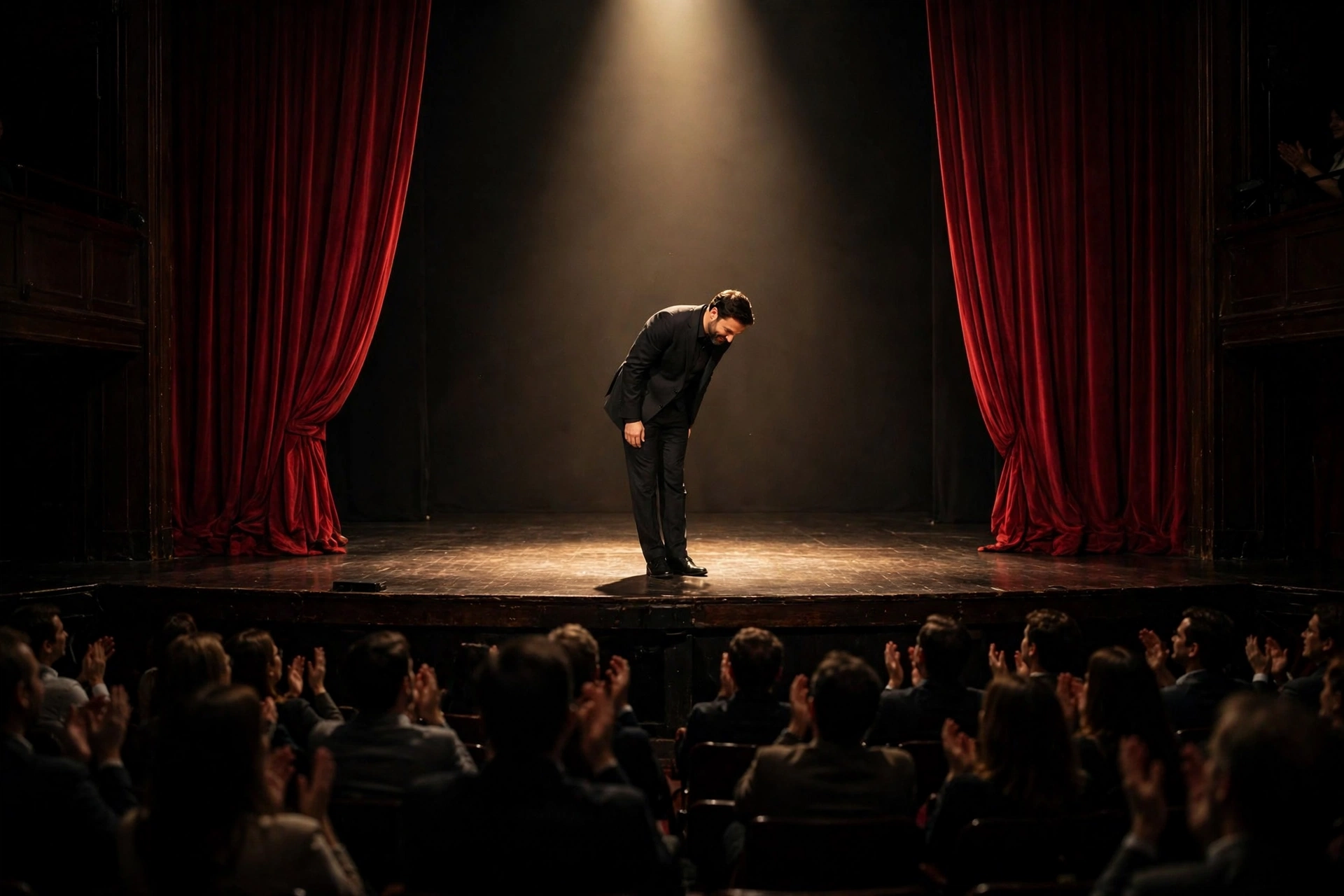
The phrase’s whole personality comes from its deliberate contradiction. You say the opposite of what you mean, and everyone in the conversation understands the inversion. That’s what makes it an idiom rather than a literal instruction — nobody has ever broken an actual leg and thanked you for the suggestion. In modern use it has spread well beyond the stage: students say it before exams, friends say it before job interviews, and it works for any performance-like moment — a big presentation, a wedding speech, a first date you’re nervous about. The theater association is still load-bearing, though. The phrase carries a whiff of footlights and curtains even when used about a job interview, and part of its charm is borrowing a little backstage glamour for an ordinary nervous moment.
Why Do Actors Say the Opposite? The Superstition Mechanism
Here’s the teachable point, and it’s more interesting than any origin story. Actors avoid saying “good luck” directly because of superstition — the old theatrical belief that wishing someone good luck outright will jinx the performance. So the profession developed a coded alternative: say something bad (“break a leg”) to secretly mean something good. The mechanism is reversal magic — the same logic behind many folk superstitions, where naming the feared thing is thought to invite it, and saying its opposite keeps it away.
This is exactly parallel to the most famous theater superstition of all: actors never say “Macbeth” inside a theater. Instead they call it “the Scottish play,” because the old belief holds that speaking the name invites disaster on the production. “Break a leg” works on the same principle — it’s a taboo-avoidance phrase, a euphemism for “good luck” built for people who believe direct wishes backfire. Once you see that mechanism, the phrase stops being random and starts being logical: it’s not that actors want injury; it’s that they won’t risk the real words.
The Origin: Honestly Unknown
Now for the honest part. Merriam-Webster’s own wordplay article on the phrase — titled “Why Do We Say ‘break a leg’?” — states plainly: “We do not know why the leg is referenced (as opposed to, say, a toe…), or where the expression came from.” The origin is explicitly unknown. Anyone who teaches you a single confident story about where it came from is selling you a theory as a fact. Here are the theories, clearly labeled as theories:
The German theory. The German phrase “Hals(bruch) und Beinbruch!” — literally “neck-break and leg-break” — was used in hunting and theater circles in the early 1900s as a good-luck wish. Some connect “break a leg” to English speakers borrowing or translating this expression. Plausible, but unproven.
The Booth theory. John Wilkes Booth broke his leg jumping from the box to the stage after assassinating Abraham Lincoln in 1865. Some accounts connect the phrase to this event. It’s dramatic — which is exactly why it’s suspicious as an origin story.
The Elizabethan theory. Some say Elizabethan audiences stamped and stomped their feet in approval, so “breaking a leg” meant getting such applause that performers bowed until their legs metaphorically broke. Colorful, but there’s no solid evidence.
The vaudeville theory. One account ties it to the transition between vaudeville acts: performers who got encores had to “break” the line of their leg to bow repeatedly. Again, undocumented.
The timeline we do know: theatrical use begins in the 1920s–1930s (that Variety citation from August 1929 is the early documentary anchor), and Merriam-Webster dates the first known use of the defined sense to 1949. Everything before that is speculation. The honest version of this idiom’s history is: actors needed a superstitious way to say “good luck,” and this phrase — origin unknown — won the job.
How to Use “Break a Leg”
The usage is straightforward. Say it to the person performing, shortly before the event: “Break a leg tonight!” / “Break a leg on your audition!” / “Break a leg — you’ll be great.” It pairs naturally with the encouragement that follows: “Break a leg, not literally” is a joke people actually make, which tells you the literal reading is always hovering in the background for newcomers.
A few usage notes. First, it’s informal — perfect for friends, classmates, and colleagues you know, slightly odd directed at a stranger. Second, timing matters: it’s a before-the-event phrase. Saying “break a leg” after the show is over makes no sense; afterward you say “well done.” Third, the theater association means it lands best when there’s an audience involved — a performance, presentation, audition, or interview. Saying it about someone’s dental surgery would be funny for about a second and then alarming. If you’re collecting idioms about performance and encouragement, the break the ice guide covers the phrase for the awkward first minutes, and the spill the beans article is another theater-free idiom with a murky origin story.
Break a Leg vs “Good Luck”
Are they interchangeable? Mostly yes in modern use, with one difference that matters. “Good luck” is neutral, universal, safe everywhere. “Break a leg” is warmer, more personal, and carries that insider theater flavor. Saying “good luck” to an actor is fine — no one will be offended. But saying “break a leg” signals you know the culture, the way saying “the Scottish play” signals it. Among performers, the idiom is a small act of belonging. For learners, the practical rule: use “good luck” when in doubt; use “break a leg” when you want the extra warmth and the moment involves a performance. And when a colleague wraps up a long meeting by telling everyone to get to the point, that’s the moment for our in-batch sibling — cut to the chase — a different idiom for a different kind of pressure.
Frequently Asked Questions
It’s an idiom used to wish good luck, especially to a performer before a show, audition, or presentation (Merriam-Webster). Despite how it sounds, it has nothing to do with actual injury — it’s the theater world’s traditional way of saying “I hope it goes well.”
Superstition. The theatrical tradition holds that saying “good luck” directly will jinx a performance, so actors developed a coded alternative: say something bad to secretly mean something good. It’s the same taboo-avoidance logic behind calling Macbeth “the Scottish play.”
Honestly, nobody knows. Merriam-Webster states the origin explicitly as unknown. Popular theories — the German “Hals(bruch) und Beinbruch!,” John Wilkes Booth’s 1865 leg break, Elizabethan foot-stomping audiences, vaudeville bow-lines — are all unproven and should be treated as theories, never facts.
Merriam-Webster dates the first known use of the phrase in its good-luck sense to 1949. Theatrical use goes back further — a Variety citation places it in theater circles by August 1929. The phrase was already established stage slang well before the dictionary record.
Yes, with judgment. Modern usage has spread to exams, interviews, presentations, and any performance-like moment. The theater association is load-bearing — it carries warmth and backstage flavor — but it works anywhere someone is about to face an audience of some kind.
Plain “good luck” is the safe universal alternative. “Knock ’em dead” is the American cousin with the same reversal-magic structure. After the event, switch to “well done” or “congratulations” — “break a leg” is strictly a before-the-event phrase.