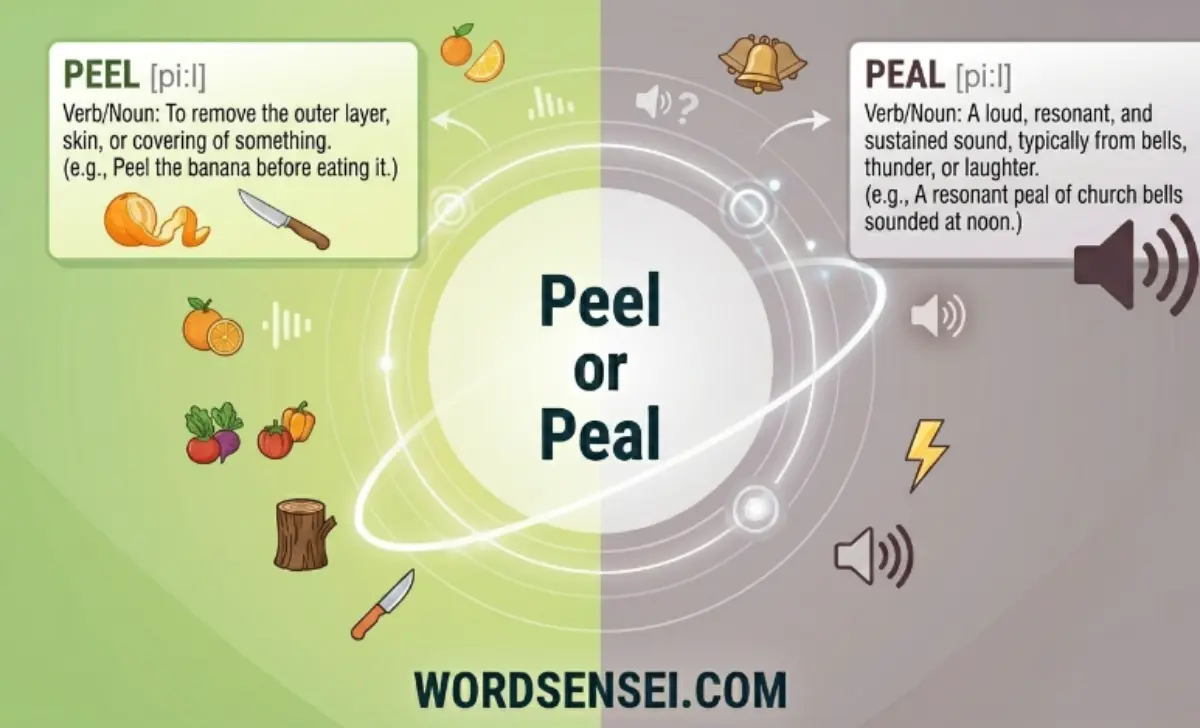
English contains many confusing words that sound alike but have completely different meanings. One common example is Peel or Peal. These words are homophones, meaning they share the same pronunciation but differ in spelling and meaning.
Because they sound identical, many English learners, students, writers, and ESL learners accidentally use the wrong word in writing and communication.
The confusion is understandable. Peel is usually related to removing an outer layer, such as the skin of a fruit or vegetable, while peal refers to a loud ringing sound, especially from church bells or a bell tower.
Understanding the difference improves vocabulary, pronunciation, writing accuracy, reading comprehension, and communication skills. This guide explains the meanings, origins, pronunciation, common mistakes, examples, and practical tips to help you use both words correctly.
Quick Answer
The difference is simple:
Peel
Peel means to remove an outer layer, skin, rind, bark, or covering.
Examples:
- Peel a banana.
- Peel an apple.
- Peel potatoes before cooking.
Peal
Peal refers to a loud ringing sound, usually made by bells.
Examples:
- A peal of church bells echoed through the town.
- The wedding began with a joyful peal of bells.
Quick Memory Rule
- Peel = Remove skin
- Peal = Ringing sound
Pronunciation of Peel or Peal
One reason these words create confusion is that they are pronounced exactly the same.
Peel
Pronunciation:
/piːl/
Sounds like:
PEEL
Peal
Pronunciation:
/piːl/
Sounds like:
PEEL
Why Spoken Confusion Happens
Because both words share identical pronunciation, listeners rely entirely on context clues to determine the intended meaning.
This makes Peel and Peal true homophones in English vocabulary.
Why People Confuse Peel or Peal
Several factors contribute to the confusion.
Identical Pronunciation
Both words sound exactly alike.
Different Meanings
Despite sounding identical, they belong to completely different categories.
- Peel → Food preparation and outer layers
- Peal → Sound, music, and bells
Similar Spelling
Only one letter differs between the words.
ESL Learning Challenges
English learners often struggle with homophones because pronunciation does not always indicate meaning.
Context Dependence
Readers and listeners must use context to understand which word is intended.
Easy Trick to Remember Peel or Peal
A simple memory trick can eliminate confusion.
Peel
Think:
Peel = Peel a potato
The double “ee” reminds you of food preparation and removing skin.
Peal
Think:
Peal = Church bell
The letter “a” can remind you of audio or acoustic sound.
Memory Formula
Peel removes.
Peal rings.
The Origin of Peel or Peal
The history of these words explains why they developed different meanings.
Origin of Peel
The word comes from Old French and Latin roots associated with removing an outer covering.
Over time, it became associated with:
- Fruit peel
- Vegetable peel
- Citrus peel
- Bark peeling
- Paint peeling
Today it is commonly used in cooking, food preparation, gardening, and household maintenance.
Origin of Peal
The word peal comes from Middle English and Old French terms related to loud ringing sounds.
Historically, it referred to:
- Church bells
- Bell towers
- Bell ringing ceremonies
- Celebratory chimes
The meaning remains closely connected to sound, music, and acoustics.
British English vs American English Spelling
There is no spelling difference between British and American English.
| Word | British English | American English |
|---|---|---|
| Peel | Peel | Peel |
| Peal | Peal | Peal |
Key Point
The challenge is choosing the correct word based on meaning, not regional spelling.
Which Spelling Should You Use?
Your context determines the correct choice.
Use Peel When Talking About:
- Fruit skin
- Vegetable skin
- Citrus peel
- Orange peel
- Lemon peel
- Banana peel
- Apple peel
- Potato peel
- Removing layers
- Food preparation
- Cooking ingredients
Examples:
- Peel the orange before eating it.
- Lemon peel adds flavor to desserts.
Use Peal When Talking About:
- Church bells
- Bell ringing
- Bell towers
- Chimes
- Carillons
- Wedding bells
- Celebration bells
- Resonant sounds
Examples:
- A peal of bells marked the celebration.
- The cathedral’s bells rang in a joyful peal.
Common Mistakes with Peel or Peal
Mistake: Using Peel for Bell Sounds
Incorrect:
- A peel of bells echoed through the village.
Correct:
- A peal of bells echoed through the village.
Mistake: Using Peal for Fruit Skin
Incorrect:
- Remove the peal from the orange.
Correct:
- Remove the peel from the orange.
Mistake: Ignoring Context
Always ask:
Am I discussing food or an outer layer?
Or
Am I discussing sound and bells?
Mistake: Relying Only on Pronunciation
Because both words sound identical, pronunciation alone cannot help determine the correct spelling.
Peel or Peal in Everyday Examples
Cooking and Food Preparation
- Peel potatoes before boiling them.
- Peel the banana carefully.
- Orange peel is often used in baking.
- Lemon zest comes from citrus peel.
Kitchen Tools
Common tools include:
- Vegetable peeler
- Fruit peeler
- Kitchen preparation tools
News and Media
- A peal of bells welcomed visitors to the cathedral.
- The church celebrated the event with a peal of ringing bells.
Social Media
- Fresh lemon peel makes every recipe better.
- The peal of wedding bells created a magical moment.
Formal Writing
The chef used citrus peel to enhance the flavor profile of the dessert.
A peal of church bells signaled the beginning of the ceremony.
Peel or Peal – Google Trends & Usage Data
Search interest in this keyword remains consistent because it is a classic English homophone pair.
Popular searches include:
- Difference between peel and peal
- Peel meaning
- Peal meaning
- Homophones in English
- Common English mistakes
- English vocabulary guide
- Similar sounding words
- Peel pronunciation
- Peal pronunciation
Interest is highest among:
- ESL learners
- Students
- Teachers
- Writers
- Content creators
- Language learners
Peel vs Peal Comparison Table
| Feature | Peel | Peal |
|---|---|---|
| Meaning | Remove outer layer | Loud ringing sound |
| Category | Food and objects | Sound and music |
| Part of Speech | Noun and verb | Noun and verb |
| Example | Banana peel | Peal of bells |
| Related Topic | Cooking | Bell ringing |
| Context | Fruit, vegetables, bark | Churches, weddings, celebrations |
| Function | Removes covering | Produces sound |
Related Vocabulary
Peel-Related Words
- Fruit peel
- Vegetable peel
- Citrus peel
- Orange peel
- Lemon peel
- Apple peel
- Banana peel
- Potato peel
- Rind
- Zest
- Bark peeling
- Paint peeling
Peal-Related Words
- Bell ringing
- Church bells
- Bell tower
- Chime
- Bell chime
- Carillon
- Wedding bells
- Cathedral bells
- Resonant sound
- Musical bells
- Acoustic signals
FAQs About Peel or Peal
What is the difference between peel and peal?
Peel refers to removing an outer layer, while peal refers to a loud ringing sound.
Are peel and peal homophones?
Yes. They sound identical but have different meanings and spellings.
What is a peel?
A peel can be the skin of a fruit or the act of removing that skin.
What is a peal?
A peal is a loud ringing sound, often from bells.
How do you use peel in a sentence?
Please peel the potatoes before cooking them.
How do you use peal in a sentence?
A peal of church bells echoed across the town square.
Why do English learners confuse peel and peal?
Because they are homophones with identical pronunciation.
Conclusion
Understanding the difference between Peel or Peal is essential for improving vocabulary, grammar, writing accuracy, and communication skills. Although the words share identical pronunciation, their meanings are completely different.
Peel relates to removing an outer layer such as fruit skin, vegetable skin, bark, or paint. Peal refers to a loud ringing sound, especially from church bells, wedding bells, bell towers, and carillons.
By understanding pronunciation, context clues, word origins, and common usage patterns, you can confidently choose the correct spelling in both speech and writing. Mastering homophones like Peel and Peal strengthens English proficiency and helps prevent common language mistakes.
Read More Blogs:
- Companies or Company’s? Examples, Rules, and Common Errors
- Saree or Sari? Most People Don’t Know the Difference

Hi, I am Gerald Nelson, a professional content writer working on wordssensei.com.
I create engaging and SEO-friendly content that informs and inspires readers.