Have you ever written the word “bearer” and then wondered if “barer” might actually be correct instead? If so, you are definitely not alone. In fact, thousands of writers, students, and ESL learners search this exact question every single day.
However, here is something interesting — unlike most spelling debates, this one is not about right or wrong. Both “bearer” and “barer” are real English words. Moreover, they sound exactly the same when spoken out loud.
So, the real challenge is not spelling at all — it is choosing the correct word for your meaning. This complete guide will explain both words clearly, show you exactly when to use each one, and give you simple tricks to never mix them up again.
Quick Answer
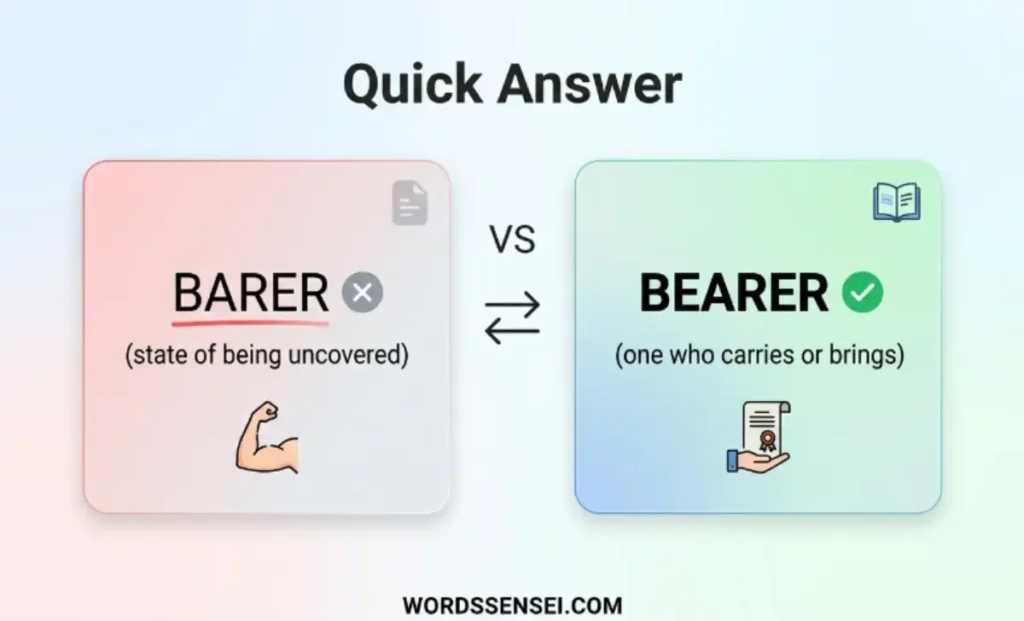
Both “bearer” and “barer” are correct English words. However, they have completely different meanings and come from completely different base words.
“Bearer” comes from the verb “bear,” which means to carry or hold something. So, a bearer is someone who carries, holds, or presents something. For example, a “bearer of news” is someone who delivers a message.
“Barer” comes from the adjective “bare,” which means empty, uncovered, or plain. Therefore, “barer” is simply the comparative form of “bare” — meaning more bare than something else.
Since both words sound identical when spoken, they are called homophones. As a result, the only way to know which one is correct is by understanding the meaning of your sentence.
✅ Correct Examples — “Bearer”
- “The bearer of the letter handed it directly to the king.”
- “Furthermore, she became the official bearer of the company’s award.”
- “He was chosen as the torch bearer for the opening ceremony.”
- “In addition, the document must be signed by the original bearer.”
✅ Correct Examples — “Barer”
- “The room looked much barer after they removed all the furniture.”
- “Moreover, his explanation seemed barer and less convincing than before.”
- “The winter landscape appeared barer with every passing week.”
- “In comparison, this version of the report is barer than the original.”
What Does “Bearer” Mean?
“Bearer” is a very common English noun. Moreover, it appears frequently in legal documents, financial terms, ceremonies, and everyday conversation. It simply refers to a person who carries, holds, presents, or delivers something.
| Feature | Detail |
|---|---|
| Word Type | Noun |
| Base Word | Bear (verb — to carry) |
| Pronunciation | /ˈbɛrər/ |
| Syllables | 2 — bear-er |
| Related Compound Words | Pallbearer, Standard bearer, Torch bearer |
Common Meanings
According to the Cambridge Dictionary{:target=”_blank” rel=”noopener noreferrer”}, a bearer is a person who carries or holds something, or who presents an official document. Furthermore, the word is widely used in legal and financial contexts.
In everyday usage, “bearer” can mean several things:
- A person who carries something — the most common meaning; used for objects, messages, or symbolic items
- A holder of a document — used in legal and financial writing, such as “bearer bonds” or “bearer checks”
- A ceremonial role — used for formal events, such as a “flag bearer” or “torch bearer”
- A messenger — used when someone delivers news, as in “bearer of bad news”
Simple Usage Examples
- “The bearer of this letter has full permission to act on my behalf.”
- “Furthermore, the flag bearer led the entire team into the stadium.”
- “She was unfortunately the bearer of some very disappointing news.”
- “Moreover, a bearer bond can be cashed by whoever physically holds it.”
What Does “Barer” Mean?
“Barer” is the comparative form of the adjective “bare.” Moreover, it follows a standard English grammar rule for short adjectives. It simply means more bare, more empty, or more exposed than something else.
| Feature | Detail |
|---|---|
| Word Type | Adjective (Comparative) |
| Base Word | Bare (uncovered, empty, plain) |
| Pronunciation | /ˈbɛrər/ |
| Syllables | 2 — bar-er |
| Superlative Form | Barest |
Common Meanings
“Barer” describes something that has less covering, less decoration, or less content compared to something else. For instance, a tree in winter looks “barer” than the same tree in summer because it has fewer leaves.
In everyday usage, “barer” can describe:
- Physical emptiness — a room, shelf, or surface with less on it
- Reduced coverage — clothing, skin, or surfaces with less covering
- Simplicity in writing or speech — an explanation with fewer details than another
- Natural landscapes — trees, fields, or land with less vegetation
Simple Usage Examples
- “After the storm, the trees looked barer than they had all autumn.”
- “Furthermore, her writing style feels barer and more direct than his.”
- “The shelves looked barer once the holiday decorations were removed.”
- “In comparison, this design feels barer and more minimal than the last one.”
The Origin of “Bearer” and “Barer”
Understanding where these two words come from helps explain why they sound the same but mean such different things. Furthermore, it shows why confusing them is such a common and understandable mistake.
Word History — “Bearer”
The word “bearer” comes from the Old English verb “beran,” which meant to carry or to bring forth. This ancient word has Germanic roots and is related to similar words in other languages, including the German word “tragen.” Over time, English speakers added the suffix “-er” to “bear,” creating “bearer” — meaning “one who carries.”
Word History — “Barer”
The word “barer” comes from the Old English adjective “bær,” meaning naked or uncovered. This word also has deep Germanic roots. When English speakers needed a comparative form, they simply added “-er” to “bare” — following the standard rule for short adjectives ending in a silent “e.” So, bare became barer, following the exact same pattern as “nice” becoming “nicer.”
Why the Confusion Happens
Both words ended up sounding identical purely by coincidence of pronunciation. Furthermore, English has many such homophone pairs — words that sound alike but have entirely different spellings, meanings, and origins. Because “bearer” and “barer” sound exactly the same out loud, many writers struggle to choose the right one when writing quickly.
Bearer vs Barer — Side-by-Side Comparison
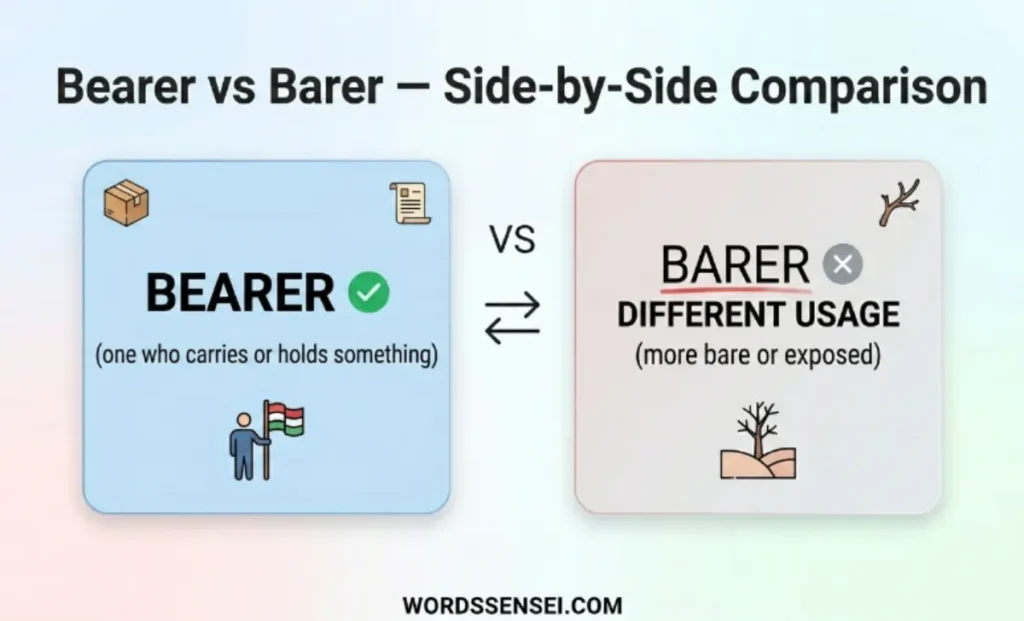
Let us look at both words clearly, side by side, so the difference becomes completely obvious.
Complete Comparison Table
| Feature | Bearer | Barer |
|---|---|---|
| Word Type | Noun | Adjective (comparative) |
| Base Word | Bear (verb) | Bare (adjective) |
| Meaning | One who carries something | More bare, more empty |
| Common Use | Legal, financial, ceremonial | Descriptive comparisons |
| Example | “He is the bearer of the message.” | “The field looked barer today.” |
| Pronunciation | /ˈbɛrər/ | /ˈbɛrər/ |
British English vs American English
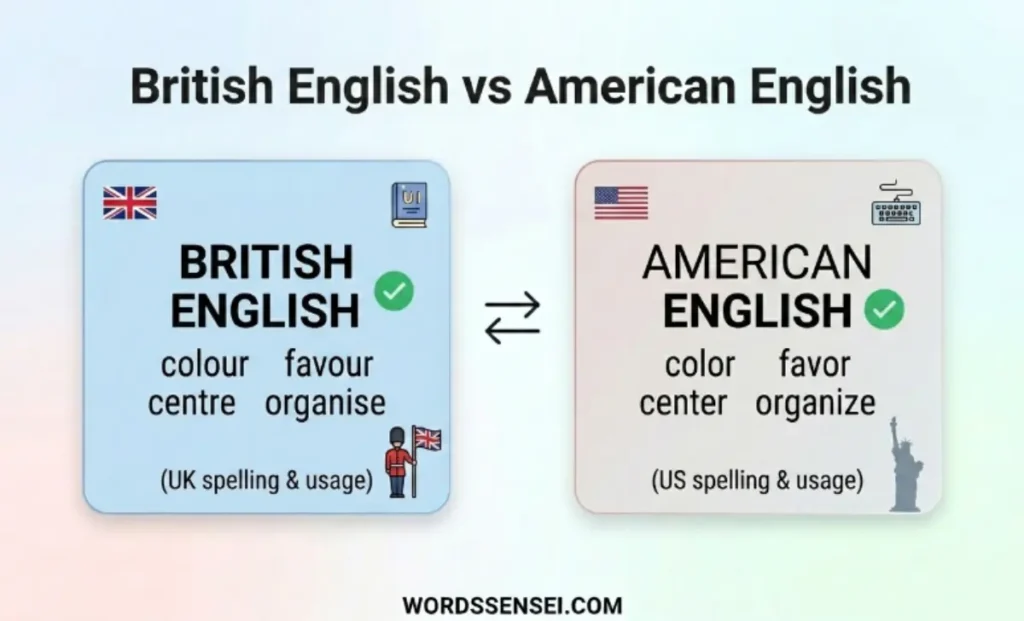
Good news — both British and American English treat these words exactly the same way. There is no regional spelling difference for either word.
Comparison Table
| Feature | American English | British English | Notes |
|---|---|---|---|
| Bearer | ✅ Same spelling | ✅ Same spelling | No regional difference |
| Barer | ✅ Same spelling | ✅ Same spelling | No regional difference |
| Pronunciation | /ˈbɛrər/ | /ˈbɛrər/ | Identical in both |
| Dictionary | Merriam-Webster | Oxford | Both confirm meanings |
No matter where you are writing — the United States, the United Kingdom, Canada, Australia, India, or Pakistan — both words exist and mean exactly what is explained above.
Which Word Should You Use?
The correct word depends entirely on your meaning — not your audience or region. So, here is a simple way to decide every time.
Use “Bearer” When You Mean a Person or Role
If your sentence is about a person carrying, holding, or presenting something, always use “bearer.” For example, “the bearer of good news” or “a bearer bond.”
Use “Barer” When You Mean More Empty or Exposed
If your sentence is comparing two things and describing something as more bare, always use “barer.” For example, “the room looked barer” or “his argument felt barer.”
Quick Memory Trick
Bearer = a person (noun) Barer = more bare (comparative adjective) If you can replace the word with “more bare” — use barer. If you can replace the word with “the person who carries” — use bearer.
Common Mistakes with “Bearer” and “Barer”
Even confident writers mix these words up. So, here is exactly what to watch for — and how to fix each mistake quickly.
Frequent Errors
- Writing “barer” when describing a person who carries something — should be “bearer”
- Writing “bearer” when comparing how bare or empty something looks — should be “barer”
- Confusing “bearer bond” with “barer bond” — the financial term always uses “bearer”
- Forgetting that “barer” is a comparative — and using it without comparing two things
- Misspelling either word as “berer” — which is never correct in any context
Corrected Examples
| ❌ Wrong | ✅ Right | Why |
|---|---|---|
| He is the barer of the letter. | He is the bearer of the letter. | This refers to a person who carries something |
| The shelf looked bearer than before. | The shelf looked barer than before. | This is a comparison of emptiness |
| She holds barer bonds. | She holds bearer bonds. | Financial term always uses “bearer” |
| The trees seemed bearer in winter. | The trees seemed barer in winter. | Describing exposure, not carrying |
“Bearer” and “Barer” in Everyday Writing Examples
Here is how both words appear naturally across different real-world writing situations. Furthermore, these examples will help you choose the correct word with much more confidence.
Emails
“Please note that the bearer of this letter has full authorization to collect the documents on our behalf. Furthermore, kindly verify their identification before releasing any files. In addition, please contact our office if you have any questions.”
Social Media
“Honored to be chosen as the flag bearer for our country at this year’s ceremony! 🏆 Moreover, representing my nation on this stage means everything to me. #Proud #FlagBearer”
News Writing
“The investigation revealed that the bearer of the anonymous letter remains unidentified. As a result, authorities are now reviewing security footage from the building. Furthermore, officials have asked the public for any information that might help.”
School Writing
“After autumn arrived, the trees in the park looked noticeably barer each week. Furthermore, fewer leaves remained on the branches with every passing storm. In addition, the once colorful landscape slowly turned into a quiet, empty scene.”
Business Writing
“Our legal department has confirmed that this document qualifies as a bearer instrument. Therefore, whoever physically holds the paper retains full legal rights to it. In addition, please store it in a secure location at all times.”
Google Trends and Usage Data
Search data shows that people search for both words for different reasons. Furthermore, the confusion mostly comes from the words sounding identical, rather than one being a true misspelling.
Why People Search This Keyword
Most searches for “bearer or barer” come from these specific groups:
- ESL learners — confused by two words that sound exactly the same but mean different things
- Students — checking which word fits their sentence correctly before submitting an assignment
- Finance students — researching terms like “bearer bond” and “bearer check”
- Content writers — making sure their articles use the correct word for clarity
- Editors and proofreaders — double-checking homophones during the editing process
Related Grammar Rules
Understanding Homophones
“Bearer” and “barer” belong to a large group of English words called homophones — words that sound the same but have different spellings and meanings. So, learning this pattern helps you recognize similar word pairs more easily in the future.
| Homophone Pair | Meanings |
|---|---|
| Bearer / Barer | Carrier (noun) / More bare (adjective) |
| Wares / Wears | Goods / Puts on clothing |
| Pairs / Pares | Groups of two / Trims something |
| Bare / Bear | Uncovered / Animal or to carry |
Helpful Grammar Tips
Tip 1 — Identify the part of speech first If the word in your sentence acts like a person or thing, you likely need “bearer.” However, if it describes a quality being compared, you likely need “barer.”
Tip 2 — Try the “more bare” replacement test If you can substitute the word with “more bare” and the sentence still makes sense, use “barer.” For example, “The room felt more bare” works perfectly — so “barer” is correct there.
Tip 3 — Remember common bearer compounds Words like pallbearer, torch bearer, and standard bearer always use “bearer,” never “barer.” Therefore, memorizing these common compounds helps you avoid mistakes in similar contexts.
💡 Pro Tip: When you are unsure about any word choice, check Merriam-Webster{:target=”_blank” rel=”noopener noreferrer”} online. It is completely free and clarifies meaning instantly.
“Bearer” — Common Phrases and Compound Words
“Bearer” appears in many fixed phrases and compound words across legal, financial, and ceremonial contexts. Moreover, knowing these helps you use the word naturally and confidently.
Common “Bearer” Phrases
| Phrase | Meaning | Example |
|---|---|---|
| Bearer of bad news | Someone who delivers unwelcome information | “I hate being the bearer of bad news, but the flight was cancelled.” |
| Bearer bond | A financial document owned by whoever holds it | “The bearer bond could be cashed by anyone who possessed it.” |
| Standard bearer | Someone who represents or leads a cause | “She became the standard bearer for the new movement.” |
| Torch bearer | Someone who carries a torch in a ceremony | “He was chosen as the torch bearer for the Olympic relay.” |
| Pallbearer | Someone who carries a casket at a funeral | “His closest friends served as pallbearers at the service.” |
| Cup bearer | A historical role serving drinks to royalty | “In ancient times, the cup bearer held a position of great trust.” |
Internal Link Suggestions
📌 (Add These Links When Related Articles Are Ready)
- Link “homophones” → your article on confusing English word pairs
- Link “comparative adjectives” → your article on English grammar rules
- Link “ESL learners” → your beginner English grammar guide
- Link “bearer bond” → your article on financial vocabulary
Author Bio
About the Author [Your Name] is an English language writer and grammar teacher with [X] years of experience. Moreover, [he/she/they] helps students, bloggers, and ESL learners write better and more confidently every day. Connect on LinkedIn | View All Posts
FAQs
Are “bearer” and “barer” both real words?
Yes. Both words are completely real and correct in English. “Bearer” is a noun meaning someone who carries or holds something. On the other hand, “barer” is the comparative form of the adjective “bare,” meaning more empty or exposed.
Why do “bearer” and “barer” sound the same?
They are homophones — words that sound identical but have different spellings, meanings, and origins. Furthermore, “bearer” comes from the verb “bear,” while “barer” comes from the adjective “bare.” Their similar sound is simply a coincidence of English pronunciation.
What does “bearer” mean?
A “bearer” is a person who carries, holds, or presents something. For example, a “bearer of news” delivers a message, and a “bearer bond” can be cashed by whoever physically holds it.
What does “barer” mean?
“Barer” means more bare, more empty, or more exposed compared to something else. For example, “The room looked barer after the furniture was removed.”
How do I know which word to use?
Try replacing the word with “more bare.” If the sentence still makes sense, use “barer.” However, if your sentence describes a person carrying or presenting something, use “bearer” instead.
What is a “bearer bond”?
A “bearer bond” is a financial document that belongs to whoever physically holds it — rather than a specific named owner. Furthermore, these bonds were once common but are now rare due to security concerns.
Is “barer” used often in everyday English?
Not as often as “bearer.” However, “barer” still appears regularly when comparing two things in terms of emptiness or exposure — such as describing landscapes, rooms, or writing styles.
What are some common compound words with “bearer”?
Common examples include pallbearer, torch bearer, standard bearer, and cup bearer. Furthermore, all of these always use “bearer” — never “barer” — since they describe a person performing a carrying or representing role.
Conclusion
After reading through this complete guide, the difference between these two words should now feel completely clear. Both “bearer” and “barer” are genuine English words — neither one is a mistake. However, they mean very different things and come from completely different roots.
“Bearer” describes a person who carries, holds, or presents something — like a torch bearer or a bearer of news. On the other hand, “barer” simply means more bare or more empty when comparing two things. The confusion happens purely because the two words sound exactly alike when spoken out loud.
So, the next time you are unsure which one to use, try the simple “more bare” replacement test explained earlier in this guide. Furthermore, remember the common compound words like pallbearer and standard bearer, which always use “bearer.”
You now have the full picture — the meanings, the origins, the comparison, and practical tips to choose correctly every single time. Therefore, go ahead and write with complete confidence. Never let this homophone pair confuse you again.
Read More Blogs:
- Crochet or Knit? Which One Is Right for You?
- Mould or Mold? UK vs US Spelling Explained With Examples

Hi, I am Anne Seaton. I am a writer and educator working with Wordssensei.com to help students learn English easily.