Have you ever written the word “embassador” and then paused to wonder — is that actually right? If so, you are definitely not alone. In fact, thousands of students, job applicants, and writers search this exact question every single day.
The confusion is completely understandable because the word “embassy” looks and sounds so similar. However, the answer is actually very simple and clear. Only one spelling exists in every English dictionary in the world. The other one has never been correct — not in any era, not in any country.
So, this complete guide will explain everything you need to know — the correct spelling, the word history, the reason for the confusion, and real usage examples. By the end, you will write this word with complete confidence every single time.
Quick Answer
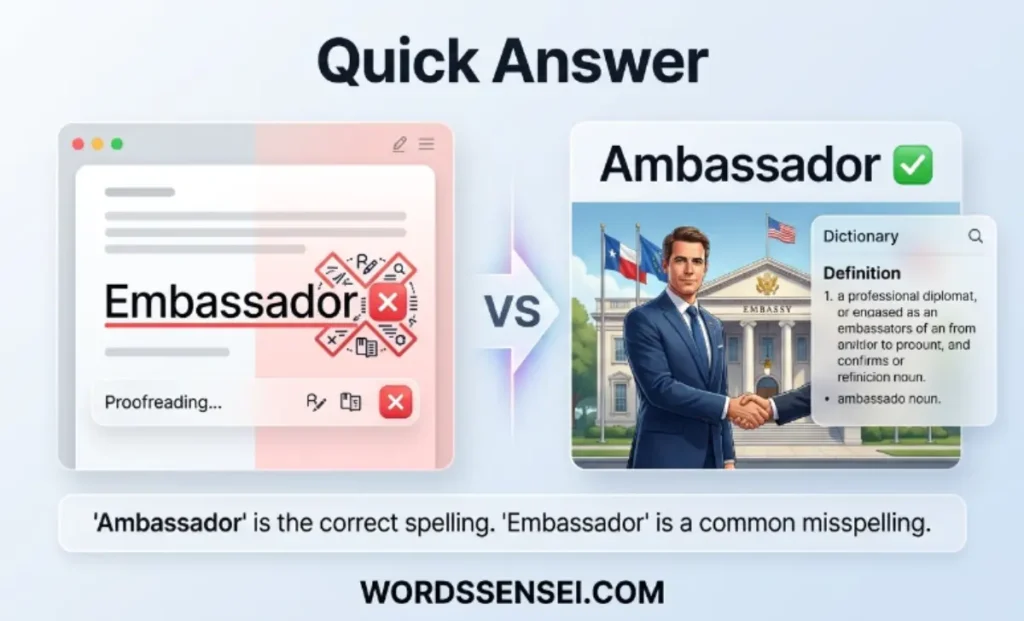
“Ambassador” is the correct spelling. On the other hand, “embassador” is wrong. In fact, it does not exist in any English dictionary — not Merriam-Webster, not Oxford, not Cambridge.
The word always starts with “am-“ — never “em-.” So, the correct spelling is a-m-b-a-s-s-a-d-o-r. Furthermore, this small difference at the beginning is the only thing that separates the correct word from the common mistake.
Most people make this error because of the word “embassy.” However, embassy and ambassador actually start with different letters — even though they are closely related in meaning.
✅ Correct Examples
- “The ambassador arrived at the summit early this morning.”
- “Furthermore, she was appointed as the new ambassador to France.”
- “The brand hired a famous athlete as their official ambassador.”
- “In addition, the ambassador’s speech focused heavily on trade relations.”
❌ Incorrect Examples
- ~~”The embassador arrived at the summit early this morning.”~~
- ~~”She was appointed as the new embassador to France.”~~
- ~~”The brand hired an embassador for their campaign.”~~
- ~~”The embassador’s speech focused on trade relations.”~~
Never use “embassador.” It is always wrong — in every context, every country, and every writing style.
What Does “Ambassador” Mean?
“Ambassador” is a very important and widely used English noun. Moreover, it appears constantly in news, politics, business, and everyday conversation. It refers to a person who officially represents their country or organization somewhere else.
| Feature | Detail |
|---|---|
| Word Type | Noun |
| Correct Spelling | Ambassador |
| Incorrect Spelling | Embassador |
| Syllables | 4 — am-bas-sa-dor |
| Pronunciation | /æmˈbæsədər/ |
| Plural Form | Ambassadors |
| Related Adjective | Ambassadorial |
| Related Place | Embassy |
Common Meanings
According to the Cambridge Dictionary{:target=”_blank” rel=”noopener noreferrer”}, an ambassador is an important official who lives in a foreign country and represents their own country there. Furthermore, the word can also describe someone who represents a brand, cause, or organization.
In everyday usage, “ambassador” can mean several different things:
- A diplomatic official — the most formal meaning; a senior government representative who lives and works in another country
- A brand representative — used in marketing; someone who promotes a company’s products publicly
- A goodwill representative — used for causes; someone who represents a charity, sport, or social mission
- A cultural representative — used loosely; someone who represents their country’s culture or traditions abroad
Simple Usage Examples
- “The ambassador met with several world leaders during the conference.”
- “Furthermore, the company chose a popular influencer as its newest ambassador.”
- “She has served as a goodwill ambassador for children’s education for many years.”
- “Moreover, the ambassador’s residence was located near the city center.”
The Origin of “Ambassador”
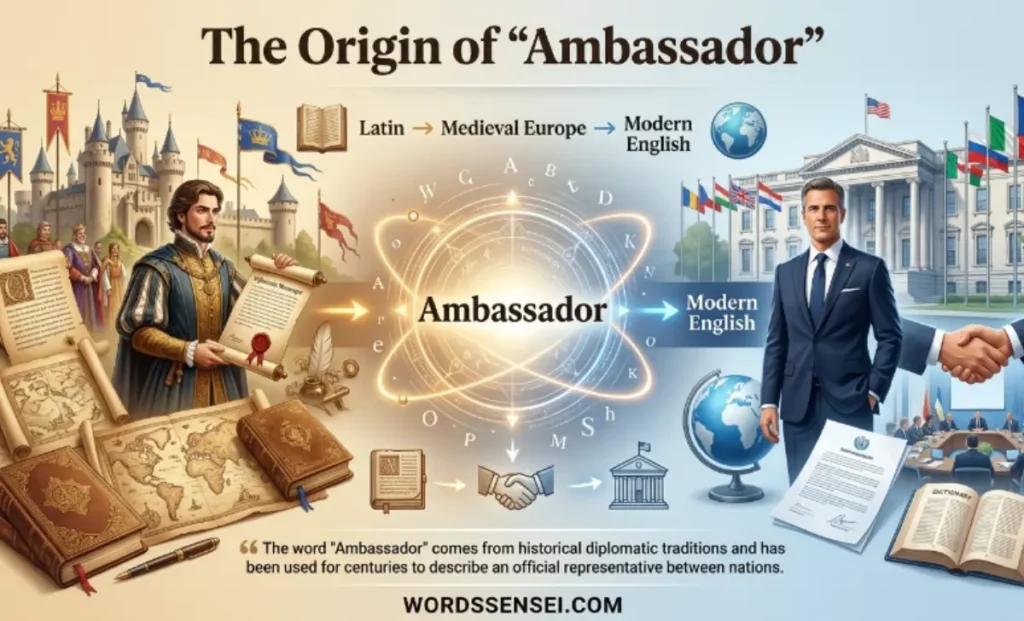
Understanding where “ambassador” comes from helps explain exactly why it is spelled the way it is. Furthermore, it shows why “embassador” has never been correct throughout the entire history of the English language.
Word History
The word “ambassador” came from the Old French word “ambassadeur.” This French word, in turn, came from the Latin word “ambactus,” which meant a servant or a person sent on a mission. The Latin root traces back even further to Celtic and Germanic languages, where it referred to someone sent to carry out an important task.
When the word entered English in the late 1300s, it kept this “amb-” beginning from its Latin and French roots. As a result, the spelling has remained consistent for over 600 years — always starting with “am-,” never “em-.”
Interestingly, the word “embassy” came from the very same root. However, over time, English speakers separated the two spellings — keeping “amb-” for the person and “emb-” for the place. This small but important difference is exactly where the confusion begins for many writers today.
Why the Confusion Happens
The word “embassy” looks extremely similar to “ambassador.” Moreover, both words are closely related in meaning — an ambassador works at an embassy. Because of this strong visual and logical connection, many people assume the spellings should match exactly.
However, this assumption is incorrect. Here is the key difference:
| Word | Correct Spelling | Meaning |
|---|---|---|
| Embassy | Embassy | The building or office |
| Ambassador | Ambassador | The person who works there |
So, even though these two words are closely connected in meaning, they have always used different first letters. Therefore, remembering this distinction is the easiest way to avoid the mistake.
British English vs American English
Good news — both British and American English completely agree on this word. “Ambassador” is correct in every English-speaking country, without any exception.
Comparison Table
| Feature | American English | British English | Australian English | Indian English |
|---|---|---|---|---|
| Correct Spelling | Ambassador ✅ | Ambassador ✅ | Ambassador ✅ | Ambassador ✅ |
| Incorrect Spelling | Embassador ❌ | Embassador ❌ | Embassador ❌ | Embassador ❌ |
| Pronunciation | /æmˈbæsədər/ | /æmˈbæsədər/ | /æmˈbæsədər/ | /æmˈbæsədər/ |
| Dictionary | Merriam-Webster | Oxford | Macquarie | Oxford Indian |
No matter where you are writing — the United States, the United Kingdom, Canada, Australia, India, or Pakistan — always write “ambassador.” The spelling never changes.
Ambassador vs Embassador — Full Comparison
Let us now look at every variation people sometimes use — and clear up the confusion once and for all.
Complete Comparison Table
| Form | Correct? | Exists in Dictionary? | Recommended? |
|---|---|---|---|
| Ambassador | ✅ Yes | ✅ Yes — all dictionaries | ✅ Always use this |
| Embassador | ❌ No | ❌ No dictionary | ❌ Never use this |
| Embassy | ✅ Yes | ✅ Different word entirely | ✅ Use only for the place |
| Ambassadorial | ✅ Yes | ✅ Correct adjective form | ✅ Use for descriptions |
Which Spelling Should You Use?
The answer is always “ambassador” — in every context and every audience. However, here is a clear breakdown by writing situation.
US Audience
Always use “ambassador.” Confirmed by Merriam-Webster as the only correct form. Moreover, all American government documents, news outlets, and academic papers use this word exclusively.
UK Audience
Always use “ambassador.” Confirmed by the Oxford English Dictionary. Furthermore, British diplomatic and political writing has used this exact spelling for centuries without any variation.
Academic and Political Writing
Use “ambassador” in all essays, news articles, and official documents related to politics or international relations. In addition, capitalize the word when using it as a formal title — for example, “Ambassador Smith.”
Business and Marketing Writing
“Ambassador” is now extremely common in marketing — especially for the term “brand ambassador.” Moreover, companies use this title for influencers and celebrities who promote their products publicly.
Social Media Usage
Always use “ambassador” for correct and professional-looking posts. In fact, since this word appears so often in marketing and influencer content, getting the spelling right makes your content look far more credible.
Common Mistakes with “Ambassador”
Even confident writers make these errors. So, here is exactly what to watch for — and how to fix each mistake quickly.
Frequent Errors
- Writing “embassador” instead of “ambassador” — most common mistake by far
- Confusing the spelling of “ambassador” with “embassy” because they look similar
- Writing “ambassadore” — adding an extra “e” at the end — also incorrect
- Forgetting to capitalize “Ambassador” when using it as a formal title before a name
- Misspelling the adjective form as “embassadorial” instead of “ambassadorial”
Corrected Examples
| ❌ Wrong | ✅ Right | Why |
|---|---|---|
| He is the embassador to Japan. | He is the ambassador to Japan. | Embassador is not a word |
| She works at the embassador’s office. | She works at the ambassador’s office. | Always use “amb-“ |
| The brand embassador posted online. | The brand ambassador posted online. | No exceptions in marketing either |
| ambassadore visited the school. | Ambassador visited the school. | No extra “e” at the end |
| The embassadorial meeting was delayed. | The ambassadorial meeting was delayed. | Adjective also uses “amb-“ |
“Ambassador” in Everyday Writing Examples
Here is how “ambassador” works naturally across different real-world writing situations. Furthermore, these examples will help you use the word with much more confidence going forward.
Emails
“We are excited to announce that you have been selected as our newest brand ambassador. Furthermore, this role will include exclusive access to upcoming product launches. In addition, full details about compensation and responsibilities are attached below.”
Social Media
“So honored to be named a goodwill ambassador for children’s literacy this year! Moreover, I cannot wait to start visiting schools and sharing the importance of reading. 📚 #Grateful #Ambassador”
News Writing
“The newly appointed ambassador met with senior officials shortly after arriving in the capital. As a result, discussions immediately focused on strengthening trade relations between the two countries. Furthermore, a formal agreement is expected within the coming weeks.”
School Writing
“An ambassador represents their country in a foreign nation. Furthermore, their main responsibilities include maintaining diplomatic relations, supporting trade agreements, and protecting their citizens living abroad. In addition, ambassadors often attend important international conferences and ceremonies.”
Business Writing
“Our company is launching a new ambassador program to expand our reach on social media. Therefore, we are looking for influencers who align closely with our brand values. In addition, selected ambassadors will receive product samples and performance-based compensation.”
Google Trends and Usage Data
Search data clearly confirms that “ambassador” completely dominates globally. On the other hand, “embassador” only appears in searches as a confused query — people checking whether it might actually be correct.
Popular Countries
| Country | Most Searched Form | Search Volume | Notes |
|---|---|---|---|
| United States | Ambassador | Very High | Dominant — no competition |
| United Kingdom | Ambassador | High | Consistent with US usage |
| Canada | Ambassador | High | Follows North American pattern |
| Australia | Ambassador | Medium-High | No regional variation |
| India | Embassador vs Ambassador | High | Large ESL population — more confusion |
| Pakistan | Embassador vs Ambassador | High | ESL learners — embassy confusion |
| Philippines | Ambassador | Medium | English widely used — ambassador dominant |
Why People Search This Keyword
Most searches for “embassador or ambassador” come from these specific groups:
- ESL learners — confused by the visual similarity between “embassy” and “ambassador”
- Job applicants — checking spelling before writing a resume or cover letter mentioning the role
- Content writers — avoiding embarrassing errors in news, marketing, or political articles
- Students — double-checking spelling before submitting assignments about politics or government
- Marketing professionals — confirming spelling before launching brand ambassador campaigns
Related Grammar Rules
Similar Spelling Mistakes
The same kind of confusion happens with other words that look related but actually have different spellings. So, here are a few similar examples worth knowing:
| Related Pair | Correct Forms | Note |
|---|---|---|
| Embassy / Ambassador | Embassy, Ambassador | Same root, different first letters |
| Embark / Ambush | Embark, Ambush | Different “em-” and “am-” prefixes |
| Embrace / Ambition | Embrace, Ambition | Easy to confuse visually |
Helpful Grammar Tips
Tip 1 — Remember the difference between place and person “Embassy” is the place. However, “ambassador” is the person. Furthermore, keeping this distinction clear in your mind helps you remember the correct spelling every time.
Tip 2 — Always start with “am-” for ambassador The word always begins with “am-” — never “em-.” So, if you find yourself typing “emb-,” stop and double-check before continuing.
Tip 3 — Capitalize when used as a title When “Ambassador” comes directly before a person’s name — like “Ambassador Johnson” — always capitalize it. However, when used generally, like “the ambassador spoke,” keep it lowercase.
Tip 4 — Check the adjective form too The correct adjective is “ambassadorial” — not “embassadorial.” Therefore, this same “am-” rule applies to every related word form.
💡 Pro Tip: When you are not sure about any spelling, check Merriam-Webster{:target=”_blank” rel=”noopener noreferrer”} online. It is completely free and gives the correct answer instantly.
“Ambassador” — Common Phrases and Modern Usage
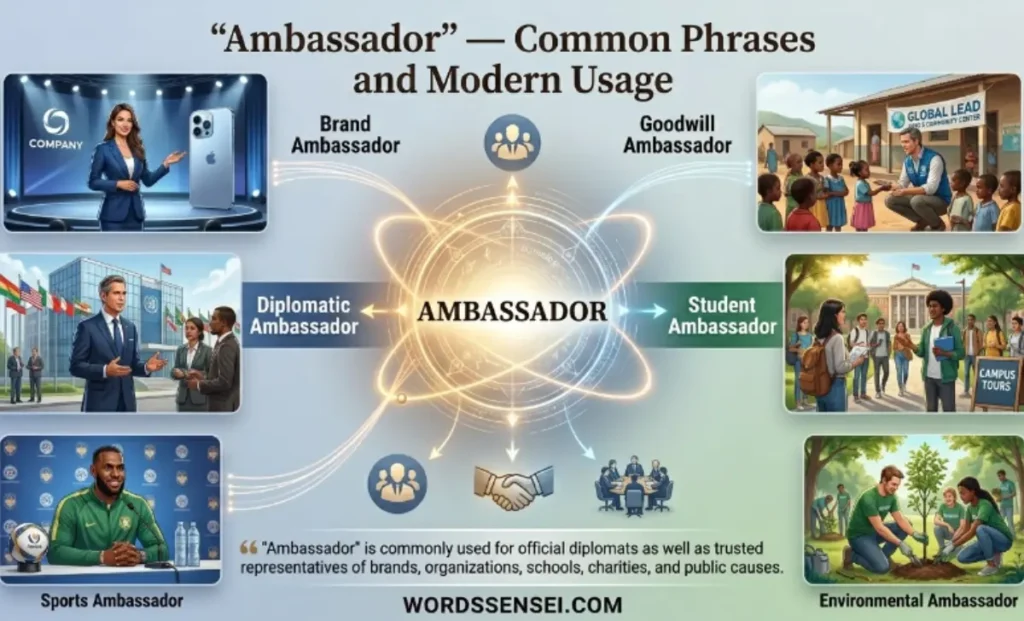
“Ambassador” appears in many common phrases today — far beyond just traditional diplomacy. Moreover, understanding these different uses helps you use the word naturally in any context.
Common “Ambassador” Phrases
| Phrase | Meaning | Example |
|---|---|---|
| Brand ambassador | Person who promotes a company | “She became a brand ambassador for the skincare line.” |
| Goodwill ambassador | Person who represents a cause | “He serves as a goodwill ambassador for the United Nations.” |
| Cultural ambassador | Person who represents their culture | “The musician acted as a cultural ambassador abroad.” |
| Sports ambassador | Athlete who represents a sport or event | “The former champion is now a sports ambassador.” |
| Ambassador’s residence | Official housing for a diplomat | “The reception was held at the ambassador’s residence.” |
| Honorary ambassador | Title given without formal duties | “She was named an honorary ambassador for the festival.” |
Internal Link Suggestions
📌 (Add These Links When Related Articles Are Ready)
- Link “diplomacy” → your article on international relations vocabulary
- Link “common spelling mistakes” → your article on English spelling errors
- Link “ESL learners” → your beginner English grammar guide
- Link “brand ambassador” → your article on marketing terminology
Author Bio
About the Author [Your Name] is an English language writer and grammar teacher with [X] years of experience. Moreover, [he/she/they] helps students, bloggers, and ESL learners write better and more confidently every day. Connect on LinkedIn | View All Posts
FAQs
Is “embassador” a real word?
No. “Embassador” is not a real English word. In fact, it does not appear in any major dictionary — not Merriam-Webster, not Oxford, not Cambridge. The only correct word is “ambassador.”
Why do people spell ambassador as embassador?
People confuse “ambassador” with the closely related word “embassy.” Since an ambassador works at an embassy, many writers assume the spellings should match. However, the two words have always used different first letters — “amb-” for ambassador and “emb-” for embassy.
What does “ambassador” mean?
An “ambassador” is an official who represents their country in a foreign nation. Furthermore, the word is also widely used today to describe someone who represents a brand, charity, or cause — such as a “brand ambassador” or “goodwill ambassador.”
What is the difference between “ambassador” and “embassy”?
“Ambassador” refers to the person — the official representative. On the other hand, “embassy” refers to the place — the building or office where that representative works. Therefore, these are two completely different words with two completely different meanings.
Is “ambassador” capitalized?
It depends on usage. When “Ambassador” appears directly before a name as a formal title — like “Ambassador Lee” — it should be capitalized. However, when used generally in a sentence — like “the ambassador gave a speech” — it stays lowercase.
What is the adjective form of “ambassador”?
The adjective form is “ambassadorial.” For example, “The meeting had a very ambassadorial tone.” Furthermore, this word also always uses “amb-” — never “emb-.”
What is a “brand ambassador”?
A “brand ambassador” is a person — often a celebrity or influencer — who is paid or partnered with a company to promote its products publicly. Moreover, this modern marketing usage has become extremely common on social media in recent years.
How do I remember the correct spelling of ambassador?
Use this simple memory trick: ambassador always starts with “am-,” just like the words “ambition” and “ambush.” So, if you remember that connection, you will never confuse it with “embassy” again.
Conclusion
After reading through this complete guide, the answer is now absolutely clear. “Ambassador” is the only correct spelling — in every country, every writing style, and every context you can think of. “Embassador” simply does not exist in any English dictionary anywhere in the world.
The confusion happens because the word looks so similar to “embassy” — and since an ambassador works at an embassy, the connection feels natural. However, these two words have always used different spellings throughout their entire history.
“Ambassador” always begins with “am-,” while “embassy” always begins with “emb-.” So, the next time you sit down to write — whether it is a school essay, a business email, a marketing campaign, or a news article — write “ambassador” with complete confidence. Moreover, remember that this same rule applies to the adjective form “ambassadorial” as well.
You now have the full picture — the correct spelling, the word history, the reason for the confusion, and practical tips to remember it forever. Therefore, go ahead and write with confidence. Never let this simple spelling question slow you down again.
Read More Blogs:
- Uncapable vs Incapable: What’s the Difference?
- Kneck or Neck? 99% of People Don’t Know the Real Answer

Gerald Nelson is a contributing writer at Wordssensei.com, covering English grammar, vocabulary, and commonly confused words.