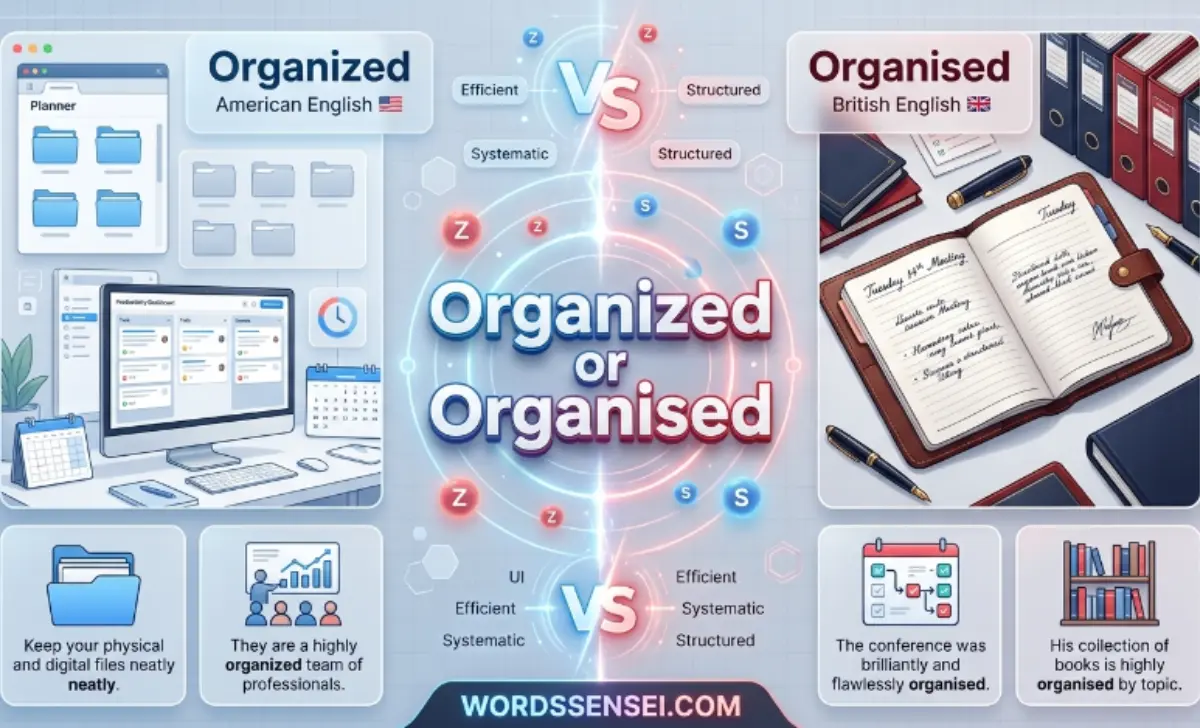
Have you ever wondered whether you should write organized or organised? If yes, then you are not alone. In fact, this is one of the most frequently searched English grammar questions worldwide. Moreover, both spellings look correct, which creates even more confusion among writers, students, and bloggers.
However, the truth is actually very simple. Both spellings are correct, but they are used in different regions of English. Therefore, the choice depends on whether you are writing in American English or British English.
In addition, this guide will not only explain the difference, but also give you real-world examples, SEO writing tips, grammar rules, and common mistakes so that you can use both forms confidently and correctly.
Quick Answer
Both organized and organised are correct spellings. However, they are used in different English variations.
- Organized → American English (United States)
- Organised → British English (United Kingdom, Australia, New Zealand, Canada mostly)
In addition, both words have exactly the same meaning. They simply refer to something arranged in a structured, planned, and efficient way.
Simple Examples
- She organized the entire event successfully. (US)
- She organised the entire event successfully. (UK)
Moreover, both sentences are grammatically correct.
What Does Organized or Organised Mean?
Basically, both words describe something that is arranged in a proper, structured, and systematic way. Furthermore, they can describe people, systems, events, and even thinking style.
Core Meanings
- Arranged neatly
- Planned in advance
- Managed efficiently
- Structured system
- Controlled workflow
Real-Life Examples
- The office is well organized for productivity.
- She is a highly organised person.
- The company organized a global conference.
- Everything is organised perfectly in the system.
In addition, these examples show that meaning never changes, only spelling does.
Origin of Organized or Organised
Interestingly, both words come from the same root but evolved differently over time.
Historical Background
The word originally comes from the Greek term “organon”, which means tool or instrument. Later, it passed through Latin and French into English usage. However, as English spread globally, two main writing systems developed.
- American English simplified spelling rules
- British English retained traditional spelling structures
Therefore, both versions survived and are still used today.
Why Confusion Happens
Since global content is shared online, people frequently see both spellings. As a result, learners naturally get confused. Moreover, search engines also index both variations equally, which increases visibility of both forms.
British English vs American English
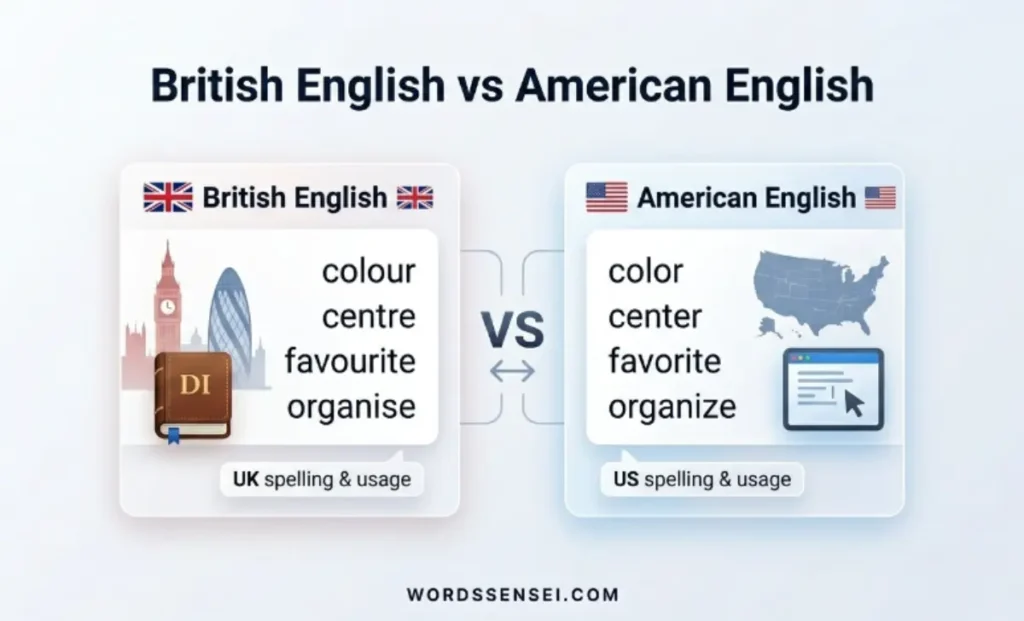
The main difference is regional spelling preference.
Comparison Table
| Feature | American English | British English |
|---|---|---|
| Verb | Organize | Organise |
| Adjective | Organized | Organised |
| Noun | Organization | Organisation |
| Region | USA | UK, Australia |
Furthermore, this pattern is common across many English words.
Organized vs Organised Variations (Word Family)
Many related words follow the same spelling rule.
Extended Table
| Word Type | US English | UK English |
|---|---|---|
| Verb | organize | organise |
| Past tense | organized | organised |
| Present continuous | organizing | organising |
| Noun | organization | organisation |
| Adjective | organizational | organisational |
Moreover, understanding this pattern helps you avoid mistakes in writing.
Which Spelling Should You Use?
Now the most important question is: which one should YOU choose?
US Audience
If your target audience is in the United States, then you should always use organized.
UK Audience
On the other hand, if your audience is from the United Kingdom or similar regions, then you should use organised.
Global Audience
However, if your audience is international, then consistency is the most important rule. Therefore, choose one version and stick with it throughout your content.
Academic Writing
In addition, always follow your institution’s style guide because universities often require specific English variants.
Business Writing
Similarly, companies usually maintain brand consistency by choosing one spelling style for all content.
Common Mistakes with Organized or Organised
Even advanced writers sometimes make mistakes with these words.
Frequent Errors
- Mixing both spellings in one article
- Switching between US and UK English randomly
- Using inconsistent spelling in SEO content
- Ignoring audience targeting
Correct vs Incorrect Usage
❌ The team organized and organised the event.
✔ The team organized the event. (US style)
❌ She organised a well organized system.
✔ She organised a well organised system. (UK style)
Therefore, consistency is more important than spelling choice.
Organized or Organised in Real Life Usage
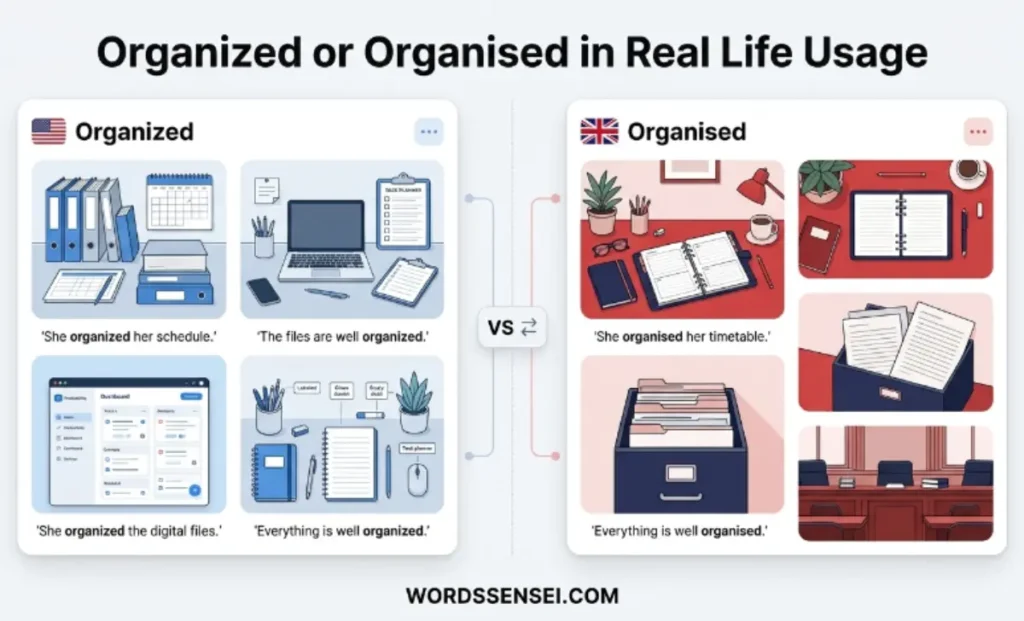
Let’s explore how both words appear in daily writing.
Emails
- US: We organized the meeting schedule.
- UK: We organised the meeting schedule.
Social Media
- Stay organized and focused.
- Stay organised and focused.
Business Writing
- Organized workflow improves productivity.
- Organised workflow improves efficiency.
Academic Writing
- Students organized their research notes.
- Students organised their research notes.
Moreover, these examples show that both forms are widely accepted.
SEO Perspective: Does Spelling Matter?
From an SEO point of view, both keywords are important.
Important SEO Insight
Google understands that organized and organised are the same concept, even though spelling differs. Therefore, content can rank for both variations if used naturally.
SEO Strategy
- Use one primary spelling (based on audience)
- Include the alternate spelling naturally in content
- Avoid keyword stuffing
- Focus on semantic meaning
Moreover, this improves topical authority and keyword coverage.
Google Trends & Usage
Search behavior shows global usage differences.
Country Preference
- United States → organized
- United Kingdom → organised
- Canada → mixed usage
- Australia → organised
- India → both commonly used
Why People Search This
- Academic writing confusion
- SEO content optimization
- English learning purposes
- Business communication accuracy
Furthermore, this keyword has consistent evergreen search demand.
Related Grammar Rules
This confusion belongs to a wider group of English spelling variations.
Similar Word Pairs
- organize / organise
- color / colour
- center / centre
- realize / realise
- traveling / travelling
- analyze / analyse
Helpful Tips
- Always identify your audience first
- Choose one English standard
- Use grammar tools for consistency
- Avoid mixing spelling systems
In addition, these habits improve writing quality and SEO performance.
Advanced Writing Tip (SEO Boost)
If you are writing blogs or SEO content, then:
👉 Use “organized” as primary keyword
👉 Mention “organised” as secondary variation
This helps you rank in both US and UK search results. Moreover, it increases semantic reach and keyword coverage.
FAQs
Is organized or organised correct?
Both are correct, depending on English region.
What is American English spelling?
“Organized” is American English.
What is British English spelling?
“Organised” is British English.
Do both words mean the same?
Yes, both have identical meaning.
Which is better for SEO?
Neither is better; audience targeting matters more.
Can I use both in one article?
No, consistency is recommended.
Does Google rank both equally?
Yes, Google understands both as same intent.
Conclusion
In conclusion, both organized and organised are correct English spellings. However, the difference lies only in regional usage. Therefore, American English uses “organized,” while British English uses “organised.”
Moreover, both words carry identical meaning and can be used depending on audience requirements. Finally, the most important rule in writing is consistency, because consistent spelling improves readability, professionalism, and SEO performance.
Read More Blogs:
- Dietitian or Dietician? The Correct Spelling May Surprise You
- Sees or See’s? The Grammar Mistake Thousands of Writers Make

Hi, I am Gerald Nelson, a professional content writer working on wordssensei.com.
I create engaging and SEO-friendly content that informs and inspires readers.