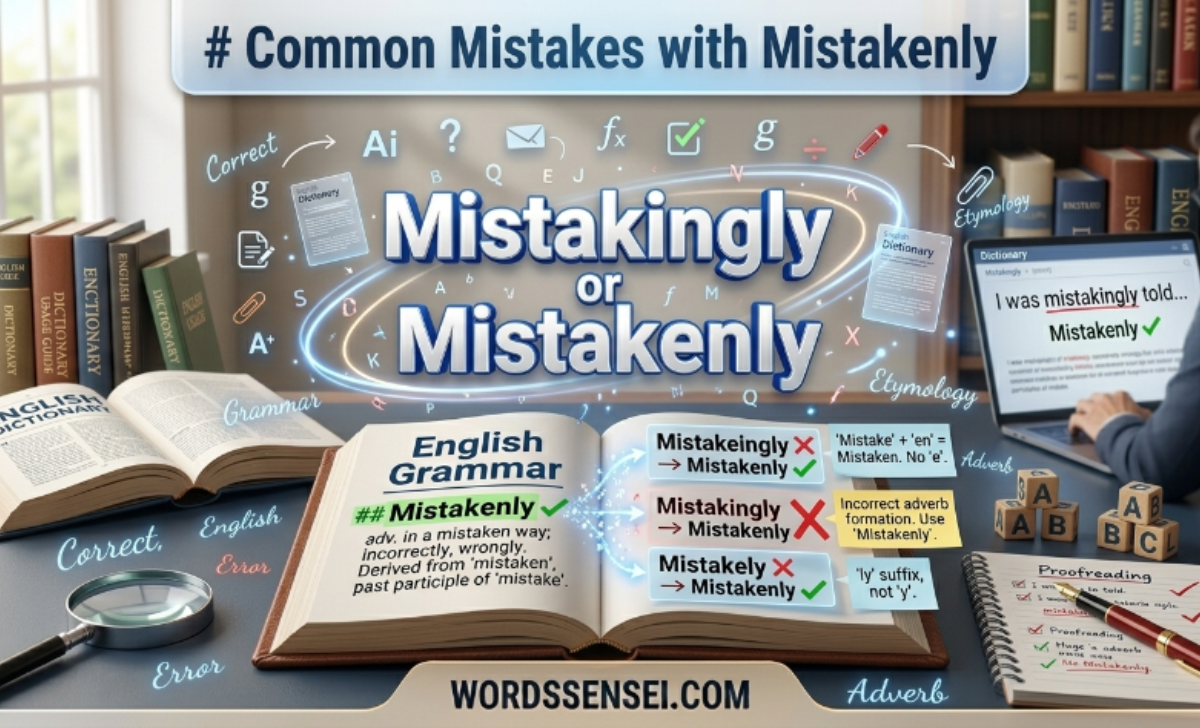
Have you ever paused while writing an important email or a formal essay, wondering if you should type mistakenly or mistakingly? If so, you are definitely not alone. This is one of the most common spelling dilemmas in the English language today. Getting this right is very important for your credibility.
Consequently, using the wrong spelling can make your writing look less professional to your readers. This guide is designed to solve this mystery once and for all. Therefore, by the time you finish reading this detailed article, you will be an expert on the correct spelling, the grammatical rules, and the everyday usage of this essential term.
Furthermore, understanding the difference between these two spellings is not just about grammar; it is about showing attention to detail. In the world of professional communication, every small detail matters.
Therefore, we will dive deep into the word’s history, explore the rules of adverb formation, and provide you with foolproof tricks to remember the right version. As a result, you will be able to write with absolute confidence in any professional setting.
Quick Answer
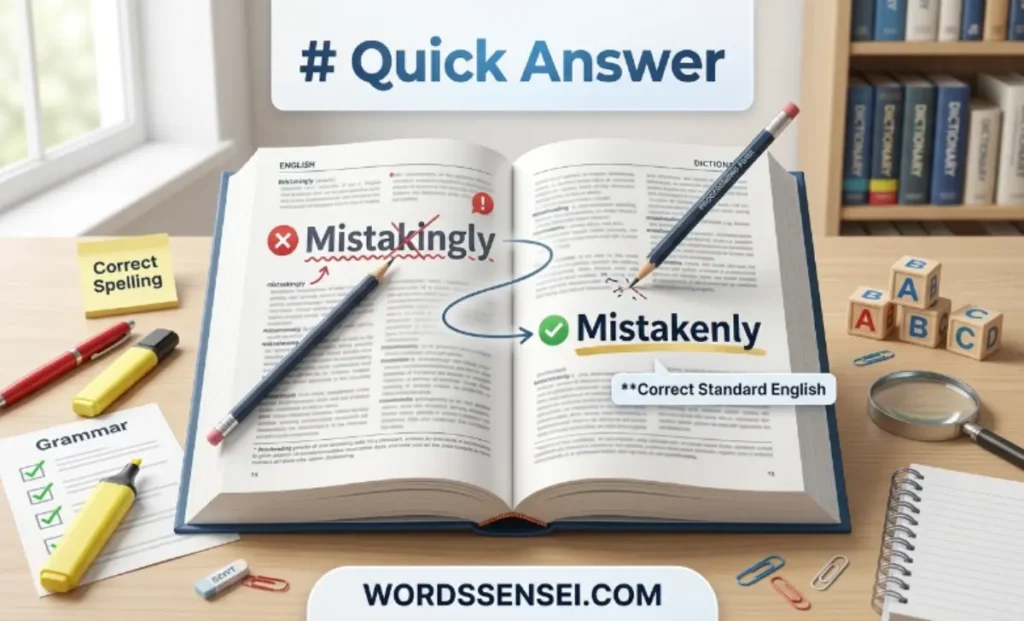
The correct and standard spelling is mistakenly. It is formed by adding the suffix “-ly” to the adjective “mistaken.” While many people use “mistakingly” in casual speech or informal writing, it is actually a mistake. In modern English, “mistakingly” is considered a non-standard or incorrect form and is not recognized in major dictionaries. You can verify this by checking the official entries on Merriam-Webster or the Oxford Learner’s Dictionary. Therefore, whether you are in the United States, the United Kingdom, or Canada, you must always use the version mistakenly.
Additionally, the reason for this spelling lies in how adverbs are created. Because the root adjective is “mistaken,” we simply add “-ly” to turn it into an adverb. Consequently, if you want to be correct, you should always stick to mistakenly.
Correct Example
- I mistakenly deleted the wrong file from the computer.
- She was mistakenly identified as the winner of the contest.
- The email was mistakenly sent to the entire department.
Incorrect Example
- I mistakingly thought the meeting was at 2 PM. (Wrong)
- He mistakingly assumed everyone knew the news. (Wrong)
- The package was mistakingly delivered to the neighbor. (Wrong)
What Does Mistakenly Mean?
The word mistakenly is an adverb that describes an action done by mistake or in error. In other words, it indicates that something happened unintentionally or incorrectly.
Common Meanings
- By Error: When an action is performed incorrectly.
- Unintentionally: When something happens without the person meaning for it to happen.
- Inaccurately: When information is given or understood in a way that is not true.
- Inadvertently: When a slip-up occurs due to a lack of attention.
- Erroneously: When a belief or statement is based on a mistake.
Simple Usage Examples
- Work: “The manager mistakenly approved the budget without checking the figures.”
- Social: “I mistakenly called my teacher by my mother’s name.”
- Technical: “The software mistakenly flagged the safe file as a virus.”
- Legal: “The witness mistakenly described the car as red instead of blue.”
The Origin of Mistakenly
The history of this word is rooted in the development of Middle English.
Word History
The word mistakenly comes from the base word “mistake,” which has Old Norse roots (mistaka meaning “to take by error”). Over time, the adjective “mistaken” was formed to describe someone who has made an error. Consequently, in the 15th century, the adverb mistakenly was created to describe the manner in which an action was performed. Therefore, it follows the long-standing English tradition of adding “-ly” to adjectives.
Why the Confusion Happens
The confusion happens because people often think of the verb “mistaking” (the present participle of mistake). As a result, they try to add “-ly” to “mistaking” to create an adverb. For instance, words like “smilingly” or “knowingly” follow this pattern. However, for the word mistake, the standard adverb is built on the past participle “mistaken.” Consequently, people often misspell it by following a different, but common, grammatical pattern.
British English vs. American English
Interestingly, the spelling of mistakenly is one of the few things that remains the same in all major versions of English.
Comparison Table
| Feature | American English (US) | British English (UK) |
|---|---|---|
| Spelling | Mistakenly | Mistakenly |
| Adjective Form | Mistaken | Mistaken |
| Verb Form | Mistake | Mistake |
| Common Error | Mistakingly | Mistakingly |
Whether you are in London or New York, the word is always mistakenly. Therefore, you do not need to worry about regional differences when using this term.
Mistakenly vs. Other Variations
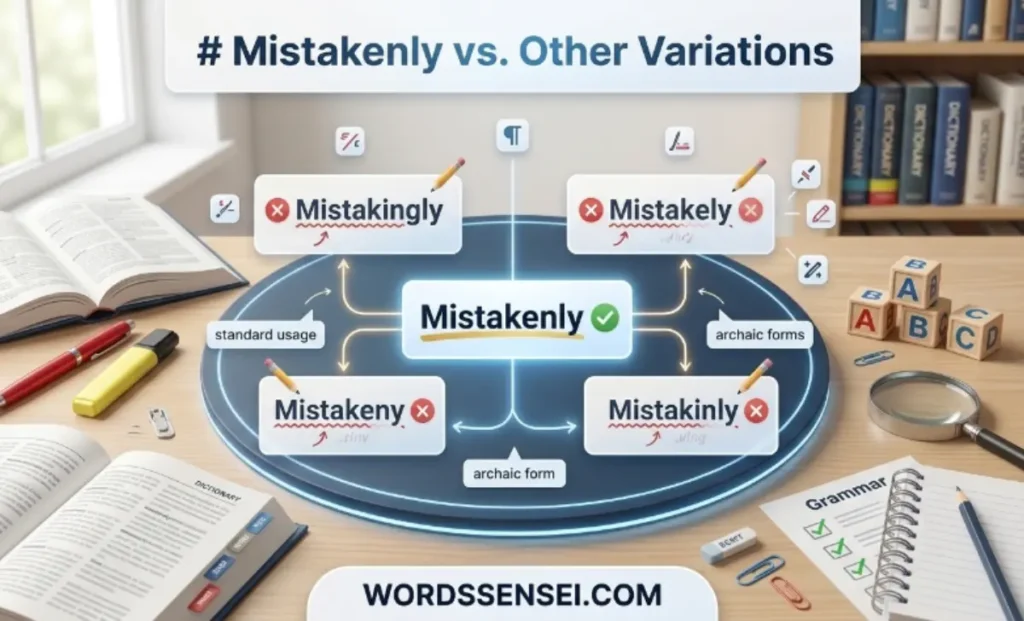
It is helpful to see how this word compares to other terms in the world of grammar and professional writing.
Spelling Comparison Table
| Correct Spelling | Incorrect Spelling | Usage | Category |
|---|---|---|---|
| Mistakenly | Mistakingly | Standard | Adverb |
| Accidentally | Accidently | Standard | Adverb |
| Inadvertently | Inadvertantly | Formal | Adverb |
| Erroneously | Erronously | Academic | Adverb |
Mistakenly vs. Accidentally Comparison
| Feature | Mistakenly | Accidentally |
|---|---|---|
| Core Cause | A wrong belief or judgment | A physical slip or chance event |
| Intent | Often involves a choice made in error | Usually involves no choice at all |
| Context | Common in logic and identification | Common in physical actions |
| Example | “I mistakenly thought he was the boss.” | “I accidentally dropped my phone.” |
Common Error Terms for Mistakenly
| Term | Definition | Importance |
|---|---|---|
| Typo | A small typing mistake | High (Common) |
| Blunder | A large or stupid mistake | Critical (Professional) |
| Slip-up | A minor or careless error | Medium (Casual) |
| Omission | Leaving something out by mistake | High (Legal/Business) |
The Rule of Adverb Formation
To truly understand why we spell it this way, you must understand how adverbs are built from adjectives.
How the Rule Works
In English, most adverbs are formed by taking an adjective and adding the suffix “-ly.” For example, “happy” becomes “happily” and “sad” becomes “sadly.” In our case, the adjective is mistaken. Therefore, when we add “-ly,” we get mistakenly. Consequently, using “mistakingly” would mean you are trying to turn a verb participle into an adverb, which is not the standard way for this specific word.
Helpful Grammar Tips
Always remember the “Adjective Test.” Ask yourself: “Is the person mistaken or mistaking?” Since we say a person is “mistaken,” the adverb must be mistakenly. Therefore, if you can remember the adjective, you will remember the adverb. Consequently, your writing will always be accurate.
Which Spelling Should You Use?
You should always use the version mistakenly. There is no professional or academic setting where “mistakingly” is accepted.
US Audience
In the US, all major style guides, including the Associated Press (AP) and Chicago Manual of Style, use mistakenly. Therefore, using the wrong spelling could lead to a lack of trust in your writing.
UK Audience
In the UK, the term is standard in all academic and professional documents. Consequently, British professionals always use the “mistakenly” version.
International Writing
For global business and international communication, mistakenly is the universal term. Therefore, using the correct spelling ensures your documents are recognized everywhere.
Academic Writing
In university papers or research journals, “mistakingly” is a significant spelling error. As a result, students should always double-check their work for the correct form.
Social Media Usage
Even on LinkedIn or Twitter, using the correct spelling shows that you are a professional. Consequently, it helps you build a better brand identity.
Common Mistakes with Mistakenly
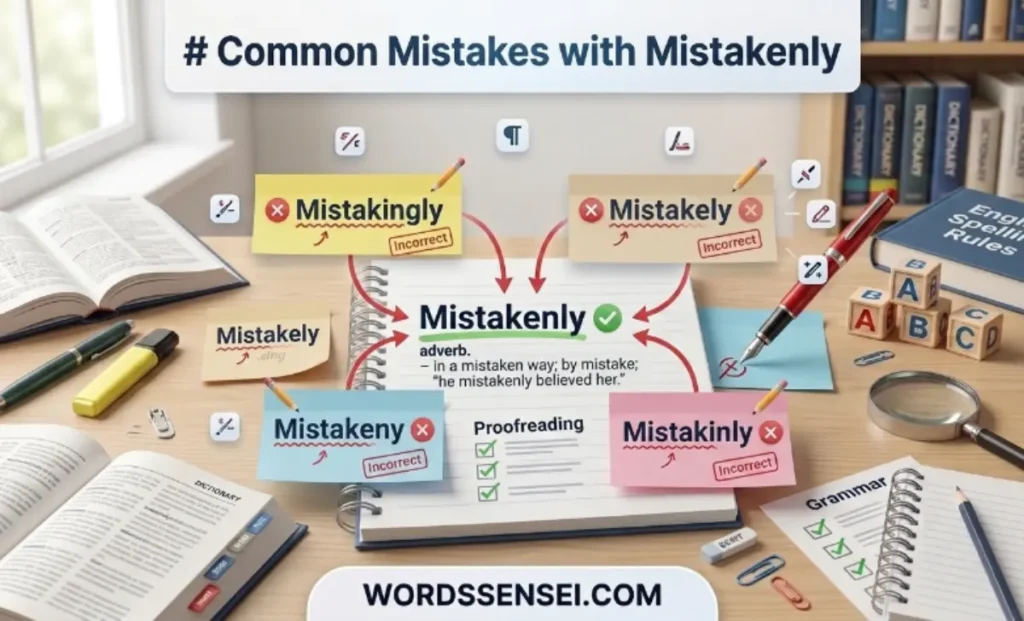
Avoid these frequent errors to keep your writing professional.
Frequent Errors
- The “ING” Trap: Writing “mistakingly” because it sounds like “mistaking.”
- Missing the ‘E’: Writing “mistaknly.”
- Double ‘L’ Confusion: Writing “mistakenlly” by mistake.
- Confusing with Accidentally: Using the two terms interchangeably when the context is different.
Corrected Examples
- Incorrect: “I mistakingly called you.”
- Correct: “I mistakenly called you.”
- Incorrect: “The file was mistakingly deleted.”
- Correct: “The file was mistakenly deleted.”
Mistakenly in Everyday Examples
Let’s look at how the word is used in different professional contexts.
Emails
“Dear Customer, we mistakenly charged your account twice. We have already issued a refund.”
Social Media
“I mistakenly thought today was Friday! #WorkLife #WeekendVibes”
News Writing
“The police mistakenly released a statement before all the facts were confirmed.”
School Writing
“In the experiment, the student mistakenly added too much salt to the solution.”
Business Writing
“The company mistakenly underestimated the demand for the new product.”
Google Trends & Usage Data
The data shows that “mistakenly” is a high-volume search term worldwide.
Popular Countries
- United States: High volume for “mistakenly deleted photos.”
- United Kingdom: Frequent searches for “mistakenly paid tax.”
- India: Large number of searches for “mistakenly sent money.”
- Australia: Common searches for “mistakenly identified.”
- Canada: High volume for “mistakenly cancelled order.”
Why People Search This Keyword
Most people search this keyword because they have made a mistake and are looking for a solution. However, a large number of searches also come from people checking the spelling before writing a formal letter. Consequently, it is a vital keyword for anyone interested in English grammar.
Related Grammar Rules
Spelling is easier when you understand the patterns of the English language.
Similar Spelling Mistakes
- Drunkenly: Often confused with “drinkingly” (which isn’t a word).
- Hiddenly: Sometimes written as “hidingly.”
- Brokenly: Sometimes confused with “breakingly.”
Helpful Grammar Tips
Always remember the “Past Participle Rule.” Many adverbs are formed from the past participle of a verb (like mistaken, broken, or hidden). Therefore, if the word ends in “-en,” just add “-ly.” Consequently, you will never get it wrong again.
FAQs
Is it mistakenly or mistakingly?
The correct spelling is mistakenly. “Mistakingly” is incorrect.
Why is mistakingly wrong?
Because the adverb is formed from the adjective “mistaken,” not the verb participle “mistaking.”
What is a synonym for mistakenly?
Common synonyms include accidentally, inadvertently, and erroneously.
Can I use mistakenly in a formal email?
Yes, mistakenly is the perfect word for formal communication to admit an error.
Is mistakenly a common word?
Yes, it is a very common adverb used in daily life, business, and law.
How do I remember the spelling?
Think of the word “mistaken.” If you are “mistaken,” you acted “mistakenly.”
Is ‘mistakenly’ used in British English?
Yes, it is the standard spelling in all forms of English.
What is an example of mistakenly in a sentence?
“The bank mistakenly sent the statement to the old address.”
Conclusion
In conclusion, the spelling of mistakenly is a small but vital detail in the world of professional writing. While the mistake of using “mistakingly” is common due to the influence of the verb “mistaking,” the correct version always follows the adjective “mistaken.”
Throughout this guide, we have seen that mistakenly is a key term in business, law, and daily life, describing the act of performing an action by error or unintentionally. Whether you are writing a formal apology or a technical report, your writing deserves the correct spelling.
Furthermore, by understanding the rules of adverb formation and the importance of the adjective root, you can avoid this spelling trap forever. Consequently, your business documents, emails, and social media posts will always look professional and credible.
Remember, attention to detail is what separates a good writer from a great one. Therefore, keep the “-en-” in mistakenly, stay focused on your intent and accuracy, and your professional reputation will continue to grow. Your commitment to accuracy is the foundation of your success in any field!
Read More Blogs:
- Now or Later: Avoid This Common English Usage Mistake
- Feel or Feal: One Is Correct, One Is a Common Mistake

Gerald Nelson is a contributing writer at Wordssensei.com, covering English grammar, vocabulary, and commonly confused words.