Have you ever stopped while writing a difficult message or a formal legal document, wondering if you should type blame or blaim? If so, you are definitely not alone. This is one of the most common spelling dilemmas in the English language today. Getting this right is very important for your credibility.
Consequently, using the wrong spelling can make your writing look less professional to your readers. This guide is designed to solve this mystery once and for all. Therefore, by the time you finish reading this detailed article, you will be an expert on the correct spelling, the psychological meaning, and the everyday usage of this essential term.
Furthermore, understanding the difference between these two spellings is not just about grammar; it is about showing attention to detail. In the worlds of law, psychology, and management, every small detail matters.
Therefore, we will dive deep into the word’s history, explore the “silent e” rule, and provide you with foolproof tricks to remember the right version. As a result, you will be able to write with absolute confidence in any professional setting.
Quick Answer
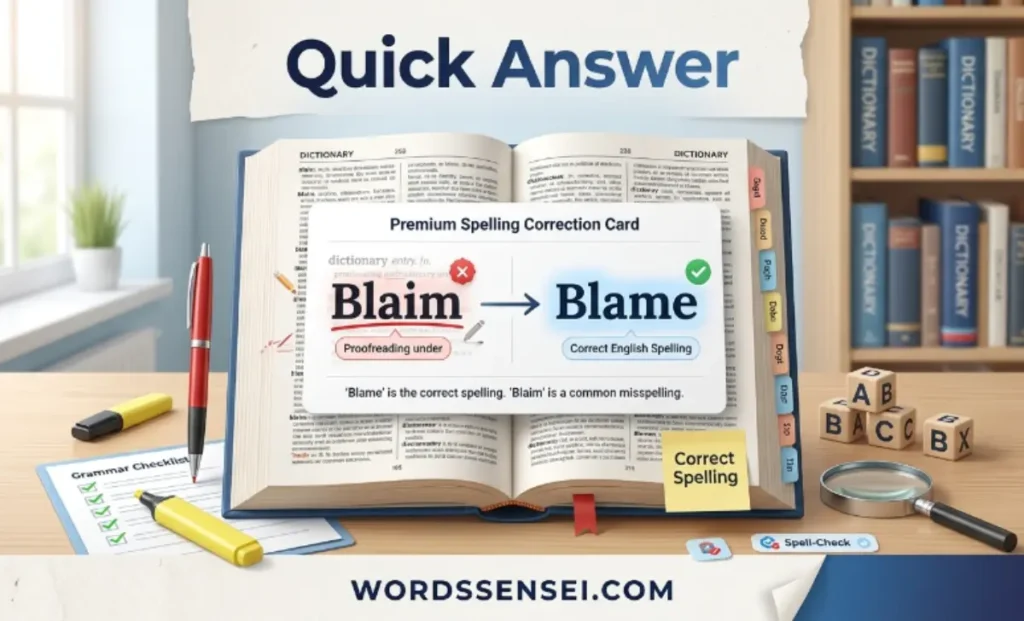
The correct and standard spelling is blame. It is spelled with a silent “e” at the end. While many people assume it follows the pattern of words like “claim” or “aim,” this is actually a mistake. In modern English, “blaim” is considered a misspelling and is not recognized in major dictionaries. You can verify this by checking the official entries on Merriam-Webster or the Cambridge Dictionary. Therefore, whether you are in the United States, the United Kingdom, or Australia, you must always use the version blame.
Additionally, the reason for this spelling lies in the “silent e” rule of English phonetics. Because the “e” at the end makes the “a” sound long, the word does not need the “i” found in words like “claim.” Consequently, if you want to be correct, you should always stick to blame.
Correct Example
- Do not blame others for your own mistakes.
- The company took the blame for the faulty product.
- She was afraid of the blame that would follow the failure.
Incorrect Example
- He tried to blaim his brother for the broken vase. (Wrong)
- There is no need to blaim the weather. (Wrong)
- She was the one to blaim for the error. (Wrong)
What Does Blame Mean?
The word blame can be both a verb and a noun. It describes the act of finding fault or the responsibility for a mistake. In other words, it is a term that deals with accountability and judgment.
Common Meanings
- To Find Fault: When you say someone is responsible for something bad.
- Responsibility: The state of being the cause of a negative event.
- Accusation: A statement that someone has done something wrong.
- Censure: A formal expression of severe disapproval.
- Culpability: The degree to which someone is to be blamed for a crime or error.
Simple Usage Examples
- Psychology: “The blame game often prevents teams from solving real problems.”
- Law: “The court determined the level of liability and assigned blame to the driver.”
- Social: “He accepted the blame with a sense of guilt and regret.”
- Management: “A good leader takes the blame and gives away the credit.”
The Origin of Blame
The history of this word is rooted in the development of Old French and Latin.
Word History
The word blame comes from the Old French word blasmer, which in turn comes from the Latin word blasphemare (meaning “to blaspheme” or “to speak ill of”). Over time, the meaning shifted from religious speaking to general fault-finding. Consequently, the spelling evolved to follow the rules of English phonetics. Therefore, the “silent e” became the standard way to represent the long “a” sound. Therefore, it follows the same pattern as words like “name” and “tame.”
Why the Confusion Happens
The confusion happens because English has several ways to create a long “a” sound. For instance, words like “claim,” “aim,” and “proclaim” use the “ai” pattern. As a result, many people naturally think they should apply this same pattern to blame. However, because blame comes from a different linguistic root, it uses the “a-e” pattern instead. Consequently, people often misspell it by following a different, but common, spelling pattern.
British English vs. American English
Interestingly, the spelling of blame is one of the few things that remains the same in all major versions of English.
Comparison Table
| Feature | American English (US) | British English (UK) |
|---|---|---|
| Spelling | Blame | Blame |
| Meaning | Fault / Responsibility | Fault / Responsibility |
| Pronunciation | bleɪm | bleɪm |
| Common Error | Blaim | Blaim |
Whether you are in London or New York, the word is always blame. Therefore, you do not need to worry about regional differences when using this term.
Blame vs. Other Variations
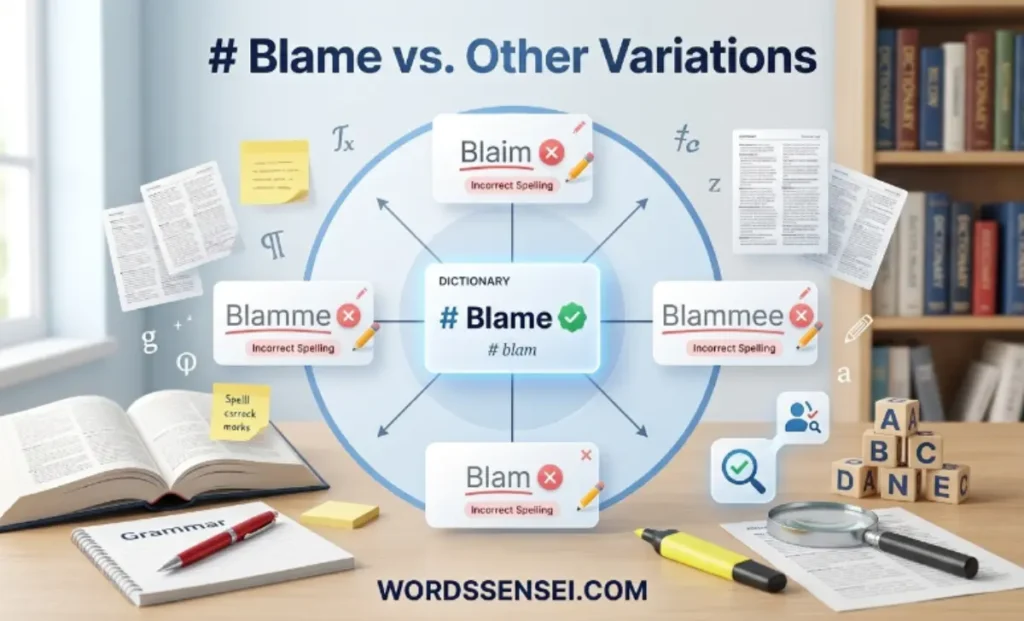
It is helpful to see how this word compares to other terms in the world of psychology and law.
Spelling Comparison Table
| Correct Spelling | Incorrect Spelling | Usage | Category |
|---|---|---|---|
| Blame | Blaim | Standard | Noun/Verb |
| Claim | Clame | Standard | Verb |
| Accountability | Acountability | Standard | Noun |
| Liability | Liabilty | Legal | Noun |
Blame vs. Responsibility Comparison
| Feature | Blame | Responsibility |
|---|---|---|
| Tone | Negative / Critical | Neutral / Professional |
| Focus | Past errors and faults | Future duties and past actions |
| Outcome | Punishment or guilt | Accountability or ownership |
| Example | “Who is to blame for this?” | “It is my responsibility to fix this.” |
Common Terms in the Blame Cycle
| Term | Definition | Importance |
|---|---|---|
| Scapegoating | Blaming someone else for one’s own problems | High (Social/Psych) |
| Culpability | Legal responsibility for a fault | Critical (Law) |
| Censure | Formal disapproval | High (Politics/Business) |
| Reproach | Expressing disappointment or blame | Medium (Social) |
The “Silent E” Rule
To truly understand why we spell it this way, you must understand the role of the final “e” in English.
How the Rule Works
In English, when a word ends in a single consonant followed by an “e,” the “e” is usually silent and makes the preceding vowel long. For example, in “name,” “tame,” and “game,” the “e” changes the sound of the “a.” In our case, the word is blame. Therefore, the “e” at the end tells us to say the “a” as a long vowel. Consequently, adding an “i” would be redundant and incorrect.
Helpful Grammar Tips
Always remember the “Claim Test.” While “claim” needs the “i” to make the sound, blame uses the “e” at the end. Therefore, if you see an “e” at the end, you don’t need the “i.” Consequently, your writing will always be accurate.
Which Spelling Should You Use?
You should always use the version blame. There is no professional or academic setting where “blaim” is accepted.
US Audience
In the US, all major style guides, including the Associated Press (AP) and Chicago Manual of Style, use blame. Therefore, using the wrong spelling could lead to a lack of trust in your writing.
UK Audience
In the UK, the term is standard in all legal and psychological documents. Consequently, British professionals always use the “blame” version.
International Writing
For global business and conflict resolution, blame is the universal term. Therefore, using the correct spelling ensures your documents are recognized everywhere.
Academic Writing
In university papers or research journals, “blaim” is a significant spelling error. As a result, students should always double-check their work for the correct form.
Social Media Usage
Even on LinkedIn or Twitter, using the correct spelling shows that you are a professional. Consequently, it helps you build a better brand identity.
Common Mistakes with Blame
Avoid these frequent errors to keep your writing professional.
Frequent Errors
- The “AI” Trap: Writing “blaim” because it sounds like “claim.”
- Missing the ‘E’: Writing “blam.”
- Confusing with Flame: Writing “flame” by mistake.
- Double ‘M’ Confusion: Writing “blamme” by mistake.
Corrected Examples
- Incorrect: “I don’t want to blaim you.”
- Correct: “I don’t want to blame you.”
- Incorrect: “She took the blaim.”
- Correct: “She took the blame.”
Blame in Everyday Examples
Let’s look at how the word is used in different professional contexts.
Emails
“Dear Team, we should not spend time assigning blame; instead, let’s focus on a solution.”
Social Media
“It’s easy to blame the circumstances, but hard to take responsibility. #GrowthMindset #Leadership”
News Writing
“The report was careful not to assign blame to any single department before the investigation.”
School Writing
“In the novel, the protagonist struggles with self-blame after the tragic accident.”
Business Writing
“The company accepted full accountability and did not try to shift the blame to its partners.”
Google Trends & Usage Data
The data shows that “blame” is a high-volume search term worldwide.
Popular Countries
- United States: High volume for “blame game psychology.”
- United Kingdom: Frequent searches for “blame for the accident.”
- India: Large number of searches for “blame someone for something.”
- Australia: Common searches for “legal blame and liability.”
- Canada: High volume for “who is to blame.”
Why People Search This Keyword
Most people search this keyword because they are dealing with a conflict. However, a large number of searches also come from people checking the spelling before writing a formal letter. Consequently, it is a vital keyword for anyone interested in social behavior.
Related Grammar Rules
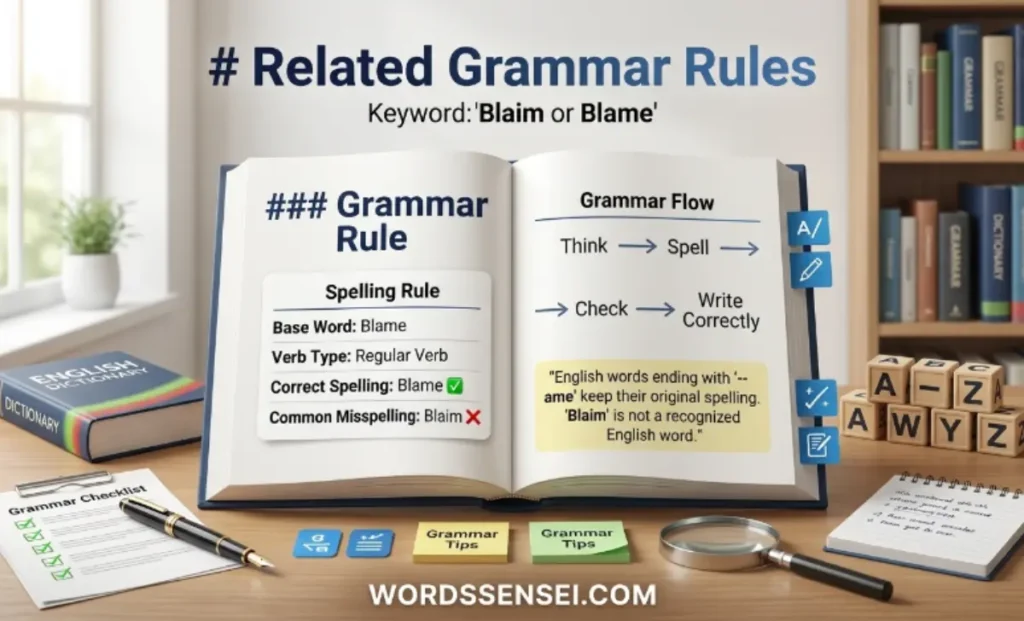
Spelling is easier when you understand the patterns of the English language.
Similar Spelling Mistakes
- Tame: Sometimes confused with “taim.”
- Game: Sometimes confused with “gaim.”
- Flame: Sometimes confused with “flaim.”
- Name: Sometimes confused with “naim.”
Helpful Grammar Tips
Always remember the “Silent E” family. Words like blame, flame, and tame all follow the same pattern. Therefore, if you can spell “game,” you can spell blame. Consequently, you will never get it wrong again.
FAQs
Is it blame or blaim?
The correct spelling is blame. “Blaim” is incorrect.
Why is blaim wrong?
Because the word follows the “silent e” rule (a-e) rather than the “ai” pattern.
What is a synonym for blame?
Common synonyms include fault, accusation, censure, and reproach.
Can I use blame in a formal email?
Yes, blame is a standard professional word, though using “responsibility” is often more positive.
What is the ‘blame game’?
It is a situation where people try to avoid responsibility by accusing others of a mistake.
How do I remember the spelling?
Think of the word “game.” If you are in the “blame game,” it ends with “e.”
Is ‘blame’ used in British English?
Yes, it is the standard spelling in all forms of English.
What is legal liability?
It is the legal state of being responsible for something, often involving blame and compensation.
Conclusion
In conclusion, the spelling of blame is a small but vital detail in the world of professional writing and social interaction. While the mistake of using “blaim” is common due to the influence of words like “claim,” the correct version always follows the “silent e” rule.
Throughout this guide, we have seen that blame is a key term in law, psychology, and conflict resolution, describing the act of assigning fault or taking responsibility for a negative event. Whether you are a manager solving a team issue or a student writing an ethics paper, your writing deserves the correct spelling.
Furthermore, by understanding the silent e rule and the importance of the a-e pattern, you can avoid this spelling trap forever. Consequently, your business documents, emails, and social media posts will always look professional and credible. Remember, attention to detail is what separates a good communicator from a great one.
Therefore, keep the “-e” at the end of blame, stay focused on accountability and ethics, and your professional reputation will continue to grow. Your commitment to accuracy is the foundation of your success in any field!
Read More Blogs:
- Stopping or Stoping: Which Spelling Is Correct? (Complete Guide)
- Knick or Nick? Most People Get This Wrong

Gerald Nelson is a contributing writer at Wordssensei.com, covering English grammar, vocabulary, and commonly confused words.