Have you ever stopped while writing a research proposal or a business report, wondering if you should type rationale or rational? If so, you are definitely not alone. This is one of the most common spelling and usage dilemmas in the English language today. Because these two words are so closely related, it is very easy to mix them up.
However, getting this right is very important for your credibility. Consequently, using the wrong word can make your writing look less professional to your readers. This guide is designed to solve this mystery once and for all. Therefore, by the time you finish reading this detailed article, you will be an expert on the correct spelling, the distinct meanings, and the everyday usage of these two essential terms.
Furthermore, understanding the difference between these two spellings is not just about grammar; it is about showing attention to detail. In the worlds of philosophy, business, and science, every small detail matters. Therefore, we will dive deep into the word’s history, explore the different contexts for each term, and provide you with foolproof tricks to remember the right version. As a result, you will be able to write with absolute confidence in any professional setting.
Quick Answer
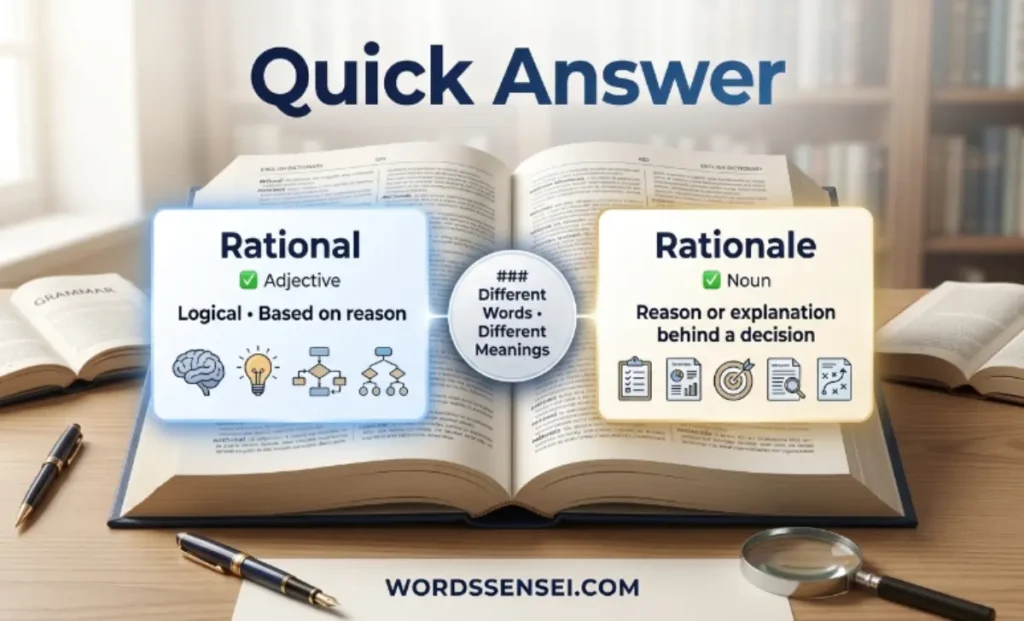
The correct word depends entirely on the grammatical role it plays in your sentence. If you are looking for a noun that describes the underlying reason or logic for something, you should use rationale (with an “e”). On the other hand, if you are looking for an adjective to describe a person or a thought as being logical or sane, you must use rational (without an “e”).
In modern English, these two words share a root but have different functions. You can verify these distinct entries on Merriam-Webster or the Cambridge Dictionary. Therefore, whether you are in the United States or the United Kingdom, you must choose the word that matches your intent.
Additionally, a helpful trick is to think of the “e” in rationale as standing for “Explanation.” Conversely, think of the end of rational as matching words like “logical” or “normal.” Consequently, if you want to be correct, you should always double-check whether you need a naming word (noun) or a describing word (adjective).
Correct Example
- What is the rationale behind this new company policy? (Noun/Reason)
- It is important to stay rational during a crisis. (Adjective/Logical)
- The rational choice was to save the money for later. (Adjective/Reasonable)
- The research paper included a detailed rationale for the study. (Noun/Justification)
Incorrect Example
- He gave a rational for his behavior. (Wrong – should be rationale)
- She is a very rationale thinker. (Wrong – should be rational)
- The rational of the project was unclear. (Wrong – should be rationale)
What Does Rationale Mean?
The word rationale is a noun that describes the fundamental reason or the set of reasons for a particular action or belief. In other words, it is the “why” behind a decision.
Common Meanings
- Underlying Reason: The core logic that supports a choice.
- Justification: The explanation given to defend an action.
- Basis: The foundation upon which a theory or project is built.
- Methodology: In research, the explanation of why a specific method was chosen.
Simple Usage Examples
- Business: “The rationale for the merger was to increase market share.”
- Academic: “The student had to write a rationale for their choice of thesis topic.”
- Legal: “The judge explained the rationale for the final ruling.”
- Daily Life: “I don’t understand the rationale for changing the schedule again.”
What Does Rational Mean?
The word rational is primarily an adjective that describes something as being based on or in accordance with reason or logic.
Common Meanings
- Logical: When a thought or action makes sense and is not based on emotion alone.
- Sane: When a person is of sound mind and capable of clear thought.
- Reasonable: When a choice is sensible and fair.
- Mathematical: A “rational number” is a number that can be expressed as a fraction.
Simple Usage Examples
- Philosophy: “Aristotle believed that humans are rational animals.”
- Psychology: “Cognitive therapy helps patients replace irrational fears with rational thoughts.”
- Mathematics: “The number 0.5 is a rational number because it is 1/2.”
- General: “Let’s try to have a rational discussion about this problem.”
The Origin of Rationale and Rational
The history of these words shows how they developed from the same Latin root into different parts of speech.
Word History
Both words come from the Latin word rationalis, which means “belonging to reason.” This Latin term is derived from ratio, meaning “reason” or “calculation.” In the early days of English, “rational” was used as an adjective to describe logical thinking. Later, in the 17th century, the noun rationale was adopted from the Latin neuter form to describe the “exposition of reasons.” Consequently, the spellings evolved to help distinguish the adjective from the noun. Therefore, we now have two distinct words that allow for more precise communication.
Why the Confusion Happens
The confusion happens because the two words look almost identical and sound very similar. As a result, when we are typing quickly, it is easy to forget the final “e” or add one where it doesn’t belong. For instance, if you are writing about a “rational basis,” you might accidentally write “rationale.” Consequently, people often misspell these words by failing to identify the grammatical role the word is playing in the sentence.
British English vs. American English
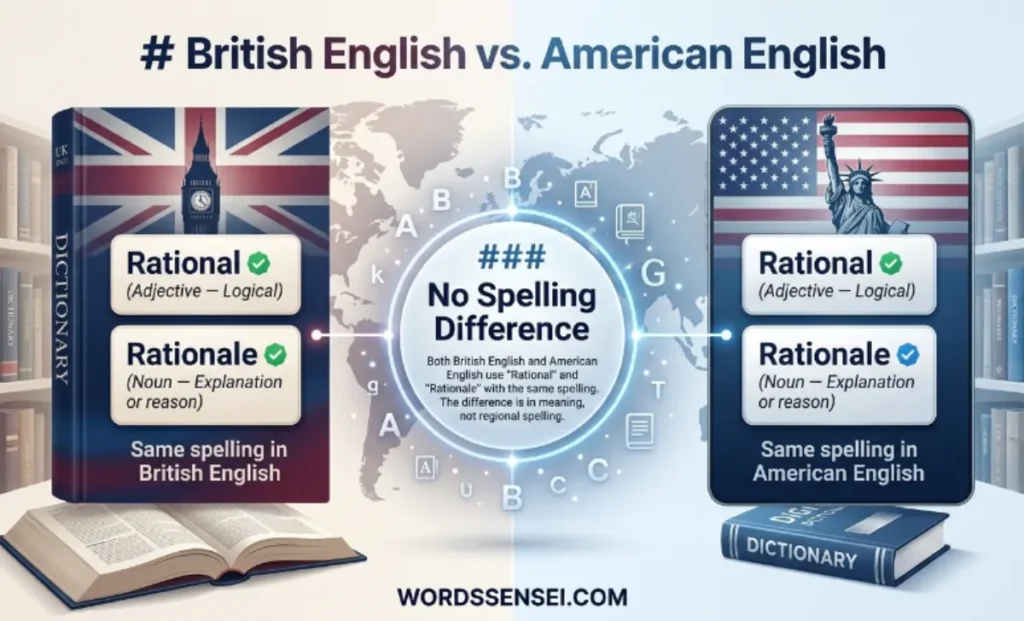
Interestingly, the spelling of both rationale and rational remains the same in all major versions of English.
Comparison Table
| Feature | American English (US) | British English (UK) |
|---|---|---|
| Noun (Reason) | Rationale | Rationale |
| Adjective (Logical) | Rational | Rational |
| Pronunciation | ˌræʃəˈnæl | ˈræʃnəl |
| Mathematics | Rational Number | Rational Number |
Whether you are in London or New York, the rules are the same. Therefore, you do not need to worry about regional differences when using these terms.
Rationale vs. Rational: Comparison Tables
It is helpful to see how these words compare in different professional and daily life settings.
Spelling Comparison Table
| Correct Spelling | Meaning | Usage | Category |
|---|---|---|---|
| Rationale | The Reason (Why) | “Project rationale” | Noun |
| Rational | Logical (How) | “Rational decision” | Adjective |
| Rationalize | To justify (Verb) | “Don’t rationalize it” | Verb |
| Rationality | The state of being rational | “Human rationality” | Noun |
Rationale vs. Rational in Different Industries
| Industry | Term Used | Context |
|---|---|---|
| Philosophy | Rational | Logic and human nature |
| Business | Rationale | Justifying investments and plans |
| Mathematics | Rational | Types of numbers and fractions |
| Psychology | Rational | Behavior and mental health |
| Academic | Rationale | Explaining research methods |
Common Phrases and Idioms
| Phrase | Correct Spelling | Meaning |
|---|---|---|
| Rational choice | Rational | A sensible decision |
| Research rationale | Rationale | The reason for a study |
| Rational basis | Rational | A logical foundation |
| Scientific rationale | Rationale | The logic behind an experiment |
| Rational thinker | Rational | Someone who uses logic |
The “E” for Explanation Rule
To truly understand why we spell it this way, you must understand the mnemonic tricks.
How the Rule Works
In English, nouns often have longer endings than their related adjectives. For rationale, the “e” is the key. You can remember that a RationalE is an Explanation. Conversely, for rational, the word ends like “logical” or “normal.” Therefore, if you are describing something, use the shorter word. If you are naming the reason, use the longer word with the “e.” Consequently, if you can link the letter to the function, you will never fail.
Helpful Grammar Tips
Always remember the “Reason Test.” If you can replace the word with “The Reason,” use rationale. If you can replace it with “Sensible” or “Logical,” use rational. Therefore, the “e” version is for the “why.” Consequently, your writing will always be accurate.
Which Spelling Should You Use?
You should always use the spelling that matches the grammatical function in your sentence. There is no setting where the two are interchangeable.
US Audience
In the US, the term rational is extremely common in political and economic discussions (e.g., “rational actor”). Therefore, using “rationale” in these contexts would be a major error.
UK Audience
In the UK, the term rationale is frequently used in government white papers and policy documents. Consequently, British writers must be careful to use the “e” spelling when explaining the “why” of a new law.
International Writing
For global business and international research, rationale is the universal term for the justification section. Therefore, using the correct spelling ensures your documents are recognized everywhere.
Academic Writing
In university papers or research journals, mixing up these terms is a significant error. As a result, students should always double-check their work for the “noun vs. adjective” difference.
Social Media Usage
Even on LinkedIn or Twitter, using the correct spelling shows that you are a professional. Consequently, it helps you build a better brand identity.
Common Mistakes with Rationale and Rational
Avoid these frequent errors to keep your writing professional.
Frequent Errors
- The Adjective Noun: Writing “he is a rationale person” instead of “rational.”
- The Noun Adjective: Writing “the rational for the change” instead of “rationale.”
- Spelling with ‘Sh’: Writing “rashional” by mistake.
- Mixing with Rationalize: Using the noun when you need the verb.
Corrected Examples
- Incorrect: “I need a rational for this purchase.”
- Correct: “I need a rationale for this purchase.”
- Incorrect: “Stop being so rationale.”
- Correct: “Stop being so rational.”
Rationale and Rational in Everyday Examples
Let’s look at how these words are used in different professional contexts.
Emails
“Dear Manager, please find the rationale for the budget increase in the attached rational analysis.”
Social Media
“Trying to stay rational in a world of emotions. #Logic #Mindset #RationalThinking”
News Writing
“The government provided a clear rationale for the new tax, arguing it was a rational step toward recovery.”
School Writing
“The student’s rationale for the experiment was based on rational observations made during the first phase.”
Business Writing
“Our rationale for entering the Asian market is supported by a rational assessment of the current trends.”
Google Trends & Usage Data
The data shows that “rational” is searched significantly more than “rationale.”
Popular Countries
- United States: High volume for “rational numbers” and “rational choice theory.”
- United Kingdom: Frequent searches for “rationale for research” and “rational behavior.”
- India: Large number of searches for “rational number definition” and “rational thinking.”
- Australia: Common searches for “rationale for policy” and “rational decision making.”
- Canada: High volume for “rational vs rationale” and “rational expectations.”
Why People Search This Keyword
Most people search “rational” because they are looking for mathematics or psychology help. However, a large number of searches also come from people checking the spelling of “rationale” for their reports. Consequently, it is a vital keyword for anyone interested in mantiq (logic) and grammar.
Related Grammar Rules
Spelling is easier when you understand the patterns of related words in English.
Similar Noun vs. Adjective Mistakes
- Moral vs. Morale: Often confused in business settings.
- Personal vs. Personnel: A very common workplace error.
- Principal vs. Principle: The classic school-related homophone.
- Advice vs. Advise: The noun vs. verb distinction.
Helpful Grammar Tips
Always remember the “Function Rule.” If you are describing a person or a thing, use the shorter word: rational. If you are providing a formal explanation or naming a reason, use the longer word: rationale. Therefore, the “e” version is for the “why.” Consequently, you will never get it wrong again.
FAQs
Is it rationale or rational?
It depends. Use rationale (noun) for the reason and rational (adjective) for being logical.
What is a research rationale?
It is the section of a study that explains the fundamental reasons why the research is being conducted.
What is a rational number?
In mathematics, it is any number that can be written as a fraction of two integers.
Can I say ‘he is a rationale man’?
No, the correct adjective is rational.
Why are they spelled differently?
To distinguish between the noun (the reason) and the adjective (the quality of being logical).
How do I remember the ‘e’?
Remember: Rationale ends in E for Explanation.
Is ‘rationality’ a word?
Yes, it is the noun form of “rational,” describing the quality of being logical.
What is a rational choice?
It is a decision made based on logic and evidence rather than just emotion or impulse.
Conclusion
In conclusion, the spelling of rationale and rational is a small but vital detail in the world of professional writing and communication. While the mistake of mixing them up is common due to their similar sound and appearance, the correct version depends entirely on whether you are naming a reason or describing a quality.
Throughout this guide, we have seen that rationale is a specific noun used in business, science, and academic research, while rational is a versatile adjective used in philosophy, mathematics, and psychology.
Furthermore, by understanding the mnemonic tricks and the importance of the noun vs. adjective distinction, you can avoid this spelling trap forever. Consequently, your business documents, academic papers, and social media posts will always look professional and credible.
Remember, attention to detail is what separates a good communicator from a great one. Therefore, keep the “e” in your rationale for projects and stay rational in your thinking, and your professional reputation will continue to grow. Your commitment to accuracy is the foundation of your success in any field!
Read More Blogs:
- Ally or Alley? Stop Making This Common English Mistake!
- Dressing or Stuffing? Learn the Difference With Simple Examples

Anne Seaton is a contributing writer at Wordssensei.com, covering English grammar, vocabulary, and commonly confused words.