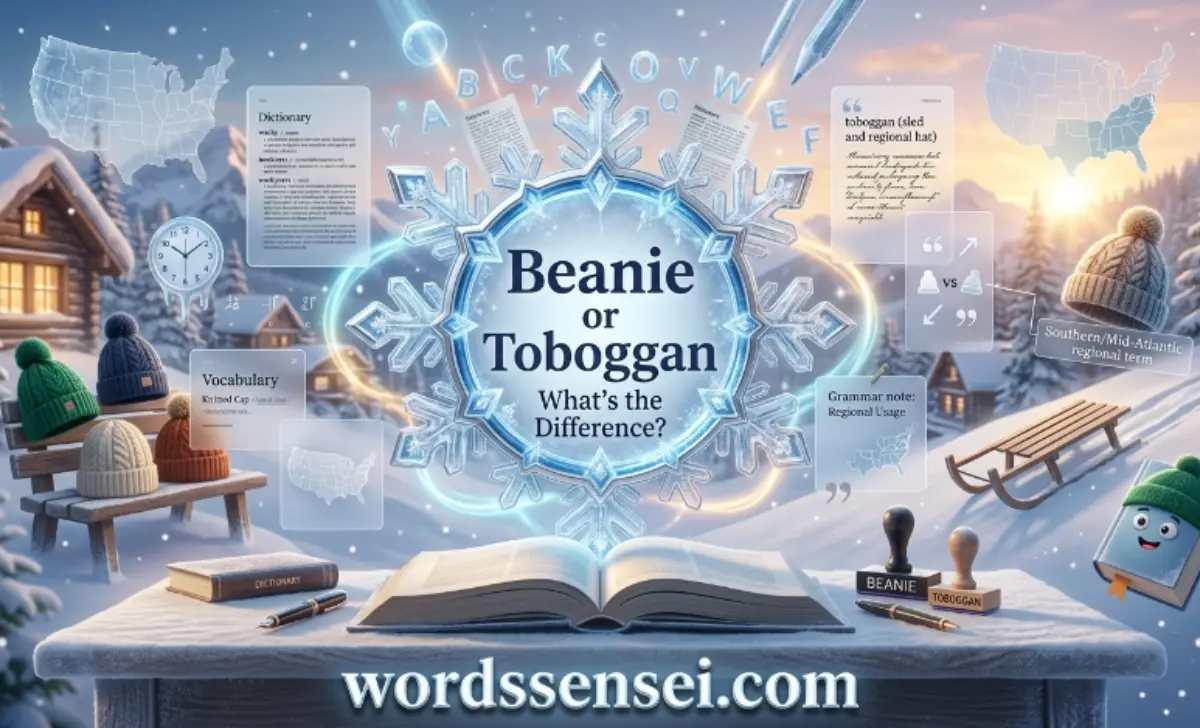
A shopper walks into a store in North Carolina and asks an employee where to find the “toboggans,” expecting to be pointed toward a rack of warm winter hats. The employee, new to the area and originally from California, looks genuinely confused and starts walking toward the sporting goods section, assuming the customer wants a sled. Neither person is wrong, exactly — they’re just speaking two different versions of American English, shaped by one of the country’s most delightfully specific regional quirks.
In most of the United States, and pretty much everywhere else in the English-speaking world, “toboggan” refers exclusively to a long, flat sled used for gliding down snowy hills. But across large parts of the American South, particularly Kentucky, Tennessee, North Carolina, and neighboring states, “toboggan” doubles as the everyday word for a knit winter cap — the exact same thing most Americans would call a “beanie.”
This isn’t a case of one word being correct and the other wrong; it’s a genuine regional dialect split, the kind of linguistic quirk that reveals just how differently English can develop even within a single country. Understanding why “toboggan” came to mean two completely unrelated things in different parts of the same nation offers a fascinating look at how vocabulary drifts, borrows, and localizes over time.
This guide breaks down where both terms come from, why the Southern “toboggan as hat” usage exists at all, how British English handles this same everyday object with its own distinct vocabulary, and how to navigate the confusion if you ever find yourself shopping for cold-weather gear outside your home region.
Quick Answer
Beanie is the standard, widely understood term across most of the English-speaking world for a snug, brimless knit cap worn for warmth. Toboggan, in most contexts, refers to a long sled used for sliding down snow-covered hills, but in the American South, particularly Kentucky, Tennessee, and parts of the surrounding region, “toboggan” is also commonly used as another word for a beanie.
According to Merriam-Webster, a beanie is defined as a small brimless hat. Interestingly, Merriam-Webster’s entry for toboggan also explicitly lists a secondary regional meaning: a knitted stocking cap, confirming that this dual meaning isn’t just casual slang, but a dictionary-recognized regional usage.
A simple way to decide: if you’re writing or speaking for a general, national, or international audience, use beanie, since it’s universally understood. If you’re specifically writing about Southern American culture, dialect, or addressing an audience from that region, “toboggan” as a hat is entirely appropriate and instantly understood.
Correct Example
- She pulled on her beanie before heading out into the cold. (General/universal usage)
- Grab your toboggan, it’s freezing outside today. (Southern US regional usage, meaning hat)
- We spent the afternoon sledding down the hill on an old wooden toboggan. (Standard meaning, sled)
Potentially Confusing Outside Context
- “I need a new toboggan for winter.” (Clear in the American South; genuinely ambiguous or confusing to most other English speakers, who would assume you mean a sled.)
What Does Beanie Mean?
Beanie is a noun referring to a small, close-fitting, brimless knit cap typically worn for warmth during cold weather, though also sometimes worn as a casual fashion accessory year-round.
Common Meanings
- Winter Headwear — a snug knit cap designed to cover the head and ears for warmth.
- Fashion Accessory — a casual style item, sometimes worn regardless of weather.
- Cuffed or Slouchy Styles — various modern variations, including cuffed beanies, slouchy beanies, and pom-pom beanies.
- Universal Term — widely recognized and used across the US, UK, Canada, Australia, and most English-speaking regions.
Simple Usage Examples
- Winter wear: “Don’t forget your beanie, it’s below freezing outside.”
- Fashion: “He wore a beanie even in summer as part of his signature look.”
- Shopping: “The store had a great selection of beanies in every color.”
- Everyday speech: “I lost my favorite beanie somewhere on the ski trip.”
What Does Toboggan Mean?
Toboggan most commonly refers to a long, flat, runnerless sled traditionally made of thin wooden boards curved upward at the front, used for sliding down snowy or icy slopes. In the American South, it also refers to a knit winter cap, functioning identically to a beanie.
Common Meanings
- Sled (Primary/Universal Meaning) — a flat sled without runners, used for sliding down hills.
- Winter Hat (Regional Southern US Meaning) — a knit cap, synonymous with “beanie” in this specific regional usage.
- Recreational Winter Activity — associated with sledding and snow-related outdoor fun.
- Historical/Indigenous Origin — originally referring to a sled used by Indigenous peoples of North America.
Simple Usage Examples
- Standard meaning (sled): “The kids spent all afternoon riding their toboggan down the hill.”
- Southern regional meaning (hat): “It’s cold enough today that I need my toboggan and gloves.”
- Recreational context: “The park has a dedicated toboggan run every winter.”
- Everyday Southern speech: “Where did you put my toboggan? I can’t find it anywhere.”
Beanie vs. Toboggan: Comparison Table
| Term | Standard Meaning | Regional Meaning | Where Regional Meaning Applies |
|---|---|---|---|
| Beanie | Knit winter cap | N/A (universal meaning) | Everywhere |
| Toboggan | Long sled without runners | Knit winter cap | American South (Kentucky, Tennessee, North Carolina, and nearby areas) |
Quick Reference Guide
| If You Mean… | Safest Word to Use Nationally/Internationally | Word Also Used Regionally in the South |
|---|---|---|
| A knit winter cap | Beanie | Toboggan |
| A sled for snow hills | Toboggan | Toboggan (no regional alternate) |
British English vs. American English
While “toboggan” as a hat is a distinctly American regional phenomenon, it’s worth stepping back to see how British English handles winter headwear terminology altogether, since the vocabulary diverges even further once you cross the Atlantic.
Comparison Table
| Term | American English (US) | British English (UK) |
|---|---|---|
| Knit winter cap (general) | Beanie | Beanie or bobble hat |
| Cap with a pom-pom on top | Pom-pom beanie | Bobble hat |
| Sled for snow hills | Toboggan (sometimes “sled”) | Toboggan or sledge |
| Southern US regional term for hat | Toboggan | Not used (no equivalent regional term) |
| Cuffed knit cap | Beanie or watch cap | Beanie |
Key Differences Explained
British English speakers do not use “toboggan” to mean a hat under any circumstances; the word retains only its traditional sled-related meaning throughout the UK. Interestingly, British English introduces its own charming regional vocabulary for winter headwear that America doesn’t share — most notably “bobble hat,” referring specifically to a knit cap topped with a pom-pom, a term almost never used in American English, where “pom-pom beanie” or simply “beanie” covers the same item.
Additionally, British English commonly uses “sledge” alongside “toboggan” for the snow-sliding equipment, while American English leans more heavily on “sled” in everyday conversation, reserving “toboggan” for the more specific, traditional flat-board style.
Why This Regional Split Exists
The American Southern usage of “toboggan” for a hat likely developed through a process linguists call semantic extension, where a word’s original meaning is stretched to cover a related object based on function or trading of goods — in this case, sleds and their riders being closely associated with cold-weather activities, warm hats included.
Since this linguistic shift happened specifically within Southern American communities rather than spreading nationally or crossing into British English, the UK never developed any equivalent secondary meaning for “toboggan,” while simultaneously developing its own separate vocabulary, like “bobble hat,” through an entirely unrelated linguistic path.
The Origin of Beanie and Toboggan
Word History
“Beanie” likely derives from American college slang from the early 20th century, possibly connected to “bean,” an old slang term for “head,” making a “beanie” quite literally a small hat for your “bean.” “Toboggan,” on the other hand, comes from the Algonquian language family, specifically from the Mi’kmaq word topaakan, referring to the traditional flat sled used by Indigenous peoples across northeastern North America for transporting goods and people across snow. The word entered English through French Canadian traders and settlers before spreading into broader North American usage.
How “Toboggan” Came to Mean “Hat” in the South
The regional shift from sled to hat likely emerged through practical association: people riding toboggans needed warm hats to keep their heads covered during the activity, and over time, particularly in Appalachian and Southern communities, the word for the sled itself simply extended to cover the knit cap worn alongside it.
This kind of word-meaning extension through close association is a well-documented pattern in regional dialects worldwide, though the specific “toboggan as hat” usage remains a distinctly American Southern phenomenon.
Which States and Regions Use “Toboggan” for Hat?
This regional usage is most strongly associated with Kentucky, Tennessee, North Carolina, Virginia, and parts of West Virginia and Georgia, generally overlapping with the Appalachian and broader Southern dialect region. Outside these areas, most Americans, along with English speakers worldwide, use “toboggan” exclusively to mean the sled, making “beanie” the far safer, more universally understood term when writing or speaking for a general audience.
Which Term Should You Use?
General/National Audience Writing
For blog posts, product listings, and content aimed at a broad American or international audience, use “beanie” to avoid any confusion with the sled meaning of “toboggan.”
Southern US Regional and Local Content
Content specifically targeting Southern US audiences, local businesses, or regional dialect features can appropriately and authentically use “toboggan” to mean hat, since it will be instantly understood and even feel more locally relevant.
E-commerce and Product Listings
Online retailers should default to “beanie” in product titles and descriptions for maximum clarity and searchability, since customers outside the South searching for “toboggan” are far more likely looking for a sled.
British and International Writing
Writers addressing a British or international audience should avoid “toboggan” for headwear entirely, using “beanie” or, where appropriate, the distinctly British “bobble hat” for pom-pom styles.
Common Mistakes with Beanie and Toboggan
Frequent Errors
- Assuming “toboggan” universally means a hat, when this usage is specifically regional to the American South.
- Using “toboggan” for headwear in national marketing or e-commerce content, risking confusion with the sled meaning.
- Assuming British English shares the Southern American “toboggan as hat” usage, when it does not.
- Overlooking the distinctly British term “bobble hat” when writing for a UK audience about pom-pom knit caps.
Corrected Examples
- Incorrect (for a national audience): “Check out our new winter toboggan collection!”
- Correct: “Check out our new winter beanie collection!”
- Incorrect (assuming universal understanding): “Everyone calls a knit hat a toboggan.”
- Correct: “In parts of the American South, people call a knit hat a toboggan, though most other English speakers say beanie.”
Beanie and Toboggan in Everyday Examples
Emails (National Audience)
“Don’t forget to pack a warm beanie and gloves for the mountain trip this weekend.”
Southern US Regional Speech
“It’s cold out there, go grab your toboggan before you head to the bus stop.”
News Writing
“Local shops in Appalachia report strong seasonal sales of toboggans, a regional term locals use for knit winter caps.”
British Writing
“She wore a cozy bobble hat to match her scarf during the snowy walk through the park.”
Business Writing
“Our winter apparel line features beanies in multiple colors, along with classic wooden toboggans for snow-day fun.”
Why This Keyword Gets Searched
People search “beanie vs toboggan” mostly out of genuine confusion after hearing someone from the American South use “toboggan” to mean a hat for the first time. Transplants moving to Southern states search it while trying to understand local vocabulary and shopping conversations. Writers and marketers search it while deciding which term to use for a specific regional or national audience. A smaller group searches it purely out of linguistic curiosity, fascinated by how the same word can mean two entirely unrelated things within different parts of a single country.
Related Regional Word Differences
Similar American Regionalisms
- Soda vs. Pop vs. Coke — a well-known regional split in what Americans call carbonated soft drinks.
- Sub vs. Hoagie vs. Grinder — another famous regional food-naming difference.
- Y’all vs. You Guys — a related Southern versus general American vocabulary distinction.
Helpful Tips
Whenever a word seems to carry two unrelated meanings within the same language, check whether the split is regional (like “toboggan”) or based on formality, context, or historical usage, since regional dialect differences often explain confusion that isn’t reflected in standard dictionaries as the primary definition.
FAQs
Why do people in the South call a beanie a “toboggan”?
The usage likely developed through association between sledding and the warm knit caps worn during the activity, eventually extending the word “toboggan” to cover the hat itself in Southern dialect.
Is a toboggan a hat or a sled?
Traditionally and universally, a toboggan is a sled. In the American South, it also commonly refers to a knit winter hat, functioning as a regional synonym for “beanie.”
What states call a beanie a toboggan?
This usage is most common in Kentucky, Tennessee, North Carolina, Virginia, and parts of West Virginia and Georgia, generally within the Appalachian and Southern dialect region.
What’s the difference between a beanie and a toboggan hat?
There is no functional difference; in regions where “toboggan” means hat, it refers to the exact same item as a “beanie” — a snug, brimless knit cap.
What other regional names exist for a beanie?
Other terms include “stocking cap,” “watch cap,” and in British English, “bobble hat” specifically for pom-pom styles.
Where did the term “toboggan” for a hat originate?
It originated in Southern Appalachian dialect, likely through semantic extension linking the sled and the warm hat commonly worn while using it.
Does British English use “toboggan” to mean a hat?
No, British English exclusively uses “toboggan” to mean a sled; the regional hat meaning is specific to the American South.
What is the British term for a beanie with a pom-pom?
British English typically calls this a “bobble hat,” a term rarely used in American English, which favors “pom-pom beanie” instead.
Conclusion
“Beanie” and “toboggan” tell one of English’s more charming regional stories — not a case of correct versus incorrect spelling, but a genuine glimpse into how a single word can quietly develop two completely unrelated meanings depending on where you happen to be standing. Across nearly the entire English-speaking world, “toboggan” means exactly one thing: a sled built for gliding down snowy hills.
But tucked within the American South, particularly across Kentucky, Tennessee, and the broader Appalachian region, that same word does double duty as an everyday term for a knit winter cap, existing comfortably alongside “beanie” through generations of regional dialect and local familiarity.
Step across the Atlantic, and the picture shifts again, with British English never adopting the Southern “toboggan as hat” usage at all, instead developing its own distinct vocabulary like “bobble hat” for pom-pom styles. None of this makes any single term more correct than another — it simply reflects how living languages branch, borrow, and localize meaning based on culture, geography, and everyday use.
Whether you’re shopping for cold-weather gear in Nashville, London, or anywhere in between, knowing this small but genuinely fascinating regional quirk means you’ll never find yourself standing confused in the sporting goods aisle when all you really wanted was a warm hat.
Read More Blogs:
- Customer or Client? The Complete Guide to Getting It Right
- Comma or Coma? The Complete Guide to Getting It Right

Hi, I am Anne Seaton. I am a writer and educator working with Wordssensei.com to help students learn English easily.