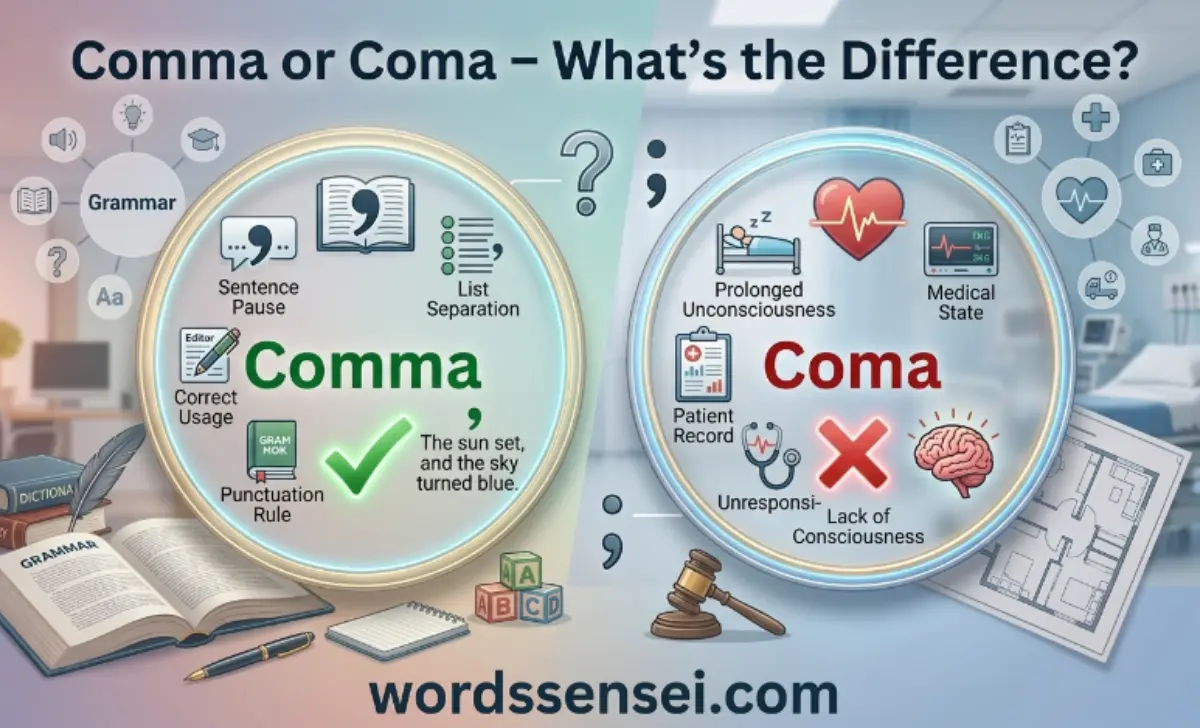
Picture two very different scenes. In the first, a writer is polishing a college essay at midnight, staring at a long sentence and wondering whether it needs a pause before “but.” In the second, a family member is reading a hospital update about a loved one, trying to understand what the doctor meant by a certain medical term.
Strangely enough, both people might end up typing the same search into Google: “comma or coma?” It’s one of those rare word pairs that pulls from two completely unrelated worlds — grammar and medicine — yet trips up writers for exactly the same reason. The two words differ by a single repeated letter, they sound almost identical when read aloud in your head, and autocorrect doesn’t always catch the swap because both spellings are technically real words.
This mix-up matters more than it might seem at first glance. A comma is one of the most frequently used punctuation marks in the English language, showing up in emails, essays, news articles, and even text messages dozens of times a day. A coma, on the other hand, is a serious medical term used in hospitals, health reporting, and personal stories about recovery and survival.
Confusing the two in writing doesn’t just look like a typo — it can genuinely confuse a reader about whether you’re talking about sentence structure or a patient’s condition. A journalist who accidentally writes “the actor is in a comma” instead of “the actor is in a coma” isn’t just making a spelling slip; they’re technically saying something nonsensical.
This guide exists to clear up that confusion permanently. Below, you’ll find the exact meaning of each word, where they come from, how they’re used across different fields, common mistakes people make, and memory tricks that will help the correct spelling stick for good — whether you’re proofreading a school paper or writing carefully about someone’s health.
Quick Answer

Comma is a punctuation mark used to separate parts of a sentence, items in a list, or clauses for clarity. Coma is a medical term describing a deep state of unconsciousness from which a person cannot be woken. They share almost the same letters but mean completely different things.
According to Merriam-Webster, a coma is a state of profound unconsciousness caused by disease, injury, or poison. The Cambridge Dictionary defines a comma as the punctuation mark used to show a pause between parts of a sentence. One word belongs in grammar; the other belongs in medicine.
A simple way to separate them: if your sentence is about writing, punctuation, or pauses, you need comma. If your sentence is about a patient, unconsciousness, or a hospital setting, you need coma.
Correct Example
- Add a comma after the introductory phrase.
- The patient has been in a coma for three weeks.
- Use a comma to separate items in a list.
- Doctors induced a coma to help the brain heal after the accident.
Incorrect Example
- Add a coma after the introductory phrase.
- The patient has been in a comma for three weeks.
- Use a coma to separate items in a list.
What Does Comma Mean?
A comma is a punctuation mark, written as a small curved line ( , ), used to organize the parts of a written sentence. It signals a brief pause and helps readers understand where one idea ends and another begins.
Common Meanings
- Separating Clauses — dividing an independent clause from a dependent one.
- Listing Items — separating three or more items in a series.
- Setting Off Phrases — marking introductory words or non-essential information.
- Joining Sentences — used with a conjunction to connect two complete thoughts.
Simple Usage Examples
- List: “I bought apples, oranges, and bananas.”
- Introductory phrase: “After the meeting, we went for coffee.”
- Joining clauses: “She wanted to leave, but the rain kept her inside.”
- Non-essential info: “My brother, who lives in Karachi, is visiting next week.”
What Does Coma Mean?
A coma is a medical term describing a prolonged state of deep unconsciousness. A person in a coma cannot be woken and does not respond normally to pain, light, or sound.
Common Meanings
- Deep Unconsciousness — a state where the brain shows minimal to no response to stimuli.
- Medical Emergency — often caused by brain injury, stroke, or severe illness.
- Induced Coma — a medically controlled state used to protect the brain during recovery.
- Diabetic Coma — a coma triggered by extremely high or low blood sugar levels.
Simple Usage Examples
- Medical: “The patient slipped into a coma after the head trauma.”
- News: “Doctors placed him in a medically induced coma to reduce brain swelling.”
- Health: “Untreated diabetes can sometimes lead to a diabetic coma.”
- Recovery: “She woke from her coma after two months in the hospital.”
Comma vs. Coma: Comparison Table
| Correct Spelling | Meaning | Field | Example Usage |
|---|---|---|---|
| Comma | Punctuation mark | Grammar/Writing | “Use a comma here.” |
| Coma | State of deep unconsciousness | Medicine | “He is in a coma.” |
Common Phrases
| Phrase | Correct Spelling | Meaning |
|---|---|---|
| Comma splice | Comma | A grammar error joining two clauses incorrectly with just a comma |
| Oxford comma | Comma | The final comma before “and” in a list |
| Medically induced coma | Coma | A controlled unconscious state used for treatment |
| Diabetic coma | Coma | Unconsciousness caused by extreme blood sugar levels |
The Origin of Comma and Coma
Word History
“Comma” comes from the Greek word komma, meaning “a piece cut off” or “a short clause” — a fitting origin, since the punctuation mark cuts a sentence into shorter, readable parts. “Coma” also comes from Greek, but from koma, meaning “deep sleep.” Despite the nearly identical spelling, the two words evolved from different Greek roots with entirely separate meanings, and neither one influenced the other as English absorbed them centuries apart.
Why the Confusion Happens
The words differ by only one letter — a double “m” versus a single “m” — which makes them easy to mistype, especially on a keyboard or phone where a single extra keystroke slips in without notice. Since both words are also relatively uncommon in casual daily speech compared to more familiar words, many writers don’t pause to double-check which spelling fits the context, and spellcheckers often let both versions pass because both are legitimate English words.
The “Double M for More Pause” Rule
A simple memory trick: comma has two m’s, just like the word “grammar” also has a double letter, linking it visually to writing and punctuation. Coma, with a single m, is shorter — much like how a coma is often described in medical terms as a single, prolonged state of unconsciousness. If you’re writing about sentence structure, reach for the double-m word. If you’re writing about a medical condition, reach for the single-m word.
Common Mistakes with Comma and Coma
Frequent Errors
- Writing “coma splice” instead of “comma splice.”
- Writing “medically induced comma” instead of “medically induced coma.”
- Dropping the second “m” out of habit while typing quickly.
- Adding an extra “m” to “coma” when writing about a medical condition.
Corrected Examples
- Incorrect: “The patient is in a comma after surgery.”
- Correct: “The patient is in a coma after surgery.”
- Incorrect: “Use a coma to separate the clauses.”
- Correct: “Use a comma to separate the clauses.”
Comma and Coma in Everyday Examples
Emails
“Please add a comma after ‘however’ in the second paragraph of the report.”
Social Media
“Grateful to share that my uncle woke up from his coma this morning.”
News Writing
“The actor remains in a coma following the accident, according to hospital officials.”
School Writing
“Students often forget to use a comma before a coordinating conjunction in compound sentences.”
Medical Writing
“The neurologist explained that a coma can result from severe swelling in the brain.”
Why This Keyword Gets Searched
People search “comma vs coma” for two very different reasons. Writers, students, and editors search it while checking grammar rules or fixing a typo in an essay or article. Meanwhile, readers following health news, medical dramas, or personal stories about hospitalized loved ones search it while trying to understand or correctly write about a coma. Both audiences land on the same search term for completely different needs, which is part of what makes this keyword so consistently searched across such different corners of the internet.
Related Grammar Rules
Similar Spelling Mistakes
- Desert vs. Dessert — a double-letter confusion with a very different meaning shift.
- Complement vs. Compliment — another single-letter mix-up.
- Stationary vs. Stationery — a classic spelling trap.
Helpful Grammar Tips
When two words differ by just one repeated letter, try linking the longer spelling to the more “detailed” or “structural” meaning. Commas structure a sentence, and the word itself has a slightly longer, doubled spelling to match.
FAQs
Is it comma or coma with one m or two?
“Comma,” the punctuation mark, has two m’s. “Coma,” the medical condition, has one m.
What does coma mean medically?
A coma is a deep, prolonged state of unconsciousness in which a person cannot be woken and does not respond normally to stimuli.
When do you use a comma in a sentence?
Use a comma to separate list items, set off introductory phrases, join two independent clauses with a conjunction, or mark non-essential information.
What is a comma splice?
A comma splice is a grammar error where two independent clauses are joined using only a comma instead of a period, semicolon, or conjunction.
Can a person wake up from a coma?
Yes, many people recover from a coma, though outcomes vary depending on the cause and severity of the underlying condition.
What’s the difference between a comma and a semicolon?
A comma marks a brief pause or separation within a sentence, while a semicolon connects two closely related independent clauses.
What causes a coma?
Comas can be caused by traumatic brain injury, stroke, severe infection, drug overdose, or extremely high or low blood sugar levels.
Is “comma splice” spelled with two m’s?
Yes, since it refers to the punctuation mark, it should always be spelled “comma splice,” not “coma splice.”
Conclusion
At the end of the day, the entire difference between “comma” and “coma” rests on a single repeated letter, yet that one letter separates two words that belong to completely different worlds. A comma lives quietly inside sentences, doing the unglamorous but essential work of keeping ideas organized and readable — without it, lists would blur together, clauses would run into each other, and meaning would get lost in the clutter.
A coma, on the other hand, carries far more weight; it describes a real medical condition that affects real people, and getting the word right matters when you’re reporting on someone’s health, writing about a hospital stay, or simply trying to understand what a doctor said in the news.
Once you connect the double “m” in “comma” to writing and punctuation, and the single “m” in “coma” to medicine and unconsciousness, the correct spelling stops being a guessing game and becomes second nature. It helps to remember that “comma” shares its doubled letter with words like “grammar,” while “coma” stays lean and short, much like the single, prolonged state it describes.
Whether you’re editing a school essay, writing a professional email, or carefully reporting on a patient’s condition, taking that extra half-second to check which word you actually need will keep your writing accurate, clear, and free of a mistake that — however small it looks on the page — can completely change what your sentence is trying to say.
Read More Blogs:
- Liter or Litre? The Official Science Answer Might Shock You
- Sulfur or Sulphur: Benefits, Uses & Side Effects

Hi, I am Gerald Nelson, a professional content writer working on wordssensei.com.
I create engaging and SEO-friendly content that informs and inspires readers.