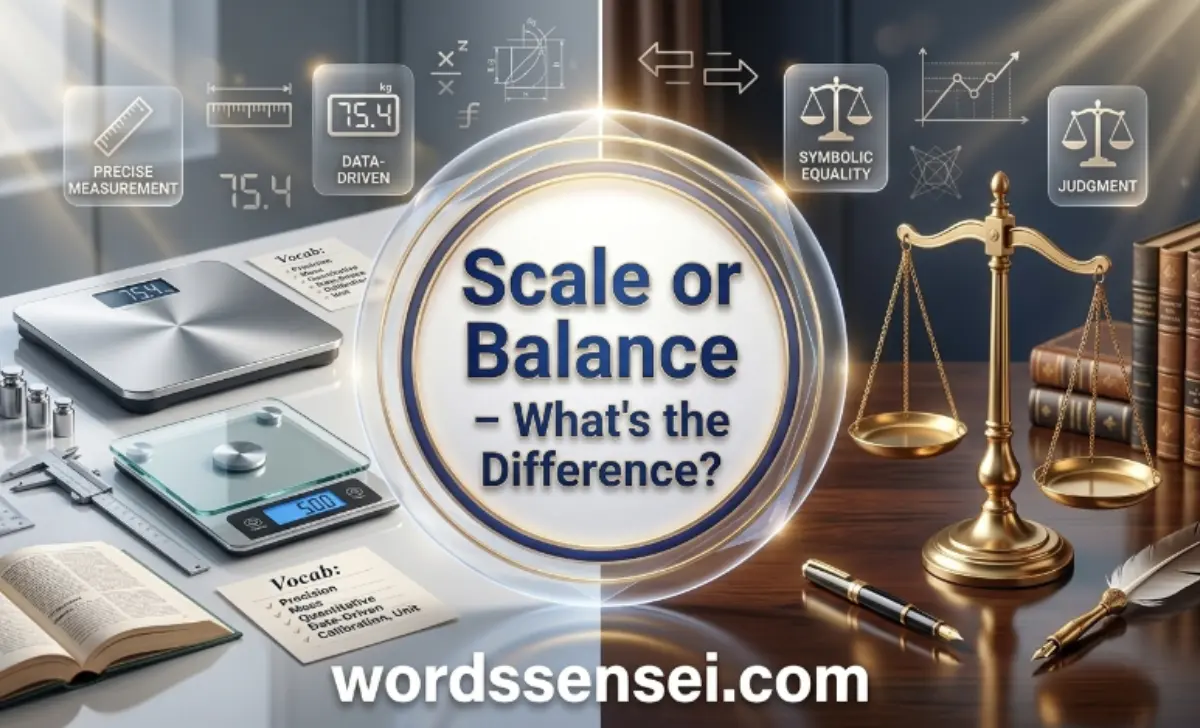
Step into a kitchen, a gym, or a high school chemistry lab, and you’ll likely encounter two very similar-sounding tools: a scale and a balance. Both sit quietly on a counter, both measure something related to weight, and both get used almost interchangeably in everyday conversation.
Someone weighing flour for a recipe might casually say “let me check the scale,” while a chemistry teacher demonstrating precise measurement might specifically ask students to use “the balance.” Are these simply two names for the same object, or is there a real, meaningful difference hiding behind the casual overlap?
As it turns out, there’s a genuinely interesting distinction between the two, rooted in both engineering and the history of measurement itself. A scale, in its modern sense, typically uses a spring, load cell, or digital sensor to measure weight, converting force into a numeric readout. A balance, by contrast, traditionally compares an unknown mass against a known reference mass, historically using two pans suspended from a beam.
This difference matters more than it might seem, especially in scientific and laboratory settings, where accuracy and the distinction between “mass” and “weight” can genuinely affect results. This guide breaks down exactly how scales and balances differ, where each term is used correctly, the surprising number of unrelated meanings both words carry outside of weighing, and how to choose the right word with confidence whether you’re baking, exercising, or working in a lab.
Quick Answer
A scale is a device that measures weight using mechanisms like springs, load cells, or digital sensors, giving a direct numeric reading. A balance is a device that measures mass by comparing an unknown object against a known reference mass, traditionally using a beam and two pans, or today, an internal calibrated mechanism.
According to Merriam-Webster, a scale is an instrument or machine for weighing. The Cambridge Dictionary defines a balance as an instrument for weighing, especially one with a central pointer that shows equal weight on both sides. Both words overlap heavily in casual use, but they point to genuinely different measuring principles.
A simple way to separate them: if you’re talking about a spring-based or digital device that gives you a quick weight reading, “scale” is usually correct. If you’re talking about a precise laboratory instrument that compares masses against a known standard, “balance” is the more accurate term.
Correct Example
- She stepped on the bathroom scale to check her weight.
- The chemist used a laboratory balance to measure the exact mass of the compound.
- The kitchen scale showed exactly 200 grams of flour.
- The analytical balance is accurate to within a fraction of a milligram.
Incorrect Example
- The chemist used a laboratory scale to measure the exact mass of the compound. (Technically imprecise — “balance” is the standard scientific term.)
- She stepped on the bathroom balance to check her weight. (Sounds unnatural — “scale” is the everyday term.)
What Does Scale Mean?
Scale, in the weighing sense, refers to a device that measures the weight of an object, typically using a spring mechanism, load cell, or digital sensor. It’s the term most commonly used in everyday, non-scientific settings.
Common Meanings
- Weighing Device — a tool that measures weight through mechanical or digital means.
- Household Use — commonly found in kitchens and bathrooms.
- Commercial Use — used in shipping, retail, and industrial settings to weigh goods.
- Unrelated Meanings — “scale” also refers to a graduated measuring system (like a map scale), a series of musical notes, or the proportional size of something.
Simple Usage Examples
- Kitchen: “Use the scale to measure exactly 100 grams of sugar.”
- Health: “He weighs himself on the bathroom scale every morning.”
- Commerce: “The warehouse uses an industrial scale to weigh shipping pallets.”
- Different meaning (proportion): “The model was built to a 1:100 scale.”
What Does Balance Mean?
Balance, in the weighing sense, refers to an instrument that measures mass by comparing an unknown object against a known reference mass. It’s the preferred term in scientific, laboratory, and precision-measurement contexts.
Common Meanings
- Comparative Weighing Instrument — measures mass relative to a known standard.
- Scientific/Laboratory Use — used in chemistry, pharmacy, and jewelry for precise measurements.
- Historical Design — traditionally built with a beam and two pans, though modern versions are often digital.
- Unrelated Meanings — “balance” also refers to physical stability, a bank account amount, emotional or lifestyle equilibrium, and fairness.
Simple Usage Examples
- Chemistry: “The student carefully placed the sample on the balance to record its mass.”
- Jewelry: “Jewelers use a precise balance to weigh gold and gemstones.”
- Pharmacy: “Pharmacists use a balance to measure exact medication doses.”
- Different meaning (stability): “She struggled to keep her balance on the narrow beam.”
Scale vs. Balance: Comparison Table
| Term | Measures | Typical Mechanism | Common Settings |
|---|---|---|---|
| Scale | Weight | Spring, load cell, digital sensor | Kitchens, bathrooms, shipping, retail |
| Balance | Mass (relative to a known standard) | Beam and pans, or calibrated digital mechanism | Laboratories, pharmacies, jewelry |
Scale vs. Balance in Different Settings
| Setting | Preferred Term | Reason |
|---|---|---|
| Kitchen Cooking | Scale | Quick, direct weight readout |
| Bathroom/Fitness | Scale | Everyday, non-precision weighing |
| Chemistry Lab | Balance | High-precision mass comparison |
| Jewelry Making | Balance | Requires extremely fine accuracy |
| Shipping/Warehouses | Scale | Fast, large-capacity weighing |
| Pharmacy | Balance | Precise medication measurement |
Mass vs. Weight: Why the Distinction Matters
Part of the reason scientists prefer “balance” over “scale” comes down to the technical difference between mass and weight. Mass is a fixed property of matter, while weight depends on gravity and can technically change depending on location — for example, an object weighs less on the Moon than on Earth, even though its mass stays the same. A balance compares mass directly against a known reference, making it unaffected by gravity differences, while a traditional spring-based scale technically measures weight, which is gravity-dependent. This is why laboratories overwhelmingly favor balances: they measure a property that stays constant regardless of location or gravitational pull.
The Origin of Scale and Balance
Word History
“Scale” comes from the Old Norse word skál, meaning “bowl” or “drinking cup,” which evolved to describe the weighing pan of a traditional balance before eventually referring to the entire weighing device itself. “Balance” comes from the Latin bilanx, meaning “having two scale pans,” formed from bi- (two) and lanx (dish or plate) — a direct reference to the classic two-pan design still associated with the word today.
Why the Confusion Happens
The confusion happens because both words historically referred to overlapping parts of the same basic weighing tool — the pans themselves were once called “scales,” while the entire two-pan instrument was called a “balance.” Over centuries, “scale” broadened to describe modern weighing devices of all kinds, including spring and digital models, while “balance” narrowed toward precision instruments used specifically for comparing mass.
Scale and Balance as Words With Other Meanings
Both words carry several unrelated definitions beyond weighing, which adds another layer of potential confusion in writing.
Other Meanings of Scale
- Map/Model Proportion: “The map uses a scale of one inch to ten miles.”
- Musical Scale: “She practiced the C major scale on the piano.”
- Fish/Reptile Scale: “The snake’s skin is covered in small scales.”
- Business Growth: “The startup plans to scale its operations next year.”
Other Meanings of Balance
- Physical Stability: “He lost his balance and nearly fell.”
- Financial Amount: “Please check your account balance before the transfer.”
- Lifestyle Equilibrium: “She’s working on a better work-life balance.”
- Fairness/Proportion: “The article presents a balance of both viewpoints.”
The “Compare vs. Convert” Rule
A simple way to remember the difference: a balance compares one mass against another known mass, much like its two-pan design historically suggested. A scale converts a physical force — like the pull of gravity on an object — into a number using a spring, load cell, or sensor. If the instrument is comparing, think “balance.” If the instrument is converting force into a direct numeric readout, think “scale.”
Which Term Should You Use?
Everyday and Household Contexts
For kitchens, bathrooms, and general household use, “scale” is the natural, expected term, since most household weighing tools are spring-based or digital rather than comparative.
Scientific and Laboratory Writing
For chemistry, pharmacy, and precision measurement writing, “balance” is the standard, technically accurate term, especially when describing instruments that measure mass rather than weight.
Commercial and Industrial Use
Shipping companies, warehouses, and retail businesses almost universally use “scale,” since speed and capacity matter more than the ultra-fine precision a balance provides.
Jewelry and Fine Measurement
Jewelers and gemologists typically use “balance,” reflecting the extremely fine accuracy required when weighing gold, diamonds, and other precious materials.
Academic and Technical Writing
Students and professionals writing about physics, chemistry, or measurement theory should use “balance” when discussing mass comparison and “scale” when discussing general weight measurement, keeping the mass-versus-weight distinction in mind.
Common Mistakes with Scale and Balance
Frequent Errors
- Using “scale” in scientific writing where “balance” is the more technically accurate term.
- Using “balance” for everyday household weighing, which can sound overly technical or out of place.
- Assuming “scale” and “balance” always measure the exact same property (weight vs. mass).
- Overlooking the many unrelated meanings of both words in casual writing, causing unintended ambiguity.
Corrected Examples
- Incorrect: “The lab technician used a scale to measure the precise mass of the sample.”
- Correct: “The lab technician used a balance to measure the precise mass of the sample.”
- Incorrect: “He checked his weight on the bathroom balance.”
- Correct: “He checked his weight on the bathroom scale.”
Scale and Balance in Everyday Examples
Emails
“Please note that all shipments must be weighed on the warehouse scale before dispatch.”
Social Media
“Finally got a new kitchen scale for baking — so much more accurate than eyeballing it!”
News Writing
“Researchers used a highly sensitive laboratory balance to measure trace amounts of the substance.”
School Writing
“The physics lesson explained the difference between a spring scale and a beam balance.”
Business Writing
“Our facility uses certified industrial scales to ensure accurate shipping weights.”
Why This Keyword Gets Searched
People search “scale vs balance” for a mix of practical and academic reasons. Home cooks and fitness enthusiasts search it while deciding which household tool to buy. Students and lab technicians search it while learning the technical difference between mass and weight measurement. Shoppers comparing kitchen or bathroom scales sometimes search it simply to understand product listings that use both terms inconsistently. A smaller group searches it out of general curiosity after noticing both words used for what seems like the same object.
Related Measurement Terminology
Similar Instrument Confusions
- Thermometer vs. Thermostat — a similar tool-function confusion.
- Ruler vs. Tape Measure — another commonly mixed-up measuring tool pair.
- Speedometer vs. Odometer — a comparable precision-instrument distinction.
Helpful Tips
Whenever two tools measure related but technically different properties, check whether the instrument compares against a known standard or converts a physical force into a number. This same logic applies neatly to “scale vs balance” and several other measurement-related word pairs.
FAQs
What is the difference between a scale and a balance?
A scale measures weight, often using a spring or digital sensor, while a balance measures mass by comparing an object against a known reference mass.
Is a balance more accurate than a scale?
Generally, yes. Balances, especially analytical balances used in labs, offer far greater precision than typical household scales.
What is a balance scale used for?
A balance scale is used to measure mass by comparing an unknown object against known reference weights, commonly used in chemistry, pharmacy, and jewelry.
Why do labs use a balance instead of a scale?
Labs use balances because they measure mass, a property unaffected by gravity, making results more consistent and precise than gravity-dependent weight measurements.
Is “weighing scale” the same as “balance”?
Not exactly. A weighing scale typically measures weight directly, while a balance measures mass through comparison, though both terms are sometimes used loosely in everyday speech.
What are the different types of balances used in science?
Common types include analytical balances, triple beam balances, and precision digital balances, each offering different levels of accuracy for scientific measurement.
Can a scale measure mass instead of weight?
Some digital scales are calibrated to display mass-equivalent readings, but technically, most scales measure weight, which depends on gravitational force.
Is “balance” always related to weighing?
No. “Balance” also refers to physical stability, financial account amounts, and lifestyle equilibrium, none of which relate to weighing instruments.
Conclusion
At a glance, “scale” and “balance” might seem like two casual synonyms for the same basic weighing tool, and in most everyday conversations, using either word rarely causes real confusion. But underneath that casual overlap lies a genuinely meaningful distinction rooted in both engineering and physics.
A scale converts a physical force, usually gravity acting on an object, into a direct numeric weight reading, making it fast and practical for kitchens, bathrooms, and shipping. A balance, by contrast, measures mass by comparing an object against a known standard, offering the kind of precision that chemistry labs, pharmacies, and jewelers depend on, unaffected by gravitational differences that could otherwise skew a simple weight reading.
Beyond the technical distinction, both words also carry entirely unrelated meanings — from musical scales and map proportions to financial balances and emotional equilibrium — which makes context even more important when choosing the right word.
Whether you’re weighing ingredients for a recipe, calibrating lab equipment, or simply trying to write with more precision, understanding the real difference between a scale and a balance adds a small but genuinely useful layer of accuracy to your vocabulary. The next time you reach for a weighing tool, or the word to describe it, you’ll know exactly which term truly fits.
Read More Blogs:
- Hamster or Hampster: Which Spelling Is Actually Correct?
- Meter or Metre: British vs American English

Hi, I am Gerald Nelson, a professional content writer working on wordssensei.com.
I create engaging and SEO-friendly content that informs and inspires readers.