Have you ever stopped while writing an email, travel article, school assignment, or business document because you weren’t sure whether to write Colombian or Columbian? You’re not alone. These two words differ by just one letter, yet they have completely different meanings.
Many writers mistakenly use Columbian when referring to the country of Colombia or its people, while others are unsure when the historical spelling is actually correct. This confusion appears frequently in travel blogs, academic papers, news articles, and online content.
Using the wrong spelling can make your writing look inaccurate and unprofessional. Fortunately, the difference is easy to understand once you know the context. This guide explains the meanings of Colombian and Columbian, their origins, grammar rules, real-life examples, and simple memory tips. By the end, you’ll know exactly which word to use in every situation.
Quick Answer
The correct spelling depends on what you’re talking about.
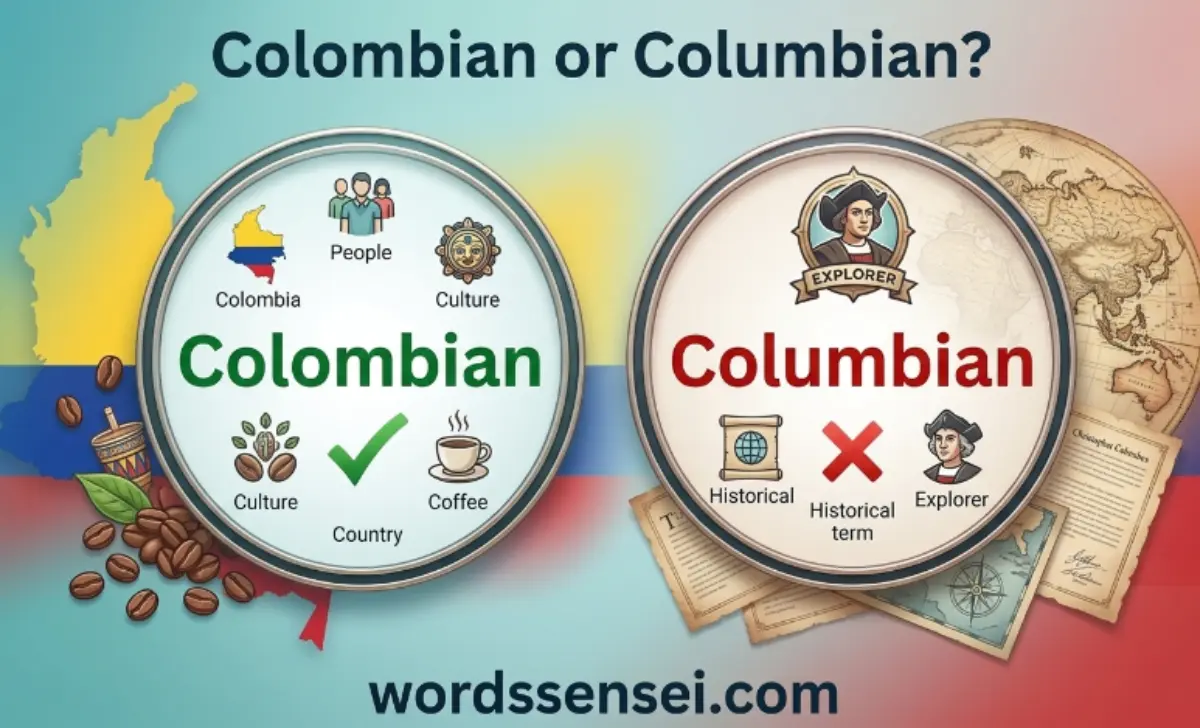
Colombian refers to anything connected with Colombia, including its people, culture, language, cities, government, sports, food, coffee, and businesses.
Columbian is mainly used in historical contexts related to Christopher Columbus or specific historical names, such as the Columbian Exchange and the World’s Columbian Exposition.
For official definitions, you can refer to the entries in Merriam-Webster and Cambridge Dictionary.
A simple way to remember it is:
- Colombian = Colombia
- Columbian = Columbus
Examples:
Correct
- She is a Colombian journalist.
- We enjoyed authentic Colombian coffee during our trip.
- Historians continue to study the Columbian Exchange.
- The museum featured exhibits about the World’s Columbian Exposition.
Incorrect
- She is a Columbian citizen of Colombia.
- Colombian Exchange changed world history.
- Columbian coffee is exported worldwide.
What Does Colombian Mean?
Colombian is the official adjective and demonym used for anything related to Colombia. Whether you’re talking about a person, product, culture, government, or location, this is the spelling you should use.
It appears regularly in newspapers, travel guides, international business, academic writing, and everyday English.
Common Meanings
The word Colombian can describe:
- A person from Colombia.
- The nationality of someone born in Colombia.
- Products made in Colombia.
- Colombian culture, traditions, and history.
- Food, music, art, literature, and sports from Colombia.
- Businesses, organizations, and government institutions located in Colombia.
Everyday Examples
Travel
Many tourists visit Cartagena each year to enjoy its colonial architecture and Caribbean coastline.
Business
Our company imports premium Colombian coffee for international markets.
Education
Students studied Colombian geography and biodiversity in class.
Sports
Several Colombian footballers play for leading European clubs.
Culture
Colombian music blends Indigenous, African, and Spanish influences, creating styles that are recognized around the world.
Well-Known Colombian Cities
Some of Colombia’s most famous cities include:
- Bogotá
- Medellín
- Cali
- Cartagena
Each city contributes to Colombia’s economy, tourism, culture, and international reputation.
What Does Columbian Mean?
Unlike Colombian, the word Columbian is rarely used to describe the modern country of Colombia or its people. Instead, it belongs mainly to historical, academic, and cultural contexts connected with Christopher Columbus.
Today, you’ll most often see Columbian in the names of historical events, exhibitions, books, and institutions rather than in modern travel or news writing.
Common Meanings
Related to Christopher Columbus
The word Columbian often describes ideas, events, or historical references connected with Christopher Columbus.
Example:
Researchers continue to examine the voyages of Christopher Columbus from different historical perspectives.
The Columbian Exchange
One of the best-known historical terms is the Columbian Exchange. It refers to the exchange of crops, animals, diseases, technology, and cultures between Europe, Africa, and the Americas after Columbus’s voyages.
Historical Events and Institutions
The spelling also appears in historical names such as the World’s Columbian Exposition, held in Chicago in 1893 to commemorate the 400th anniversary of Columbus’s arrival in the Americas.
Usage Examples
- The Columbian Exchange permanently changed agriculture around the world.
- Historians still debate the long-term effects of the Columbian Exchange.
- The World’s Columbian Exposition introduced many technological innovations to visitors.
- Several nineteenth-century organizations included the word “Columbian” in their official names.
The Origin of Colombian and Columbian
Although these words look almost identical, they developed for different reasons over time.
The name Colombia was chosen in honor of Christopher Columbus, and the adjective Colombian became the accepted English term for the country’s people and everything associated with it.
The word Columbian, however, developed from the historical name Columbia, which was once widely used as a poetic name for the Americas and later appeared in the names of historical institutions, exhibitions, and events. Because of this, modern English keeps the two spellings separate to avoid confusion.
As English evolved, dictionaries standardized their meanings:
- Colombian relates to the country of Colombia.
- Columbian relates mainly to Christopher Columbus and specific historical names.
This distinction is now accepted worldwide in academic writing, journalism, publishing, and international communication.
British English vs American English
Unlike many English words that have different spellings in British and American English, Colombian and Columbian are spelled exactly the same in both versions of English.
The difference is not based on location or regional spelling rules. It depends completely on meaning and context.
Whether you are writing for readers in the United States, United Kingdom, Canada, Australia, India, or any other English-speaking region, the same rule applies:
- Use Colombian when referring to Colombia.
- Use Columbian when referring to Christopher Columbus or historical terms.
Comparison Table
| Meaning | American English | British English |
|---|---|---|
| Person from Colombia | Colombian | Colombian |
| Colombian culture | Colombian | Colombian |
| Colombian coffee | Colombian | Colombian |
| Colombian government | Colombian | Colombian |
| Christopher Columbus related | Columbian | Columbian |
| Columbian Exchange | Columbian | Columbian |
| Historical references | Columbian | Columbian |
Examples:
American English
- Colombian coffee is popular worldwide.
- The Columbian Exchange changed global history.
British English
- Colombian culture attracts millions of visitors.
- Historians continue studying the Columbian Exchange.
The spelling remains unchanged in both regions.
Colombian vs Columbian: Main Differences
Understanding the difference between these two words becomes easier when you compare their purpose and usage.
| Word | Meaning | Common Usage |
|---|---|---|
| Colombian | Related to Colombia | People, culture, food, cities, products, nationality |
| Columbian | Related to Christopher Columbus or historical terms | History, events, academic discussions |
Colombian Examples
- Colombian food is known for its variety and regional flavors.
- The Colombian economy has grown in several industries.
- Many Colombian artists have gained international recognition.
- She works with a Colombian company.
Columbian Examples
- The Columbian Exchange changed the history of world trade.
- The museum displayed items from the World’s Columbian Exposition.
- Researchers studied Columbian history and exploration.
Colombia vs Columbia: Another Common Confusion
Many people also confuse Colombia and Columbia because they look similar.
However, they are not the same word.
Colombia
Colombia is a country located in South America.
Examples:
- Colombia is famous for coffee production.
- Bogotá is the capital city of Colombia.
- Colombian culture is recognized worldwide.
Columbia
Columbia is usually used in other names, places, or historical references.
Examples:
- District of Columbia
- British Columbia
- Columbia University
A useful memory rule:
Colombia = South American country
Columbia = Other names and places
The Easy Memory Rule for Colombian and Columbian
A simple memory trick can help you choose the correct spelling quickly.
Remember the Letter Difference
Colombian contains “Colom”, which connects directly to Colombia.
Columbian contains “Colum”, which connects with Columbus.
Remember:
Colombian = Country
Columbian = Columbus
Before using the word, ask yourself one question:
“Am I talking about the modern country or a historical connection?”
If the answer is the country, use Colombian.
If the answer is Christopher Columbus or a historical event, use Columbian.
This simple check prevents most spelling mistakes.
Which Spelling Should You Use?
The correct choice depends on the subject of your sentence. Although these words share a similar appearance, they cannot replace each other.
US Audience
American English uses Colombian in everyday communication when discussing:
- Colombian citizens
- Colombian products
- Colombian businesses
- Colombian culture
- Colombian tourism
- Colombian sports
Examples:
- The company exports Colombian coffee.
- Many Colombian athletes compete internationally.
The word Columbian appears mainly in history-related topics.
Example:
- Students learned about the Columbian Exchange in history class.
UK Audience
British English follows the same pattern.
British writers use Colombian when discussing the country and its people.
Examples:
- The newspaper published an article about Colombian politics.
- The restaurant serves traditional Colombian cuisine.
They use Columbian only for historical references.
Example:
- The documentary explored the effects of the Columbian Exchange.
International Writing
For global communication, choosing the correct spelling is especially important.
International writers often discuss:
- Colombian trade
- Colombian tourism
- Colombian companies
- Colombian culture
- Colombian history
Using the correct term helps readers understand your meaning immediately.
Incorrect spelling may confuse readers because Columbian does not normally describe the modern country.
Academic Writing
Academic writing requires accuracy because one incorrect word can change the meaning of a sentence.
Use Colombian when writing about:
- Geography
- Anthropology
- Culture
- Politics
- Economics
- Modern history
Examples:
- Colombian society has experienced significant cultural changes.
- Researchers studied Colombian environmental policies.
Use Columbian when writing about:
- European exploration
- Christopher Columbus
- The Columbian Exchange
- Historical events after 1492
Examples:
- The Columbian Exchange affected populations across continents.
- Historians analyze Columbian exploration from different perspectives.
Social Media Usage
On social media platforms, people often type quickly, which increases spelling mistakes.
Correct examples:
- Exploring Colombian beaches was an amazing experience.
- Colombian coffee lovers know the difference in quality.
- Reading about the Columbian Exchange changed my view of history.
Using the correct spelling improves your credibility and makes your content look more professional.
Common Mistakes with Colombian and Columbian
Because these words are so similar, writers often make predictable mistakes.
Frequent Errors
Mistake 1: Using Columbian for Colombian Products
Incorrect:
I bought Columbian coffee from a local store.
Correct:
I bought Colombian coffee from a local store.
Explanation:
Coffee comes from Colombia, so the correct adjective is Colombian.
Mistake 2: Using Columbian for Nationality
Incorrect:
She is a Columbian citizen.
Correct:
She is a Colombian citizen.
Explanation:
A person from Colombia is Colombian.
Mistake 3: Using Colombian for Historical Terms
Incorrect:
The Colombian Exchange influenced global history.
Correct:
The Columbian Exchange influenced global history.
Explanation:
The historical term is connected with Christopher Columbus, so it uses Columbian.
Mistake 4: Confusing Colombia and Columbia
Incorrect:
Columbia is a country in South America.
Correct:
Colombia is a country in South America.
Explanation:
The South American country is spelled Colombia.
Mistake 5: Using Colombian in Historical Names
Incorrect:
The World’s Colombian Exposition was held in Chicago.
Correct:
The World’s Columbian Exposition was held in Chicago.
Explanation:
The official historical name uses Columbian.
Colombian and Columbian in Everyday Examples
Understanding how these words appear in real situations makes the difference much easier to remember. Both words are used in different areas, but Colombian appears much more frequently in modern English because it describes a country, nationality, and culture.
Emails
Professional emails often mention countries, businesses, products, and international partnerships. Using the correct adjective helps maintain clear communication.
Colombian examples:
- Our company has started working with Colombian suppliers.
- We are interested in importing Colombian coffee products.
- The meeting will include several Colombian business representatives.
Columbian example:
- The report includes a section about the Columbian Exchange and its effect on global trade.
In business communication, Colombian is usually the correct choice because most topics involve modern Colombia.
Social Media
Social media posts about travel, food, culture, and personal experiences commonly use Colombian.
Examples:
- My trip to Colombia introduced me to amazing Colombian traditions.
- Colombian food has become popular around the world.
- Learning about Colombian music helped me understand the country’s culture.
Historical content may use Columbian:
- The documentary explains how the Columbian Exchange changed the world.
Using the correct spelling improves the quality and credibility of online content.
News Writing
Journalists frequently use Colombian when reporting on current events.
Examples:
- The Colombian government announced new economic plans.
- A Colombian athlete won an international competition.
- Colombian businesses are expanding into global markets.
News articles about history may use Columbian:
- Researchers discovered new information about the Columbian Exchange.
- Historians discussed the impact of Columbian exploration.
The context decides which spelling is correct.
School Writing
Students often encounter both words in different subjects.
Geography:
- Colombia is located in South America.
- Colombian cities have diverse landscapes.
Culture Studies:
- Colombian traditions reflect different historical influences.
- Colombian literature has gained global attention.
History:
- The Columbian Exchange changed the movement of plants and animals between continents.
- Christopher Columbus’s voyages are studied in relation to Columbian history.
Using the correct word helps students produce accurate academic work.
Business Writing
Companies often discuss Colombian markets, customers, products, and partnerships.
Examples:
- The company plans to expand into the Colombian market.
- Our brand sources high-quality Colombian coffee beans.
- The organization works with Colombian suppliers.
Historical business reports may mention:
- The Columbian Exchange influenced early global trade patterns.
In modern business writing, Colombian is the word you will use most often.
Google Trends & Usage Data
Search interest for Colombian or Columbian remains consistent because many people confuse these words while writing about travel, history, culture, and geography.
Users often search this topic because:
- The spellings look almost identical.
- Both words are connected historically.
- People confuse Colombia with Columbia.
- Historical terms like Columbian Exchange create uncertainty.
- Writers want to avoid mistakes in professional content.
This keyword attracts searches from students, travelers, writers, researchers, and English learners.
Popular Countries
People commonly search this grammar topic in:
- United States
- United Kingdom
- Canada
- Australia
- India
Searches are especially common among:
- English learners
- Students studying history
- Travel writers
- Content creators
- Academic researchers
Popular Search Queries
Common searches include:
- Colombian or Columbian
- Colombian meaning
- Columbian meaning
- Colombian vs Columbian
- Is Colombian correct?
- Is Columbian a word?
- Colombian coffee spelling
- Columbian Exchange meaning
- Colombia or Columbia
- Nationality of Colombia
- How to spell Colombian
These searches show that people mainly want clarity about the correct spelling and usage.
Why People Search This Keyword
Most users want answers to questions such as:
- Is it Colombian or Columbian?
- Why is Colombia spelled with an “o”?
- Is Columbian the same as Colombian?
- Can I call a person from Colombia Columbian?
- Why is the historical term called the Columbian Exchange?
- Is Columbia a country?
Providing clear answers to these questions helps content rank for informational searches and featured snippets.
Related Grammar Rules
Learning similar confusing words can improve your overall English accuracy. Many English words look similar but have completely different meanings.
Similar Spelling Mistakes
Colombia or Columbia
Colombia refers to the South American country.
Example:
- I want to visit Colombia next year.
Columbia appears in names of places and institutions.
Example:
- She studies at Columbia University.
Quit or Quite
Quit means to stop or leave.
Example:
- He decided to quit his job.
Quite means fairly, very, or completely.
Example:
- The movie was quite interesting.
Premise or Premises
Premise means an idea or assumption.
Example:
- The argument is based on a false premise.
Premises refers to a building or property.
Example:
- Visitors must leave the premises.
Affect or Effect
Affect usually means to influence.
Example:
- Weather can affect travel plans.
Effect usually means a result.
Example:
- The effect was unexpected.
Helpful Grammar Tips
To avoid confusing similar words:
- Focus on meaning, not only spelling.
- Check the context before choosing a word.
- Learn common word pairs together.
- Pay attention to historical and modern meanings.
- Use reliable dictionaries when unsure.
A simple habit of checking the meaning before writing can prevent many common English mistakes.
FAQs
Is it Colombian or Columbian?
Both words are correct, but they have different meanings. Colombian refers to the country of Colombia, its people, culture, products, and locations. Columbian mainly refers to historical topics connected with Christopher Columbus.
Is a person from Colombia called Colombian or Columbian?
A person from Colombia is called Colombian. This is the official English demonym used for the citizens of Colombia.
Is Columbian coffee the correct spelling?
No. The correct term is Colombian coffee because the coffee comes from Colombia. Columbian coffee is a common spelling mistake.
What does Columbian mean?
Columbian is an adjective mainly used for historical references connected with Christopher Columbus, such as the Columbian Exchange and the World’s Columbian Exposition.
What is the difference between Colombia and Columbia?
Colombia is a country in South America. Columbia is used in other names, such as Columbia University, British Columbia, and the District of Columbia.
Is Columbian still used today?
Yes, but mostly in historical contexts. It is not normally used to describe modern Colombia or Colombian people.
Why do people confuse Colombian and Columbian?
People confuse them because they look almost identical and both words have a connection to Christopher Columbus. However, modern usage separates their meanings.
How can I remember Colombian vs Columbian?
Remember:
Colombian = Colombia
Columbian = Columbus
This simple rule works in most situations.
Conclusion
Understanding the difference between Colombian and Columbian is important for accurate English writing. Although these words look almost identical, they have different meanings and should not be used interchangeably. Colombian is the correct word for anything related to Colombia, including its people, culture, products, businesses, and geography.
On the other hand, Columbian is mainly used for historical references connected with Christopher Columbus, such as the Columbian Exchange and the World’s Columbian Exposition. Remembering the simple rule “Colombian = Colombia, Columbian = Columbus” can help you avoid this common mistake. By choosing the right word, your academic writing, professional communication, and everyday English become clearer and more accurate.
Read More Blogs:
- Is It Cuter or Cutier? Here’s the Answer Most Writers Miss
- Possess or Posess: How to Spell It Right Every Single Time

Hi, I am Gerald Nelson, a professional content writer working on wordssensei.com.
I create engaging and SEO-friendly content that informs and inspires readers.