Do you type “cuter” or “cutier” — then stop and wonder which one is right? You are not alone. Thousands of writers, students, and social media users search this exact question every single day.
This tiny spelling confusion trips up even fluent English speakers. The answer, however, is simple and clear. One form follows proper English grammar rules. The other has never existed in any dictionary.
In this guide, you will find the correct spelling, the grammar rule behind it, and real examples you can use right away.
Quick Answer
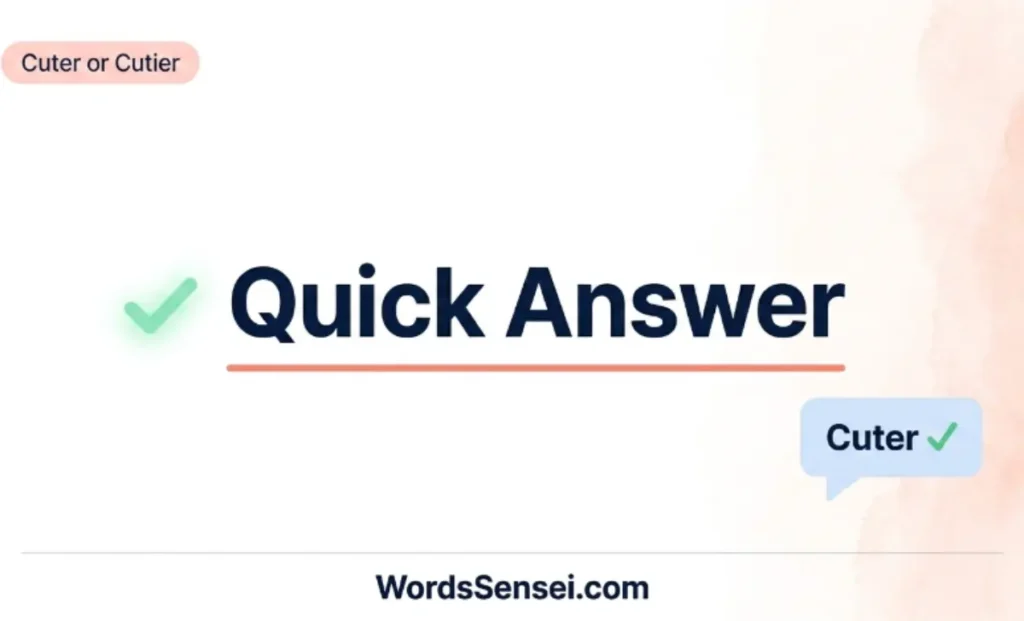
“Cuter” is the correct spelling. “Cutier” is wrong. It is not a real word in the English language.
“Cute” is a one-syllable adjective. According to standard English grammar — as confirmed by Merriam-Webster Dictionary and the Oxford English Dictionary — one-syllable adjectives ending in a silent “e” form their comparative simply by adding “-r” at the end. So “cute” becomes “cuter.”
You never add “-ier” to a word that already ends in “e.” That rule belongs to a completely different group of adjectives.
Think of similar words: we say “nicer,” not “nicier.” We say “wider,” not “widier.” We say “finer,” not “finier.” The same rule applies to cute — it becomes cuter, every single time.
✅ Correct Example
- “This kitten is cuter than the one we saw yesterday.”
- “She has the cuter smile of the two sisters.”
- “Your drawing looks cuter with the added colors.”
- “The new design is cuter and more user-friendly.”
❌ Incorrect Example
“This kitten is cutier than the one we saw yesterday.”“She has the cutier smile.”“Your drawing looks cutier now.”“The new design is cutier.”
Never use “cutier.” It is a spelling error — every single time, in every context.
What Does “Cuter” Mean?
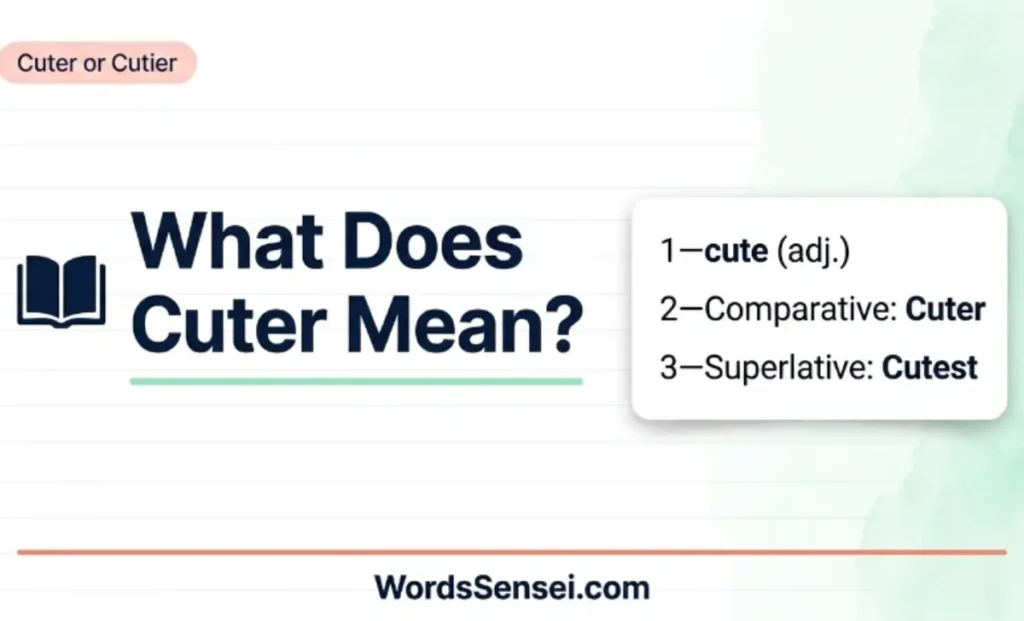
“Cuter” is the comparative adjective form of “cute.” You use it when you are comparing exactly two things. It tells the reader that one thing has more of the “cute” quality than another.
The complete adjective scale for “cute” looks like this:
| Degree | Form | Used When |
|---|---|---|
| Positive | Cute | Describing one thing |
| Comparative | Cuter | Comparing two things |
| Superlative | Cutest | Comparing three or more things |
Common Meanings
According to the Cambridge Dictionary, “cute” — and by extension “cuter” — can mean:
- Attractive in a sweet or charming way — most common meaning; used for babies, pets, people, and objects
- Clever or shrewd — an older American English meaning, now rarely used
- Appealing or endearing — widely used in casual conversation, social media, and digital writing
Simple Usage Examples
- “The baby panda is cuter than I expected.”
- “My new phone case is cuter than my old one.”
- “That joke was cuter than anything he had said before.”
- “Which puppy is cuter — the brown one or the white one?”
- “The first logo design was good, but the second one is far cuter.”
The Origin of “Cuter”
Understanding where “cute” comes from helps you spell its comparative form correctly — and never confuse it again.
Word History
The word “cute” has an interesting history. It originally came from the word “acute,” an English adjective meaning sharp, clever, or perceptive. In everyday 18th-century speech, people began dropping the first letter and saying simply “cute” — meaning clever or shrewd.
Over the next century, the meaning shifted significantly. By the 1830s and 1840s — especially in American English — “cute” began to describe something attractive, charming, or sweet in appearance. This is the meaning most people use today.
Because “cute” ends in a silent “e,” its comparative form follows a specific English spelling rule: you simply add “-r” without removing anything. So: cute + r = cuter.
Why the Confusion Happens
Here is where most people go wrong. Many adjectives ending in a consonant + “y” form their comparative by changing the “y” to “i” and adding “-er.” For example:
| Base Word | Comparative |
|---|---|
| Pretty | Prettier |
| Funny | Funnier |
| Happy | Happier |
| Lovely | Lovelier |
People see this “-ier” pattern and sometimes apply it to “cute” — writing “cutier” by mistake. But “cute” does not end in “y.” It ends in “e.” So the “-ier” rule simply does not apply. This mix-up is the single biggest reason “cutier” keeps appearing online.
British English vs American English

Good news: both British and American English agree completely on this word. “Cuter” is correct in both regions. There is no regional spelling difference whatsoever.
Comparison Table
| Feature | American English | British English | Canadian English | Australian English |
|---|---|---|---|---|
| Correct Spelling | Cuter ✅ | Cuter ✅ | Cuter ✅ | Cuter ✅ |
| Incorrect Spelling | Cutier ❌ | Cutier ❌ | Cutier ❌ | Cutier ❌ |
| Superlative Form | Cutest | Cutest | Cutest | Cutest |
| Dictionary Source | Merriam-Webster | Oxford | Oxford Canadian | Macquarie |
This is one of the rare English words where every major dialect agrees completely. No matter where you are writing — always write “cuter.”
Cuter vs Other Variations
Some writers also wonder about “more cute” vs “cuter.” Let us clear that up too.
Spelling and Usage Comparison Table
| Form | Correct? | Formality | Region | Recommended? |
|---|---|---|---|---|
| Cuter | ✅ Yes | Formal & Informal | All regions | ✅ Always use this |
| Cutier | ❌ No | Never | None | ❌ Never use this |
| More cute | ⚠️ Marginal | Very informal | Casual speech only | ⚠️ Avoid in writing |
| More cuter | ❌ No | Never | None | ❌ Never use this |
| Cutest | ✅ Yes | Formal & Informal | All regions | ✅ For superlative |
| Most cute | ⚠️ Marginal | Very informal | Casual speech only | ⚠️ Avoid in writing |
“More cute” occasionally appears in very casual speech. However, “cuter” is always the correct, standard, and preferred written form — in every style guide including AP, Chicago, and MLA.
Which Spelling Should You Use?
The answer is always “cuter” — but here is a clear breakdown by writing context and audience.
US Audience
Use “cuter” always. American English strongly prefers the “-er” comparative for one-syllable adjectives. Both the AP Stylebook and the Chicago Manual of Style support this form.
UK Audience
Use “cuter” always. British grammar follows the same comparative rule for one-syllable adjectives ending in “e.” The Oxford Style Guide confirms this.
International Writing
Use “cuter.” It is universally understood and accepted across all English-speaking countries, including Canada, Australia, New Zealand, and India.
Academic Writing
Always use “cuter” in academic papers, essays, and research writing. Avoid “more cute” entirely in formal writing. “Cuter” is cleaner, more precise, and grammatically unambiguous.
Social Media Usage
“Cuter” is the dominant form across Instagram, TikTok, Twitter/X, Pinterest, and YouTube comments. Using the correct form makes your captions and posts look polished and professional. Misspellings like “cutier” can reduce your credibility with readers.
Common Mistakes with “Cuter”
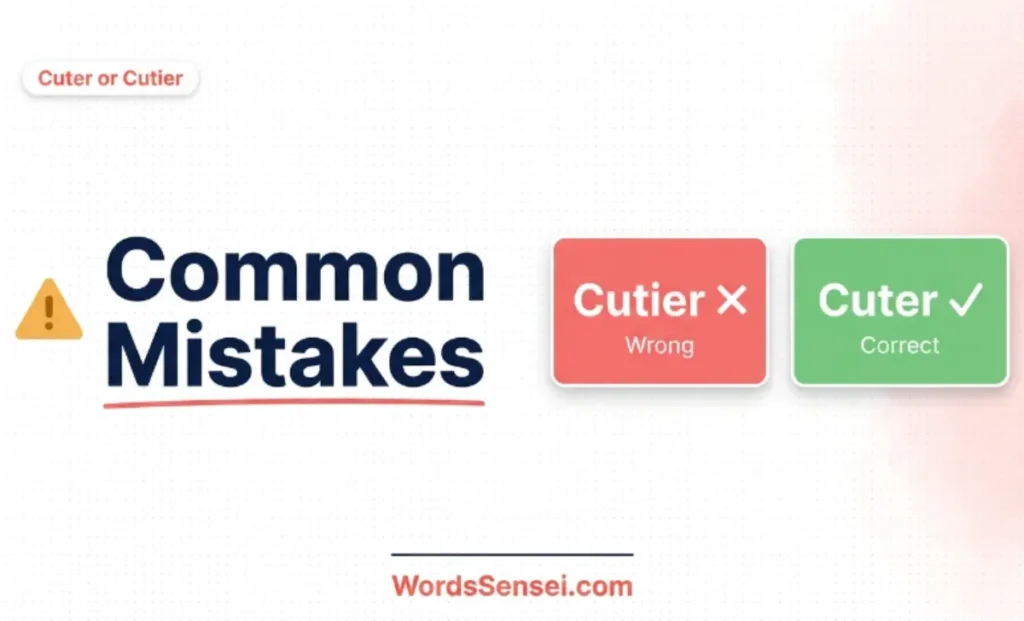
Even fluent English speakers make these errors. Here is exactly what to watch for — and how to fix each one.
Frequent Errors
- Writing “cutier” instead of “cuter” — most common mistake
- Writing “more cuter” — this is a double comparative and is always wrong
- Using “cutest” when comparing only two things — should be “cuter”
- Confusing the “-ier” rule (for “y” words) with the “-r” rule (for “e” words)
- Writing “most cutest” — another double superlative error
Corrected Examples
| ❌ Wrong | ✅ Right | Why |
|---|---|---|
| She is cutier than her sister. | She is cuter than her sister. | “Cutier” is not a word |
| This is more cuter than that. | This is cuter than that. | Double comparative is wrong |
| He is the cutest of the two. | He is the cuter of the two. | Two items = comparative, not superlative |
| That puppy is cutier. | That puppy is cuter. | “Cutier” does not exist |
| She looks most cutest today. | She looks cutest today. | Double superlative is wrong |
“Cuter” in Everyday Writing Examples
Here is how “cuter” works naturally across different real-world writing situations.
Emails
“Thank you for sending those product photos — the second packaging design looks cuter and fits our brand identity much better. Let us go with that version.”
Social Media
“Just spotted the fluffiest cloud formation — honestly cuter than any puppy I have ever seen ☁️ #NatureWins”
News Writing
“The animal shelter’s newest arrival — a three-legged kitten named Tripod — proved even cuter than any animal featured in the organization’s previous adoption campaigns.”
School Writing
“In my opinion, the red panda is cuter than the giant panda. Its smaller size, bushy tail, and rust-colored fur make it one of the most charming animals in the world.”
Business Writing
“Our updated product packaging is cuter and more compact than last year’s design, which has already improved customer appeal by 30% in early test markets.”
Google Trends and Usage Data
Search data strongly confirms that “cuter” dominates globally. “Cutier” only appears in search as a confused query — people trying to check whether it is even a real word.
Popular Countries
| Country | Most Searched Form | Search Volume | Notes |
|---|---|---|---|
| United States | Cuter | Very High | Highest volume globally |
| United Kingdom | Cuter | High | Consistent with US usage |
| Canada | Cuter | High | Follows North American pattern |
| Australia | Cuter | Medium-High | No regional variation |
| India | Cuter vs Cutier | Medium | Higher confusion — large ESL population |
| Philippines | Cuter | Medium | English widely used; cuter dominant |
Why People Search This Keyword
Most searches for “cuter or cutier” come from:
- ESL learners — English as a second language speakers applying the wrong grammar rule
- Students — double-checking spelling before submitting essays or assignments
- Social media users — wanting captions and comments to look correct
- Content writers and bloggers — avoiding embarrassing spelling errors in published work
- Non-native English teachers — verifying the rule before teaching it to students
Related Grammar Rules
Similar Spelling Mistakes
The same confusion happens with many other adjectives ending in silent “e.” Here are the most common:
| Base Word | ❌ Wrong Form | ✅ Right Form |
|---|---|---|
| Nice | Nicier | Nicer |
| Wide | Widier | Wider |
| Fine | Finier | Finer |
| Late | Latier | Later |
| Safe | Safier | Safer |
| Pale | Palier | Paler |
| Large | Largier | Larger |
| Strange | Strangier | Stranger |
All of these end in silent “e.” All follow the same rule: just add “-r” to form the comparative.
Helpful Grammar Tips
Here are the three core comparative rules you need to know:
Rule 1 — Silent “e” adjectives → add “-r”
- Cute → Cuter | Nice → Nicer | Wide → Wider | Fine → Finer
Rule 2 — Consonant + “y” adjectives → change “y” to “i,” add “-er”
- Pretty → Prettier | Happy → Happier | Funny → Funnier | Lovely → Lovelier
Rule 3 — Two-syllable+ adjectives (not ending in “y”) → use “more”
- Beautiful → More beautiful | Careful → More careful | Modern → More modern
Quick memory test:
- Word ends in “e”? → Just add “-r” (cute → cuter)
- Word ends in “y”? → Change to “-ier” (pretty → prettier)
- Word is long (2+ syllables, no “y” ending)? → Use “more” (more beautiful)
💡 Pro Tip: When in doubt, check Merriam-Webster or Cambridge Dictionary online — both are free and show the correct comparative form instantly.
Internal Link Suggestions
📌 (For Website Owners — Add These Internal Links in Your Article)
- Link “comparative adjective” → your article on English grammar rules
- Link “superlative form” → your article on superlative adjectives
- Link “ESL learners” → your beginner English grammar guide
- Link “social media captions” → your article on writing for Instagram
Author Bio Section
About the Author [Your Name] is an English language writer and grammar educator with [X] years of experience helping students, bloggers, and ESL learners write with confidence. [He/She/They] has written extensively on grammar, spelling, and vocabulary for publications including [Website Name]. Connect on LinkedIn | View All Posts
FAQs
Is “cutier” a real word?
No. “Cutier” is not a real English word. It does not appear in any major English dictionary — not Merriam-Webster, not Oxford, not Cambridge. The correct and only accepted word is “cuter.”
What is the comparative form of “cute”?
The comparative form of “cute” is “cuter.” The superlative form is “cutest.” These are the only two forms recognized by all major English dictionaries and grammar authorities.
Can I say “more cute” instead of “cuter”?
In very casual everyday speech, “more cute” is occasionally heard. However, in any kind of writing — formal, informal, academic, or professional — “cuter” is always the correct and preferred form. Avoid “more cute” in written content.
Why do people write “cutier” instead of “cuter”?
People confuse two different grammar rules. Adjectives ending in consonant + “y” (like pretty → prettier) use the “-ier” ending. But adjectives ending in silent “e” (like cute → cuter) just add “-r.” “Cute” ends in “e” — so it follows the “-r” rule, not the “-ier” rule.
Is “cuter” used in British English?
Yes. “Cuter” is correct in both British and American English — and in all other major varieties including Canadian, Australian, and Indian English. There is no regional spelling difference for this comparative form.
Which is correct — “cutest” or “most cute”?
“Cutest” is the correct superlative form. “Most cute” is technically possible in very informal speech but is rarely used and generally considered poor style. Always use “cutest” in writing.
Is “more cuter” ever correct?
No. Never. “More cuter” is a double comparative — it uses two comparative markers at once (“more” + “-er”). This is always grammatically wrong in standard English. Use only “cuter.”
How do I remember the correct spelling of “cuter”?
Use this simple memory trick: C-U-T-E ends in E — just add R. Cute + r = Cuter. Nothing else changes. No extra letters, no “i,” no “y.” Just add the letter R and you are done.
Conclusion
The answer has always been clear: “cuter” is correct — in every country, every context, and every style of writing. “Cutier” is a misspelling that no dictionary in the world recognizes. The confusion happens because of a mix-up between two different grammar rules.
The fix is easy: when “cute” needs a comparative form, just add “-r.” Write with confidence, avoid the common mistake, and your English will always look sharp.
Whether you are writing a school essay, a business email, or an Instagram caption — “cuter” is your word.
Read More Blogs:

Gerald Nelson is a contributing writer at Wordssensei.com, covering English grammar, vocabulary, and commonly confused words.