
Have you ever stopped while writing a formal agreement or a business email, wondering if you should type contractor or contracter? If so, you are definitely not alone. This is one of the most common spelling questions in the world of professional writing and the construction industry.
Getting this right is very important for your credibility. Consequently, using the wrong spelling can make your business look less professional to clients and partners. This guide is designed to solve this mystery once and for all. Therefore, by the time you finish reading this detailed article, you will be an expert on the correct spelling, the legal meaning, and the everyday usage of this essential term.
Furthermore, understanding the difference between these two spellings is not just about grammar; it is about showing attention to detail. In the competitive world of service providers, every small detail matters.
Therefore, we will dive deep into the word’s history, explore its legal roots, and provide you with foolproof tricks to remember the right version. As a result, you will be able to write with absolute confidence in any professional setting.
Quick Answer
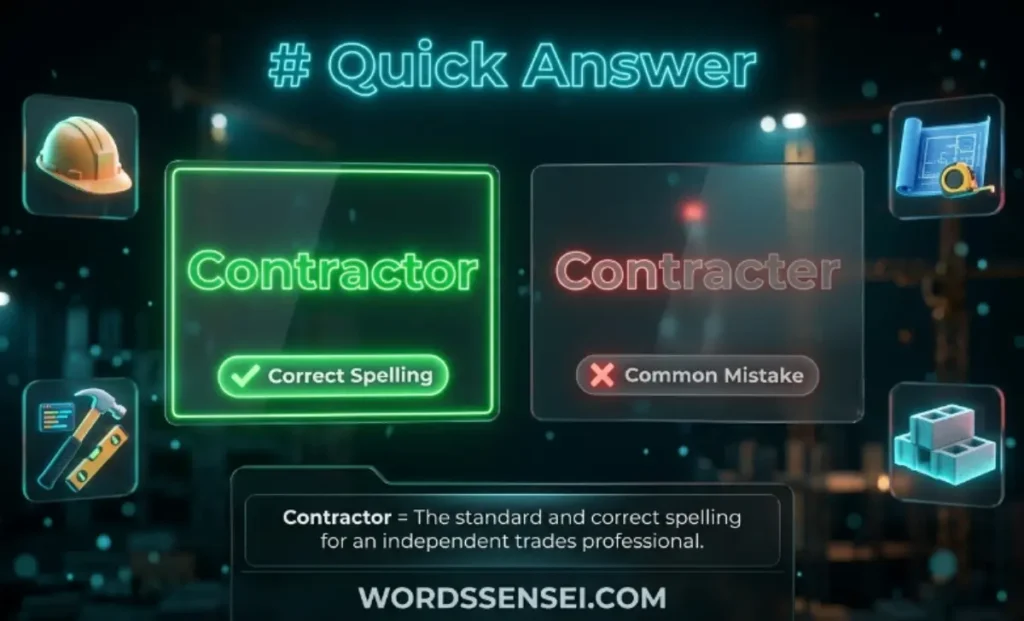
The correct and standard spelling is contractor. It is spelled with an “or” at the end. While many people assume it follows the common “er” pattern found in words like “teacher” or “worker,” this is actually a mistake. In modern English, “contracter” is considered a misspelling and is not recognized in major dictionaries. You can verify this by checking the official entries on Merriam-Webster or the Oxford Learner’s Dictionary. Therefore, whether you are in the United States, the United Kingdom, or India, you must always use the version ending in “or.”
Additionally, the reason for this spelling lies in the word’s origin. Because it comes from the legal concept of a contract, the suffix “-or” is used to denote the person or entity performing the action. Consequently, if you want to be correct, you should always stick to contractor.
Correct Example
- We hired a licensed contractor for the home renovation.
- The general contractor managed the entire building project.
- He works as an independent contractor for several tech firms.
Incorrect Example
- The contracter arrived late to the site. (Wrong)
- I am looking for a reliable contracter. (Wrong)
- The contracter signed the agreement yesterday. (Wrong)
What Does Contractor Mean?
A contractor is a person or a company that enters into a legal agreement to provide services or materials. In other words, they are a service provider who works under a specific set of rules defined in a binding document.
Common Meanings
- General Contractor: A professional who oversees an entire project, such as building a house.
- Independent Contractor: A person who provides services but is not a permanent employee.
- Subcontractor: A person hired by a main contractor to do a specific part of a larger job, like plumbing or electrical work.
- Government Contractor: A business that provides goods or services to a government agency.
Simple Usage Examples
- Construction: “The contractor is responsible for the remodeling of the kitchen.”
- Business: “As an independent contractor, she manages her own taxes and insurance.”
- Legal: “The contractor must comply with all local building codes and labor laws.”
- Freelance: “Many writers work as contractors for digital marketing agencies.”
The Origin of Contractor
The history of this word is closely tied to the history of law and commerce.
Word History
The word contractor comes from the Latin word contractus, which means “drawn together.” This refers to the two parties being drawn together by an agreement. In the early days of English, many words for professions ended in “-or” if they had Latin roots. For example, “doctor” and “actor” follow this same rule. Therefore, contractor follows this historical pattern.
Why the Confusion Happens
The confusion happens because most English nouns for people who do things end in “-er.” For instance, we have “baker,” “runner,” and “player.” As a result, our brains naturally want to apply this same rule to contractor. However, because of its legal and Latin background, it keeps the “-or” ending. Consequently, people often misspell it by following the more common pattern.
British English vs. American English
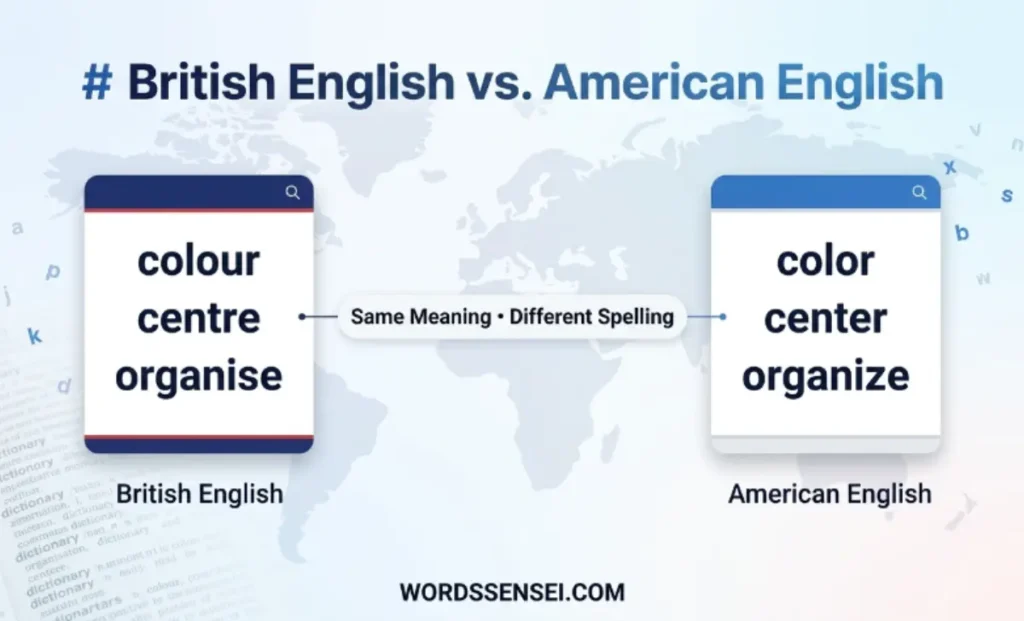
Interestingly, the spelling of contractor is one of the few things that remains the same in all major versions of English.
Comparison Table
| Feature | American English (US) | British English (UK) |
|---|---|---|
| Spelling | Contractor | Contractor |
| Meaning | Service Provider | Service Provider |
| Pronunciation | kən-ˈtrak-tər | kən-ˈtrak-tə |
| Legal Status | Recognized | Recognized |
Whether you are in London or New York, the word is always contractor. Therefore, you do not need to worry about regional differences when using this term.
Contractor vs. Other Variations
It is helpful to see how this word compares to other terms in the construction industry and employment world.
Spelling Comparison Table
| Correct Spelling | Incorrect Spelling | Usage | Category |
|---|---|---|---|
| Contractor | Contracter | Standard | Professional |
| Agreement | Agrement | Legal | Document |
| License | Lisence | Legal | Requirement |
| Insurance | Insurrance | Legal | Requirement |
Contractor vs. Subcontractor Comparison
| Feature | General Contractor (GC) | Subcontractor |
|---|---|---|
| Role | Manages the whole project | Performs a specific task |
| Hiring | Hired by the Client | Hired by the General Contractor |
| Responsibility | Overall site safety & timeline | Specific trade (Plumbing, etc.) |
| Payment | Paid by the Owner | Paid by the GC |
Common Legal Terms for Contractors
| Term | Definition | Importance |
|---|---|---|
| Liability | Legal responsibility for damages | High (Protects the business) |
| Indemnity | Protection against loss | Critical for contracts |
| Breach | Failure to meet contract terms | Leads to legal disputes |
| Force Majeure | Unforeseen events (Act of God) | Excuses non-performance |
Types of Contractor Licenses
| License Type | Scope of Work | Typical Requirement |
|---|---|---|
| Class A | Large-scale engineering | High capital & experience |
| Class B | Residential & commercial building | General construction knowledge |
| Class C | Specialty trades (HVAC, Electrical) | Specific trade certification |
Which Spelling Should You Use?
You should always use the version ending in “or.” There is no professional setting where “contracter” is correct.
US Audience
In the US, the Internal Revenue Service (IRS) and the Department of Labor always use contractor. Therefore, using the wrong spelling could lead to confusion in tax documents and employment status reports.
UK Audience
In the UK, the term is standard in all procurement and tameerati kaam (construction) documents. Consequently, British professionals always use the “or” version.
International Writing
For global business and international contracts, contractor is the universal term. Therefore, using the correct spelling ensures your documents are recognized everywhere.
Academic Writing
In law or business schools, “contracter” is a spelling error. As a result, students should always double-check their work for the “or” ending.
Social Media Usage
Even on LinkedIn or Twitter, using the correct spelling shows that you are a professional. Consequently, it helps you build a better brand identity.
Common Mistakes with Contractor
Avoid these frequent errors to keep your writing professional.
Frequent Errors
- The “ER” Trap: Writing “contracter” by mistake.
- Confusing with Employee: A contractor is not the same as a permanent employee.
- Missing the Second ‘C’: Writing “contrator.”
- Plural Errors: Writing “contractors” incorrectly as “contracter’s.”
Corrected Examples
- Incorrect: “I need a contracter for the roof.”
- Correct: “I need a contractor for the roof.”
- Incorrect: “The contracter signed the bid.”
- Correct: “The contractor signed the bid.”
Contractor in Everyday Examples
Let’s look at how the word is used in different professional contexts.
Emails
“Dear Team, please find the attached legal agreement for the new general contractor.”
Social Media
“Excited to start our new renovation project with the best contractor in town!
#Construction #HomeDesign”
News Writing
“The city council awarded the tender to a local contractor for the new bridge project.”
School Writing
“In business law, a contractor is defined by their obligations and liabilities under a signed muahida.”
Business Writing
“Our company ensures full compliance with all labor laws when hiring an independent contractor.”
Google Trends & Usage Data
The data shows that “contractor” is a high-volume search term worldwide.
Popular Countries
- United States: High volume for “general contractor near me.”
- United Kingdom: Frequent searches for “building contractor.”
- Canada: Common searches for “independent contractor taxes.”
- Australia: High volume for “subcontractor agreements.”
- India: Large number of searches for “government contractor tenders.”
Why People Search This Keyword
Most people search this keyword because they are looking for professional services. However, a large number of searches also come from people checking the spelling before writing a contract. Consequently, it is a vital keyword for anyone in the service industry.
Related Grammar Rules
Spelling is easier when you understand the patterns of the English language.
Similar Spelling Mistakes
- Governor: Often misspelled as “governer.”
- Advisor: Often misspelled as “adviser” (though both are sometimes used, “advisor” is more formal).
- Collector: Often misspelled as “collecter.”
Helpful Grammar Tips
Always remember the “Legal Or” rule. Words that come from legal or official Latin roots often end in “-or.” Since a contractor works with a contract, it follows this rule. Therefore, if you think of the law, you will remember the “or.”
FAQs
Is it contractor or contracter?
The correct spelling is contractor. It always ends with “or.”
What is a general contractor?
A general contractor is a professional who manages an entire construction project from start to finish.
What is the difference between a contractor and an employee?
A contractor works for themselves or another company under a specific agreement, while an employee is a permanent part of a company’s staff.
Do I need a license to be a contractor?
In many places, yes. A license and insurance are often required to perform professional work.
What is a subcontractor?
A subcontractor is hired by a main contractor to perform a specific part of a larger project.
Is ‘contracter’ ever correct?
No, “contracter” is not a recognized word in standard English.
How do I hire a good contractor?
You should check their license, read reviews, and ensure they have proper insurance.
What is a government contractor?
A business that provides goods or services to a government agency under a formal tender or bid.
Conclusion
In conclusion, the spelling of contractor is a small but vital detail in the world of professional writing. While the mistake of using “contracter” is common due to the general “-er” pattern in English, the correct version always ends in “-or.”
Throughout this guide, we have seen that a contractor is a key player in the construction industry and the broader economy, working under legal agreements to provide essential services. Whether you are a general contractor managing a large site or an independent contractor providing specialized skills, your title deserves the correct spelling.
Furthermore, by understanding the word’s Latin roots and its connection to the word contract, you can avoid this spelling trap forever. Consequently, your business documents, emails, and social media posts will always look professional and credible.
Remember, attention to detail is what separates a good service provider from a great one. Therefore, keep the “-or” in contractor, stay focused on compliance and quality workmanship, and your professional reputation will continue to grow. Your commitment to accuracy is the foundation of your success in any field!
Read More Blogs:
- Focusses or Focuses: Which Spelling Is Correct?
- Dysregulated or Disregulated? Most Writers Get This Wrong

Anne Seaton is a contributing writer at Wordssensei.com, covering English grammar, vocabulary, and commonly confused words.