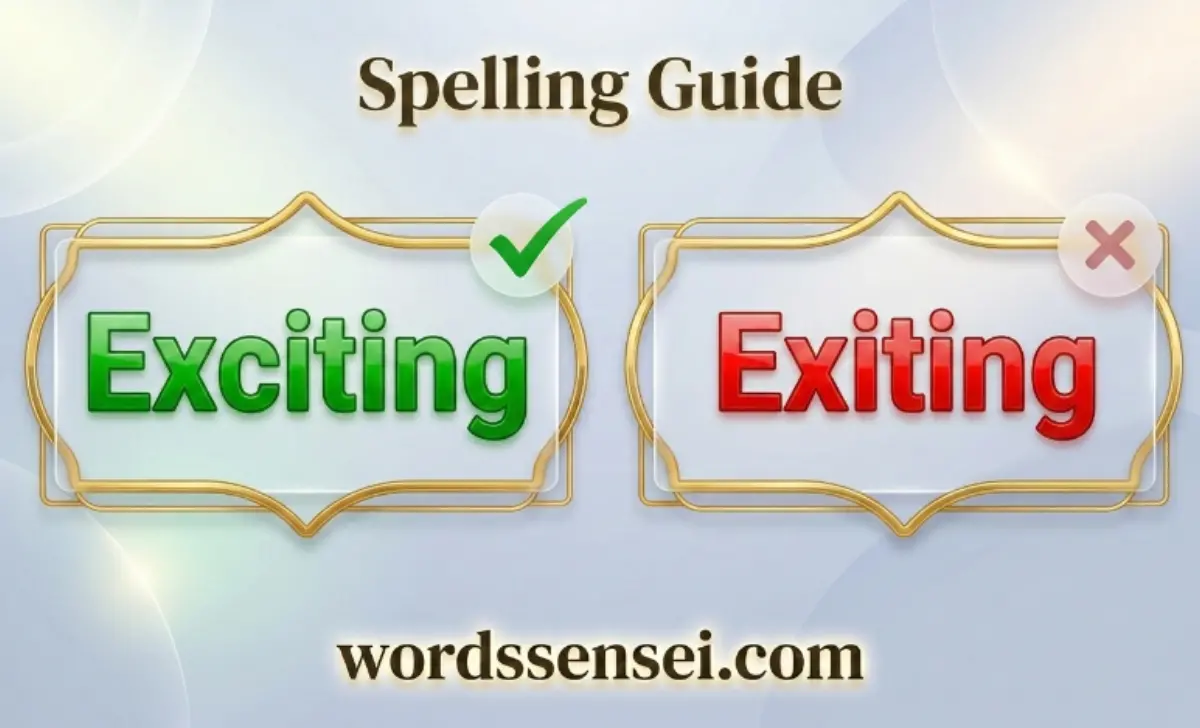
Many English learners and even native speakers get confused between exiting or exciting because the words look very similar and differ by only one letter.
This small spelling difference can completely change the meaning of a sentence. As a result, people often write “exiting” when they actually mean “exciting,” especially in emails, social media posts, job applications, marketing content, and everyday communication.
The confusion is understandable because both words share similar spelling patterns. However, they belong to different word categories and have completely different meanings.
Exiting relates to leaving or going out, while exciting describes something thrilling, interesting, enjoyable, or emotionally engaging.
In this guide, you’ll learn the difference between exiting and exciting, their meanings, grammar rules, sentence structures, examples, common mistakes, and simple memory tricks that will help you use both words correctly every time.
Quick Answer
The correct word depends on what you want to say.
Quick Answer Table
| Word | Meaning | Part of Speech |
| exiting | leaving or going out | Verb form |
| exciting | thrilling or interesting | Adjective |
Correct Examples
- She is exiting the building.
- We have exciting news to share.
Incorrect Examples
- We have exiting news. ❌
- She is exciting the building. ❌
What Does “Exiting” Mean?
Exiting comes from the verb exit.
Exiting Meaning
To leave, depart, or go out of a place.
Examples
- She is exiting the room.
- The vehicle is exiting the highway.
- We are exiting the program.
- Passengers are exiting the aircraft.
Common Situations for Exiting
The word is commonly used in:
- transportation
- buildings
- software programs
- emergency procedures
- travel instructions
Examples
- Exiting through the rear door.
- The driver is exiting the parking lot.
- Users are exiting the application.
What Does “Exciting” Mean?
Exciting comes from the verb excite.
Meaning
Something that causes enthusiasm, interest, enjoyment, or anticipation.
Examples
- That was an exciting game.
- We have exciting news.
- It was an exciting adventure.
- She received an exciting opportunity.
Common Situations for Exciting
The word is often used to describe:
- events
- sports
- travel
- careers
- opportunities
- announcements
Examples
- An exciting career opportunity.
- An exciting vacation.
- An exciting movie.
- An exciting discovery.
Difference Between Exiting and Exciting
This is the most important rule.
Simple Comparison
| Word | Meaning |
| exiting | leaving |
| exciting | thrilling |
Easy Rule
If someone is going out, use exiting.
If something creates enthusiasm, use exciting.
Why People Confuse Exiting and Exciting
Several factors contribute to the confusion.
Common Reasons
- Similar spelling
- Typing errors
- Fast writing
- Autocorrect mistakes
- ESL learning challenges
Key Insight
Only one letter changes, but the meanings are completely different.
Grammar Explained
Exiting as a Verb Form
Exiting is the present participle form of the verb exit.
Structure
Subject + is/am/are + exiting
Examples:
- She is exiting the building.
- They are exiting the stadium.
Exciting as an Adjective
Exciting describes a noun.
Structure
Exciting + noun
Examples:
- exciting event
- exciting project
- exciting opportunity
Exiting vs Exciting in Business Communication
Professional communication often includes both words.
Correct Usage
- The employee is exiting the company.
- We have exciting growth plans.
Incorrect Usage
- The employee is exciting the company. ❌
- We have exiting growth plans. ❌
Exiting vs Exciting in Emails
Correct Email Examples
- Thank you for exiting the system properly.
- We are excited to announce an exciting update.
Workplace Examples
- Visitors are exiting through the main entrance.
- The company launched an exciting new product.
Exiting vs Exciting in Marketing
Marketing teams frequently use exciting.
Examples:
- exciting offers
- exciting promotions
- exciting features
- exciting announcements
Exiting is rarely used unless discussing departures or navigation.
Exiting vs Exciting in Travel
Exiting Examples
- Passengers are exiting the train.
- Tourists are exiting the museum.
Exciting Examples
- It was an exciting journey.
- We enjoyed an exciting adventure.
Common Mistakes with Exiting and Exciting
Mistake 1
Using exiting instead of exciting.
❌ We have exiting news.
✔ We have exciting news.
Mistake 2
Using exciting instead of exiting.
❌ People are exciting the building.
✔ People are exiting the building.
Mistake 3
Ignoring context.
Always ask:
- Is someone leaving?
- Or is something interesting?
Mistake 4
Relying only on pronunciation.
Carefully check spelling before publishing content.
Exiting vs Exciting Side-by-Side Examples
| Exiting | Exciting |
| Exiting the room | Exciting opportunity |
| Exiting the highway | Exciting game |
| Exiting the program | Exciting announcement |
| Exiting the building | Exciting adventure |
Related English Word Confusions
Many learners confuse similar words.
Examples include:
- affect vs effect
- than vs then
- compliment vs complement
- accept vs except
- your vs you’re
Like exiting and exciting, these mistakes often result from similar spelling.
User Intent Questions Answered
What is the difference between exiting and exciting?
Exiting means leaving. Exciting means thrilling or interesting.
Is exiting the same as exciting?
No. They have completely different meanings.
Which word should I use?
Use exiting for departures and exciting for enthusiasm.
Why do people confuse these words?
Because they differ by only one letter.
Is exciting an adjective?
Yes.
Is exiting a verb form?
Yes.
Exiting or Exciting Synonyms
Both exiting and exciting have different meanings, so their synonyms are also different. Here are some common alternatives for each word.
Synonyms for Exiting
- Leaving — going away from a place or situation.
- Departing — going away, especially from a place.
- Going out — moving from inside to outside.
- Withdrawing — moving away from a place, group, or situation.
- Moving out — leaving a building, home, or location.
- Disembarking — leaving a bus, train, plane, or other vehicle.
Synonyms for Exciting
Electrifying — creating a powerful feeling of excitement.
Thrilling — causing strong excitement or enjoyment.
Exhilarating — making you feel very excited and energetic.
Stimulating — creating interest, thought, or enthusiasm.
Fascinating — extremely interesting or engaging.
Engaging — holding someone’s attention and interest.
FAQs
What does exiting mean?
It means leaving or going out.
What does exciting mean?
It means thrilling, enjoyable, or interesting.
Is exiting an adjective?
Usually no. It is primarily a verb form.
Is exciting an adjective?
Yes.
How do I use exiting in a sentence?
Example: She is exiting the building.
How do I use exciting in a sentence?
Example: We have exciting news.
Are exiting and exciting interchangeable?
No.
Which word is used for announcements?
Exciting.
Which word is used for leaving a place?
Exiting.
Why is this a common mistake?
Because the words have very similar spellings.
Memory Trick
A simple trick can help.
Exiting = Exit
Both words contain exit.
Think:
- exit
- exiting
- leaving
Exciting = Excitement
Both words contain excit.
Think:
- excitement
- exciting
- enthusiasm
Conclusion
The difference between exiting and exciting is simple once you understand their meanings. Exiting refers to leaving, departing, or going out, while exciting describes something thrilling, interesting, or enjoyable.
Although the words differ by only one letter, using the wrong one can completely change the meaning of a sentence.
By remembering that exiting relates to exit and exciting relates to excitement, you can avoid one of the most common English vocabulary mistakes and communicate more clearly in writing and speech.
Read More Blogs:
- Coaches or Coach’s? The Grammar Rule Most People Get Wrong
- Organising vs Organizing: Which Spelling Is Actually Correct?
- 31st or 31th? Which Is Correct?
- Response or Respond : Here’s the Correct Word to Use
- Focusses or Focuses: Which Spelling Is Correct?
- Elude or Allude: What’s the Difference?

Hi, I am Gerald Nelson, a professional content writer working on wordssensei.com.
I create engaging and SEO-friendly content that informs and inspires readers.