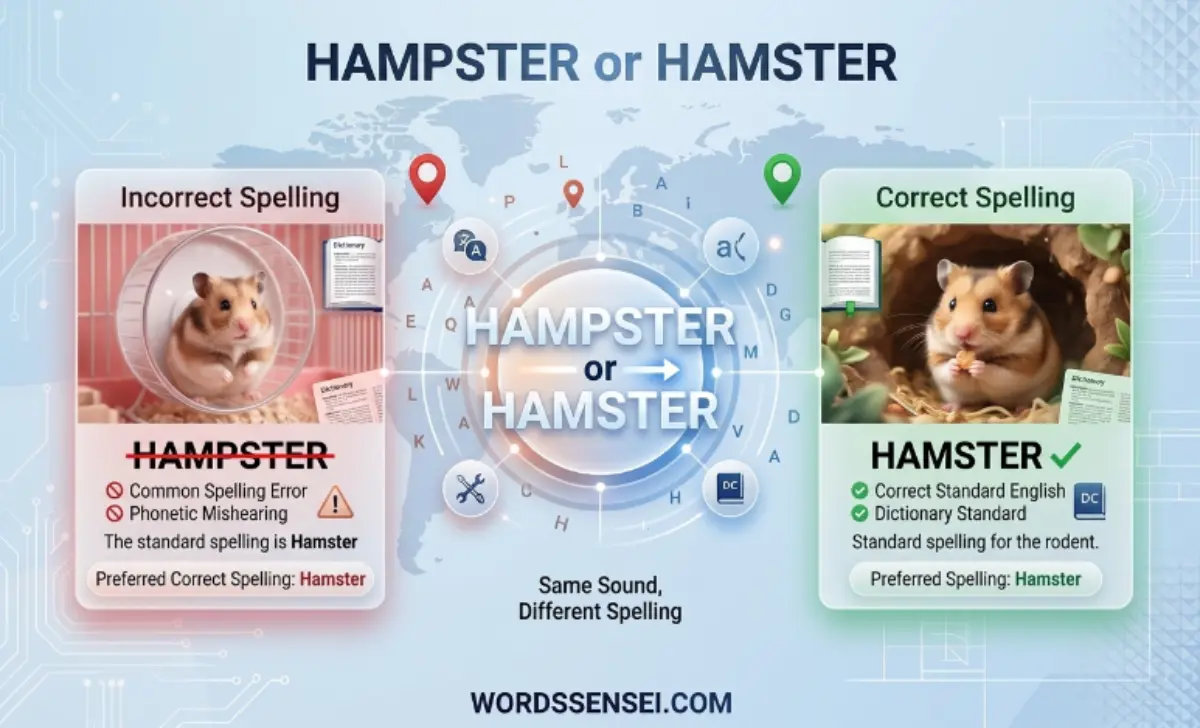
You typed “hamster” and then “hampster” and then paused to wonder — is that actually right? If so, you are definitely not alone. In fact, thousands of pet owners, students, and writers search this exact question every single day.
The confusion is completely understandable because “hampster” sounds so natural when spoken quickly. However, the answer is actually very simple and clear. Only one spelling exists in every English dictionary in the world.
Therefore, this complete guide will explain everything you need to know: the correct spelling, the word history, the reason for the confusion, and real usage examples. By the end, you will write this word with complete confidence every single time.
Quick Answer
“Hamster” is the correct spelling. Meanwhile, “hampster” is incorrect and does not appear in any major English dictionary, including Merriam-Webster, Oxford, or Cambridge.
The word never includes a “p,” even though many people pronounce it that way. Furthermore, the correct spelling is h-a-m-s-t-e-r, with no letter between the “m” and the “s.”
Most people make this mistake because of how the word sounds when spoken casually. Nevertheless, the spelling itself has never included a “p” at any point in its history.
✅ Correct Examples
“She bought a new cage for her hamster.”
“Furthermore, hamsters are popular pets among children.”
“The hamster ran on its wheel all night.”
“In addition, our teacher brought a class hamster named Biscuit.”
❌ Incorrect Examples
~~”She bought a new cage for her hampster.”~~
~~”Hampsters are popular pets among children.”~~
~~”The hampster ran on its wheel all night.”~~
~~”Our teacher brought a class hampster named Biscuit.”~~
Never add a “p” to this word. After all, “hampster” simply does not exist in standard English.
What Does “Hamster” Mean?
“Hamster” is a common English noun. Moreover, it appears constantly in pet care articles, children’s books, and everyday conversation. It refers to a small, furry rodent commonly kept as a pet.
| Feature | Detail |
|---|---|
| Word Type | Noun |
| Correct Spelling | Hamster |
| Incorrect Spelling | Hampster |
| Syllables | 2 — ham-ster |
| Pronunciation | /ˈhæmstər/ |
| Plural Form | Hamsters |
| Animal Family | Rodent |
Common Meanings
According to the Cambridge Dictionary{:target=”_blank” rel=”noopener noreferrer”}, a hamster is a small animal with a short tail and large cheek pouches, often kept as a household pet. Meanwhile, the word can also describe several related species kept for scientific research or as pets.
In everyday usage, “hamster” typically refers to a few common situations:
A pet hamster, for example, is the most common meaning, referring to a small caged rodent kept at home
Meanwhile, a Syrian hamster describes the largest and most popular pet breed
Similarly, a dwarf hamster describes smaller breeds often kept in pairs or small groups
Finally, a hamster wheel refers to the spinning exercise device found inside most hamster cages
Simple Usage Examples
“The hamster stuffed food into its cheek pouches.”
“Meanwhile, my daughter named her new hamster Peanut.”
“Veterinarians, therefore, recommend a specific diet for pet hamsters.”
“Eventually, the hamster fell asleep inside its wooden hideout.”
The Origin of “Hamster”
Knowing where this word comes from helps explain exactly why it is spelled the way it is. Additionally, it shows why “hampster” has never been correct throughout the entire history of the English language.
Word History
The word “hamster” came from the German word “Hamster,” which referred to the same small rodent. This German word, in turn, likely came from an Old High German term related to hoarding or storing food, since hamsters are known for stuffing their cheek pouches with grain.
When the word entered English in the 1600s, it kept this German spelling almost exactly. As a result, the spelling has remained consistent for centuries, always without a “p” anywhere in the word.
Interestingly, no related word in the hamster’s linguistic history has ever included a “p” sound. Therefore, the “p” in “hampster” is purely a modern pronunciation habit, not a historical spelling variant.
Why the Confusion Happens
Many English speakers naturally insert a slight “p” sound between the “m” and the “s” when speaking quickly. Moreover, this happens with other similar words too, since the mouth naturally transitions through a “p”-like sound between those two letters. Because of this pronunciation habit, many people assume the spelling should match.
However, this assumption is incorrect. So, here is the key difference:
| Word | Correct Spelling | Common Mistake |
|---|---|---|
| Hamster | Hamster | Hampster ❌ |
Even though many speakers pronounce a faint “p” sound, the spelling has never changed. Therefore, remembering the German origin is the easiest way to avoid the mistake.
British English vs American English
Good news — both British and American English completely agree on this word. “Hamster” is correct in every English-speaking country, without any exception.
Comparison Table
| Feature | American English | British English | Australian English | Indian English |
|---|---|---|---|---|
| Correct Spelling | Hamster ✅ | Hamster ✅ | Hamster ✅ | Hamster ✅ |
| Incorrect Spelling | Hampster ❌ | Hampster ❌ | Hampster ❌ | Hampster ❌ |
| Pronunciation | /ˈhæmstər/ | /ˈhæmstər/ | /ˈhæmstər/ | /ˈhæmstər/ |
| Dictionary | Merriam-Webster | Oxford | Macquarie | Oxford Indian |
No matter where you are writing, whether the United States, the United Kingdom, Canada, Australia, or India, the spelling never changes. Overall, always write “hamster” without a “p.”
Hamster vs Hampster — Full Comparison
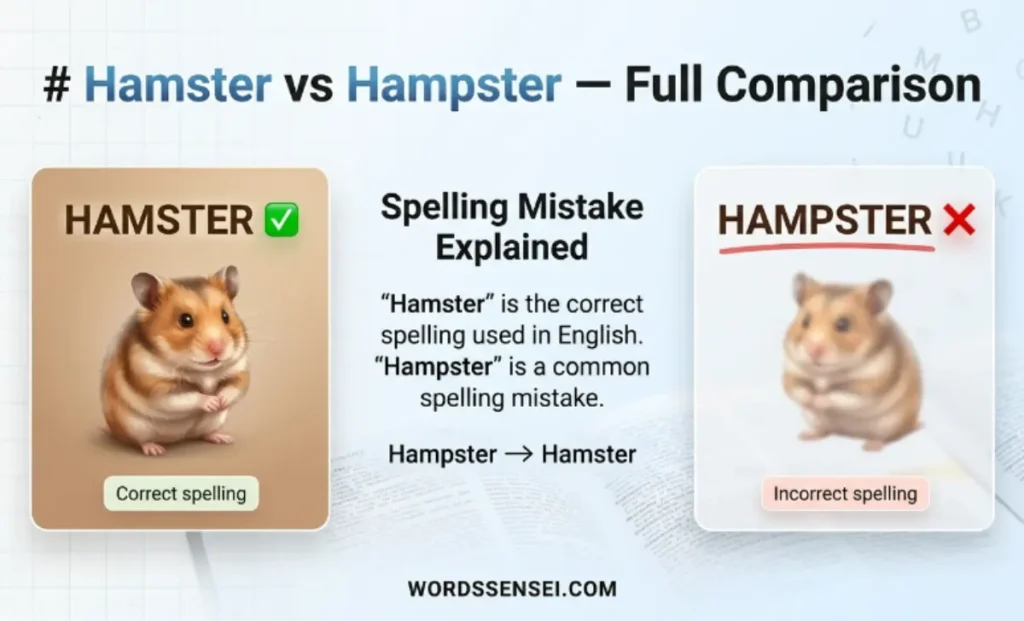
Let us now look at every variation people sometimes use, and clear up the confusion once and for all.
Complete Comparison Table
| Form | Correct? | Exists in Dictionary? | Recommended? |
|---|---|---|---|
| Hamster | ✅ Yes | ✅ Yes — all dictionaries | ✅ Always use this |
| Hampster | ❌ No | ❌ No dictionary | ❌ Never use this |
| Hamsters | ✅ Yes | ✅ Correct plural form | ✅ Use for multiple hamsters |
| Hampsters | ❌ No | ❌ No dictionary | ❌ Never use this |
Which Spelling Should You Use?
The answer is always “hamster,” in every context and every audience. However, here is a clear breakdown by writing situation.
US Audience
American writers should always use “hamster,” confirmed by Merriam-Webster{:target=”_blank” rel=”noopener noreferrer”} as the only correct form. Consequently, all American pet care guides, children’s books, and academic texts use this word exclusively.
UK Audience
British writers, similarly, always use “hamster,” confirmed by the Oxford English Dictionary. Likewise, British veterinary and pet care writing has used this exact spelling for centuries without variation.
Academic and Scientific Writing
In academic contexts, biology textbooks and research papers always use “hamster.” Conversely, no scientific classification or species name ever includes a “p” in this word.
Business and Pet Industry Writing
Pet stores, veterinary clinics, and product packaging always use “hamster” for professional credibility. As a result, using the correct spelling makes your content look far more trustworthy.
Social Media Usage
Casual posts often misspell this word because of how it sounds when typed quickly. Therefore, always double-check before posting about your pet online.
Common Mistakes with “Hamster”
Even confident writers make these errors. So, here is exactly what to watch for, and how to fix each mistake quickly.
Frequent Errors
First, writing “hampster” instead of “hamster” remains the most common mistake by far
Second, adding an extra “p” sound purely out of habit while typing quickly
Additionally, misspelling the plural form as “hampsters”
Meanwhile, confusing “hamster” with unrelated rodents like “gerbil” or “guinea pig”
Finally, forgetting to double-check pet-related content before publishing it online
Corrected Examples
| ❌ Wrong | ✅ Right | Why |
|---|---|---|
| I bought a hampster yesterday. | I bought a hamster yesterday. | Hampster is not a word |
| My hampsters live in the same cage. | My hamsters live in the same cage. | No “p” in the plural form either |
| The hampster wheel keeps squeaking. | The hamster wheel keeps squeaking. | Compound terms follow the same rule |
| She adopted a baby hampster. | She adopted a baby hamster. | Always drop the “p” |
“Hamster” in Everyday Writing Examples
Here is how “hamster” works naturally across different real-world writing situations. Furthermore, these examples will help you use the word with much more confidence going forward.
Emails
“We are excited to welcome your new hamster to our veterinary clinic. In addition, please bring any previous health records during your first visit. So, let us know if you have any questions before then.”
Social Media
“Meet my new hamster, Waffles! 🐹 Honestly, he already loves his wheel and hideout. #Hamster #NewPet”
News Writing
“Researchers confirmed that hamsters can recognize familiar scents from other hamsters in their group. As a result, the study offers new insight into rodent social behavior, and further research is expected soon.”
School Writing
“A hamster is a small rodent commonly kept as a classroom pet. Furthermore, hamsters are nocturnal animals, meaning they sleep during the day and become active at night.”
Business Writing
“Our pet store now offers a wider selection of hamster cages and accessories. Therefore, customers can choose from several sizes depending on their hamster’s breed. Meanwhile, our staff is happy to help first-time hamster owners.”
Google Trends and Usage Data
Search data clearly confirms that “hamster” completely dominates globally. On the other hand, “hampster” only appears in searches as a confused query, people checking whether it might actually be correct.
Popular Countries
| Country | Most Searched Form | Search Volume | Notes |
|---|---|---|---|
| United States | Hamster | Very High | Dominant — no competition |
| United Kingdom | Hamster | High | Consistent with US usage |
| Canada | Hamster | High | Follows North American pattern |
| Australia | Hamster | Medium-High | No regional variation |
| India | Hampster vs Hamster | High | Large ESL population — more confusion |
| Pakistan | Hampster vs Hamster | High | ESL learners — pronunciation confusion |
Why People Search This Keyword
Overall, most searches for “hamster or hampster” come from these specific groups:
First, new pet owners looking up care guides for the first time
Second, parents helping children write school reports about pets
Additionally, ESL learners confused by the word’s pronunciation
Meanwhile, content writers avoiding embarrassing errors in pet care articles
Finally, students double-checking spelling before submitting assignments
Related Grammar Rules
Similar Spelling Mistakes
The same kind of confusion happens with other words that include a silent transition sound. So, here are a few similar examples worth knowing:
| Related Pair | Correct Forms | Note |
|---|---|---|
| Hamster / Hampster | Hamster | No “p” despite the sound |
| Something / Somepthing | Something | Same pronunciation trap |
| Warmth / Warmpth | Warmth | Similar “m” to consonant transition |
Helpful Grammar Tips
Tip 1 — Remember there is no “p” anywhere in the word. “Hamster” contains only h-a-m-s-t-e-r. Therefore, if you find yourself typing a “p,” stop and double-check.
Tip 2 — Think of the German origin. The original German word “Hamster” never included a “p” either, so this history confirms the modern spelling.
Tip 3 — Watch the plural form too. The correct plural is “hamsters,” never “hampsters.” Consequently, this same rule applies to every related form of the word.
Tip 4 — Say it slowly when unsure. Pronouncing the word slowly, ham-ster, helps you notice there is no real “p” sound at all.
💡 Pro Tip: When you are not sure about any spelling, check Merriam-Webster{:target=”_blank” rel=”noopener noreferrer”} online. Best of all, it is completely free and gives the correct answer instantly.
“Hamster” — Common Phrases and Related Terms
“Hamster” appears in several common phrases and related terms today. Moreover, understanding these different uses helps you use the word naturally in any context.
Common Phrases
| Phrase | Meaning | Example |
|---|---|---|
| Hamster wheel | Spinning exercise device | “The hamster ran on its wheel for hours.” |
| Hamster ball | Rolling exercise toy | “She let her hamster explore in a hamster ball.” |
| Syrian hamster | Largest common pet breed | “Syrian hamsters must live alone in their own cage.” |
| Dwarf hamster | Smaller pet breed | “Dwarf hamsters can sometimes live in small groups.” |
| Hamster cage | Housing enclosure | “Clean the hamster cage at least once a week.” |
| Running like a hamster on a wheel | Idiom for repetitive effort | “This job feels like running on a hamster wheel.” |
Internal Link Suggestions
📌 (Add These Links When Related Articles Are Ready)
The term “hamster care guide” can link to your article on pet hamster feeding and habitat tips.
Similarly, “commonly misspelled animal names” can link to your article on English spelling mistakes.
For pet-related content, “choosing the right small pet” can link to your article comparing hamsters, gerbils, and guinea pigs.
Finally, “silent letter confusion” can link to your article on tricky English pronunciation and spelling patterns.
Author Bio
About the Author [Your Name] is an English language writer and grammar teacher with [X] years of experience. Additionally, [he/she/they] helps students, bloggers, and ESL learners write better and more confidently every day. Connect on LinkedIn | View All Posts
FAQs
Is “hampster” a real word?
No. “Hampster” is not a real English word. In fact, it does not appear in any major dictionary, not Merriam-Webster, not Oxford, not Cambridge. The only correct word is “hamster.”
Why do people spell hamster as hampster?
People naturally insert a faint “p” sound while pronouncing the word quickly. Since the mouth transitions between the “m” and “s” sounds, many speakers hear a “p” that was never actually part of the spelling.
What does “hamster” mean?
A “hamster” is a small rodent with cheek pouches, commonly kept as a household pet. Furthermore, the word can also refer to related species used in scientific research.
Is the plural “hamsters” or “hampsters”?
The correct plural is “hamsters.” Since “hampster” itself is not a real word, its plural form does not exist either.
Are hamsters and gerbils the same animal?
No. Hamsters and gerbils are related rodents, but they belong to different species with different behaviors, tails, and care requirements.
How do I remember the correct spelling of hamster?
Try this simple approach: say the word slowly, ham-ster. Since there is no real “p” sound when spoken slowly, this trick helps you avoid adding one in writing.
Is “hamster” capitalized?
No. “Hamster” is a common noun and stays lowercase, except when it begins a sentence or appears in a title.
What is a Syrian hamster?
A Syrian hamster is the largest and most popular pet hamster breed, known for living alone rather than in groups.
Conclusion
After reading through this complete guide, the answer is now absolutely clear. “Hamster” is the only correct spelling, in every country, every writing style, and every context you can think of. “Hampster” simply does not exist in any English dictionary anywhere in the world.
The confusion happens because many people pronounce a faint “p” sound between the “m” and the “s.” However, this word has never included a “p” throughout its entire history, tracing back to its German origin.
So, the next time you sit down to write, whether it is a school report, a pet care blog, a social media post, or a veterinary form, write “hamster” with complete confidence. Overall, you now have the full picture: the correct spelling, the word history, and practical tips to remember it forever.
Read More Blogs:
- Colombia vs Columbia: Which Spelling Is Correct?
- Beemer or Beamer? The BMW Nickname Most People Get Wrong

Anne Seaton is a contributing writer at Wordssensei.com, covering English grammar, vocabulary, and commonly confused words.