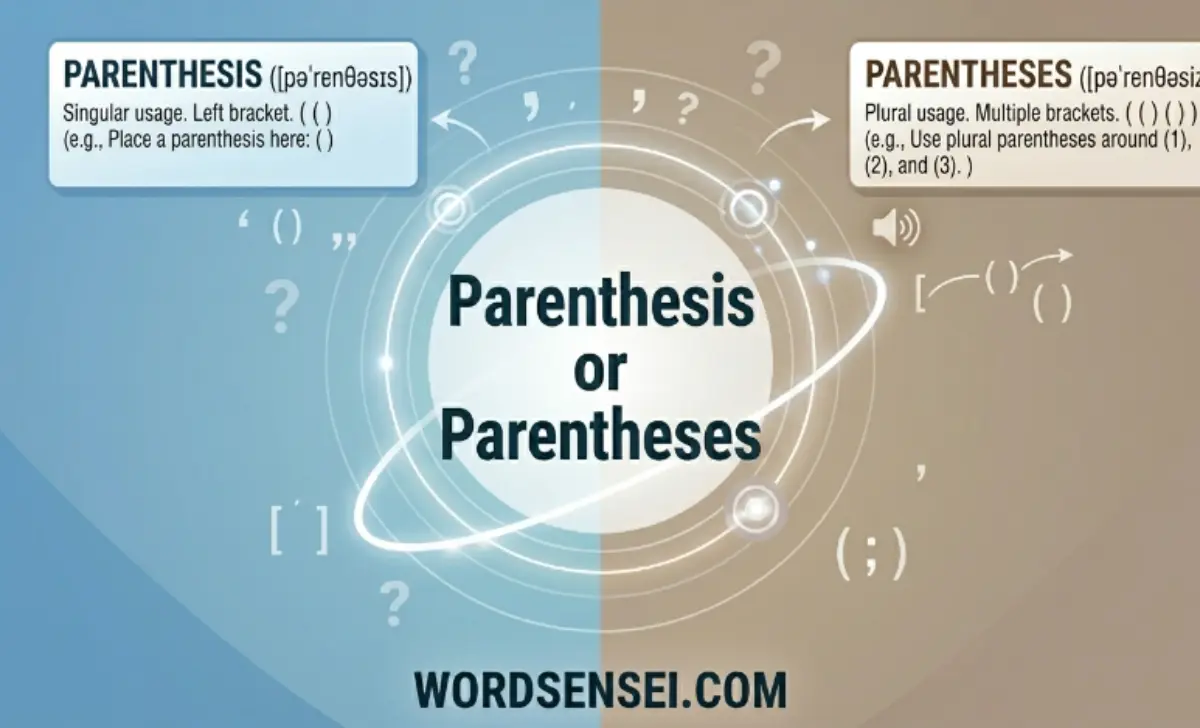
Many English learners, students, writers, and professionals often get confused between parenthesis and parentheses. These punctuation marks are widely used in academic writing, business communication, legal documents, technical writing, and everyday sentences.
The confusion mainly arises because one word is singular (parenthesis) and the other is plural (parentheses), yet both refer to the same punctuation concept involving round brackets.
In simple terms, parentheses are used to add extra information, clarification, or non-essential details inside a sentence. They help improve writing clarity and structure. Whether you are writing essays, reports, emails, or programming code, understanding how and when to use parentheses correctly is essential for strong grammar and professional writing skills.
This guide explains meaning, usage rules, examples, style guides, and common mistakes in a simple and clear way.
Quick Answer
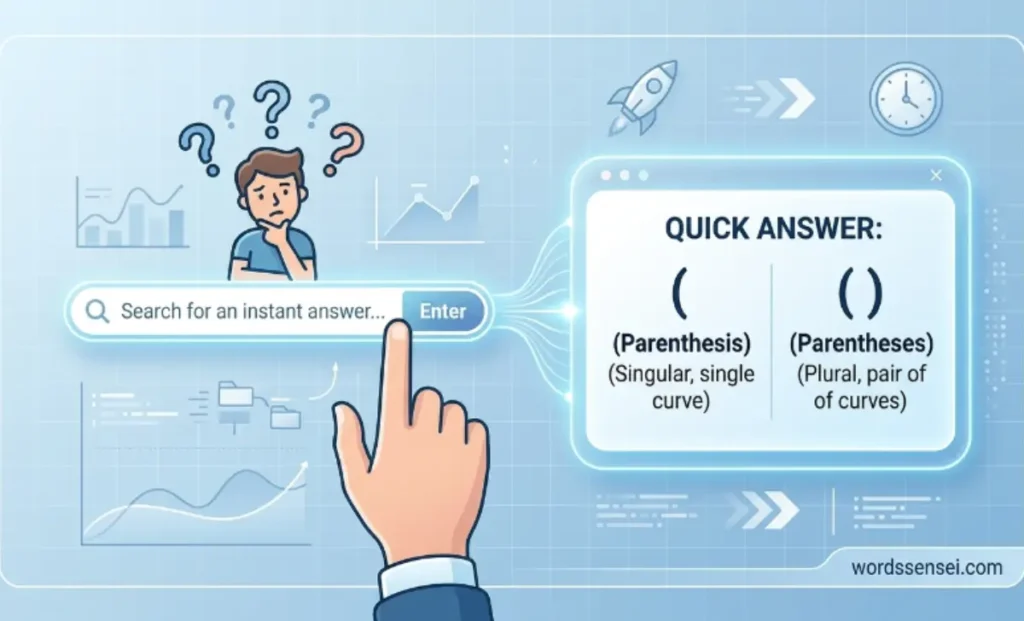
The difference is simple:
Parenthesis = Singular form (one bracket mark, rarely used alone)
Parentheses = Plural form (used for the pair of round brackets: ( ))
Example:
- She added a note in parentheses.
- (This is called a parenthesis pair.)
👉 In real usage, “parentheses” is the correct and commonly used term because we always use them in pairs.
Pronunciation of Parenthesis or Parentheses
Understanding pronunciation helps avoid confusion in academic and spoken English.
Parenthesis
Pronunciation:
/pəˈrenθəsɪs/
Sounds like:
puh-REN-thuh-sis
Parentheses
Pronunciation:
/pəˈrenθəsiːz/
Sounds like:
puh-REN-thuh-seez
Spoken Confusion
Many learners struggle because both words sound similar, especially in fast speech. However, context in grammar or writing usually makes the meaning clear.
Why People Confuse Parenthesis or Parentheses
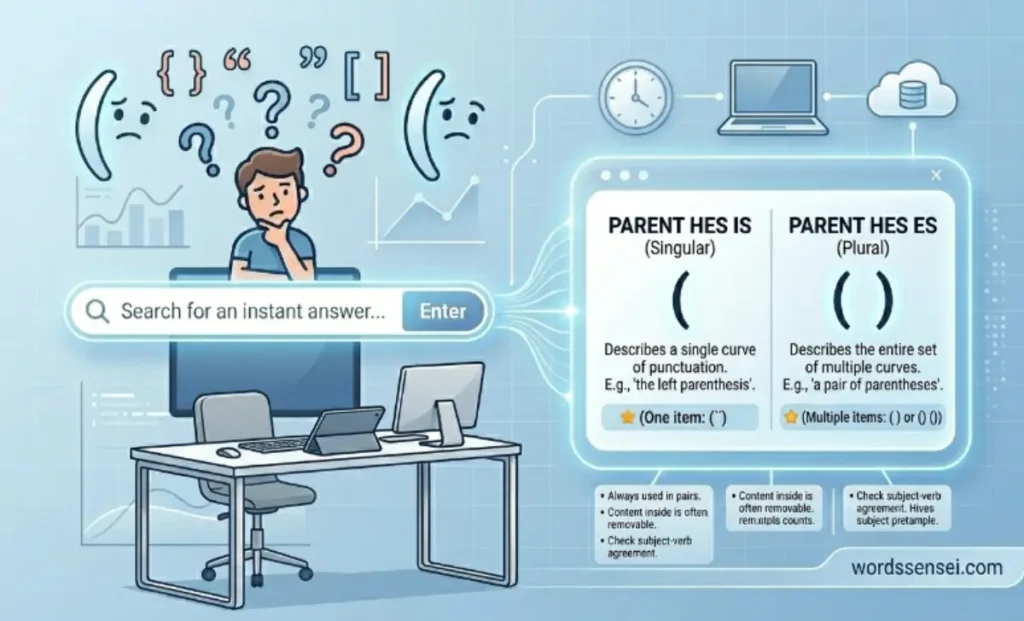
There are several reasons for confusion:
Singular vs Plural Form
- Parenthesis = one form (rare in usage)
- Parentheses = two brackets used together
Visual Similarity
Both refer to round brackets: ( )
Grammar Learning Issues
ESL learners often assume both are interchangeable without understanding plural structure.
Style Guide Differences
Different writing guides explain usage in slightly different ways, causing confusion in academic writing.
Easy Trick to Remember Parenthesis or Parentheses
A simple memory trick helps:
Trick:
- Parenthesis = One thought
- Parentheses = Two brackets (a pair)
Formula:
Parentheses always come in pairs → ( )
Visual Tip:
Think:
- Parenthesis = single idea
- Parentheses = complete enclosure of extra information
The Origin of Parenthesis or Parentheses
The word comes from Greek:
- “parenthesis” means “insertion” or “to place beside”
It entered English through Latin and became widely used in academic writing and punctuation systems.
Over time, grammar rules standardized the use of parentheses to describe the paired punctuation marks used in sentences.
These marks are now essential in:
- Academic writing
- Legal documents
- Technical documentation
- Programming syntax
- Mathematical expressions
British English vs American English Usage
There is no spelling difference between British and American English for this term.
| Term | British English | American English |
|---|---|---|
| Parenthesis | Parenthesis | Parenthesis |
| Parentheses | Parentheses | Parentheses |
Key Point
Both varieties use the same punctuation rules, especially in formal writing and academic standards like APA, MLA, and Chicago style.
Which Term Should You Use?
Use “Parentheses” When:
- Referring to punctuation marks ( )
- Writing academic papers
- Editing formal documents
- Explaining grammar rules
- Technical writing or coding explanations
Use “Parenthesis” When:
- Referring to a single instance or concept in theory
- Discussing grammar structure in explanation form
👉 In real-world writing, “parentheses” is used most of the time.
Common Mistakes with Parenthesis or Parentheses
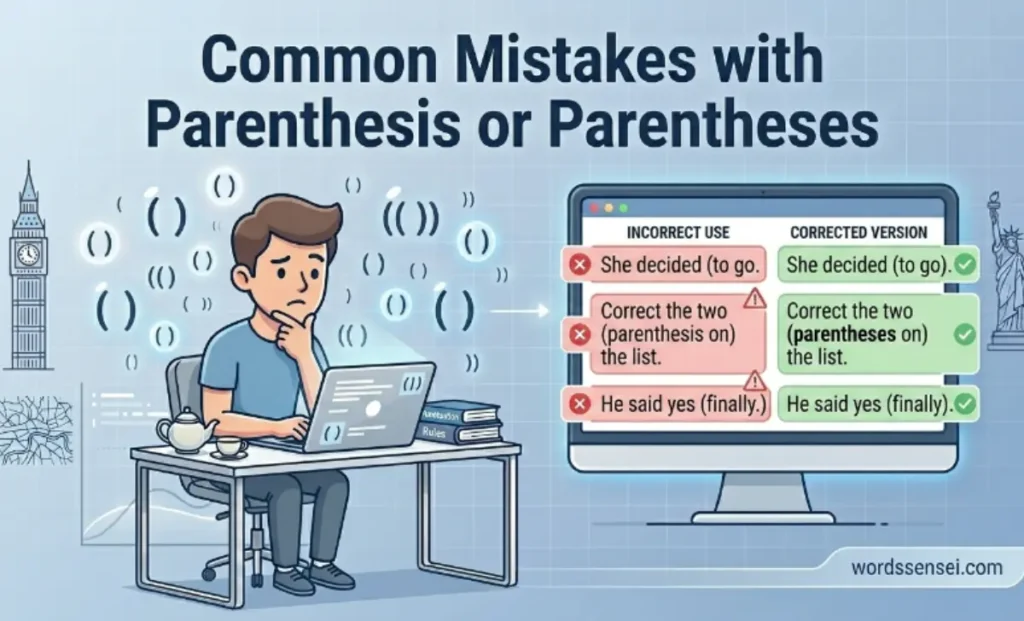
Mistake: Using “parenthesis” for plural usage
Incorrect:
- Add the text in parenthesis.
Correct:
- Add the text in parentheses.
Mistake: Forgetting pairing
Parentheses must always appear in pairs: ( )
Mistake: Overusing in sentences
Too many parentheses can reduce clarity in writing.
Mistake: Mixing with other punctuation
They should be placed carefully with commas, periods, and quotation marks.
Parenthesis or Parentheses in Everyday Examples
Academic Writing
“The theory (as explained in chapter 2) is widely accepted.”
Business Writing
“The report (attached below) contains full details.”
Technical Writing
“The function returns a value (integer type).”
Programming
Parentheses are used in many programming languages for:
- Functions
- Conditions
- Expressions
Mathematics
Used for grouping expressions:
- (2 + 3) × 5
Parenthesis or Parentheses – Google Trends & Usage Data
Search interest is high among:
- Students
- ESL learners
- Writers
- Editors
- Programmers
Popular searches include:
- What are parentheses
- Parenthesis vs parentheses difference
- How to use parentheses in a sentence
- Grammar punctuation guide
- Academic writing rules
- Common punctuation mistakes
This keyword is especially common in:
- Academic seasons
- Exam preparation periods
- English learning platforms
Countries with high interest include:
- United States
- United Kingdom
- India
- Pakistan
- Canada
- Australia
Parenthesis vs Parentheses Comparison Table
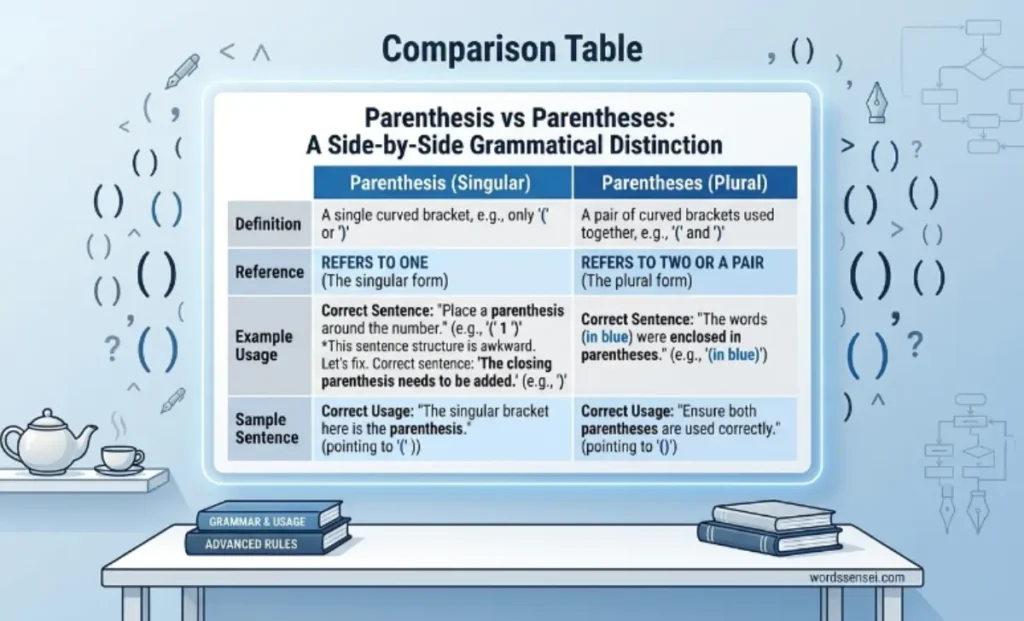
| Feature | Parenthesis | Parentheses |
|---|---|---|
| Meaning | Single idea / concept | Pair of brackets ( ) |
| Usage | Rare in practice | Common usage |
| Grammar role | Theoretical reference | Practical punctuation |
| Writing context | Linguistics | Academic, business, technical writing |
| Example | A parenthesis in theory | Text in parentheses |
Common Uses of Parentheses
Parentheses are widely used in:
- Academic essays
- Research papers
- Business reports
- Legal documents
- Technical manuals
- Programming code
- Mathematical equations
They help improve:
- Writing clarity
- Sentence structure
- Reading flow
- Information organization
FAQs About Parenthesis or Parentheses
What is the difference between parenthesis and parentheses?
Parenthesis is singular, while parentheses is plural and refers to round brackets ( ).
When should I use parentheses?
Use them to add extra or non-essential information in a sentence.
Are parentheses punctuation marks?
Yes, they are punctuation marks used for clarification or additional information.
What is an example of parentheses?
“She (my teacher) helped me with the assignment.”
Are parentheses used in formal writing?
Yes, especially in academic and technical writing.
What is the symbol of parentheses?
The symbol is ( ).
Conclusion
Understanding the difference between parenthesis and parentheses is important for strong grammar, clear writing, and professional communication. While “parenthesis” refers to a single theoretical concept, “parentheses” refers to the actual pair of punctuation marks used in writing.
These marks play a vital role in academic writing, business communication, technical documentation, programming, and mathematics. By using them correctly, you improve sentence clarity, structure, and readability.
Whether you are an ESL learner, student, or professional writer, mastering parentheses will significantly enhance your writing skills and help you avoid common punctuation mistakes.
Read More Blogs:
- Friend or Faux: How to Identify a True Friend vs a Fake Friend
- Wintry or Wintery: Which Spelling Is Correct? (Complete Guide)

Anne Seaton is a contributing writer at Wordssensei.com, covering English grammar, vocabulary, and commonly confused words.