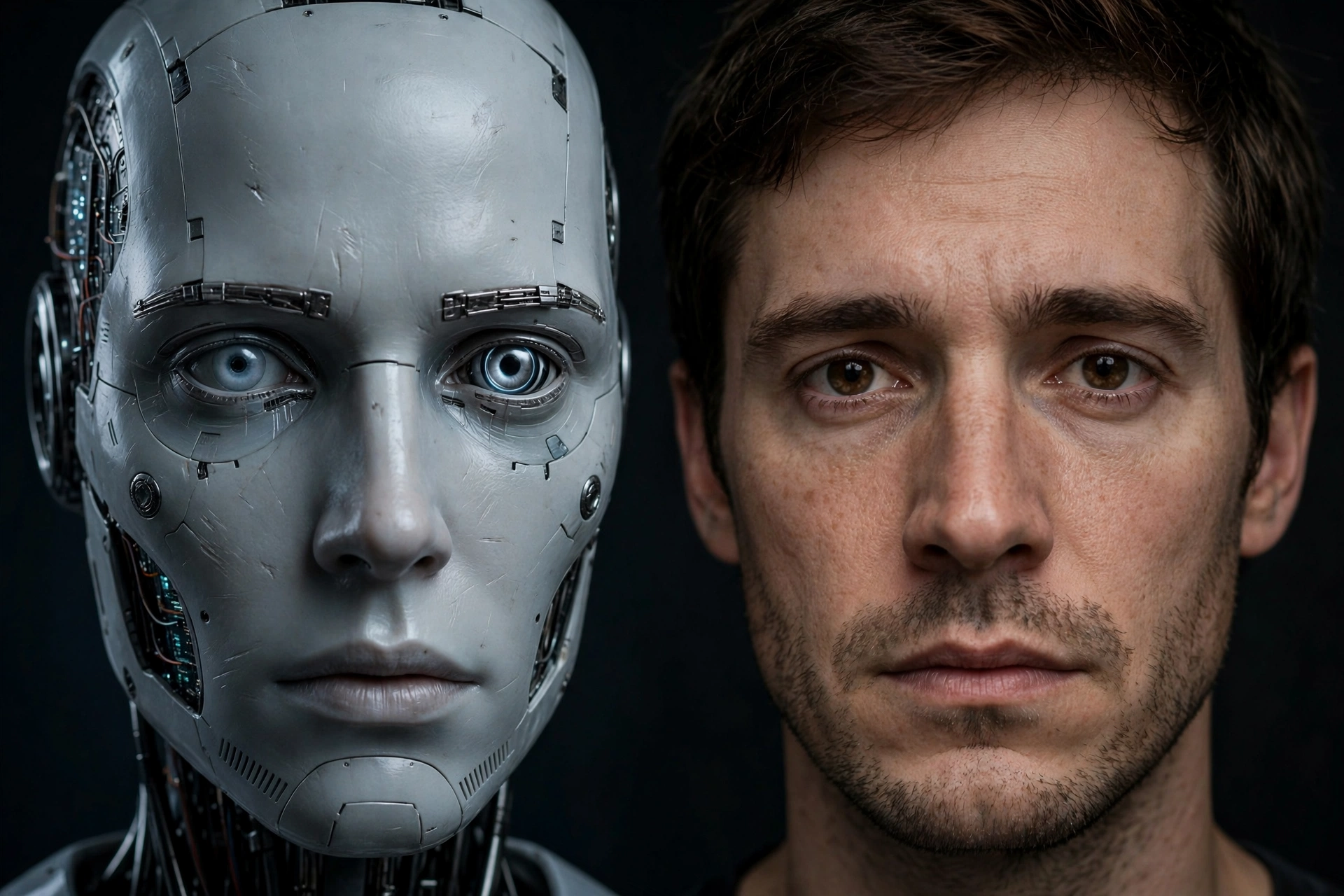
Uncanny Valley: The Short Answer
The “uncanny valley” is the feeling of unease or revulsion people get from something that looks almost — but not quite — human: a lifelike robot, a CGI character, or an AI-generated face. Japanese roboticist Masahiro Mori proposed the concept in a 1970 essay. Merriam-Webster added the term to its dictionary in September 2026, noting it now applies well beyond robotics.
The Definition
Merriam-Webster defines the uncanny valley as “a psychological effect characterized by feelings of unease or revulsion in response to the nearly but imperfectly lifelike quality of something (such as a doll, a robot, an AI-generated image or voice, or a computer-animated character) that is intended to simulate a human.”
The name comes from a graph. Mori theorized that as a robot looks more human, our comfort with it rises — until it gets very close to human but misses the mark. At that point, comfort plunges into a “valley” of eeriness. Only when the likeness becomes essentially perfect (a living person) does comfort rise again.
Mori’s 1970 Hypothesis
Masahiro Mori introduced the idea in his 1970 essay “Bukimi no Tani” — literally “the uncanny valley phenomenon.” His observations:
- We feel increasing warmth toward machines as they become more lifelike — a toy robot is more appealing than an industrial arm.
- But past a certain point, the almost-human robot suddenly feels creepy. The closer it gets without being convincing, the worse it feels.
- Movement makes it stronger: a still mannequin is odd; a moving almost-human figure is unsettling.
The essay was translated into English in Jasia Reichardt’s 1978 book “Robots: Fact, Fiction, and Prediction,” which is how “uncanny valley” entered English. The “uncanny” half of the name also echoes the psychoanalytic concept of the uncanny — the familiar made strange — discussed by Ernst Jentsch (1906) and Sigmund Freud (1919).
Where You Encounter the Uncanny Valley
Mori was writing about robots, but the effect shows up everywhere:
- Robotics: humanoid robots with realistic skin but slightly off movement or eyes.
- Film and animation: motion-captured CGI characters whose faces look dead-eyed or waxy.
- Video games: photorealistic characters whose expressions do not quite match their voices.
- AI-generated media: synthetic faces, voices, and videos that look human at a glance but feel wrong on closer inspection — a growing concern as generative AI improves.
- Dolls and mannequins: hyper-realistic figures that trigger discomfort in shops and museums.
The AI era has given the concept new life. As AI-generated actors and influencers appear in ads and social feeds, the valley is no longer a robotics curiosity — it is a daily media experience. Discussions of AGI and human-like AI systems increasingly run into it, slang like clanker shows how pop culture processes the same unease, and even AI-assisted work like vibe coding can produce output that feels almost — but not quite — human-made.
Why Does It Happen?
Researchers have proposed several explanations, and there is no single settled answer:
- Expectation mismatch: the almost-human appearance sets up expectations of human behavior that the object then violates.
- Threat detection: the brain may flag the not-quite-human as sick, dead, or dangerous — an evolved alarm system misfiring.
- Category confusion: the object sits between “human” and “object,” and the brain dislikes ambiguity.
What is well established is the pattern itself: near-human likeness plus small imperfections reliably produces discomfort across cultures and age groups.
How the Term Is Used Today
Merriam-Webster notes the term has expanded far beyond robotics into discussions of computer animation, video games, and AI. Common modern uses:
- “The digital de-aging in that film fell straight into the uncanny valley.”
- “AI customer-service voices are crossing the uncanny valley — they sound almost human, which somehow makes them worse.”
- “That virtual influencer gives me uncanny valley vibes.”
It is usually used as a noun phrase, often with verbs like “fall into,” “cross,” or “escape.”
Frequently Asked Questions
It is the creepy feeling you get from something that looks almost human but not quite — like a lifelike robot or CGI character. Comfort drops sharply just before perfect realism.
Japanese roboticist Masahiro Mori, in his 1970 essay “Bukimi no Tani” (The Uncanny Valley).
On Mori’s graph of human-likeness versus emotional comfort, there is a sharp dip — a valley — where near-human objects cause unease before comfort rises again at full realism.
Yes. Merriam-Webster’s 2026 definition explicitly includes AI-generated images and voices, and the term is now commonly used for synthetic media.
In Mori’s model, yes: objects either stay clearly non-human (cute robots, cartoons) or achieve essentially perfect likeness. The problem zone is the almost-but-not-quite middle.
It is a hypothesis with substantial supporting evidence across studies, though researchers still debate exactly why the effect occurs.