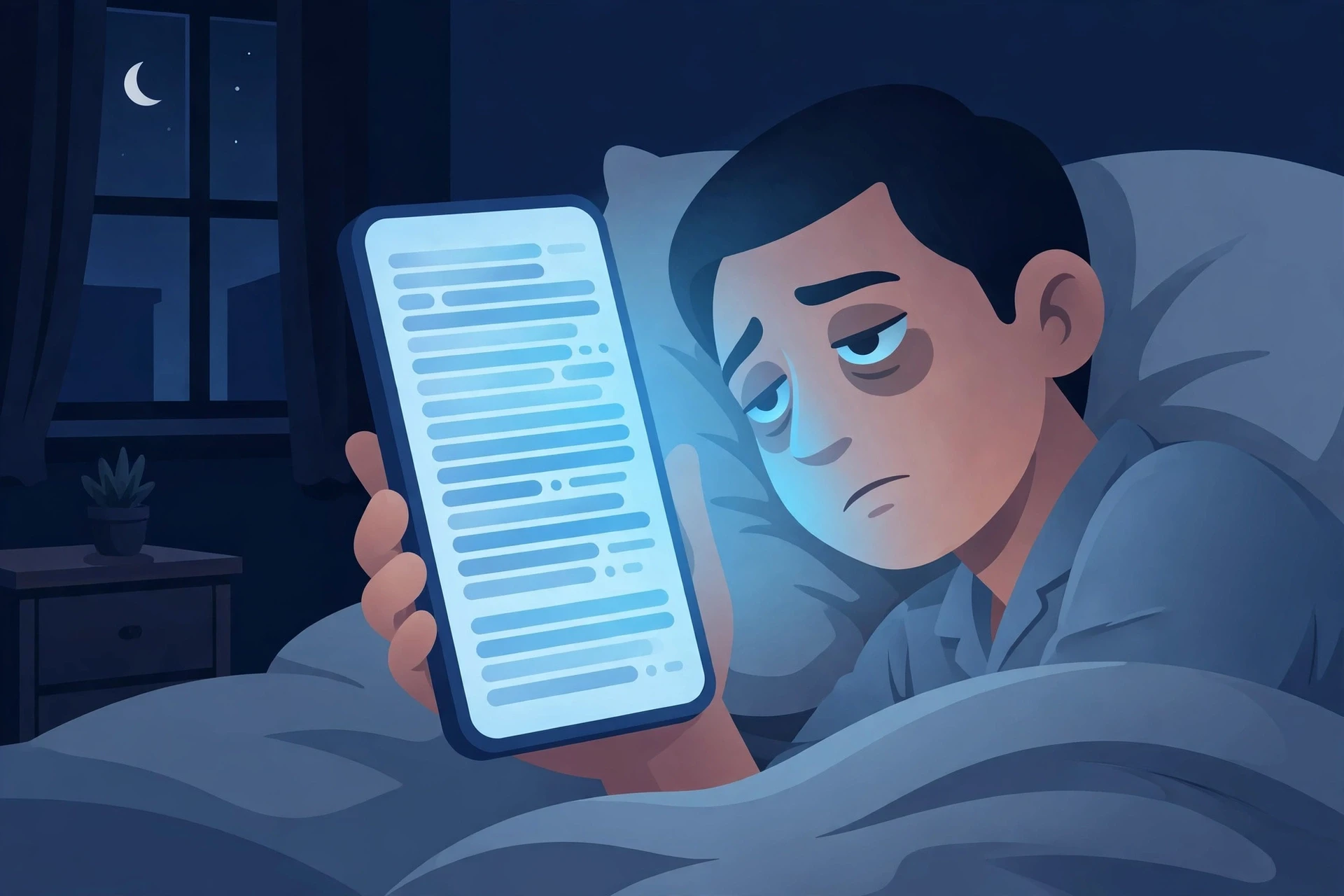
If you’ve ever told yourself “just one more scroll” at 1 a.m. and surfaced an hour later feeling worse about everything, you’ve been doomscrolling. The word went mainstream during the pandemic, but the habit is older than the name. Here’s what doomscrolling really means — and why your brain can’t seem to stop.
Doomscrolling: The Short Answer
Doomscrolling means compulsively scrolling through bad news and negative content online, even though it makes you feel anxious, sad, or angry. Merriam-Webster defines the verb doomscroll as “to spend excessive time scrolling through online content (especially news) that makes one feel sad, anxious, angry, etc.” The key word is excessive — it’s not staying informed, it’s scrolling past the point of usefulness.
What Does “Doomscrolling” Mean?
Doomscroll works as both a transitive and intransitive verb: you can “doomscroll Twitter” or just “doomscroll.” The noun form is a doomscroll (“that late-night doomscroll ruined my mood”), and the person doing it is a doomscroller. A close cousin is doomsurfing, which means essentially the same thing — but doomscrolling is the version that stuck, probably because most of us do our worst scrolling on phones.
Notice the definition doesn’t require the news to be about any one topic. War coverage, disaster updates, angry comment threads, outrage bait — if it’s negative and you can’t stop consuming it, it counts. Like brain rot, doomscrolling describes a modern habit that needed a modern word.
Where Did “Doomscrolling” Come From?
Merriam-Webster records the first known use of doomscroll in 2020, the year the word exploded. But reports trace an early sighting to a little-noticed 2018 tweet — the concept was floating around before it had a name everyone used.
Then came the pandemic. Stuck at home in 2020, millions of people refreshed case counts, death tolls, and breaking-news alerts deep into the night. In April 2020, Merriam-Webster added the term to its “Words We’re Watching” blog, noting a huge spike in lookups, and Google Trends showed searches for the word surging. Media outlets from NPR to Wired to The New York Times all wrote explainers. By the time the dictionary gave it a full entry, doomscrolling had already become the default word for the habit.
Why Can’t We Stop Doomscrolling?
Psychologists point to a few overlapping reasons. First, the negativity bias: human brains pay more attention to threats than to good news, because noticing danger kept our ancestors alive. A alarming headline will always out-pull a pleasant one.
Second, uncertainty makes us seek information. During a crisis, scrolling feels like doing something — like staying informed will give you control. Times tech writer Brian X. Chen described the experience as “sinking into emotional quicksand,” and noted that the activity can leave people angry, anxious, and less connected to the people around them.
Third, the feed never ends. Unlike a newspaper with a last page, a social feed is infinite, and every refresh promises something new. That unpredictability is exactly what keeps the thumb moving. It’s the same loop that makes touch grass such a popular prescription — logging off is the only reliable exit.
Doomscrolling vs. Doomsurfing: Is There a Difference?
Practically none. Both describe compulsively consuming negative online content. Doomsurfing nods to the older “surfing the web” metaphor, while doomscrolling reflects how we actually consume content now — by scrolling. Dictionaries list them as variants, and doomscrolling won the popularity contest by a wide margin. If you say “doomsurfing,” people will understand you, but they might think you’re being retro on purpose.
How to Use “Doomscroll” in a Sentence
- “I was doomscrolling until 2 a.m. and now I’m anxious about things happening on another continent.”
- “She deleted the news app from her phone to break her doomscrolling habit.”
- “Election week turned everyone I know into a doomscroller.”
- “He caught himself doomscrolling through the comments and put the phone down.”
- “Doomscrolling before bed is the fastest way to ruin a good mood.”
Frequently Asked Questions
Doomscrolling means spending excessive time scrolling through negative online content — especially bad news — even though it makes you feel sad, anxious, or angry. Merriam-Webster defines doomscroll as “to spend excessive time scrolling through online content (especially news) that makes one feel sad, anxious, angry, etc.”
Yes. It’s a full dictionary entry in Merriam-Webster, which records its first known use in 2020. It started on the dictionary’s “Words We’re Watching” list during the pandemic before earning a permanent entry.
Almost nothing. They’re variants of the same idea — compulsively consuming negative online content. Doomscrolling (scrolling on a phone) is far more common than doomsurfing (surfing the web).
Because it keeps your brain marinating in threats and outrage with no resolution. Writers and psychologists have linked heavy doomscrolling to anxiety, anger, poor sleep, and feeling disconnected. The information rarely helps you act — it just keeps you scrolling.
The standard advice: set time limits on news apps, charge your phone outside the bedroom, replace the bedtime scroll with a book, and notice the physical cue — if your jaw is clenched and your thumb is still moving, that’s the signal to stop.
No single inventor is credited. Merriam-Webster’s first known use is dated 2020, though reports trace an early Twitter use to 2018. The word went mainstream during the COVID-19 pandemic, when media coverage and dictionary blogs picked it up.