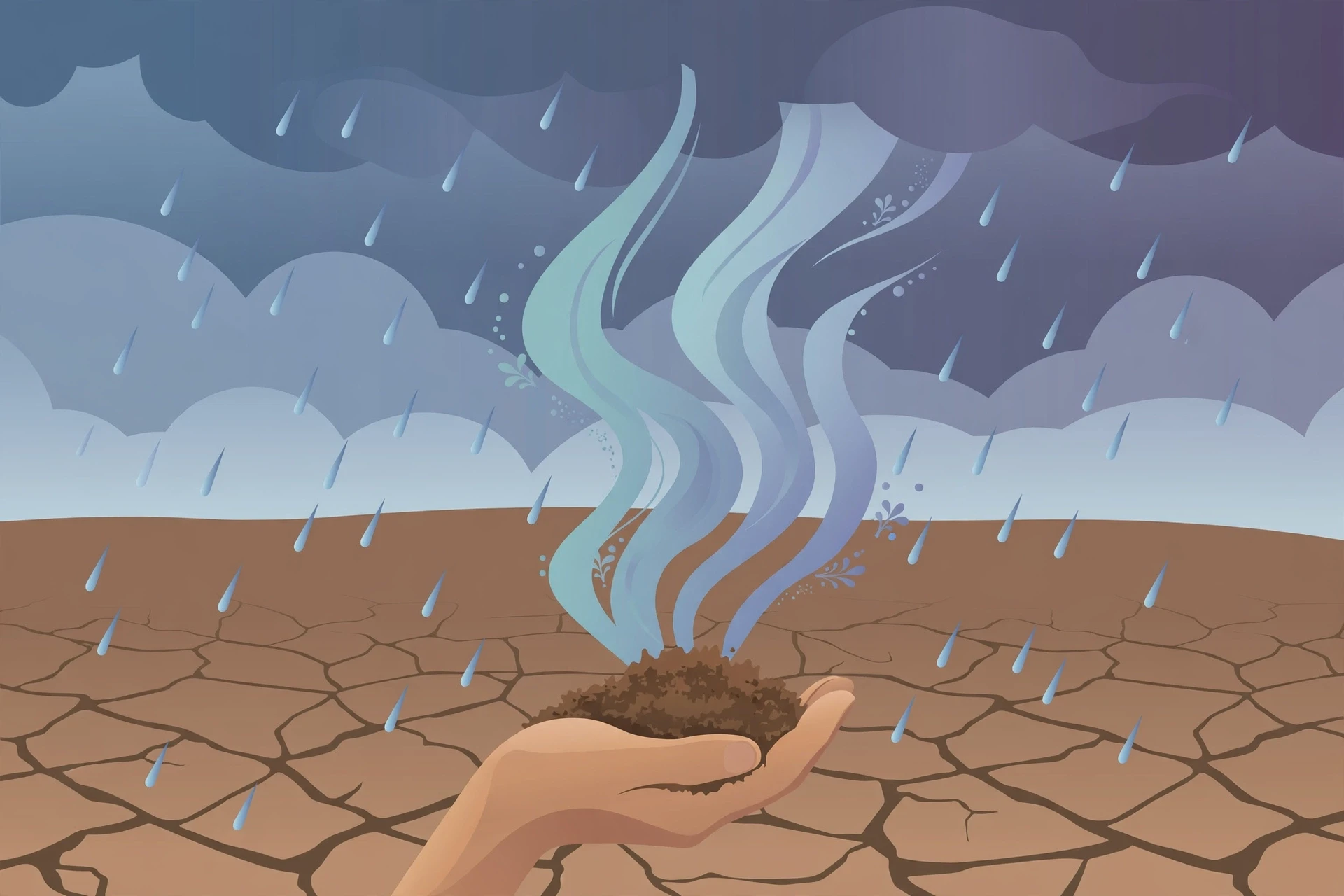
You know that smell — the first rain hitting hot, dry earth after weeks without it. It has a name, and the story behind the name involves Australian scientists, ancient Greek gods, and a 1964 paper in the journal Nature. The word is petrichor.
Petrichor: The Short Answer
Petrichor is the earthy scent produced when rain falls on dry soil or rock. It’s a noun — it names the smell itself, not the rain. Pronounced PET-rih-kor, it’s the word for one of the most universally loved scents in the world.
What Does “Petrichor” Mean?
Petrichor is the technical term for that distinctive earthy aroma that rises when moisture hits dry ground — strongest after a long dry spell, when the first drops land on dusty soil, rock, or pavement. Poets had been describing the smell for centuries, but it had no scientific name until two researchers decided it needed one.
The word has since escaped the lab. Writers use it to add precision and atmosphere to descriptions of rain, and it’s a favorite of word lovers precisely because it names something everyone knows but few can label. Like uncanny valley — another term with a fascinating origin story — petrichor proves that the best words often come with the best backstories.
Who Named the Smell of Rain?
In 1964, two Australian scientists — Isabel Joy Bear and Richard Grenfell Thomas, working at CSIRO’s Division of Mineral Chemistry in Melbourne — published a paper in Nature titled “Nature of Argillaceous Odour.” They had been investigating a phenomenon mineralogists had noted for years: dry clays and soils give off a peculiar odor when moistened.
By steam-distilling rocks that had been exposed to warm, dry conditions, they isolated a yellowish oil trapped in the rock and soil — released only when moisture arrived. They needed a name for this “apparently unique odour,” and they reached for ancient Greek. The paper, published March 7, 1964, introduced petrichor to the world.
Interestingly, they weren’t the first to notice the smell’s appeal. A small perfumery industry in India had already been capturing it in sandalwood oil, calling it matti ka attar — “earth perfume.” But Bear and Thomas gave it a scientific name and an explanation.
Breaking Down the Word
Petrichor is a compound of two Greek words:
- Petra (πέτρα) — “stone” or “rock”
- Ichor (ἰχώρ) — the ethereal golden fluid said to flow in the veins of the ancient Greek gods, instead of mortal blood
Put together, it literally means something like “the blood of the stone” — or, as the scientists phrased it, an “ichor,” a “tenuous essence,” derived from rock or stone. It’s one of the most poetic etymologies in science: the idea that stone itself bleeds a divine fluid when the rain comes.
What Actually Causes Petrichor?
The 1964 paper identified the core mechanism, and later research filled in the details:
- Plant oils accumulate on rocks and soil surfaces during dry periods, absorbed into clay and pores.
- Actinobacteria — soil-dwelling microbes — produce a compound called geosmin as a metabolic byproduct, which adds the musty-earthy note.
- Rain strikes: high-speed photography later showed that raindrops hitting porous surfaces trap tiny air bubbles, which rise and burst as aerosols, flinging the scent compounds into the air.
- Ozone from lightning can add a sharp, electric edge if a storm is involved.
Humans are remarkably sensitive to geosmin — some researchers suggest we inherited the attraction from ancestors who relied on rain for survival. The smell of rain meant water was coming, and water meant life. Petrichor is one of several modern scientific coinages that entered everyday language; greenhushing is another recent one worth knowing.
Petrichor vs. Geosmin: What’s the Difference?
They’re related but not the same. Geosmin is a specific chemical compound produced by soil bacteria — it’s one ingredient of the smell. Petrichor is the name for the whole scent experience: the plant oils plus geosmin plus the aerosol mechanics, all triggered by rain on dry earth. Think of geosmin as a spice and petrichor as the finished dish.
How to Use “Petrichor” in a Sentence
- “The petrichor rising from the garden after the storm was intoxicating.”
- “She loved the petrichor of summer rain on hot pavement.”
- “We opened the windows to let the petrichor in.”
- “That first rain after the drought brought the strongest petrichor he’d ever smelled.”
- “The novel’s opening scene was all heat, dust, and petrichor.”
Frequently Asked Questions
Petrichor is the earthy scent produced when rain falls on dry soil or rock. It’s a noun naming the smell itself, pronounced PET-rih-kor.
Australian scientists Isabel Joy Bear and Richard Grenfell Thomas, in a 1964 paper in the journal Nature titled “Nature of Argillaceous Odour.”
It’s built from the Greek petra (“stone”) and ichor (the ethereal fluid in the veins of the Greek gods) — roughly “the blood of the stone,” or an essence derived from rock.
Plant oils that accumulate on dry soil, plus geosmin (a compound from soil bacteria), released into the air when raindrops strike porous surfaces and burst as aerosols. Ozone from lightning can add to it.
No. Geosmin is one chemical ingredient (from bacteria); petrichor is the name for the complete scent of rain on dry earth.
What people describe as “smelling rain coming” is usually ozone carried ahead of a storm, or petrichor from rain already falling nearby — the wind delivers it before the drops reach you.