Have you ever written the word “meter” and then wondered if “metre” might actually be the correct form instead? If so, you are definitely not alone. In fact, thousands of students, engineers, and writers search this exact question every single day.
However, here is something interesting — unlike most spelling debates, this one is not about right or wrong. Both spellings are completely correct, depending on where you live. Moreover, there is a surprising twist that almost nobody knows about.
The word “meter” — when it refers to a measuring device like a gas meter or parking meter — is spelled the same way in every English-speaking country, even in Britain. So, this complete guide will explain both spellings clearly, reveal this hidden exception, and show you exactly when to use each form with total confidence.
Quick Answer
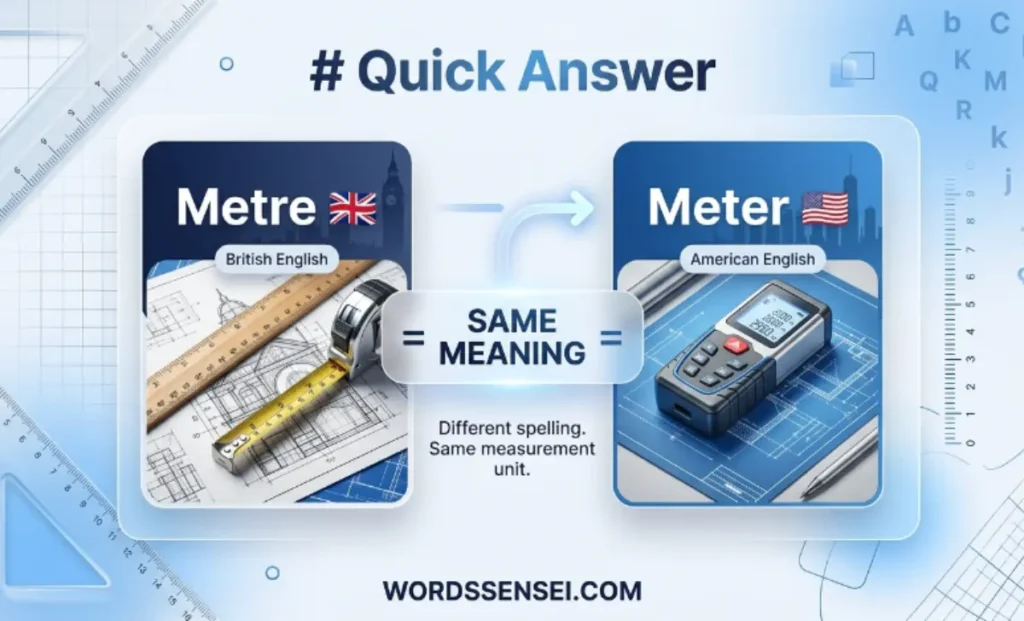
Both “metre” and “meter” are correct English spellings — but they belong to different regions and serve slightly different purposes.
“Meter” is the American English spelling for the unit of length. It is widely used throughout the United States in science, education, and everyday writing.
“Metre” is the British English spelling for the same unit of length. Furthermore, it is also the official spelling used by the International System of Units (SI) — the global authority for measurement standards.
However, there is an important exception. When the word “meter” refers to a measuring device — such as a gas meter, water meter, or parking meter — it is always spelled “meter,” even in British English. This is one of the most overlooked facts about this word pair.
What Does “Meter” Mean?
A meter — or metre — is the base unit of length in the metric system. Moreover, it is one of the most fundamental measurement units used in science, construction, sports, and everyday life around the world.
| Feature | Detail |
|---|---|
| Unit Type | Length measurement |
| Symbol | m |
| Equal To | 100 centimeters |
| Equal To | Approximately 3.28 feet |
| American Spelling | Meter |
| British Spelling | Metre |
| SI Standard | Metre |
Common Meanings
According to the Cambridge Dictionary{:target=”_blank” rel=”noopener noreferrer”}, a metre is a unit for measuring length, equal to 100 centimeters. Furthermore, this same dictionary notes that “meter” is also used as a noun for a device that measures or records something, such as time, distance, or quantity.
In everyday usage, “meter” or “metre” can mean several different things:
- A unit of length — used to measure distance, height, or size in the metric system
- A measuring device — used for gas, water, electricity, or parking, spelled “meter” everywhere
- A pattern in poetry — refers to rhythm and stress patterns in verse, typically spelled “meter” even in British contexts
- A scientific measurement — used in physics, engineering, and construction worldwide
Simple Usage Examples
- “The fence needs to be exactly two meters high to meet safety regulations.”
- “Furthermore, the sprinter finished the 200-meter race in record time.”
- “The plumber checked the water meter to estimate the monthly bill.”
- “In addition, the poem uses a strict iambic meter throughout each stanza.”
The Origin of “Meter” and “Metre”
Understanding where these two spellings come from helps explain why both exist — and why the measuring device exception makes perfect historical sense.
Word History
The word “metre” traces back to the French word “mètre,” which was introduced during the French Revolution as part of the new metric system in the late 1700s. The French word itself came from the ancient Greek word “metron,” meaning “measure.”
When the metric system spread across Europe and the British Empire, the spelling “metre” became standard in British English, following French conventions. However, the United States adopted a simplified spelling — “meter” — as part of broader American spelling reforms in the 1800s, similar to changes like “centre” becoming “center.”
Interestingly, when the International System of Units (SI) was formally established, it officially adopted “metre” as the standard international spelling for the unit of length. As a result, “metre” remains the official scientific spelling recognized by international organizations worldwide.
Why “Meter” the Device Never Changes
The word “meter” meaning a measuring instrument actually comes from a completely different root — the English suffix “-meter,” which is added to words to describe a device that measures something. For example, “thermometer” measures temperature, and “speedometer” measures speed. Because this suffix developed independently within English itself, rather than coming through French metric system reforms, it never adopted the British “re” spelling. Therefore, words like “gas meter,” “parking meter,” and “thermometer” are spelled the same way in both American and British English.
“Meter” the Unit vs “Meter” the Device
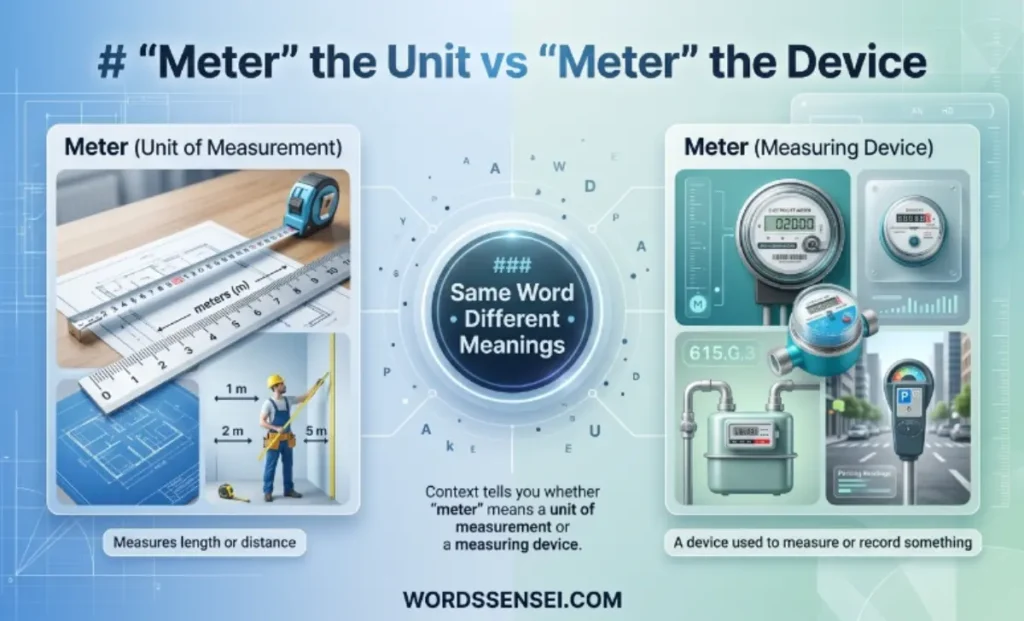
This is the most important and most overlooked distinction in the entire metre versus meter debate. So, let us break it down clearly.
Complete Comparison Table
| Meaning | American Spelling | British Spelling | Why |
|---|---|---|---|
| Unit of length | Meter | Metre | Came through French metric reforms |
| Measuring device | Meter | Meter | Came from English “-meter” suffix |
| Poetry rhythm | Meter | Meter (sometimes Metre) | Mixed usage — often kept as “meter” |
So, even a British writer would write “the gas meter” and “I walked five metres” in the very same sentence — using two different spellings of what looks like the same word.
British English vs American English
This is the heart of the entire debate for the unit of length specifically. Unlike most spelling differences — where one form is a clear mistake — metre and meter are both fully accepted and correct.
Comparison Table
| Feature | American English | British English | SI Standard | Canadian English | Australian English |
|---|---|---|---|---|---|
| Length unit | Meter ✅ | Metre ✅ | Metre ✅ | Metre | Metre |
| Measuring device | Meter | Meter | Meter | Meter | Meter |
| Related units | Centimeter, Kilometer | Centimetre, Kilometre | Centimetre, Kilometre | Centimetre, Kilometre | Centimetre, Kilometre |
| Dictionary | Merriam-Webster | Oxford | SI Brochure | Oxford Canadian | Macquarie |
Interesting Fact About Canada
Just like with “litre,” Canada follows the British spelling convention for the length unit. Therefore, Canadians write “metre,” not “meter,” despite being geographically located in North America.
Metre vs Meter — Full Comparison
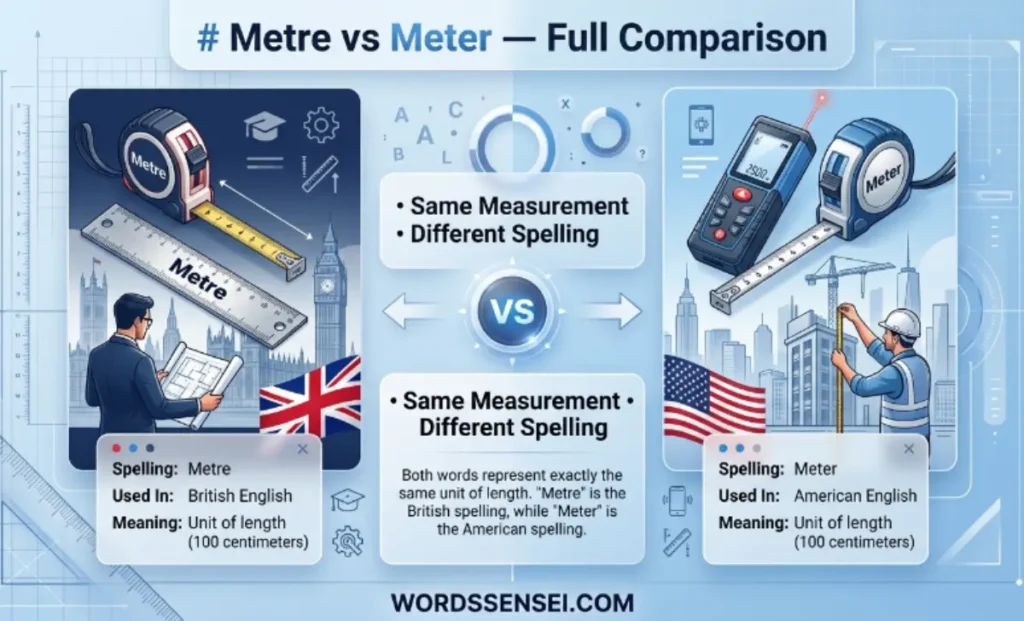
Let us look at every context and decide which spelling fits best in each situation.
Complete Usage Comparison Table
| Context | Best Spelling | Reason |
|---|---|---|
| American English — length | Meter | Standard American form |
| British English — length | Metre | Traditional British form |
| International science papers | Metre | Official SI standard |
| US construction documents | Meter | American building standard |
| UK and international construction | Metre | British and global standard |
| Canadian writing — length | Metre | Follows British convention |
| Any region — gas/water meter | Meter | Device spelling never changes |
| Any region — parking meter | Meter | Device spelling never changes |
| Poetry analysis — any region | Meter | Conventionally kept as “meter” |
Which Spelling Should You Use?
The answer depends on context first, then audience. However, here is a clear breakdown for every common situation.
US Audience — Length Unit
Always use “meter.” This is confirmed by Merriam-Webster. Moreover, all US textbooks, construction documents, and scientific papers written for American readers use this spelling consistently.
UK Audience — Length Unit
Use “metre” always. Confirmed by the Oxford English Dictionary. Furthermore, this spelling is used throughout British education, construction, and everyday measurement.
International Science Writing — Length Unit
Always use “metre.” The SI officially adopted this spelling as the global standard. As a result, most international scientific journals and research papers use this form, even when published by American authors.
Any Region — Measuring Devices
Always use “meter,” regardless of whether you are writing in American or British English. This applies to gas meters, water meters, electric meters, parking meters, and any compound word like “thermometer” or “speedometer.”
Sports and Athletics Writing
Both spellings appear depending on the publication’s region. However, international sporting events like the Olympics often use “metre” in official documentation, since the International Olympic Committee follows SI conventions.
Common Mistakes with “Meter” and “Metre”
Even experienced writers make these errors. So, here is exactly what to watch for — and how to fix each mistake quickly.
Frequent Errors
- Writing “metre” for a measuring device, such as a “gas metre” — this should always be “meter”
- Writing “meter” in international or scientific writing when “metre” is the official SI standard for length
- Mixing both spellings inconsistently within the same document for the unit of length
- Forgetting that compound words like “thermometer” and “speedometer” always use “meter,” never “metre”
- Writing “metar” or “meeter” — these are actual misspellings that are never correct anywhere
Corrected Examples
| ❌ Wrong | ✅ Right | Why |
|---|---|---|
| Check the gas metre. | Check the gas meter. | Devices always use “meter” |
| The thermometre is broken. | The thermometer is broken. | Compound device words use “meter” |
| Mixed: meter… metre (length) | Pick one — stay consistent | Mixing styles looks unprofessional |
| Metre (US-only audience) | Meter (for American readers) | Match spelling to your audience |
| Meter (international SI paper) | Metre (SI official standard) | SI requires the British spelling |
“Meter” in Everyday Writing Examples
Here is how meter and metre appear naturally across different real-world writing situations.
Emails
“Please confirm the warehouse ceiling height is at least four meters. Furthermore, our equipment requires adequate clearance for safe operation. In addition, let us know if any structural adjustments will be necessary before installation.”
Social Media
“Just ran my fastest 100-metre sprint ever today — shaved half a second off my personal best! 🏃♂️ Moreover, all those early morning training sessions are finally paying off. #Running #PersonalBest”
News Writing
“City officials confirmed that the new water meter system will be installed across all residential areas by next spring. As a result, residents will receive more accurate monthly billing. Furthermore, the upgrade is expected to reduce water waste significantly.”
School Writing
“A meter is the base unit of length in the metric system and is equal to 100 centimeters. Furthermore, this unit is used worldwide in science, construction, and everyday measurement, except in countries that primarily use the imperial system.”
Business Writing
“Our new office space spans approximately 500 square meters, providing ample room for the expanding team. In addition, the building’s smart meter system will help us monitor and reduce overall energy consumption throughout the year.”
Google Trends and Usage Data
Search data shows that both spellings are actively searched globally — with clear regional patterns that closely match the American versus British English divide.
Popular Countries
| Country | Most Searched Form | Notes |
|---|---|---|
| United States | Meter | Strong American English dominance |
| United Kingdom | Metre | Traditional British spelling |
| Canada | Metre | Follows British and SI convention |
| Australia | Metre | British English influence |
| India | Metre | British education system influence |
| Pakistan | Metre | British education system influence |
| International Science | Metre | Official SI standard worldwide |
Why People Search This Keyword
Most searches for “metre or meter” come from these specific groups:
- Students — checking which spelling to use in science, math, or construction assignments
- Engineers and architects — ensuring consistency in technical drawings and documentation
- Content writers — making sure their articles use the correct spelling for their audience
- ESL learners — confused by seeing both spellings in different textbooks and contexts
- Athletes and sports writers — uncertain whether to use “meter” or “metre” in race reporting
Related Grammar Rules
The “Er” vs “Re” Pattern in Metric Units
Metre and meter are part of a much larger and consistent pattern. In fact, many metric measurement words follow this exact same British versus American spelling difference.
| British English | American English |
|---|---|
| Metre | Meter |
| Litre | Liter |
| Centimetre | Centimeter |
| Kilometre | Kilometer |
| Millimetre | Millimeter |
Helpful Grammar Tips
Tip 1 — Identify whether you mean the unit or the device first If you mean a length measurement, the spelling depends on your audience. However, if you mean a measuring instrument, always use “meter,” regardless of region.
Tip 2 — Writing for American readers? Always use “er” for the length unit — meter, centimeter, kilometer.
Tip 3 — Writing for British or international readers? Use “re” for the length unit — metre, centimetre, kilometre.
Tip 4 — Remember compound device words never change Thermometer, speedometer, odometer, and barometer always use “meter” in every English-speaking country.
💡 Pro Tip: When in doubt, check Merriam-Webster{:target=”_blank” rel=”noopener noreferrer”} for American English spelling and the official SI Brochure for the international scientific standard.
Metre and Meter — Conversions, Uses, and Key Facts
The meter is one of the most practical and widely used measurement units in daily life. Here is a complete overview of conversions and common uses.
Common Meter Conversions
| Unit | Equivalent in Meters |
|---|---|
| 1 centimeter | 0.01 meters |
| 1 meter | 100 centimeters |
| 1 kilometer | 1000 meters |
| 1 foot | Approximately 0.3048 meters |
| 1 yard | Approximately 0.9144 meters |
| 1 mile | Approximately 1609.34 meters |
Key Uses of Meters
| Context | How Meters Are Used |
|---|---|
| Construction | Measuring building dimensions and materials |
| Sports | Track and field events, such as the 100-meter dash |
| Science | Laboratory measurements and physics calculations |
| Geography | Measuring elevation, distance, and area |
| Everyday Life | Measuring rooms, furniture, and personal height |
| Devices | Gas, water, electric, and parking meters |
Internal Link Suggestions
📌 (Add These Links When Related Articles Are Ready)
- Link “metric system” → your article on measurement units
- Link “American English vs British English” → your article on spelling differences
- Link “SI units” → your article on international measurement standards
- Link “liter or litre” → your article on related metric spelling differences
Author Bio
About the Author [Your Name] is an English language writer and grammar teacher with [X] years of experience. Moreover, [he/she/they] helps students, bloggers, and ESL learners write better and more confidently every day. Connect on LinkedIn | View All Posts
FAQs
Is metre or meter correct?
Both are correct — but in different contexts. “Meter” is the American English spelling for the unit of length. On the other hand, “metre” is the British English spelling and also the official SI international standard. However, “meter” is always used for measuring devices in every region.
Why is a gas meter never called a gas metre?
Because the word “meter” meaning a measuring device comes from a completely different root than the unit of length. Furthermore, this device meaning developed within English itself, rather than through French metric system reforms, so it never adopted the British “re” spelling.
Which spelling does the SI officially use for length?
The International System of Units (SI) officially uses “metre” as the standard spelling for the unit of length. Furthermore, this remains true even though many American scientists still use “meter” in domestic publications.
How many centimeters are in a meter?
There are 100 centimeters in one meter. Moreover, one meter is also equal to approximately 3.28 feet, making it easy to convert between metric and imperial units.
Does Canada use metre or meter?
Canada uses “metre” for the unit of length, following British spelling conventions. However, Canada still uses “meter” for measuring devices, just like every other English-speaking country.
Is “meter” used in poetry?
Yes. In poetry, “meter” refers to the rhythmic pattern of stressed and unstressed syllables in a line of verse. Interestingly, this spelling is conventionally kept as “meter” even in British English writing about poetry.
What is the origin of the word meter?
The unit of length comes from the French word “mètre,” which traces back to the ancient Greek word “metron,” meaning “measure.” However, the device meaning comes from the English suffix “-meter,” used in words like “thermometer.”
What are common conversions for meters?
One meter equals 100 centimeters, and one kilometer equals 1000 meters. Furthermore, one meter is approximately equal to 3.28 feet or 1.09 yards.
Conclusion
So — metre or meter? After reading this complete guide, the answer is now fully clear, including the surprising twist that most people never learn. For the unit of length, both spellings are completely correct, depending on your region. If you are writing in American English, always choose “meter.”
That is the form confirmed by Merriam-Webster and used throughout American education and publishing. On the other hand, if you are writing in British English, for an international audience, or following the official SI standard, “metre” is the correct and preferred choice.
However, here is the part most people miss completely — when “meter” refers to a measuring device, like a gas meter, water meter, or parking meter, the spelling is always “meter,” in every single English-speaking country, including Britain.
Furthermore, this same rule applies to compound words like thermometer and speedometer. Now that you understand the history, the regional rules, and this important device exception, you can write either form with complete confidence in any situation you encounter.
Read More Blogs:

Norman Coe is a contributing writer at Wordssensei.com, covering English grammar, vocabulary, and commonly confused words.