You typed “ignitor” and then “igniter” and then paused to wonder — is that actually right? If so, you are definitely not alone. In fact, thousands of engineers, technicians, and homeowners search this exact question every single day.
The confusion is completely understandable because both words describe the exact same type of device. However, the answer is actually very simple and clear. Both spellings exist, but one is far more common than the other.
Therefore, this complete guide will explain everything you need to know: the correct meaning, the word history, the reason for the confusion, and real usage examples. By the end, you will write both words with complete confidence every single time.
Quick Answer
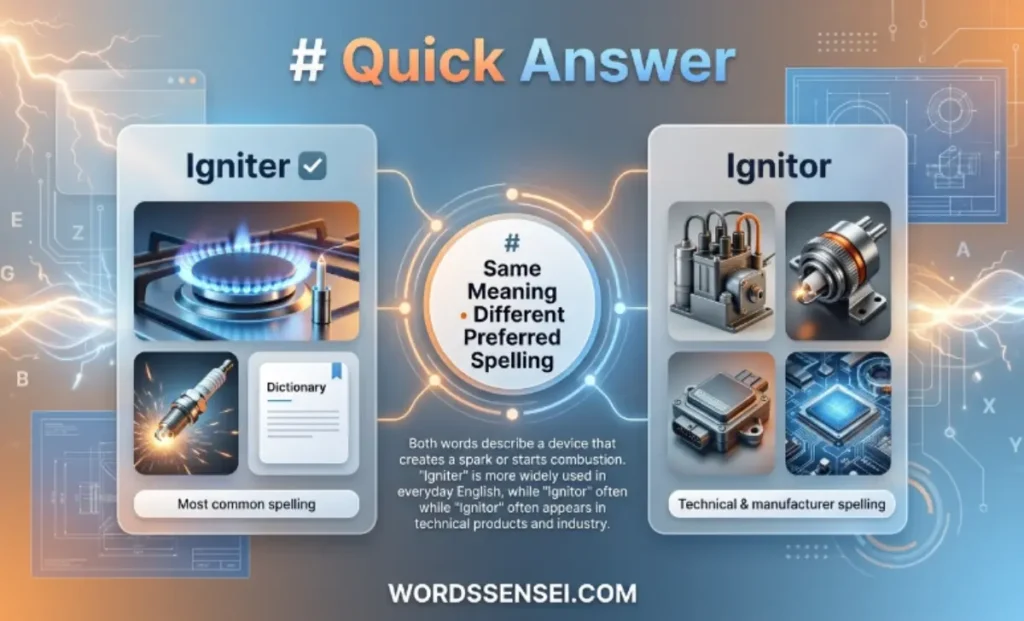
Both “ignitor” and “igniter” are technically correct spellings. However, they are not equally common, since usage differs across industries and writing styles.
Igniter, for instance, is the more widely accepted spelling in modern English, technical writing, and consumer products. Furthermore, appliance manuals, automotive guides, and engineering textbooks almost always use this form.
Ignitor, on the other hand, still appears frequently in industrial specifications and manufacturer documentation. Moreover, certain equipment brands and technical catalogs continue using this spelling by tradition.
So, the word ends with “-er” in modern general writing and “-or” in many technical or manufacturer contexts. Ultimately, the correct choice depends on your audience and industry, not on strict grammar rules.
✅ Correct Examples
“Replace the faulty igniter before restarting the furnace.”
“The ignitor assembly requires replacement on this model.”
“The gas stove igniter stopped working last week.”
“Inspect the burner ignitor for corrosion.”
❌ Incorrect Examples
~~”Replace the faulty ignitor before restarting the furnace.” (acceptable in some technical contexts, but less common)~~
~~”The igniter and ignitor have completely different functions.”~~ — this is a myth, not a fact
Never assume one spelling is simply wrong. After all, both forms describe the same device; the difference is mostly about convention, not correctness.
What Does “Ignitor” or “Igniter” Mean?
Both “ignitor” and “igniter” are common technical nouns. Moreover, they appear constantly in heating systems, automotive engineering, appliances, and industrial machinery. Each spelling, however, refers to the same basic function.
| Feature | Igniter | Ignitor |
|---|---|---|
| Word Type | Noun | Noun |
| Meaning | Device that starts combustion | Device that starts combustion |
| Function | Creates spark or heat to ignite fuel | Creates spark or heat to ignite fuel |
| Modern Usage | More common | Less common |
| Related Field | Engineering, appliances, automotive | Industrial machinery, manufacturer specs |
Common Meanings
According to Merriam-Webster{:target=”_blank” rel=”noopener noreferrer”}, an igniter is a device used to ignite something, such as a fuel mixture in an engine or appliance. Meanwhile, “ignitor” is simply a recognized variant spelling with the exact same meaning.
In addition, several everyday applications use these words in slightly different settings:
An igniter, for example, is the most common term used in furnaces, water heaters, and gas stoves
Meanwhile, an ignitor often appears in industrial burner specifications and equipment manuals
Similarly, both terms describe spark igniters, hot surface igniters, and pilot igniters
Finally, automotive and aerospace industries use both spellings depending on the manufacturer
Simple Usage Examples
“The furnace igniter creates the spark needed to start the burner.”
“Meanwhile, the ignitor assembly on this industrial unit needs regular inspection.”
“Technicians, therefore, often check both the igniter and the gas valve together.”
“Eventually, a faulty igniter can prevent the entire heating system from starting.”
The Origin of “Ignitor” or “Igniter”
Knowing where these words come from helps explain exactly why two spellings exist today. Additionally, it shows why both forms remain acceptable in different contexts.
Word History
Both words, in fact, trace back to the Latin verb “ignire,” meaning to set on fire or kindle. From there, English formed the base verb “ignite,” which describes the act of starting combustion.
When English speakers created a noun for “one who or that which ignites,” two common suffix patterns competed: “-er” and “-or.” Historically, however, “-er” tends to attach to native English verb roots, while “-or” often attaches to words with strong Latin influence. Essentially, both suffixes are grammatically valid here, which is exactly why neither spelling became universally dominant.
As a result, English ended up with two accepted spellings from the same root word: one favored in general and consumer writing, and one favored in certain technical and industrial contexts.
Why the Confusion Happens
Both words sound identical when spoken aloud. In addition, they describe the exact same physical component, which makes the spelling choice feel arbitrary to many writers. Because dictionaries list both forms, people often assume one of them must be a mistake.
That assumption, though, is incorrect. So, here is the key difference:
| Word | Correct Spelling | Meaning |
|---|---|---|
| Igniter | Igniter | Device that starts combustion (modern preferred form) |
| Ignitor | Ignitor | Device that starts combustion (technical/industrial variant) |
Even though these two words describe identical devices, industry habits have kept both spellings alive for decades. Therefore, recognizing the context is the easiest way to choose confidently.
British English vs American English
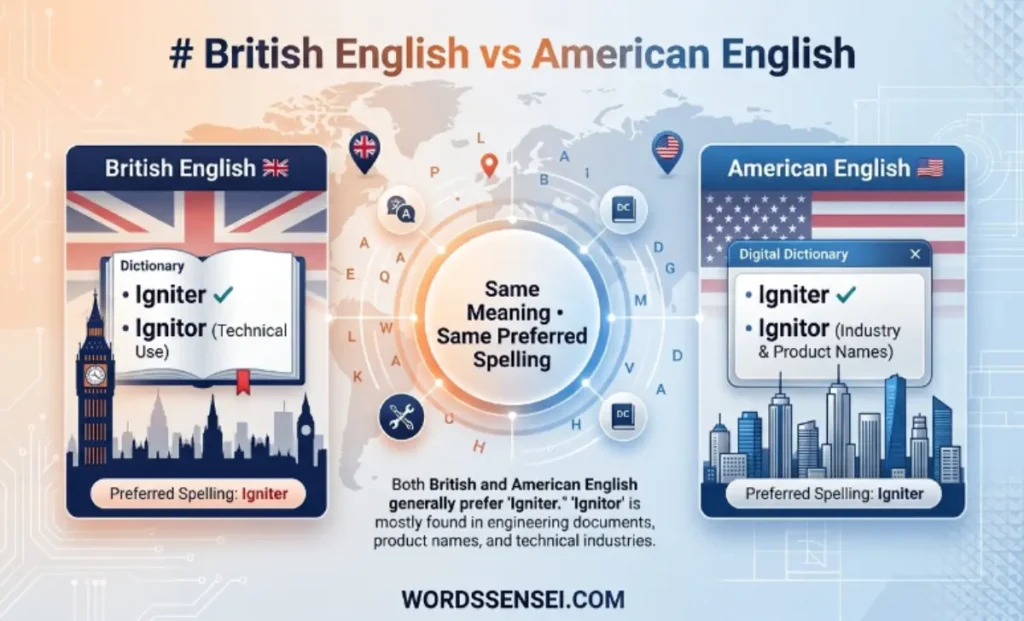
Good news: both British and American English accept these two spellings in similar ways. As a result, there is no strict regional rule dividing them.
Comparison Table
| Feature | American English | British English | Australian English | Indian English |
|---|---|---|---|---|
| Preferred spelling | Igniter ✅ | Igniter ✅ | Igniter ✅ | Igniter ✅ |
| Technical/industrial variant | Ignitor ✅ | Ignitor ✅ | Ignitor ✅ | Ignitor ✅ |
| Pronunciation | /ɪɡˈnaɪtər/ | /ɪɡˈnaɪtər/ | /ɪɡˈnaɪtər/ | /ɪɡˈnaɪtər/ |
| Dictionary | Merriam-Webster | Oxford | Macquarie | Oxford Indian |
No matter where you are writing, whether the United States, the United Kingdom, Canada, Australia, or India, the general pattern stays the same. Overall, general and consumer writing favors “igniter,” while some industrial documentation still favors “ignitor.”
Ignitor vs Igniter — Full Comparison
Now, let us look at every related term and application people sometimes confuse, and clear things up completely.
Complete Comparison Table
| Form | Meaning | Field | Recommended? |
|---|---|---|---|
| Igniter | Device that starts combustion | General, consumer, engineering | ✅ Use for most writing |
| Ignitor | Device that starts combustion | Industrial specs, manufacturer terms | ✅ Acceptable in technical contexts |
| Spark Igniter | Produces an electrical spark | Furnaces, stoves | ✅ Common device type |
| Hot Surface Igniter | Uses heat instead of a spark | Modern furnaces | ✅ Common device type |
| Pilot Igniter | Works alongside pilot flames | Older heating systems | ✅ Common device type |
| Ignition Coil | Related automotive component | Automotive engineering | ✅ Different but related term |
Which Spelling Should You Use?
The answer mostly depends on your audience and industry, not on your location. Below, then, is a clear breakdown by writing situation.
General and Consumer Writing
For blog posts, appliance guides, and everyday communication, writers should generally use “igniter,” since it is confirmed by Merriam-Webster{:target=”_blank” rel=”noopener noreferrer”} as the more common modern spelling. Consequently, most consumer product manuals follow this exact pattern.
Technical and Industrial Writing
Engineers and manufacturers, similarly, often follow whichever spelling their specific industry or product line already uses. Likewise, industrial burner specifications and manufacturer catalogs have used “ignitor” for decades without confusion.
Academic and Engineering Writing
In academic contexts, engineering textbooks and technical publications mostly use “igniter.” Conversely, some specialized combustion research papers still use “ignitor” depending on the author’s background.
Automotive Writing
Automotive writers often use “igniter” or related terms like “ignition system,” “spark plug,” and “ignition coil.” As a result, sticking with “igniter” keeps your writing consistent with most modern repair guides.
Social Media and Marketing
Brands that sell heating or automotive parts often use whichever spelling matches their product listing. Therefore, matching your spelling to your specific product documentation avoids confusing customers.
Common Mistakes with “Ignitor” or “Igniter”
Even confident writers make these errors. So, here is exactly what to watch for, and how to fix each mistake quickly.
Frequent Errors
First, assuming “ignitor” is always incorrect, when it is actually a recognized technical variant
Second, assuming “igniter” and “ignitor” refer to different devices, when they usually mean the same thing
Additionally, mixing spellings inconsistently within the same document or manual
Meanwhile, confusing “igniter” with unrelated terms like “ignition coil” or “spark plug”
Finally, forgetting to match the spelling used in a specific manufacturer’s official documentation
Corrected Examples
| ❌ Wrong | ✅ Right | Why |
|---|---|---|
| Ignitor is a spelling mistake. | Ignitor is an accepted technical variant. | Both spellings are valid |
| The igniter and ignitor work differently. | The igniter and ignitor work the same way. | They describe the same device |
| I mixed up igniter and ignition coil. | The igniter creates the spark; the ignition coil powers it. | Related but distinct components |
| This manual uses igniter, so I’ll switch to ignitor. | This manual uses igniter, so I’ll stay consistent with igniter. | Consistency matters more than preference |
“Ignitor” or “Igniter” in Everyday Writing Examples
Here, then, is how these words work naturally across different real-world writing situations. Overall, these examples will help you use both terms with much more confidence going forward.
Emails
“Please schedule a technician to inspect the furnace igniter before winter. In addition, we should also check the ignitor assembly on the backup heating unit. So, let me know your availability this week.”
Social Media
“Finally fixed my gas stove after the igniter stopped sparking! 🔧 Honestly, such an easy fix once I knew what part to order. #HomeRepair #DIY”
News Writing
“Officials confirmed that a faulty igniter caused the equipment malfunction at the facility. As a result, the company issued a recall notice, and technicians began inspecting similar units nationwide.”
School Writing
“In engineering class, we learned how an igniter converts electrical energy into heat or spark. Furthermore, our instructor explained how different igniter types work in furnaces, stoves, and jet engines.”
Business Writing
“Our warranty covers replacement of the igniter if it fails within the first year. Therefore, customers should contact support immediately if the ignitor assembly shows signs of malfunction. Meanwhile, our technicians remain available for on-site inspections.”
Google Trends and Usage Data
Search data clearly confirms that both “ignitor” and “igniter” are searched heavily, but for very different reasons depending on the audience.
Popular Countries
| Country | Most Searched Term | Search Volume | Notes |
|---|---|---|---|
| United States | Ignitor vs Igniter | Very High | Appliance repair and automotive searches |
| United Kingdom | Igniter | High | Consistent with modern usage |
| Canada | Ignitor vs Igniter | High | Follows North American pattern |
| Australia | Igniter | Medium-High | Mostly appliance-related searches |
| India | Ignitor vs Igniter | High | Large technical and engineering audience |
Why People Search This Keyword
Overall, most searches for “ignitor or igniter” come from these specific groups:
First, homeowners troubleshooting a broken furnace or gas stove
Second, technicians ordering replacement parts and checking manufacturer specifications
Additionally, engineering students studying combustion systems and terminology
Meanwhile, automotive enthusiasts researching ignition components
Finally, content writers avoiding embarrassing errors in technical or repair articles
Related Grammar Rules
Similar Spelling Mistakes
Other technical word pairs, similarly, cause the same kind of confusion, since they involve competing “-er” and “-or” suffixes. So, here are a few similar examples worth knowing:
| Related Pair | Correct Forms | Note |
|---|---|---|
| Advisor / Adviser | Advisor, Adviser | Both accepted; “adviser” slightly more traditional |
| Connector / Connecter | Connector, Connecter | “Connector” is far more common today |
| Sensor / Censor | Sensor, Censor | Different meanings, not just spelling variants |
Helpful Grammar Tips
Tip 1 — Default to “igniter” in general writing. Since it is the more common modern spelling, this choice works safely in almost any non-technical context.
Tip 2 — Match your source documentation. If a manufacturer’s manual uses “ignitor,” stay consistent with that spelling throughout your own writing about that specific product.
Tip 3 — Remember the shared root word. Both spellings come from “ignite,” so this connection helps you recall that neither form is actually wrong.
Tip 4 — Never mix spellings in one document. Consistency matters more than which spelling you personally choose, so pick one and stick with it throughout an article or manual.
💡 Pro Tip: Whenever you are not sure about any spelling, check Merriam-Webster{:target=”_blank” rel=”noopener noreferrer”} online. Best of all, it is completely free and gives the correct answer instantly.
“Ignitor” and “Igniter” — Common Types and Applications
Both terms describe several specific device types across different industries. Moreover, understanding these variations helps you use each term more precisely in technical writing.
Common Types
| Type | Meaning | Example |
|---|---|---|
| Spark Igniter | Produces an electrical spark | “The spark igniter clicks several times before lighting.” |
| Hot Surface Igniter | Heats a surface until fuel ignites | “Modern furnaces mostly use a hot surface igniter.” |
| Pilot Igniter | Lights a small standing flame | “Older water heaters often rely on a pilot igniter.” |
| Electronic Igniter | Uses electronic control systems | “The electronic igniter offers more precise timing.” |
| Ignitor Assembly | A packaged industrial ignition unit | “The ignitor assembly failed after years of heavy use.” |
Internal Link Suggestions
📌 (Add These Links When Related Articles Are Ready)
The term “spark plug vs igniter” can link to your article on automotive ignition components.
Similarly, “furnace maintenance tips” can link to your article on home heating system care.
For appliance-related content, “gas stove troubleshooting” can link to your article on kitchen appliance repair.
Finally, “commonly confused technical terms” can link to your article on engineering vocabulary and spelling.
Author Bio
About the Author [Your Name] is a technical writer and engineering content specialist with [X] years of experience. Additionally, [he/she/they] helps technicians, students, and homeowners understand complex terminology more clearly every day. Connect on LinkedIn | View All Posts
FAQs
Is it ignitor or igniter?
Both spellings are correct. However, “igniter” is the more common modern spelling used in general and consumer writing, while “ignitor” remains common in certain technical and industrial contexts.
Do ignitor and igniter mean the same thing?
Yes. Both words describe a device that starts combustion by creating heat or sparks. Therefore, they usually refer to the exact same type of component.
Which spelling is more common today?
“Igniter” is generally more common in modern English, technical publications, and consumer appliance manuals. Nevertheless, “ignitor” still appears frequently in industrial specifications.
Is ignitor incorrect?
No. In fact, “ignitor” is a recognized alternative spelling, not a mistake. It simply reflects an older or more industry-specific naming convention.
What does an igniter do?
An igniter starts combustion by generating heat, sparks, or electrical energy that ignites fuel. Consequently, it plays a critical role in furnaces, stoves, engines, and industrial burners.
Are igniters used in vehicles?
Yes. Automotive engines rely on ignition components, including spark plugs and ignition coils, to start and sustain combustion.
Which spelling should I use in a technical manual?
Match whichever spelling your specific manufacturer or industry already uses. Ultimately, consistency throughout the document matters more than personal preference.
How do I remember the difference between ignitor and igniter?
Try this simple approach: think of the base verb “ignite” first. Since “igniter” more closely resembles “ignite,” many writers find it the easier default spelling to remember.
Conclusion
After reading through this complete guide, the answer is now absolutely clear. Both “ignitor” and “igniter” are correct spellings, and they describe the exact same type of device. Specifically, “igniter” remains the more common choice in modern engineering, consumer products, and general writing, while “ignitor” continues appearing in certain industrial and manufacturer-specific documentation.
The confusion happens because both words share the same root, “ignite,” and describe identical functions. Nevertheless, understanding the context helps you choose confidently. Ultimately, defaulting to “igniter” works safely in most situations, while matching manufacturer terminology works best in technical documentation.
So, the next time you write about furnaces, stoves, engines, or industrial burners, choose your spelling based on your audience and source material, not personal guesswork. Overall, you now have the full picture: the correct meaning, the word history, and practical tips to remember it forever.
Read More Blogs:
- Response or Respond : Here’s the Correct Word to Use
- Colombia vs Columbia: Which Spelling Is Correct?

Gerald Nelson is a contributing writer at Wordssensei.com, covering English grammar, vocabulary, and commonly confused words.