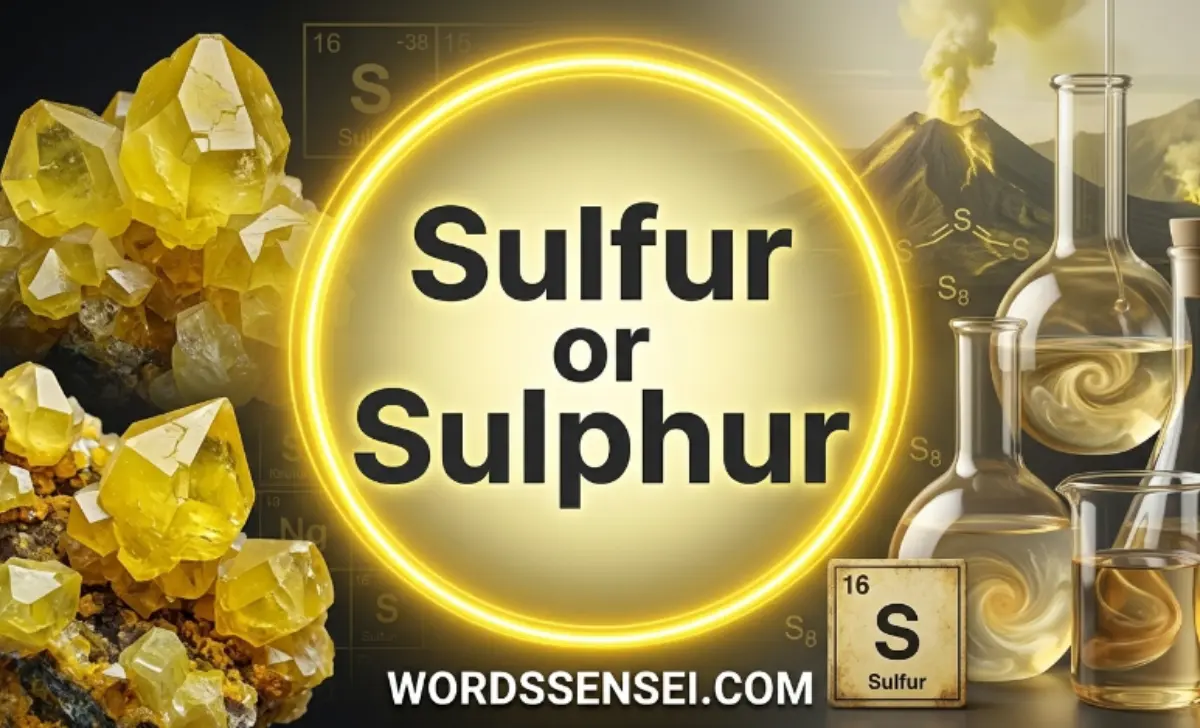
Have you ever typed the word “sulfur” and then stopped to think? Maybe you wondered — is it spelled with an “f” or a “ph”? If so, you are definitely not alone. In fact, thousands of students, writers, and bloggers search this exact question every single day.
The great news is that both spellings are actually correct. However, they are used in different countries and different writing styles. So, this guide will explain everything in a simple and clear way.
By the end, you will know exactly which spelling to use, why both forms exist, and when each one is appropriate. As a result, you will never feel confused about this word again.
Quick Answer

“Sulfur” is the American English spelling. On the other hand, “sulphur” is the British English spelling. So, both are correct — but they belong to different places and writing styles.
For example, if you are writing in the United States, always use sulfur. However, if you are writing for a British audience, sulphur is perfectly fine and widely accepted. In addition to this, the IUPAC — the world’s top chemistry authority — officially uses sulfur as the global science standard. Therefore, for any international science writing, sulfur is always the right choice.
The only real difference between the two is the letters “f” and “ph.” Apart from that, both words mean the exact same thing — the yellow chemical element with atomic number 16 and symbol S.
✅ Correct — American English
- “Sulfur is a yellow element found near volcanoes.”
- “As a result, the factory now produces large amounts of sulfuric acid daily.”
- “Furthermore, sulfur is widely used in fertilizers and pesticides around the world.”
- “In addition, scientists actively study sulfur deposits near active volcanic zones.”
✅ Correct — British English
- “Sulphur is commonly found near hot springs and volcanic areas.”
- “Moreover, the student wrote a detailed report about sulphur in her chemistry class.”
- “However, sulphuric acid must always be handled with great care in the laboratory.”
- “In fact, bright yellow sulphur deposits covered the rocks near the volcanic crater.”
What Does “Sulfur” Mean?
Sulfur is a natural chemical element. Moreover, it is one of the most important non-metals found on Earth. In fact, humans have known about sulfur for thousands of years. As a result, it plays a key role in chemistry, farming, medicine, and modern industry worldwide.
| Feature | Detail |
|---|---|
| Chemical Symbol | S |
| Atomic Number | 16 |
| Atomic Mass | 32.06 |
| Group | Chalcogen — Group 16 |
| State | Solid at room temperature |
| Color | Bright yellow |
| Smell | Very faint — pure sulfur barely smells |
| American Spelling | Sulfur |
| British Spelling | Sulphur |
| Science Standard | Sulfur — IUPAC official |
Common Meanings
According to the Cambridge Dictionary{:target=”_blank” rel=”noopener noreferrer”}, sulfur is a pale yellow chemical element. Furthermore, it has a strong smell when it burns. In addition, it is widely used in matches, gunpowder, and fertilizers around the world.
In everyday life, sulfur can mean several different things:
- A chemical element — non-metal, atomic number 16, found in Group 16 of the periodic table alongside oxygen and selenium
- An industrial material — furthermore, it is used to make sulfuric acid, which is the world’s most produced chemical
- A natural mineral — in addition, it is found near volcanoes, hot springs, and underground mineral deposits
- A body chemical — moreover, it is found in amino acids that build proteins in all living things on Earth
Simple Examples
- “Sulfur is one of the oldest known elements in all of human history.”
- “In addition, yellow sulfur deposits were clearly visible all around the volcanic crater.”
- “Furthermore, sulfur is absolutely essential for building proteins in the human body.”
- “As a result, farmers also use sulfur-based sprays to protect crops from harmful fungus.”
The Origin of “Sulfur” and “Sulphur”
Both spellings actually come from the same ancient root. Therefore, neither one is a mistake — they simply developed differently over time in different countries and regions.
Word History
The word “sulfur” originally came from the Latin word “sulpur.” In fact, Romans used this word for the yellow element they commonly found near volcanoes. Later, the word moved into Old English and Middle English through Latin and Old French. As a result, it kept the “ph” spelling — and this gave us the British form “sulphur.”
In the United States, however, spelling was greatly simplified during the 1800s. Noah Webster — the creator of the very first American dictionary — changed many “ph” words to use just “f” instead. For example, “colour” became “color” and “programme” became “program.” Similarly, “sulphur” became “sulfur” as part of this major spelling reform.
Then, in 1990, the IUPAC officially chose “sulfur” as the international science standard. Consequently, most science journals and research institutions around the world now use the “f” spelling in all their publications.
Why the “Ph” vs “F” Confusion Happens
Many English words use “ph” because they originally came from ancient Greek. In Greek, the letter “phi” made a specific sound that was later written as “ph” in Latin and English. However, American English gradually simplified this pattern to just “f.” As a result, we now have two different but equally valid spellings for many chemistry words.
Here are some clear examples of this pattern:
| British English | American English |
|---|---|
| Sulphur | Sulfur |
| Sulphate | Sulfate |
| Sulphide | Sulfide |
| Sulphuric | Sulfuric |
| Sulphurous | Sulfurous |
British English vs American English

This is truly the heart of the whole debate. Unlike most spelling mistakes — where one form is simply wrong — sulfur and sulphur are both fully correct. However, they belong to different countries and different writing traditions.
Comparison Table
| Feature | American English | British English | IUPAC Standard | Australian English | Indian English |
|---|---|---|---|---|---|
| Element | Sulfur ✅ | Sulphur ✅ | Sulfur ✅ | Sulphur | Sulphur |
| Acid | Sulfuric acid | Sulphuric acid | Sulfuric acid | Sulphuric acid | Sulphuric acid |
| Compounds | Sulfate, Sulfide | Sulphate, Sulphide | Sulfate, Sulfide | Sulphate, Sulphide | Sulphate, Sulphide |
| Dictionary | Merriam-Webster | Oxford | IUPAC guidelines | Macquarie | Oxford Indian |
Important Note About British English Today
Interestingly, even within Britain, things are now changing. In fact, many British universities and international science journals now prefer “sulfur” to match the IUPAC standard. Therefore, if you are a British student writing a science paper, always check your teacher’s preferred style before you begin writing.
Sulfur vs Sulphur — Full Comparison
Now, let us look at every writing situation carefully. As a result, you will always know exactly which spelling to pick for any context or audience.
Complete Usage Table
| Writing Context | Best Spelling | Reason |
|---|---|---|
| American English writing | Sulfur | Standard US form |
| British English writing | Sulphur | Traditional UK form |
| International science papers | Sulfur | IUPAC standard since 1990 |
| US chemistry textbooks | Sulfur | American school standard |
| UK chemistry textbooks | Sulphur or Sulfur | Depends on publisher |
| Global social media | Sulfur | Most widely recognized worldwide |
| International academic papers | Sulfur | IUPAC and global standard |
| UK news writing | Sulphur | Follows British style guide |
| US news writing | Sulfur | Follows American style guide |
Which Spelling Should You Use?
The answer depends on your audience and your purpose. However, here is a very simple and clear breakdown for every common writing situation.
US Audience
Always use “sulfur.” This is confirmed by Merriam-Webster Dictionary. Moreover, all US textbooks, science journals, and academic papers use this form consistently and without any exception.
UK Audience
Use “sulphur” for general writing and journalism. However, for science papers and chemistry writing specifically, many UK publishers now strongly prefer “sulfur” to match IUPAC rules. Therefore, always check your specific style guide first before making a choice.
International Science Writing
Always use “sulfur” without any hesitation. The IUPAC officially chose this as the global standard back in 1990. As a result, all major international chemistry journals, global research institutions, and worldwide academic bodies now follow this spelling exclusively.
Academic Writing
Use “sulfur” for any international academic work or globally read content. On the other hand, use “sulphur” only if your teacher or institution specifically and clearly requires British spelling conventions throughout your work.
Social Media Usage
“Sulfur” is more widely searched and internationally recognized across all platforms. Therefore, using it makes your content look significantly more professional and credible. In addition, it works better on YouTube, Reddit, Twitter/X, and science blogs where content reaches a truly global audience every day.
Common Mistakes with “Sulfur” and “Sulphur”

Even experienced writers make these errors regularly. So, here is exactly what to watch out for — and how to quickly fix each mistake before you publish.
Frequent Errors
- Writing “sulphur” in an international science paper — it should always be “sulfur” instead
- Writing “sulfur” in a British essay when your teacher clearly requires British spelling
- Mixing both spellings in the same document — always pick one form and stay fully consistent
- Writing related compounds differently — for example, “sulfate” in one paragraph and “sulphate” in the very next one
- Writing “sulfer” or “sulpher” — these are actual misspellings that are never correct anywhere in the world
- Adding an extra “e” at the end — writing “sulfure” or “sulphure” — also always completely wrong
Corrected Examples
| ❌ Wrong | ✅ Right | Why |
|---|---|---|
| Sulfer is a yellow element. | Sulfur is a yellow element. | Sulfer is never correct |
| Sulpher dioxide is a gas. | Sulfur dioxide is a gas. | Sulpher is never correct |
| Mixed sulfur… sulphur | Pick one — stay consistent | Mixing looks very unprofessional |
| Sulphuric acid in IUPAC paper | Sulfuric acid | IUPAC always requires “f” |
| Sulfure or Sulphure | Sulfur or Sulphur | Never add extra “e” at the end |
“Sulfur” in Everyday Writing Examples
Here is how to use sulfur and sulphur naturally across different real-world writing situations. Moreover, these examples will help you write with much more confidence going forward.
Emails
“Please note that our new fertilizer product contains sulfur-based compounds. Furthermore, these compounds significantly improve soil health and increase crop yield. In addition, full technical details are attached for your careful review.”
Social Media
“Fun chemistry fact — that rotten egg smell near hot springs is actually hydrogen sulfide gas. In fact, it is NOT pure sulfur itself at all! Moreover, pure sulfur barely has any smell whatsoever. 🌋 #ChemistryFacts #Science”
News Writing
“Scientists studying the active volcano reported dangerously high levels of sulphur dioxide in the surrounding air. As a result, health authorities quickly warned nearby residents to stay indoors. Furthermore, schools in the area were temporarily closed as a precaution.”
School Writing
“Sulfur is a bright yellow non-metal element with the chemical symbol S. Furthermore, its atomic number is 16. In addition, it belongs to the chalcogen group on the periodic table. Moreover, sulfur is found naturally near volcanoes, hot springs, and mineral deposits all around the world.”
Business Writing
“Our industrial sulfuric acid fully meets all IUPAC and international safety standards. In addition, it is widely used in battery manufacturing, metal processing, and large-scale chemical production. Furthermore, our clients report consistently high satisfaction with both quality and delivery times.”
Google Trends and Usage Data
Search data clearly shows that both spellings are actively searched all around the world. However, the preferred form varies strongly and consistently by region, audience type, and writing purpose.
Popular Countries
| Country | Most Searched Form | Notes |
|---|---|---|
| United States | Sulfur | Strong American English dominance |
| United Kingdom | Sulphur | Traditional British spelling still widely used |
| Canada | Sulfur | Follows American and IUPAC standard |
| Australia | Sulphur | Strong British English education influence |
| India | Sulphur | British education system deeply rooted |
| Pakistan | Sulphur | British education system influence |
| International Science | Sulfur | IUPAC global standard since 1990 |
Why People Search This Keyword
Most people search “sulfur or sulphur” for these very specific reasons:
- Chemistry students — checking which spelling to use in assignments and lab reports before submitting
- Science bloggers — wanting to follow the correct international standard in their content
- ESL learners — confused by seeing both spellings used in different textbooks and websites
- Content writers — making sure their health and science articles are completely accurate
- Teachers — confirming the right form before teaching it clearly to their students
Related Grammar Rules
The “Ph” vs “F” Pattern in Chemistry
Sulfur and sulphur are actually part of a much bigger and very consistent pattern in English. In fact, many chemistry words follow this exact same British versus American spelling difference. So, understanding this pattern helps you spell all related words correctly too.
| British English | American English | What It Is |
|---|---|---|
| Sulphur | Sulfur | Element S |
| Sulphate | Sulfate | SO₄ compound |
| Sulphide | Sulfide | S²⁻ compound |
| Sulphuric acid | Sulfuric acid | H₂SO₄ |
| Sulphurous | Sulfurous | Related adjective |
| Sulphonyl | Sulfonyl | Chemical group |
Simple and Helpful Grammar Tips
Tip 1 — Writing for American readers? Always use “f” — sulfur, sulfate, sulfuric. Moreover, this applies to all related compound words too.
Tip 2 — Writing for British readers? Use “ph” — sulphur, sulphate, sulphuric. However, check your publisher’s style guide first for science content.
Tip 3 — Writing for international science? Always use “f” without exception. In fact, IUPAC officially confirmed this standard back in 1990.
Tip 4 — Never mix both spellings. Instead, pick one form and use it consistently throughout your entire document from start to finish.
Tip 5 — Never write “sulfer” or “sulpher.” These are always wrong everywhere in the world — they are not acceptable spelling variations at all.
💡 Pro Tip: When you are not sure about any spelling, check Merriam-Webster{:target=”_blank” rel=”noopener noreferrer”} for American English. It is completely free and gives you the correct answer instantly.
Sulfur — Compounds, History, and Key Facts
Sulfur is truly one of the most useful and historically important elements on Earth. So, here is a complete and easy-to-understand overview of its key compounds, industrial uses, and fascinating history.
Important Sulfur Compounds
| Compound | Formula | Main Use |
|---|---|---|
| Sulfuric acid | H₂SO₄ | World’s most produced industrial chemical |
| Hydrogen sulfide | H₂S | Toxic gas — causes the rotten egg smell |
| Sulfur dioxide | SO₂ | Air pollutant from volcanoes and factories |
| Sodium sulfate | Na₂SO₄ | Used in detergents and paper making |
| Ammonium sulfate | (NH₄)₂SO₄ | Very common farming fertilizer |
| Calcium sulfate | CaSO₄ | Gypsum — widely used in construction |
Key Uses of Sulfur
| Industry | How Sulfur Is Used |
|---|---|
| Chemical industry | Primary raw material for sulfuric acid production |
| Agriculture | Fertilizers, fungicides, and natural pesticides |
| Rubber industry | Vulcanization — makes rubber much stronger and longer lasting |
| Medicine | Skin treatments, antifungal medicines, and pharmaceutical compounds |
| Food industry | Sulfur dioxide is used as a preservative in dried fruits and wines |
| History | One of three key ingredients in traditional gunpowder |
Sulfur in History and Culture
- Brimstone — the ancient Old English name for sulfur; moreover, it appears many times in the Bible as “fire and brimstone” symbolizing divine punishment
- Alchemy — furthermore, sulfur was one of the three primes in medieval science alongside mercury and salt
- Ancient Rome — in addition, Romans actively used sulfur to fumigate their homes and fight insects
- Medicine — interestingly, sulfur has been used in skin care and healing treatments for over 4000 years
Internal Link Suggestions
📌 (Add These Links When Related Articles Are Ready on Your Site)
- Link “American English” → your article on American vs British English differences
- Link “IUPAC standard” → your article on chemistry writing rules
- Link “chemical element” → your article on periodic table vocabulary
- Link “British English” → your article on British English spelling rules
Author Bio
About the Author [Your Name] is an English language writer and grammar teacher with [X] years of experience. Moreover, [he/she/they] helps students, bloggers, and ESL learners write better and more confidently every day. Connect on LinkedIn | View All Posts
FAQs
Is sulfur or sulphur correct?
Both are correct — but in different regions. “Sulfur” is American English and the IUPAC international science standard. On the other hand, “sulphur” is traditional British English. However, for all international science writing, always use “sulfur” without exception.
Which spelling does IUPAC recommend?
IUPAC officially recommends “sulfur” for all international scientific writing. Furthermore, this standard was formally adopted in 1990. As a result, most major science journals and academic institutions worldwide now follow this spelling consistently.
What is the chemical symbol for sulfur?
The symbol is S. Moreover, its atomic number is 16 and atomic mass is 32.06. In addition, it belongs to the chalcogen group — Group 16 — of the periodic table alongside oxygen, selenium, and tellurium.
Why does sulfur smell like rotten eggs?
The rotten egg smell actually comes from hydrogen sulfide — H₂S — not from pure sulfur itself. In fact, pure sulfur has almost no smell at all. However, hydrogen sulfide is naturally released by volcanoes, hot springs, and decomposing organic matter.
What was sulfur called in Old English?
It was historically called “brimstone.” Furthermore, this name appears many times in the Bible — especially in the very famous phrase “fire and brimstone” which symbolizes destruction and punishment.
Is sulphur still used in British English?
Yes, absolutely. “Sulphur” is still very widely used in British, Australian, and Indian English. However, many British science institutions now prefer “sulfur” to align with the IUPAC international standard that was adopted in 1990.
Is sulfuric acid or sulphuric acid correct?
Both are correct depending on your region. “Sulfuric acid” is American English and the IUPAC standard. On the other hand, “sulphuric acid” is traditional British English. However, for all international chemistry and science writing, always use “sulfuric acid.”
What are the main uses of sulfur?
Sulfur is used in making sulfuric acid, fertilizers, pesticides, rubber, medicines, and food preservatives. Furthermore, it was historically used as a key ingredient in gunpowder. In addition, it is considered one of the most industrially important and widely used elements on Earth today.
Conclusion
So — sulfur or sulphur? After reading through this complete guide, the answer is now fully clear. Both spellings are completely correct — however, they belong to different audiences and different writing traditions. If you are writing in American English or for any international science audience, always choose “sulfur.”
In fact, that is the form officially approved by IUPAC, confirmed by Merriam-Webster, and now adopted by most global science institutions worldwide. On the other hand, if you are writing in British English — for a UK classroom, a British publication, or an Australian audience — then “sulphur” is perfectly correct, widely accepted, and completely professional.
However, there is one rule that applies to absolutely everyone, everywhere, without any exception — never mix both spellings in the same piece of writing. Instead, pick one form based on your audience and stick with it consistently from the very first word to the very last.
Furthermore, consistent spelling makes your writing look clean, confident, and truly authoritative. Moreover, it shows your reader that you clearly know what you are doing and that you take your writing seriously. So go ahead — write with complete confidence and never let this spelling question slow you down again.
Read More Blogs:
- Is It Cuter or Cutier? Here’s the Answer Most Writers Miss
- Possess or Posess: How to Spell It Right Every Single Time

Gerald Nelson is a contributing writer at Wordssensei.com, covering English grammar, vocabulary, and commonly confused words.