Have you ever stopped while working on a professional document or a video project, wondering if you should type edited or editted? If so, you are definitely not alone. This is one of the most frequent spelling questions in the world of digital content and professional writing. Getting this right is very important for your credibility.
Consequently, using the wrong spelling can make your work look less professional to your clients and audience. This guide is designed to solve this mystery once and for all. Therefore, by the time you finish reading this detailed article, you will be an expert on the correct spelling, the grammatical rules, and the everyday usage of this essential term.
Furthermore, understanding the difference between these two spellings is not just about grammar; it is about showing attention to detail. In the worlds of journalism, filmmaking, and publishing, every small detail matters.
Therefore, we will dive deep into the word’s history, explore the “stressed syllable” rule, and provide you with foolproof tricks to remember the right version. As a result, you will be able to write with absolute confidence in any professional setting.
Quick Answer
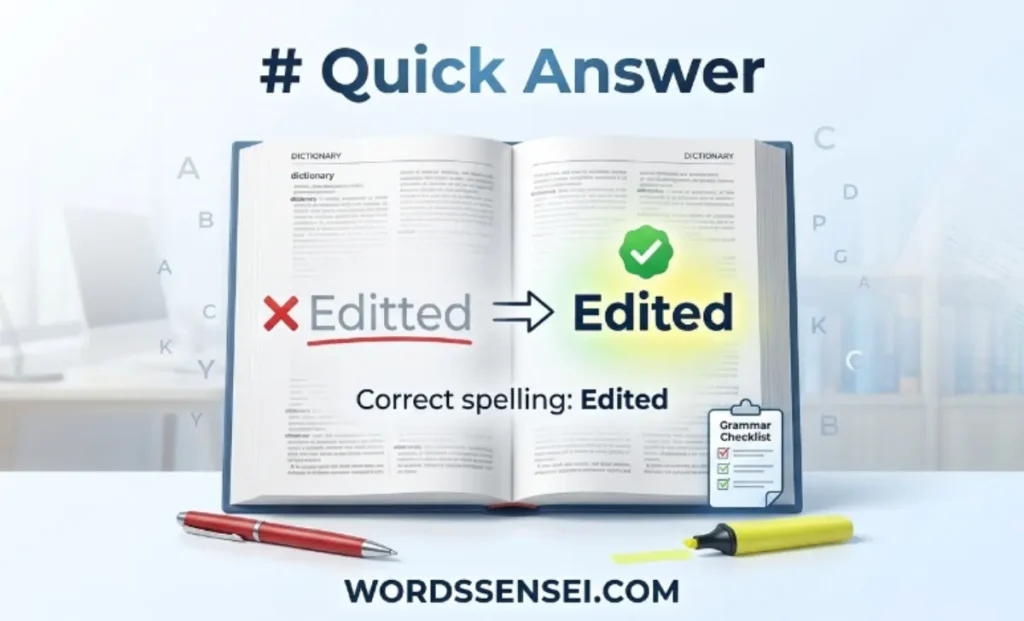
The correct and standard spelling is edited. It is spelled with a single “t” before the “-ed” ending. While many people assume it follows the pattern of words like “fitted” or “admitted,” this is actually a mistake. In modern English, “editted” is considered a misspelling and is not recognized in major dictionaries. You can verify this by checking the official entries on Merriam-Webster or the Oxford Learner’s Dictionary. Therefore, whether you are in the United States, the United Kingdom, or India, you must always use the version with the single “t.”
Additionally, the reason for this spelling lies in a specific grammar rule regarding word stress. Because the word “edit” has two syllables and the stress is on the first syllable (E-dit), the final consonant is not doubled when adding a suffix. Consequently, if you want to be correct, you should always stick to edited.
Correct Example
- The video was edited using professional software.
- She edited the manuscript for over three months.
- The final report has been edited and proofread.
Incorrect Example
- The photo was editted for the magazine. (Wrong)
- I editted my profile yesterday. (Wrong)
- He editted the code to fix the bug. (Wrong)
What Does Edited Mean?
The word edited is the past tense and past participle of the verb “edit.” It has several important meanings depending on the context in which it is used. In other words, it is a versatile term that describes the process of revision and refinement.
Common Meanings
- To Revise: When you change a piece of writing to improve it.
- To Correct: When you remove errors from a document or video.
- To Format: When you adjust the layout or style of content.
- To Curate: When you select and organize content for a specific purpose.
- To Modify: When you make changes to a digital file or computer code.
Simple Usage Examples
- Journalism: “The editor edited the news story to ensure accuracy.”
- Filmmaking: “The director edited the raw footage into a three-minute trailer.”
- Publishing: “The book was edited for clarity and flow.”
- Technology: “The user edited the configuration file to enable the new feature.”
The Origin of Edited
The history of this word is rooted in the ancient Latin language.
Word History
The word edited comes from the Latin word editus, which is the past participle of edere (meaning “to give out” or “to publish”). In the early days of English, the word was used specifically in the context of publishing books. Over time, it entered the digital world through film and software. Consequently, the spelling evolved to follow the rules of English phonetics. Therefore, the single “t” became a standard part of the language because the stress remains on the first vowel.
Why the Confusion Happens
The confusion happens because many English verbs ending in a consonant double that consonant when they become past tense. For instance, words like “fitted,” “spotted,” and “admitted” follow this pattern. However, because the stress in “edit” is on the first syllable (E-dit), the rule for doubling does not apply. Consequently, people often misspell it by following the pattern of words with a different stress pattern.
British English vs. American English
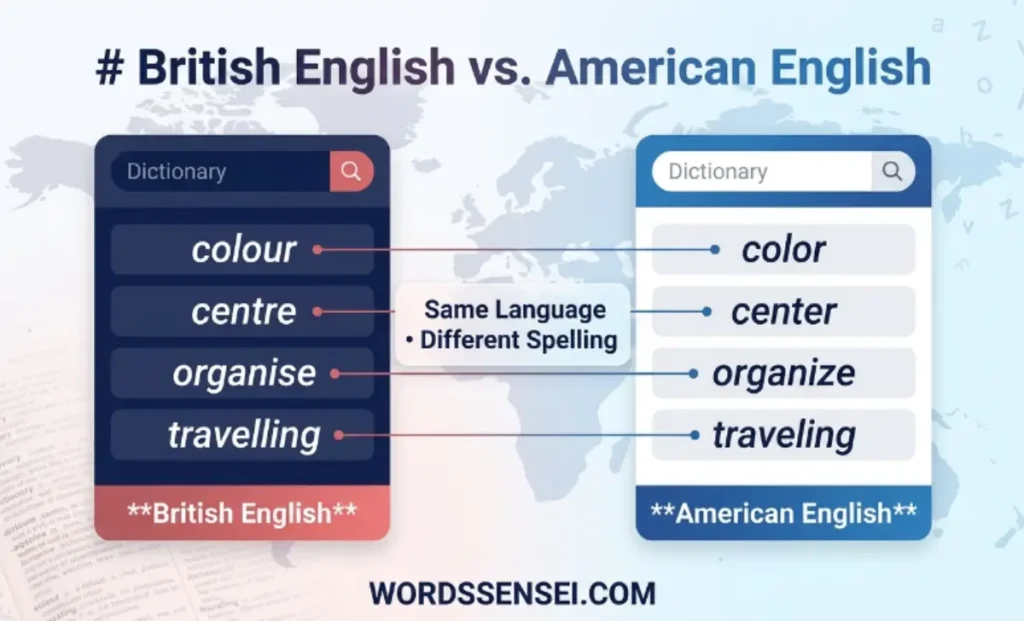
Interestingly, the spelling of edited is one of the few things that remains the same in all major versions of English.
Comparison Table
| Feature | American English (US) | British English (UK) |
|---|---|---|
| Spelling | Edited | Edited |
| Infinitive | Edit | Edit |
| Present Participle | Editing | Editing |
| Noun Form | Editor | Editor |
Whether you are in London or New York, the word is always edited. Therefore, you do not need to worry about regional differences when using this term.
Edited vs. Other Variations
It is helpful to see how this word compares to other terms in the world of grammar and professional writing.
Spelling Comparison Table
| Correct Spelling | Incorrect Spelling | Usage | Category |
|---|---|---|---|
| Edited | Editted | Standard | Past Tense |
| Revision | Revesion | Noun | Correction |
| Proofreading | Proof-reading | Standard | Refinement |
| Formatting | Formating | Standard | Adjustment |
Editing vs. Proofreading Comparison
| Feature | Editing | Proofreading |
|---|---|---|
| Goal | Improving clarity, style, and flow | Fixing grammar, spelling, and punctuation |
| Scope | Broad (Structure and tone) | Narrow (Surface-level errors) |
| Timing | Done during the writing process | Done as the final step |
| Outcome | A better story or argument | A clean, error-free document |
Common Editing Tools
| Tool | Purpose | Importance |
|---|---|---|
| Adobe Premiere | Video Editing | High (Professional) |
| Microsoft Word | Document Editing | Critical (Business) |
| Grammarly | Grammar Correction | High (Writing) |
| Google Docs | Collaborative Editing | Essential (Remote Work) |
The “Stressed Syllable” Rule
To truly understand why we spell it this way, you must understand the rule of final consonant doubling.
How the Rule Works
In English, you double the final consonant of a two-syllable word only if the last syllable is stressed. For example, in “ad-MIT,” the stress is on the second half. Therefore, we write “admitted.” However, in “E-dit,” the stress is on the first half. Consequently, we do not double the “t.” Therefore, we write edited.
Helpful Grammar Tips
Always remember the “Ear Test.” Say the word out loud. If the first part of the word is louder or stronger (like E-dit), then do not double the letter. If the end is stronger (like fit), do double the letter. Therefore, “fitted” has two “t”s, but edited has one.
Which Spelling Should You Use?
You should always use the version with the single “t.” There is no professional or academic setting where “editted” is correct.
US Audience
In the US, all major style guides, including the Associated Press (AP) and Chicago Manual of Style, use edited. Therefore, using the wrong spelling could lead to a lack of trust in your writing.
UK Audience
In the UK, the term is standard in all journalism and publishing documents. Consequently, British professionals always use the single “t” version.
International Writing
For global business and digital content, edited is the universal term. Therefore, using the correct spelling ensures your documents are recognized everywhere.
Academic Writing
In university papers or research journals, “editted” is a significant spelling error. As a result, students should always double-check their work for the single “t.”
Social Media Usage
Even on LinkedIn or Twitter, using the correct spelling shows that you are a professional. Consequently, it helps you build a better brand identity.
Common Mistakes with Edited
Avoid these frequent errors to keep your writing professional.
Frequent Errors
- The “Double T” Trap: Writing “editted” by mistake.
- Confusing with Admitted: Following the wrong pattern.
- Missing the ‘E’: Writing “editd.”
- Misplacing the Stress: Thinking the stress is on the second syllable.
Corrected Examples
- Incorrect: “The file was editted.”
- Correct: “The file was edited.”
- Incorrect: “She editted the video.”
- Correct: “She edited the video.”
Edited in Everyday Examples
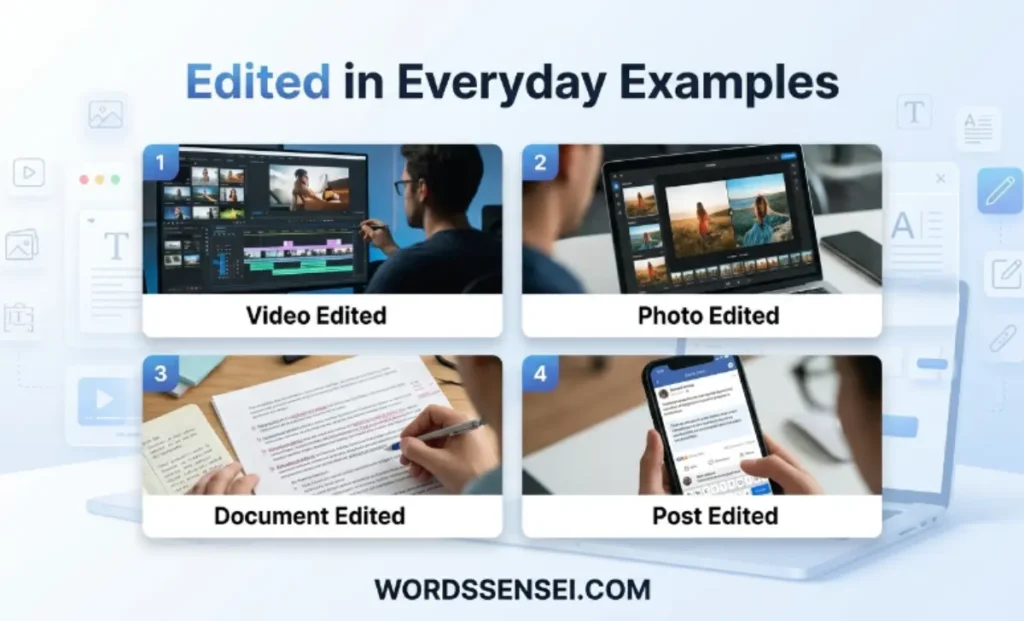
Let’s look at how the word is used in different professional contexts.
Emails
“Dear Team, I have edited the project proposal. Please review the changes.”
Social Media
“Just finished my latest video! It took hours to get it edited just right. #VideoEditing #Creator”
News Writing
“The story was edited for length before it went to print in the morning edition.”
School Writing
“The student edited their thesis based on the feedback from the professor.”
Business Writing
“The company edited its mission statement to reflect its new goals for 2026.”
Google Trends & Usage Data
The data shows that “edited” is a high-volume search term worldwide.
Popular Countries
- United States: High volume for “video edited software.”
- United Kingdom: Frequent searches for “edited by professional.”
- India: Large number of searches for “photo edited apps.”
- Australia: Common searches for “edited manuscript.”
- Canada: High volume for “edited document.”
Why People Search This Keyword
Most people search this keyword because they are looking for tools or services. However, a large number of searches also come from people checking the spelling before publishing content. Consequently, it is a vital keyword for anyone in the content creation industry.
Related Grammar Rules
Spelling is easier when you understand the patterns of the English language.
Similar Spelling Mistakes
- Fitted: Correct with double “t.”
- Benefited: Correct with single “t” (Stress on first syllable).
- Targeted: Correct with single “t” (Stress on first syllable).
- Admitted: Correct with double “t.”
Helpful Grammar Tips
Always remember the “Stress Test.” If the first part of the word is the “strong” part, the spelling stays simple. Since “edit” starts strong, the spelling is simple: edited. Consequently, your writing will always be accurate.
FAQs
Is it edited or editted?
The correct spelling is edited. It always has a single “t.”
Why is edited not spelled with two ‘t’s?
Because the stress is on the first syllable (E-dit), the final consonant is not doubled when adding suffixes like “-ed.”
What is the difference between editing and proofreading?
Editing improves the flow and structure, while proofreading fixes surface-level errors like spelling and grammar.
Can I say ‘editted’ in British English?
No, “editted” is incorrect in all forms of English, including British and American.
What are the best tools for video editing?
Adobe Premiere, Final Cut Pro, and DaVinci Resolve are among the best professional tools.
Is ‘editing’ also spelled with one ‘t’?
Yes, editing follows the same rule and is spelled with a single “t.”
How do I remember the single ‘t’?
Think of the word “editor.” Since “editor” has one “t,” the past tense edited does too.
What is version control?
Version control is a system that records changes to a file so you can recall specific edited versions later.
Conclusion
In conclusion, the spelling of edited is a small but vital detail in the world of professional writing and content creation. While the mistake of using “editted” is common due to the influence of other words like “fitted,” the correct version always requires a single “t.”
Throughout this guide, we have seen that edited is a key term in journalism, filmmaking, and publishing, describing the act of revising and refining content to its best possible form. Whether you are a video editor working on a blockbuster or a student refining a thesis, your work deserves the correct spelling.
Furthermore, by understanding the stressed syllable rule and the importance of the first vowel, you can avoid this spelling trap forever. Consequently, your business documents, emails, and digital projects will always look professional and credible.
Remember, attention to detail is what separates a good creator from a great one. Therefore, keep the single “t” in edited, stay focused on your revision and refinement, and your professional reputation will continue to grow. Your commitment to accuracy is the foundation of your success in any field!
Read Bore Blogs:
- Wintry or Wintery: Which Spelling Is Correct? (Complete Guide)
- Cognisant vs Cognizant: British vs American English Explained

Norman Coe is a contributing writer at Wordssensei.com, covering English grammar, vocabulary, and commonly confused words.