
Have you ever written the word “uncapable” and then wondered — wait, is that even right? If so, you are definitely not alone. In fact, thousands of students, writers, and English learners search this exact question every single day.
The confusion is completely understandable because English has two very common negative prefixes — “un-” and “in-” — and knowing which one to use with which word is not always obvious. However, the answer in this case is very clear and simple.
One of these words is correct and widely used. The other does not exist in any English dictionary anywhere in the world. So, this complete guide will explain everything you need to know — the correct word, the grammar rule behind it, the word history, real usage examples, and tips to help you never make this mistake again. By the end, you will write with complete confidence every single time.
Quick Answer
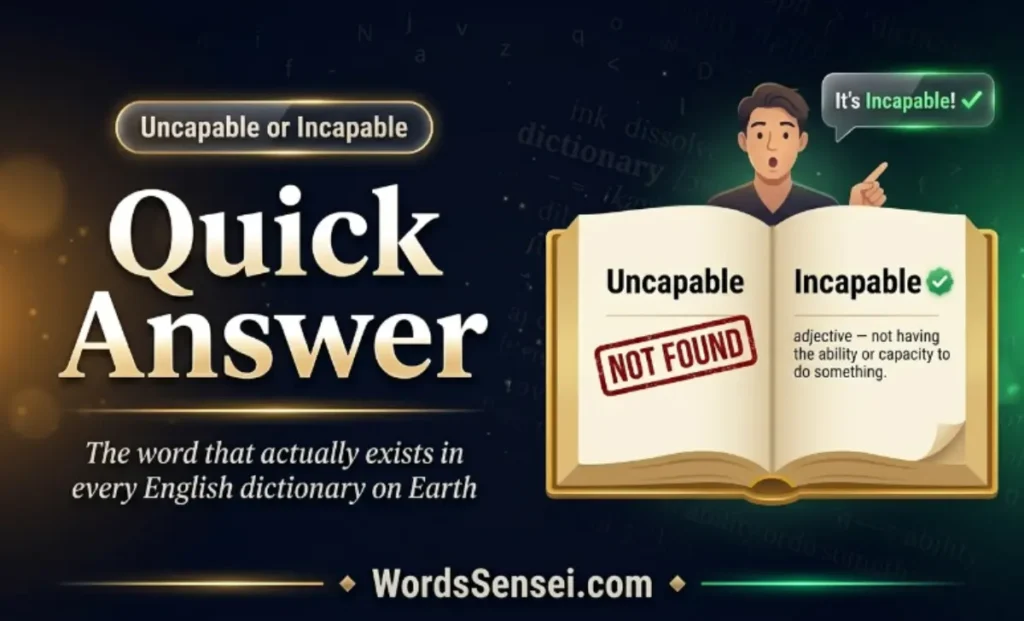
“Incapable” is the correct word. On the other hand, “uncapable” is wrong. In fact, it does not exist in any English dictionary — not Merriam-Webster, not Oxford, not Cambridge.
The correct word uses the prefix “in-“ — not “un-.” So, the word is built like this: in + capable = incapable. Furthermore, this follows a very important English grammar rule about Latin-origin words and which prefix they take.
Think of similar words: we say “inability” not “unability.” Moreover, we say “incomplete” not “uncomplete.” Similarly, we say “incapable” — never “uncapable.”
✅ Correct Examples
- “She felt completely incapable of making a decision under pressure.”
- “Furthermore, he was deemed incapable of managing his own affairs.”
- “The team was incapable of finishing the project on time.”
- “In addition, the old machine became incapable of processing large files.”
❌ Incorrect Examples
- ~~”She felt completely uncapable of making a decision.”~~
- ~~”He was uncapable of managing his own affairs.”~~
- ~~”The team was uncapable of finishing on time.”~~
- ~~”The machine became uncapable of processing files.”~~
Never use “uncapable.” It is always wrong — in every context, every country, and every writing style.
What Does “Incapable” Mean?
“Incapable” is a common English adjective. Moreover, it is used very widely in formal writing, legal documents, medical contexts, and everyday conversation. It simply means “not able to do something” or “lacking the ability or quality needed.”
| Feature | Detail |
|---|---|
| Word Type | Adjective |
| Correct Form | Incapable |
| Incorrect Form | Uncapable |
| Syllables | 4 — in-ca-pa-ble |
| Pronunciation | /ɪnˈkeɪpəbl/ |
| Prefix Used | “in-” — Latin origin |
| Base Word | Capable |
| Antonym | Capable |
| Related Noun | Incapacity |
| Related Verb | Incapacitate |
Common Meanings
According to the Cambridge Dictionary{:target=”_blank” rel=”noopener noreferrer”}, “incapable” means not able to do something or lacking the necessary ability, power, or quality to perform a task or function.
In everyday usage, “incapable” can mean several things:
- Not able to do something — the most common meaning; used when someone or something lacks the ability to perform a specific action
- Lacking basic skills or competence — used when describing someone who cannot handle a responsibility
- Legally unable — used in law to describe someone who cannot make their own decisions
- Medically unable — used in medicine to describe someone who has lost a physical or mental ability
Simple Usage Examples
- “The injured player was incapable of running during the final match.”
- “Furthermore, the old software was completely incapable of handling modern data formats.”
- “She was so exhausted that she felt incapable of forming a single clear thought.”
- “Moreover, the court ruled that he was incapable of making his own financial decisions.”
- “As a result, the broken engine left the car incapable of reaching highway speeds.”
The Origin of “Incapable”
Understanding where “incapable” comes from helps explain why it uses “in-” and not “un-.” Furthermore, it shows exactly why “uncapable” has never been correct in any period of the English language.
Word History
The word “incapable” came directly from the Late Latin word “incapabilis.” In Latin, the prefix “in-“ meant “not” — so “incapabilis” literally meant “not capable.” This Latin word entered English in the late 1500s through French — and it has used the “in-” prefix ever since.
The base word “capable” also came from Latin — from “capabilis” meaning “able to hold or contain.” So, capable and incapable are both Latin-origin words. As a result, they naturally use the Latin negative prefix “in-” — not the Old English prefix “un-.”
This is a very important distinction in English grammar. In fact, understanding it helps you avoid many similar spelling mistakes.
Why the Confusion Happens
English has two very common negative prefixes — “in-“ and “un-.” Both mean “not.” However, they come from completely different language roots and are used with different types of words.
Here is the key rule:
| Prefix | Origin | Used With |
|---|---|---|
| “in-“ | Latin | Words that came from Latin or French |
| “un-“ | Old English / Anglo-Saxon | Words that came from Old English or Germanic roots |
Because “capable” came from Latin, it naturally takes the Latin prefix “in-” — giving us “incapable.” On the other hand, the “un-” prefix belongs to Old English words — like “happy” becoming “unhappy” or “kind” becoming “unkind.” Therefore, “uncapable” breaks this fundamental rule — which is why it has never been accepted as a real English word.
“In-” vs “Un-” — The Complete Prefix Rule
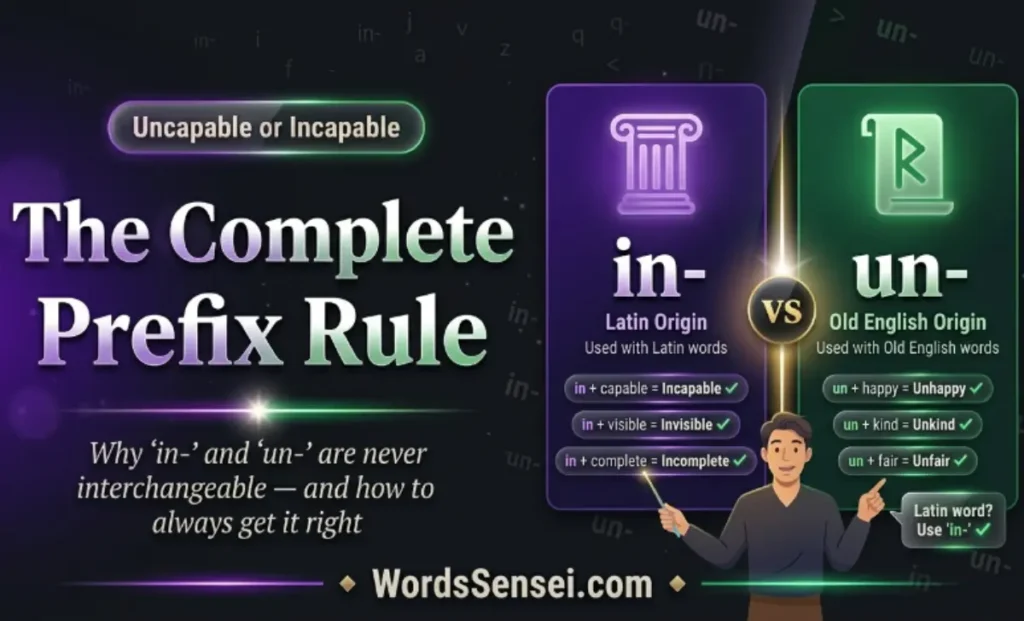
This is one of the most useful grammar rules in English. Moreover, mastering it helps you spell dozens of words correctly — not just “incapable.”
When to Use “in-“
Use “in-“ with words that came from Latin or French. Here are clear examples:
| Base Word | Correct Negative Form | Wrong Form |
|---|---|---|
| Capable | Incapable | ~~Uncapable~~ |
| Complete | Incomplete | ~~Uncomplete~~ |
| Correct | Incorrect | ~~Uncorrect~~ |
| Ability | Inability | ~~Unability~~ |
| Visible | Invisible | ~~Unvisible~~ |
| Formal | Informal | ~~Unformal~~ |
| Adequate | Inadequate | ~~Unadequate~~ |
| Consistent | Inconsistent | ~~Unconsistent~~ |
When to Use “un-“
Use “un-“ with words that came from Old English or Germanic roots. Here are clear examples:
| Base Word | Correct Negative Form | Wrong Form |
|---|---|---|
| Happy | Unhappy | ~~Inhappy~~ |
| Kind | Unkind | ~~Inkind~~ |
| Fair | Unfair | ~~Infair~~ |
| Helpful | Unhelpful | ~~Inhelpful~~ |
| Welcome | Unwelcome | ~~Inwelcome~~ |
| Aware | Unaware | ~~Inaware~~ |
Quick Memory Trick
Latin word + “in-” = correct Old English word + “un-” = correct Capable came from Latin → incapable ✅
British English vs American English
Great news — both British and American English completely agree on this one. “Incapable” is correct in every English-speaking country without any exception.
Comparison Table
| Feature | American English | British English | Australian English | Indian English |
|---|---|---|---|---|
| Correct Word | Incapable ✅ | Incapable ✅ | Incapable ✅ | Incapable ✅ |
| Incorrect Word | Uncapable ❌ | Uncapable ❌ | Uncapable ❌ | Uncapable ❌ |
| Pronunciation | /ɪnˈkeɪpəbl/ | /ɪnˈkeɪpəbl/ | /ɪnˈkeɪpəbl/ | /ɪnˈkeɪpəbl/ |
| Dictionary | Merriam-Webster | Oxford | Macquarie | Oxford Indian |
No matter where you are writing in the world — the United States, the United Kingdom, Canada, Australia, India, or Pakistan — always write “incapable.” The word never changes.
Incapable vs Uncapable — Full Comparison
Let us now look at every possible form people use — and settle this debate once and for all.
Complete Comparison Table
| Form | Correct? | Exists in Dictionary? | Recommended? |
|---|---|---|---|
| Incapable | ✅ Yes | ✅ Yes — all dictionaries | ✅ Always use this |
| Uncapable | ❌ No | ❌ No dictionary | ❌ Never use this |
| Not capable | ✅ Yes | ✅ Informal alternative | ⚠️ Casual use only |
| Unable | ✅ Yes | ✅ Common synonym | ✅ Good alternative |
| Incompetent | ✅ Yes | ✅ Stronger synonym | ✅ For specific contexts |
Which Word Should You Use?
The answer is always “incapable” — in every context and every audience. However, here is a clear breakdown by writing situation.
US Audience
Always use “incapable.” Confirmed by Merriam-Webster as the only correct form. Moreover, all American textbooks, legal documents, and academic papers use this word exclusively.
UK Audience
Always use “incapable.” Confirmed by the Oxford English Dictionary. Furthermore, British legal and medical writing has used this word for centuries without any variation.
Academic Writing
Use “incapable” in all essays, research papers, and academic writing. In addition, avoid “unable” in formal academic contexts — “incapable” sounds more precise and authoritative.
Legal and Medical Writing
“Incapable” is the standard term in both legal and medical writing. For example, courts use phrases like “mentally incapable” and “deemed incapable.” Similarly, doctors use “physically incapable” in medical reports.
Social Media Usage
Use “incapable” for correct and professional-looking posts. However, “unable” works well too in casual social media content where shorter words feel more natural.
Common Mistakes with “Incapable”
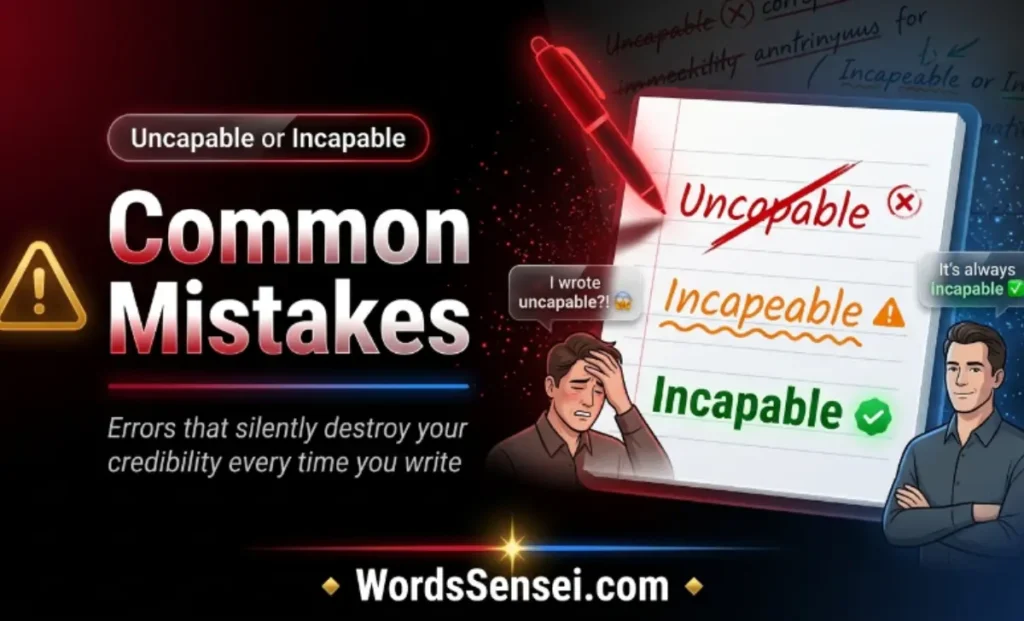
Even confident English writers make these errors. So, here is exactly what to watch for — and how to fix each mistake quickly.
Frequent Errors
- Writing “uncapable” instead of “incapable” — most common mistake by far
- Writing “incapeable” — adding an extra “e” in the middle — also wrong
- Writing “uncapeable” — combining both errors at once
- Confusing “incapable” with “unable” — both correct but used differently
- Using “incapable” when “incompetent” is more appropriate in professional contexts
Corrected Examples
| ❌ Wrong | ✅ Right | Why |
|---|---|---|
| She is uncapable of lying. | She is incapable of lying. | Uncapable is not a word |
| He is uncapable of love. | He is incapable of love. | Always use incapable |
| They are uncapable of change. | They are incapable of change. | No exceptions |
| The machine is incapeable. | The machine is incapable. | No extra “e” needed |
| She is uncapeable of trust. | She is incapable of trust. | Both errors fixed |
“Incapable” in Everyday Writing Examples
Here is how “incapable” works naturally across different real-world writing situations. Furthermore, these examples will help you use the word with much more confidence going forward.
Emails
“Unfortunately, our current system is completely incapable of processing requests of this size. Furthermore, we are working on an upgrade that will resolve this issue within the next two weeks. In addition, we apologize for any inconvenience this may cause.”
Social Media
“Sometimes you meet people who are simply incapable of admitting they were wrong. Moreover, trying to reason with them just wastes your energy. So, just let it go and move forward. 💯 #LifeLessons #Growth”
News Writing
“The investigation revealed that the department was completely incapable of handling the scale of the disaster. As a result, emergency services from three neighboring regions were called in. Furthermore, a full review of emergency protocols has now been ordered.”
School Writing
“In the novel, the main character is shown to be incapable of trusting others. Furthermore, this inability to trust stems directly from his difficult childhood experiences. As a result, he pushes away everyone who tries to get close to him throughout the story.”
Business Writing
“Our analysis shows that the existing infrastructure is incapable of supporting the planned expansion. Therefore, we recommend a full system upgrade before proceeding. In addition, delaying this investment will result in significantly higher costs further down the line.”
Legal Writing
“The court determined that the defendant was mentally incapable of understanding the nature of the contract at the time of signing. As a result, the agreement was declared null and void. Furthermore, the case was referred to a medical panel for further assessment.”
Google Trends and Usage Data
Search data clearly confirms that “incapable” completely dominates globally. On the other hand, “uncapable” only appears in searches as a confused query — people checking whether it is actually a real word.
Popular Countries
| Country | Most Searched Form | Search Volume | Notes |
|---|---|---|---|
| United States | Incapable | Very High | Dominant — no competition |
| United Kingdom | Incapable | High | Consistent with US usage |
| Canada | Incapable | High | Follows North American pattern |
| Australia | Incapable | Medium-High | No regional variation |
| India | Uncapable vs Incapable | High | Large ESL population — more confusion |
| Pakistan | Uncapable vs Incapable | High | ESL learners — prefix confusion |
| Philippines | Incapable | Medium | English widely used — incapable dominant |
Why People Search This Keyword
Most searches for “uncapable or incapable” come from these specific groups:
- ESL learners — confused by the two negative prefixes “in-” and “un-” in English
- Students — double-checking their spelling before submitting essays or assignments
- Content writers — avoiding embarrassing errors in published blog posts and articles
- Social media users — wanting their captions and comments to look correct and professional
- Non-native English teachers — verifying the correct form before teaching it to students
Related Grammar Rules
Similar “In-” vs “Un-” Mistakes
The same confusion between “in-” and “un-” happens with many other English words. So, here is a complete list of the most common ones:
| ❌ Wrong Form | ✅ Right Form | Rule |
|---|---|---|
| Uncapable | Incapable | Latin word — use “in-“ |
| Uncomplete | Incomplete | Latin word — use “in-“ |
| Uncorrect | Incorrect | Latin word — use “in-“ |
| Unability | Inability | Latin word — use “in-“ |
| Unvisible | Invisible | Latin word — use “in-“ |
| Unadequate | Inadequate | Latin word — use “in-“ |
| Inconsistent | Inconsistent | Latin word — use “in-“ |
| Infair | Unfair | Old English word — use “un-“ |
| Inhappy | Unhappy | Old English word — use “un-“ |
| Inkind | Unkind | Old English word — use “un-“ |
Helpful Grammar Tips
Tip 1 — Check the word origin first If the base word came from Latin or French — use “in-.” Furthermore, most long formal English words came from Latin. So, longer words usually take “in-.”
Tip 2 — Short everyday words usually take “un-“ Words like happy, kind, fair, and helpful are Old English words. Therefore, they take “un-” — unhappy, unkind, unfair, unhelpful.
Tip 3 — When in doubt — check a dictionary If you are not sure which prefix to use, always check. In fact, a quick dictionary search takes less than 10 seconds and saves you from an embarrassing mistake.
Tip 4 — “Incapable of” is the correct phrase Always use “incapable of” — never “incapable to.” For example, “She is incapable of lying” is correct. However, “She is incapable to lie” sounds unnatural and wrong.
💡 Pro Tip: When you are not sure about any prefix or spelling, check Merriam-Webster{:target=”_blank” rel=”noopener noreferrer”} online. It is completely free and gives the correct answer instantly.
“Incapable” — Common Phrases and Collocations
“Incapable” is used in many fixed phrases and common expressions in English. Moreover, knowing these helps you use the word naturally and confidently in all writing situations.
Most Common “Incapable of” Phrases
| Phrase | Meaning | Example |
|---|---|---|
| Incapable of love | Cannot feel or give love | “He seemed incapable of love after years of heartbreak.” |
| Incapable of change | Cannot or will not change | “Some people are simply incapable of change.” |
| Incapable of lying | Always tells the truth | “She is completely incapable of lying to her family.” |
| Incapable of work | Cannot work — medical/legal | “The injury left him incapable of work for six months.” |
| Mentally incapable | Lacks mental capacity | “The court found him mentally incapable of standing trial.” |
| Physically incapable | Lacks physical ability | “She was physically incapable of climbing the stairs alone.” |
| Deemed incapable | Officially judged unable | “He was deemed incapable of making his own decisions.” |
Internal Link Suggestions
📌 (Add These Links When Related Articles Are Ready)
- Link “negative prefixes” → your article on English prefix rules
- Link “common spelling mistakes” → your article on English spelling errors
- Link “ESL learners” → your beginner English grammar guide
- Link “Latin origin words” → your article on Latin roots in English
Author Bio
About the Author [Your Name] is an English language writer and grammar teacher with [X] years of experience. Moreover, [he/she/they] helps students, bloggers, and ESL learners write better and more confidently every day. Connect on LinkedIn | View All Posts
FAQs
Is “uncapable” a real word?
No. “Uncapable” is not a real English word. In fact, it does not appear in any major dictionary — not Merriam-Webster, not Oxford, not Cambridge. The only correct word is “incapable.”
Why is it “incapable” and not “uncapable”?
Because “capable” came from Latin — and Latin-origin words use the prefix “in-“ to make them negative. On the other hand, the prefix “un-” is used with Old English words like “happy” and “kind.” Therefore, “uncapable” breaks the fundamental prefix rule of English grammar.
What does “incapable” mean?
“Incapable” means not able to do something or lacking the necessary ability to perform a task. Furthermore, it is used in everyday writing, formal essays, legal documents, and medical reports. Moreover, it is always followed by “of” — for example, “incapable of lying.”
What is the difference between “incapable” and “unable”?
Both words mean “not able.” However, “incapable” suggests a deeper or more permanent inability — often a lack of skill, power, or capacity. On the other hand, “unable” usually suggests a temporary situation. For example, “She is incapable of empathy” sounds more permanent than “She is unable to attend today.”
Is “incapable” formal or informal?
“Incapable” is used in both formal and informal writing. However, it is especially common in formal contexts like legal writing, medical reports, and academic essays. In addition, in casual speech, people often prefer “unable” or “can’t” instead.
What is the noun form of “incapable”?
The noun form is “incapacity.” Furthermore, the related verb is “incapacitate” — meaning to make someone unable to do something. For example, “The accident incapacitated him for three months.”
Can I say “incapable to” instead of “incapable of”?
No. The correct phrase is always “incapable of” — never “incapable to.” For example, “She is incapable of making that decision” is correct. However, “She is incapable to make that decision” sounds unnatural and grammatically wrong in standard English.
What are some synonyms for “incapable”?
Good synonyms include unable, incompetent, unfit, powerless, and helpless. However, each has a slightly different meaning. Furthermore, “incompetent” is stronger and more critical — suggesting a lack of skill or professionalism specifically. So, always choose the synonym that best fits your exact meaning and context.
Conclusion
After going through this complete guide, the answer is now absolutely clear. “Incapable” is the only correct word — in every country, every writing style, and every context you can think of. “Uncapable” simply does not exist in any English dictionary anywhere in the world.
The confusion happens because English has two negative prefixes — “in-” and “un-” — and knowing which one to use with which word requires understanding the origin of the base word. However, once you know the rule, it becomes very easy. “
Capable” came from Latin — so it takes the Latin prefix “in-” — giving us “incapable.” Furthermore, this same rule applies to many other English words like “incomplete,” “incorrect,” and “invisible.”
So, the next time you sit down to write — whether it is a school essay, a business email, a social media post, or a published article — write “incapable” with total confidence. Moreover, remember the phrase is always “incapable of” — never “incapable to.”
You now have the full picture — the correct word, the grammar rule, the word history, and the practical tips. Therefore, go ahead and write with complete confidence. Never let this simple question slow you down again.
Read More Blogs:
- Coaches or Coach’s? The Grammar Rule Most People Get Wrong
- Kneck or Neck? 99% of People Don’t Know the Real Answer

Hi, I am Anne Seaton, a professional content writer working on wordssensei.com.
I create engaging and SEO-friendly articles that inform, inspire, and connect with readers.