
You typed “responsibility” and then “responsability” and then paused to wonder — is that actually right? If so, you are definitely not alone. In fact, thousands of students, professionals, and non-native English speakers search this exact question every single day.
The confusion is completely understandable, especially for French speakers, since the word looks almost identical in both languages. However, the answer is actually very simple and clear. Only one spelling exists in every English dictionary in the world.
Therefore, this complete guide will explain everything you need to know: the correct spelling, the word history, the reason for the confusion, and real usage examples. By the end, you will write this word with complete confidence every single time.
Quick Answer
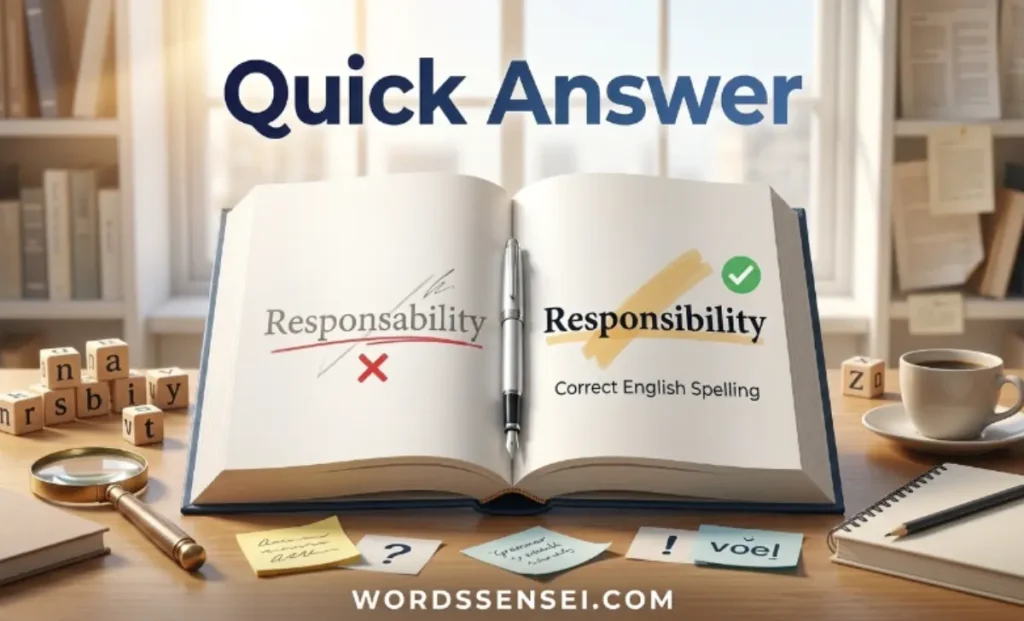
“Responsibility” is the correct spelling in English. Meanwhile, “responsability” is incorrect and does not appear in any major English dictionary, including Merriam-Webster, Oxford, or Cambridge.
The word always contains “-ibility,” not “-ability,” since it comes from the adjective “responsible.” Furthermore, the correct spelling is r-e-s-p-o-n-s-i-b-i-l-i-t-y, with an “i” right before “bility.”
Most people make this mistake because of French influence, since the French word “responsabilité” uses an “a” instead of an “i.” Nevertheless, English has always kept the “i” spelling, tied directly to “responsible.”
✅ Correct Examples
“She accepted full responsibility for the mistake.”
“Furthermore, employees share responsibility for workplace safety.”
“Taking responsibility is an important part of growing up.”
“In addition, the manager clarified everyone’s responsibilities during the meeting.”
❌ Incorrect Examples
~~”She accepted full responsability for the mistake.”~~
~~”Employees share responsability for workplace safety.”~~
~~”Taking responsability is an important part of growing up.”~~
~~”The manager clarified everyone’s responsabilities during the meeting.”~~
Never replace the “i” with an “a” in this word. After all, “responsability” simply does not exist in standard English.
What Does “Responsibility” Mean?
“Responsibility” is a common English noun. Moreover, it appears constantly in business, education, law, and everyday conversation. It refers to the state of being accountable for something or someone.
| Feature | Detail |
|---|---|
| Word Type | Noun |
| Correct Spelling | Responsibility |
| Incorrect Spelling | Responsability |
| Syllables | 6 — re-spon-si-bil-i-ty |
| Pronunciation | /rɪˌspɒnsɪˈbɪləti/ |
| Plural Form | Responsibilities |
| Root Word | Responsible |
Common Meanings
According to the Cambridge Dictionary{:target=”_blank” rel=”noopener noreferrer”}, “responsibility” means a duty to deal with something, or having control over someone, and being blamed if something goes wrong. Meanwhile, the word can also describe a specific task or role that someone is expected to handle.
In everyday usage, “responsibility” typically appears in a few common situations:
Personal responsibility, for example, refers to owning your own actions and their consequences
Meanwhile, job responsibility describes specific duties assigned within a workplace role
Similarly, social responsibility refers to obligations individuals or companies have toward society
Finally, legal responsibility refers to being answerable under the law for an action or outcome
Simple Usage Examples
“The team leader took responsibility for the project’s delay.”
“Meanwhile, parents hold responsibility for their children’s wellbeing.”
“Companies, therefore, increasingly focus on corporate social responsibility.”
“Eventually, she was promoted after showing great responsibility at work.”
The Origin of “Responsibility”
Knowing where this word comes from helps explain exactly why it is spelled the way it is. Additionally, it shows why “responsability” has never been correct in English, despite feeling familiar to many speakers.
Word History
The word “responsibility” comes from the adjective “responsible,” which traces back to the Latin word “responsus,” the past participle of “respondere,” meaning to respond or answer. This root entered English through French influence during the medieval period, eventually forming “responsible” and later “responsibility.”
When English formed the noun from “responsible,” it followed a common pattern: replacing “-ible” with “-ibility.” As a result, the spelling has remained consistent for centuries, always with an “i,” never an “a.”
Interestingly, French took a slightly different path with the same Latin root, forming “responsable” and “responsabilité,” both using an “a.” Therefore, this is exactly why French speakers, and English learners influenced by French, often write “responsability” by mistake in English.
Why the Confusion Happens
Both English and French share the same Latin ancestor for this word. Moreover, since French uses “responsabilité” with an “a,” many bilingual speakers or French-influenced writers naturally transfer that spelling into English. Because of this cross-language similarity, the mistake happens frequently among learners and even experienced multilingual writers.
However, this assumption is incorrect in English. So, here is the key difference:
| Language | Correct Spelling |
|---|---|
| English | Responsibility (with “i”) |
| French | Responsabilité (with “a”) |
Even though these words share the same Latin root, English and French developed slightly different spelling patterns over time. Therefore, remembering that English follows “responsible” with an “i” is the easiest way to avoid the mistake.
British English vs American English
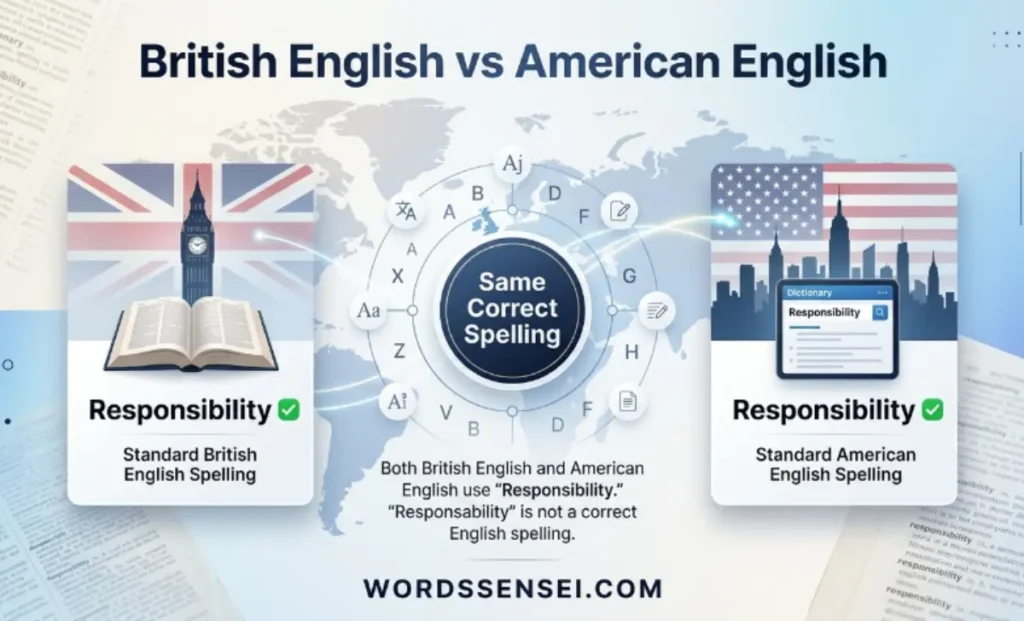
Good news — both British and American English completely agree on this word. “Responsibility” is correct in every English-speaking country, without any exception.
Comparison Table
| Feature | American English | British English | Australian English | Indian English |
|---|---|---|---|---|
| Correct Spelling | Responsibility ✅ | Responsibility ✅ | Responsibility ✅ | Responsibility ✅ |
| Incorrect Spelling | Responsability ❌ | Responsability ❌ | Responsability ❌ | Responsability ❌ |
| Pronunciation | /rɪˌspɒnsɪˈbɪləti/ | /rɪˌspɒnsɪˈbɪləti/ | /rɪˌspɒnsɪˈbɪləti/ | /rɪˌspɒnsɪˈbɪləti/ |
| Dictionary | Merriam-Webster | Oxford | Macquarie | Oxford Indian |
No matter where you are writing, whether the United States, the United Kingdom, Canada, Australia, or India, the spelling never changes. Overall, always write “responsibility” with an “i,” never an “a.”
Responsibility vs Responsability — Full Comparison
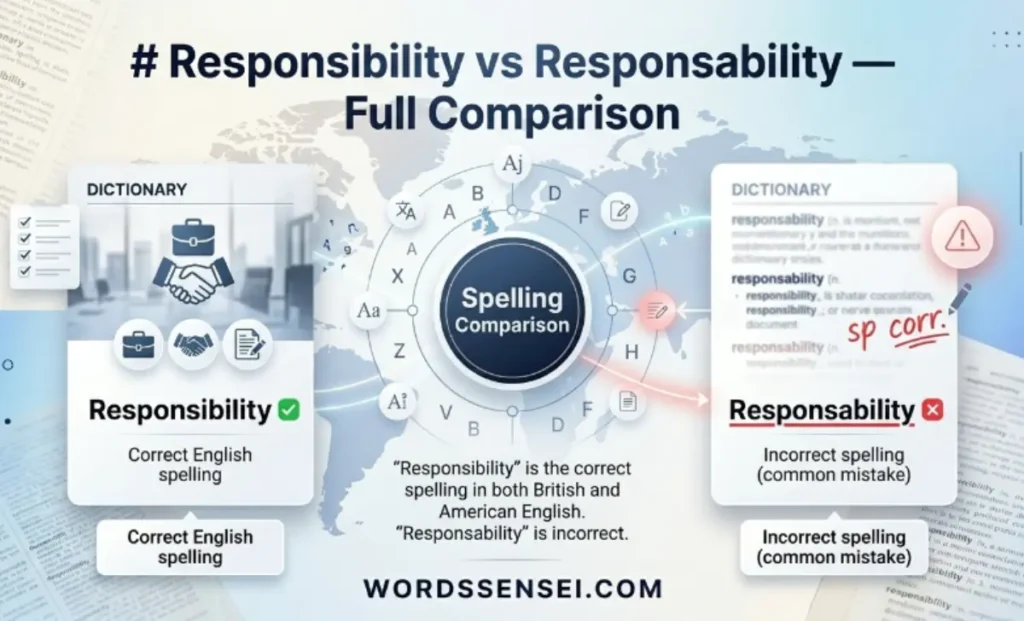
Let us now look at every variation people sometimes use, and clear up the confusion once and for all.
Complete Comparison Table
| Form | Correct? | Exists in Dictionary? | Recommended? |
|---|---|---|---|
| Responsibility | ✅ Yes | ✅ Yes — all English dictionaries | ✅ Always use this in English |
| Responsability | ❌ No | ❌ No English dictionary | ❌ Never use this in English |
| Responsibilities | ✅ Yes | ✅ Correct plural form | ✅ Use for multiple duties |
| Responsable | ❌ No (in English) | ❌ Only valid in French/Spanish | ❌ Never use in English writing |
Which Spelling Should You Use?
The answer is always “responsibility,” in every English context and every audience. However, here is a clear breakdown by writing situation.
US Audience
American writers should always use “responsibility,” confirmed by Merriam-Webster{:target=”_blank” rel=”noopener noreferrer”} as the only correct form. Consequently, all American business documents, academic papers, and legal writing use this word exclusively.
UK Audience
British writers, similarly, always use “responsibility,” confirmed by the Oxford English Dictionary. Likewise, British corporate and legal writing has used this exact spelling for centuries without variation.
Bilingual and ESL Writers
For French, Spanish, or Portuguese speakers, remembering that English drops the “a” for an “i” is especially important. Conversely, no English dictionary recognizes the French-style spelling, even though it looks nearly identical.
Business and Workplace Writing
Job descriptions, resumes, and performance reviews rely heavily on this word. As a result, using the correct spelling protects your professional credibility in written communication.
Academic Writing
In academic contexts, essays and research papers about ethics, law, or sociology frequently use “responsibility.” Therefore, spelling it correctly matters significantly for formal grading and publication standards.
Common Mistakes with “Responsibility”
Even confident writers make these errors. So, here is exactly what to watch for, and how to fix each mistake quickly.
Frequent Errors
First, writing “responsability” instead of “responsibility” remains the most common mistake by far, especially among French-influenced writers
Second, confusing the English spelling pattern with the French word “responsabilité”
Additionally, misspelling the plural form as “responsabilities”
Meanwhile, dropping a letter and writing “responsiblity” instead of “responsibility”
Finally, forgetting to proofread resumes or professional documents before submitting them
Corrected Examples
| ❌ Wrong | ✅ Right | Why |
|---|---|---|
| I take full responsability for this. | I take full responsibility for this. | English always uses “i,” not “a” |
| Our team shares these responsabilities. | Our team shares these responsibilities. | Plural also uses “i” |
| Leadership requires great responsiblity. | Leadership requires great responsibility. | Do not drop the “i” |
| This is not my responsability. | This is not my responsibility. | French spelling does not apply in English |
“Responsibility” in Everyday Writing Examples
Here is how “responsibility” works naturally across different real-world writing situations. Furthermore, these examples will help you use the word with much more confidence going forward.
Emails
“As discussed, you will now take responsibility for managing client accounts. In addition, please review the attached document outlining your new duties. So, let me know if you have any questions before Monday.”
Social Media
“Learning to take responsibility for my mistakes has honestly changed my life. It’s never easy, but it’s always worth it. #PersonalGrowth #Responsibility”
News Writing
“Officials confirmed that the company accepted full responsibility for the safety violation. As a result, an internal investigation is now underway, and further updates are expected within the coming weeks.”
School Writing
“Responsibility means being accountable for your own actions and their consequences. Furthermore, developing a sense of responsibility helps students succeed both academically and personally.”
Business Writing
“Each department head holds responsibility for meeting quarterly performance targets. Therefore, clear communication about expectations remains essential across all teams. Meanwhile, HR continues updating job descriptions to reflect these responsibilities.”
Google Trends and Usage Data
Search data clearly confirms that “responsibility” completely dominates globally. On the other hand, “responsability” only appears in searches as a confused query, mostly from bilingual or French-influenced writers.
Popular Countries
| Country | Most Searched Form | Search Volume | Notes |
|---|---|---|---|
| United States | Responsibility | Very High | Dominant — no competition |
| United Kingdom | Responsibility | High | Consistent with US usage |
| Canada | Responsability vs Responsibility | High | Bilingual French-English population |
| France | Responsability vs Responsibility | High | Direct influence from French spelling |
| India | Responsibility | Medium-High | ESL population, less French influence |
Why People Search This Keyword
Overall, most searches for “responsibility or responsability” come from these specific groups:
First, French speakers or bilingual writers transferring French spelling into English
Second, job applicants checking spelling before writing a resume or cover letter
Additionally, students double-checking spelling before submitting academic essays
Meanwhile, content writers avoiding embarrassing errors in professional or business writing
Finally, ESL learners studying common English suffix patterns like “-ibility”
Related Grammar Rules
Similar Spelling Mistakes
The same kind of confusion happens with other English words that follow “-ibility” instead of “-ability,” especially for French or Spanish speakers. So, here are a few similar examples worth knowing:
| Related Pair | Correct Forms | Note |
|---|---|---|
| Responsibility / Responsability | Responsibility | English keeps “i,” French uses “a” |
| Possibility / Possability | Possibility | Same “-ibility” pattern |
| Flexibility / Flexability | Flexibility | Same “-ibility” pattern |
| Accessibility / Accessability | Accessibility | Same “-ibility” pattern |
Helpful Grammar Tips
Tip 1 — Remember the connection to “responsible.” “Responsibility” simply adds “-ility” to “responsible.” Therefore, if you can spell “responsible” correctly, you already know the correct base for this word.
Tip 2 — Separate English from French spelling. French uses “responsabilité” with an “a,” but English never follows this pattern. Consequently, keeping the two languages mentally separate helps avoid the mistake.
Tip 3 — Check the plural form too. The correct plural is “responsibilities,” never “responsabilities.” So, this same rule applies to every related form of the word.
Tip 4 — Watch for other “-ibility” words. Since English generally favors “-ibility” for words like “possibility” and “flexibility,” recognizing this pattern helps you spell “responsibility” correctly as well.
Pro Tip: When you are not sure about any spelling, check Merriam-Webster{:target=”_blank” rel=”noopener noreferrer”} online. Best of all, it is completely free and gives the correct answer instantly.
“Responsibility” — Common Phrases and Modern Usage
“Responsibility” appears in many common phrases today, far beyond just its basic definition. Moreover, understanding these different uses helps you use the word naturally in any context.
Common Phrases
| Phrase | Meaning | Example |
|---|---|---|
| Take responsibility | To accept accountability for an action | “He took responsibility for the error immediately.” |
| Corporate social responsibility | A company’s ethical obligations to society | “The brand is known for its corporate social responsibility programs.” |
| Sense of responsibility | A personal feeling of accountability | “She has a strong sense of responsibility toward her team.” |
| Shared responsibility | Accountability divided among multiple people | “Parenting requires shared responsibility between both partners.” |
| Job responsibilities | Specific duties tied to a role | “Please review your job responsibilities in the attached document.” |
| Moral responsibility | Ethical duty to act rightly | “Many believe there is a moral responsibility to help others in need.” |
Internal Link Suggestions
(Add These Links When Related Articles Are Ready)
The term “commonly confused word pairs” can link to your article on English spelling mistakes.
Similarly, “French to English spelling errors” can link to your article on bilingual writing challenges.
For workplace-related content, “how to write job responsibilities” can link to your article on resume and job description writing.
Finally, “-ibility vs -ability words” can link to your article on English suffix patterns and spelling rules.
Author Bio
About the Author [Your Name] is an English language writer and grammar teacher with [X] years of experience. Additionally, [he/she/they] helps students, bloggers, and ESL learners write better and more confidently every day. Connect on LinkedIn | View All Posts
FAQs
Is “responsability” a real word?
No. “Responsability” is not a real English word. In fact, it does not appear in any major English dictionary, not Merriam-Webster, not Oxford, not Cambridge. The only correct English word is “responsibility.”
Why do people spell responsibility as responsability?
This mistake happens mostly because of French influence, since the French word “responsabilité” uses an “a” instead of an “i.” Bilingual speakers or French-influenced writers often transfer that spelling into English by mistake.
What does “responsibility” mean?
“Responsibility” means being accountable for something or someone, or having a duty to handle a specific task. Furthermore, the word is widely used in personal, legal, and professional contexts.
Is “responsability” correct in French?
Yes, in French, the correct word is “responsabilité,” with an “a.” However, this spelling only applies to French, not to English.
Is the plural “responsibilities” or “responsabilities”?
The correct plural is “responsibilities.” Since “responsability” itself is not a real English word, its plural form does not exist either.
What is the root word of “responsibility”?
The root word is “responsible,” which comes from the Latin “respondere,” meaning to respond or answer. English then added “-ility” to form the noun “responsibility.”
How do I remember the correct spelling of responsibility?
Try this simple approach: first spell “responsible” correctly, then add “-ity.” Since English keeps the “i” throughout, this method helps you avoid the French-style “a” spelling.
Are there other English words with the same “-ibility vs -ability” confusion?
Yes. Words like “possibility,” “flexibility,” and “accessibility” follow the same “-ibility” pattern, and are sometimes misspelled with “-ability” by the same type of language transfer.
Conclusion
After reading through this complete guide, the answer is now absolutely clear. “Responsibility” is the only correct spelling in English, in every country, every writing style, and every context you can think of. “Responsability” simply does not exist in any English dictionary anywhere in the world.
The confusion happens largely because of French influence, since French uses “responsabilité” with an “a.” However, English has always followed “responsible” with an “i,” keeping the two languages spelled differently despite their shared Latin root.
So, the next time you sit down to write, whether it is a resume, a business email, a school essay, or a professional report, write “responsibility” with complete confidence. Overall, you now have the full picture: the correct spelling, the word history, and practical tips to remember it forever.
Read More Blogs:
- Response or Respond : Here’s the Correct Word to Use
- Colombia vs Columbia: Which Spelling Is Correct?

Norman Coe is a contributing writer at Wordssensei.com, covering English grammar, vocabulary, and commonly confused words.