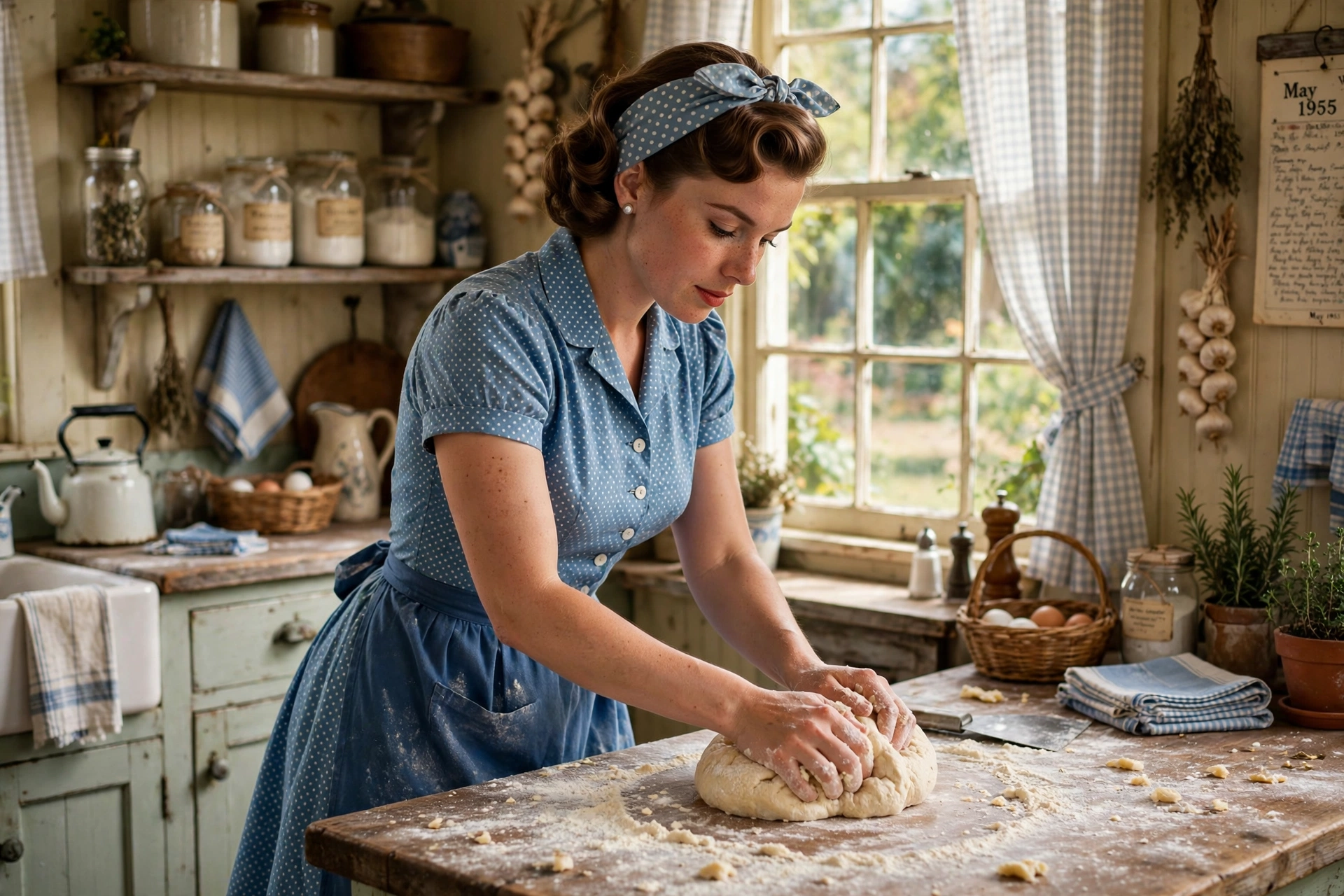
She bakes her own sourdough from scratch, wears a prairie dress, homeschools her five children, and her morning routine video has three million views. Is she living a dream life, making a political statement, or building a brand? The answer depends entirely on who you ask — which is exactly why the word “tradwife” is one of the most contested terms in modern slang.
Tradwife: The Short Answer
“Tradwife” (short for “traditional wife”) is slang for a wife who fulfills a traditional gender role based on Western middle-class femininity of the mid-twentieth century (Wiktionary) — a portmanteau of “traditional” and “wife” (Wikipedia). The word labels an internet subculture of women who embrace homemaking, home cooking, and traditional domestic roles as an identity and often a public brand. It is politically charged: sources including Wikipedia and Wiktionary associate the term with far-right and alt-right politics, while the most famous creators using the aesthetic publicly reject the label.
What Does “Tradwife” Mean?
Strip away the controversy for a moment and the literal meaning is simple: a woman who chooses the role of a traditional wife — staying home, raising children, cooking from scratch, and presenting domestic life as a calling rather than a fallback. The aesthetic draws on 1950s imagery: vintage dresses, farmhouse kitchens, homemade bread, a visual world that looks deliberately untouched by modern feminism’s later waves.
But the word carries a second, heavier meaning. Wikipedia describes the tradwife movement as associated with far-right and alt-right politics, and Wiktionary’s usage note warns that the term is “heavily associated with the white supremacist subculture.” These attributions are not fringe claims — they come from major reference works — and they mean the word functions as an accusation as often as a self-description. When journalists write about “tradwives,” they frequently mean a political phenomenon; when creators film themselves kneading dough, they often mean a lifestyle. Both meanings live in the same word, and that overlap is the source of the friction.
The Origin of “Tradwife”
The word “tradwife” is a straightforward portmanteau: traditional + wife. Wiktionary’s entry collects quotations from the New York Times, The Guardian, and Stylist spanning 2018–2022, showing the term moving from niche internet corners into mainstream media over four years. Cambridge Dictionary added “tradwife” to its lexicon in 2025 (alongside “skibidi” and “delulu”), with editors noting they had been tracking the word since 2018 — a sign of sustained, genuine usage rather than a flash trend.
The subculture itself, though, is older than the hashtag. Traditionalist homemaking communities existed in blogs and forums long before TikTok gave them a name. What changed around 2024 was the scale: viral creators like Nara Smith and Hannah Neeleman (of Ballerina Farm) brought the tradwife aesthetic to audiences of millions, turning a subculture into a full-blown internet phenomenon and pulling the word into everyday vocabulary.
The Controversy: Attributed Positions
This section needs care, because the controversy is real and attributing it correctly matters. Here is what the sources actually say — not what any one side wishes they said.
Position 1 (Wikipedia, Wiktionary): The term is associated with far-right, alt-right, and white supremacist politics. This association comes from documented overlap between early tradwife online communities and extremist-adjacent forums, and from critics who read the aesthetic — a return to mid-century gender roles — as a rejection of feminist progress with political overtones.
Position 2 (the creators themselves): Nara Smith and Hannah Neeleman — the two most visible faces of the aesthetic — have both publicly rejected the “tradwife” label. They describe their lives as personal choices and content brands, not political statements. Millions of followers engage with their content as lifestyle entertainment: recipes, routines, and aspirational domesticity.
Position 3 (the middle ground): Many commentators argue the word has outgrown its origins — that for most users today, “tradwife” is simply shorthand for the vintage-homemaking aesthetic, detached from any ideology. Others argue that the aesthetic can’t be separated from its history, and that the label sticks regardless of intent.
This article takes no side. What you can say accurately: the term is politically charged, its reference-work attributions are serious, and the most famous creators reject the label. What you should NOT say: that every woman filming a sourdough tutorial is an extremist, or that the political associations are a myth. Both claims go further than the evidence.
How to Use “Tradwife”
The word is a countable noun: “a tradwife,” “two tradwives” (the plural follows the standard -wife → -wives pattern). It’s almost always lowercase in internet usage, and it’s used both descriptively and critically:
- “Her content went viral in the tradwife niche — four million views on the bread video alone.”
- “She’s been called a tradwife online, but she rejects the label.”
- “The documentary traces how tradwife aesthetics moved from niche forums to mainstream TikTok.”
Three usage notes. First, because the word is an accusation as often as a description, quoting who applied the label — “critics call it…,” “she describes herself as…” — is the honest framing. Second, avoid using it as a blanket label for any woman who stays home; that’s how sloppy generalizations start. Third, like demure, the term lives partly as an aesthetic descriptor — but unlike demure, it carries documented political baggage that demure doesn’t. If you’re mapping the landscape of viral lifestyle slang, a glow-down is the opposite end of the self-presentation spectrum — and just as internet-native.
Frequently Asked Questions
Tradwife — short for “traditional wife” — is slang for a wife who fulfills a traditional gender role based on Western mid-twentieth-century femininity (Wiktionary). In practice it labels an internet subculture of women who embrace homemaking, home cooking, and traditional domestic roles as a public identity, often on TikTok and Instagram.
It depends entirely on the speaker. Some women use it as a proud self-description; many journalists and critics use it as a political accusation. Because of the documented far-right/alt-right associations noted by Wikipedia and Wiktionary, the word reads as an insult in many contexts — which is why the most famous creators associated with the aesthetic publicly reject the label.
Nara Smith and Hannah Neeleman (of Ballerina Farm) are the two creators most associated with the tradwife aesthetic after driving its 2024 viral wave. Both have publicly rejected the “tradwife” label, describing their content as lifestyle and personal choice rather than a political statement.
This is genuinely contested. Wikipedia associates the term with far-right and alt-right politics, and Wiktionary’s usage note says it is “heavily associated with the white supremacist subculture.” The creators driving the current wave reject any political framing. The honest answer: the term’s documented history has political associations, but individual creators’ intentions vary — attribute claims to their sources rather than stating them as universal fact.
The portmanteau (traditional + wife) appeared in internet usage around the late 2010s — Wiktionary cites quotations from 2018 onward, and Cambridge Dictionary editors tracked it from 2018 before formally adding it in 2025. It became mainstream vocabulary during the 2024 TikTok wave.
Be careful. Because the term functions as a political accusation in many contexts, applying it to someone who hasn’t claimed it can read as an attack rather than a description. If you’re discussing the phenomenon, the safe and honest framing is to name who used the label: “critics describe her content as tradwife-style,” or “she embraces the tradwife label.”