
You typed “seamless” and then “seemless” and then paused to wonder — is that actually right? If so, you are definitely not alone. In fact, thousands of writers, students, and professionals search this exact question every single day.
The confusion is completely understandable because the word sounds like it should relate to “seem.” However, the answer is actually very simple and clear. Only one spelling exists in every English dictionary in the world.
Therefore, this complete guide will explain everything you need to know: the correct spelling, the word history, the reason for the confusion, and real usage examples. By the end, you will write this word with complete confidence every single time.
Quick Answer
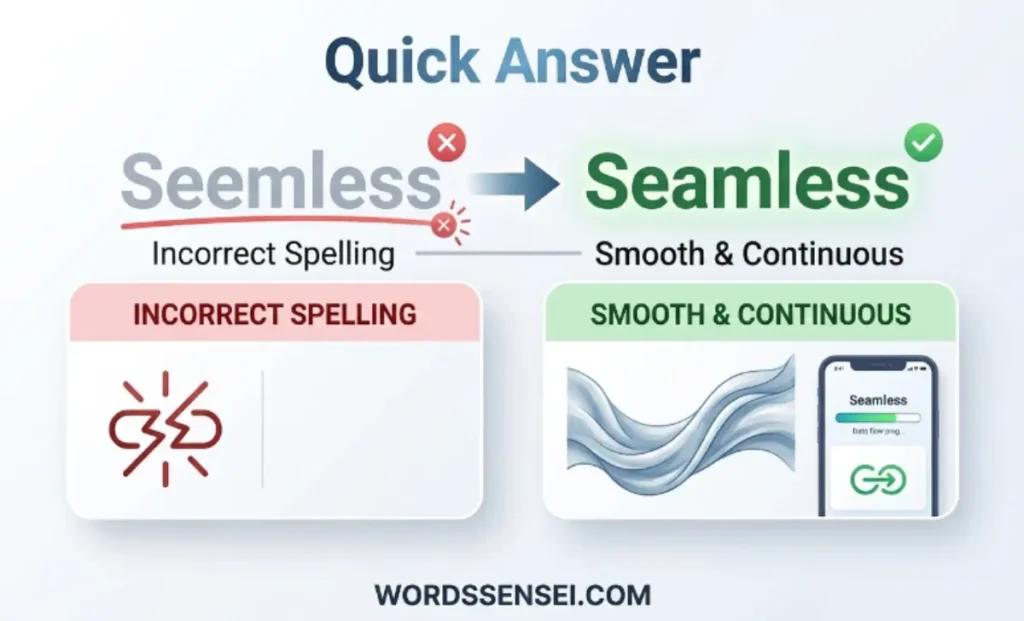
“Seamless” is the correct spelling. Meanwhile, “seemless” is incorrect and does not appear in any major English dictionary, including Merriam-Webster, Oxford, or Cambridge.
The word always contains “seam,” not “seem,” since it comes directly from the noun describing a line where two pieces of fabric join. Furthermore, the correct spelling is s-e-a-m-l-e-s-s, built from “seam” plus the suffix “-less.”
Most people make this mistake because the word “seem” looks and sounds familiar in everyday speech. Nevertheless, “seamless” has nothing to do with “seem”; it relates entirely to the word “seam.”
✅ Correct Examples
“The tailor created a seamless finish on the dress.”
“Furthermore, the software update offered a seamless experience for users.”
“Their teamwork made the entire project feel seamless.”
“In addition, the company promised a seamless transition to the new system.”
❌ Incorrect Examples
~~”The tailor created a seemless finish on the dress.”~~
~~”The software update offered a seemless experience for users.”~~
~~”Their teamwork made the entire project feel seemless.”~~
~~”The company promised a seemless transition to the new system.”~~
Never replace the “a” with an “e” in this word. After all, “seemless” simply does not exist in standard English.
What Does “Seamless” Mean?
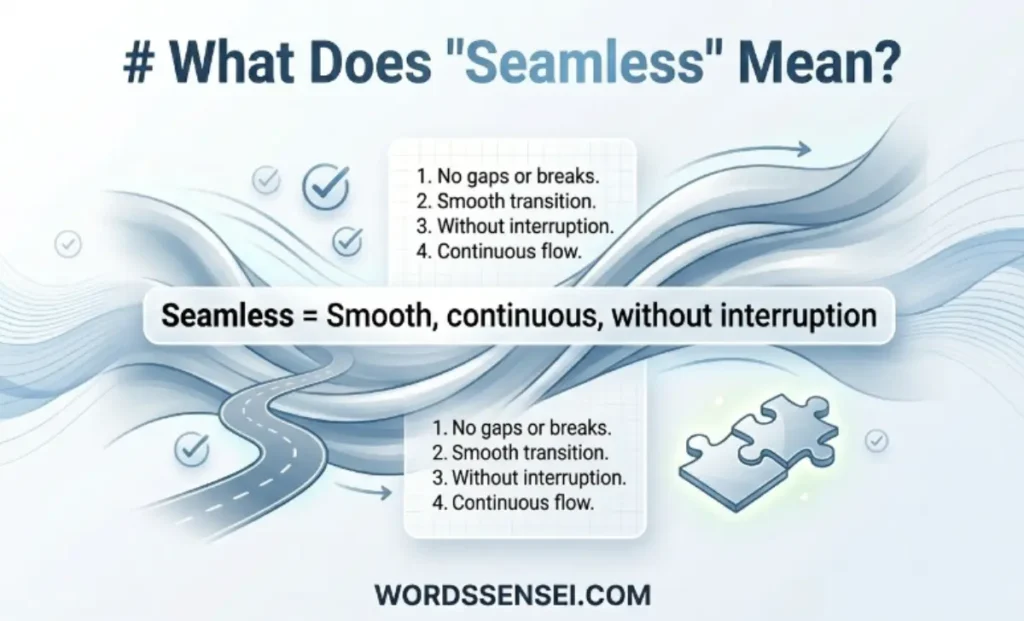
“Seamless” is a common English adjective. Moreover, it appears constantly in fashion, technology, business, and everyday conversation. It describes something smooth, continuous, or free of visible joins or interruptions.
| Feature | Detail |
|---|---|
| Word Type | Adjective |
| Correct Spelling | Seamless |
| Incorrect Spelling | Seemless |
| Syllables | 2 — seam-less |
| Pronunciation | /ˈsiːmləs/ |
| Related Adverb | Seamlessly |
| Root Word | Seam |
Common Meanings
According to the Cambridge Dictionary{:target=”_blank” rel=”noopener noreferrer”}, “seamless” describes something that has no seams or joins, or a process that happens smoothly without any problems or interruptions. Meanwhile, the word can also describe an experience, transition, or system that feels effortless from start to finish.
In everyday usage, “seamless” typically appears in a few common situations:
A seamless garment, for example, refers to clothing made without visible stitching or joins
Meanwhile, a seamless experience describes a smooth process, such as using an app or completing a task
Similarly, a seamless integration describes software or systems that connect without technical issues
Finally, a seamless transition describes moving from one situation to another without disruption
Simple Usage Examples
“The app offers a seamless checkout process for online shoppers.”
“Meanwhile, the new employee had a seamless first week at the company.”
“Designers, therefore, often aim for a seamless look in modern furniture.”
“Eventually, the merger resulted in a seamless combination of both teams.”
The Origin of “Seamless”
Knowing where this word comes from helps explain exactly why it is spelled the way it is. Additionally, it shows why “seemless” has never been correct throughout the entire history of the English language.
Word History
The word “seamless” comes directly from the Old English word “seam,” meaning a line formed by sewing two pieces of fabric together. This root traces back to Proto-Germanic origins related to sewing and joining materials.
When English speakers added the suffix “-less,” meaning “without,” the resulting word “seamless” simply meant “without a seam.” As a result, the spelling has remained tied to “seam” for centuries, never to the unrelated word “seem.”
Interestingly, “seem,” meaning to appear or give an impression, comes from a completely different root related to Old Norse. Therefore, the two words share no historical connection at all, despite their similar sound.
Why the Confusion Happens
Both “seam” and “seem” sound almost identical when spoken quickly. Moreover, “seem” is a far more common everyday word, which makes it feel like the more familiar spelling choice. Because of this frequent exposure, many people assume “seemless” must be correct.
However, this assumption is incorrect. So, here is the key difference:
| Word | Correct Spelling | Meaning |
|---|---|---|
| Seamless | Seamless | Without a seam; smooth or uninterrupted |
| Seem | Seem | To appear or give an impression |
Even though these words sound alike, they come from entirely different roots. Therefore, remembering the connection to “seam” is the easiest way to avoid the mistake.
British English vs American English
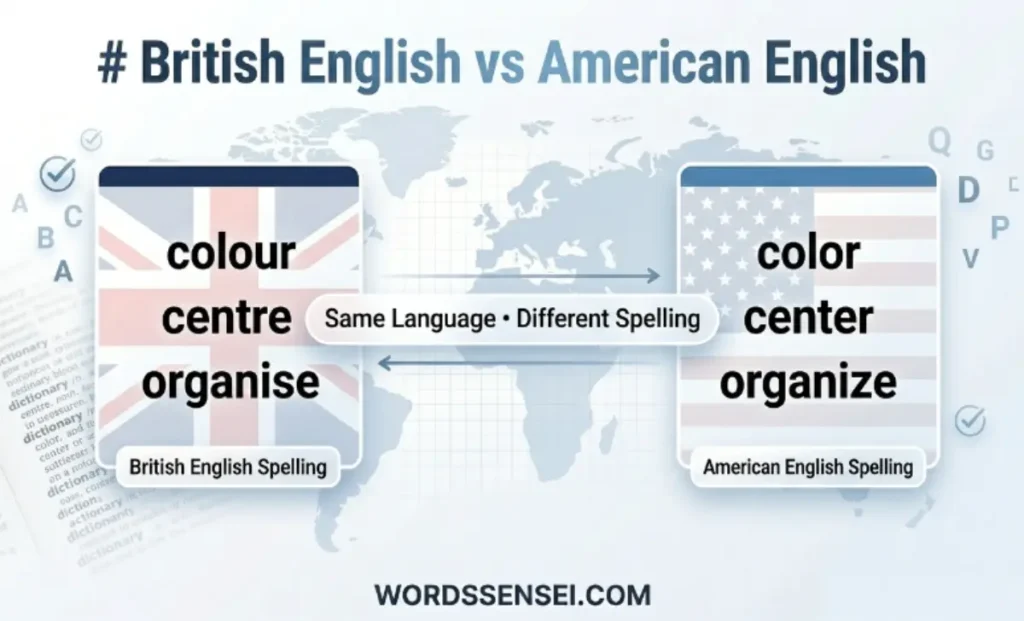
Good news — both British and American English completely agree on this word. “Seamless” is correct in every English-speaking country, without any exception.
Comparison Table
| Feature | American English | British English | Australian English | Indian English |
|---|---|---|---|---|
| Correct Spelling | Seamless ✅ | Seamless ✅ | Seamless ✅ | Seamless ✅ |
| Incorrect Spelling | Seemless ❌ | Seemless ❌ | Seemless ❌ | Seemless ❌ |
| Pronunciation | /ˈsiːmləs/ | /ˈsiːmləs/ | /ˈsiːmləs/ | /ˈsiːmləs/ |
| Dictionary | Merriam-Webster | Oxford | Macquarie | Oxford Indian |
No matter where you are writing, whether the United States, the United Kingdom, Canada, Australia, or India, the spelling never changes. Overall, always write “seamless” with an “a,” never an “e.”
Seamless vs Seemless — Full Comparison
Let us now look at every variation people sometimes use, and clear up the confusion once and for all.
Complete Comparison Table
| Form | Correct? | Exists in Dictionary? | Recommended? |
|---|---|---|---|
| Seamless | ✅ Yes | ✅ Yes — all dictionaries | ✅ Always use this |
| Seemless | ❌ No | ❌ No dictionary | ❌ Never use this |
| Seamlessly | ✅ Yes | ✅ Correct adverb form | ✅ Use for describing actions |
| Seemlessly | ❌ No | ❌ No dictionary | ❌ Never use this |
Which Spelling Should You Use?
The answer is always “seamless,” in every context and every audience. However, here is a clear breakdown by writing situation.
US Audience
American writers should always use “seamless,” confirmed by Merriam-Webster{:target=”_blank” rel=”noopener noreferrer”} as the only correct form. Consequently, all American business writing, tech documentation, and marketing content use this word exclusively.
UK Audience
British writers, similarly, always use “seamless,” confirmed by the Oxford English Dictionary. Likewise, British fashion and technology writing has used this exact spelling for centuries without variation.
Business and Marketing Writing
In marketing contexts, “seamless” describes smooth customer experiences, effortless integrations, and frictionless processes. Conversely, no professional marketing material ever uses “seemless,” since it signals a spelling error to readers.
Technical and Software Writing
Software documentation frequently uses “seamless integration” to describe systems that work together without errors. As a result, using the correct spelling maintains credibility in technical writing.
Social Media Usage
Casual posts often misspell this word because “seem” feels more familiar than “seam.” Therefore, always double-check before posting about a smooth experience or transition online.
Common Mistakes with “Seamless”
Even confident writers make these errors. So, here is exactly what to watch for, and how to fix each mistake quickly.
Frequent Errors
First, writing “seemless” instead of “seamless” remains the most common mistake by far
Second, confusing the root word “seam” with the unrelated word “seem”
Additionally, misspelling the adverb form as “seemlessly”
Meanwhile, using “seamless” incorrectly to describe something unrelated to smoothness or continuity
Finally, forgetting to proofread business or marketing copy before publishing
Corrected Examples
| ❌ Wrong | ✅ Right | Why |
|---|---|---|
| The app offers a seemless experience. | The app offers a seamless experience. | Seemless is not a word |
| Our team ensures a seemless transition. | Our team ensures a seamless transition. | Always use “seam,” not “seem” |
| The process worked seemlessly. | The process worked seamlessly. | Adverb also uses “seam” |
| The jacket has a seemless design. | The jacket has a seamless design. | Fashion context still uses “seam” |
“Seamless” in Everyday Writing Examples
Here is how “seamless” works naturally across different real-world writing situations. Furthermore, these examples will help you use the word with much more confidence going forward.
Emails
“We are pleased to offer a seamless onboarding process for new clients. In addition, our support team will guide you through every step. So, please let us know if you have any questions before we begin.”
Social Media
“Just switched to this new app and the setup was completely seamless! Honestly, I didn’t expect it to be this easy. #TechReview #Seamless”
News Writing
“Officials confirmed that the merger resulted in a seamless transition for both companies’ employees. As a result, operations continued without disruption, and further updates are expected in the coming weeks.”
School Writing
“A seamless garment is a piece of clothing made without any visible stitching. Furthermore, this technique requires specialized manufacturing equipment to achieve a smooth, continuous surface.”
Business Writing
“Our platform is designed to provide a seamless integration with your existing software. Therefore, businesses can adopt our system without any downtime. Meanwhile, our technical team remains available for support throughout the process.”
Google Trends and Usage Data
Search data clearly confirms that “seamless” completely dominates globally. On the other hand, “seemless” only appears in searches as a confused query, people checking whether it might actually be correct.
Popular Countries
| Country | Most Searched Form | Search Volume | Notes |
|---|---|---|---|
| United States | Seamless | Very High | Dominant — no competition |
| United Kingdom | Seamless | High | Consistent with US usage |
| Canada | Seamless | High | Follows North American pattern |
| Australia | Seamless | Medium-High | No regional variation |
| India | Seemless vs Seamless | High | Large ESL population — more confusion |
| Pakistan | Seemless vs Seamless | High | ESL learners — pronunciation confusion |
Why People Search This Keyword
Overall, most searches for “seamless or seemless” come from these specific groups:
First, business writers checking spelling before publishing marketing content
Second, software professionals writing technical documentation about integrations
Additionally, ESL learners confused by the similarity to the word “seem”
Meanwhile, content writers avoiding embarrassing errors in professional writing
Finally, students double-checking spelling before submitting assignments
Related Grammar Rules
Similar Spelling Mistakes
The same kind of confusion happens with other word pairs that sound alike but come from different roots. So, here are a few similar examples worth knowing:
| Related Pair | Correct Forms | Note |
|---|---|---|
| Seam / Seem | Seam, Seem | Different roots, similar sound |
| Complement / Compliment | Complement, Compliment | Different meanings, similar sound |
| Stationary / Stationery | Stationary, Stationery | Easy to confuse visually |
Helpful Grammar Tips
Tip 1 — Remember the connection to “seam.” “Seamless” simply means “without a seam.” Therefore, if you think of sewing or fabric, you will always remember the “a.”
Tip 2 — Separate “seam” from “seem” completely. “Seem” relates to appearance, while “seam” relates to a joining line. Consequently, these two words never overlap in meaning.
Tip 3 — Check the adverb form too. The correct adverb is “seamlessly,” never “seemlessly.” So, this same rule applies to every related form of the word.
Tip 4 — Think of related compound words. Words like “seamstress” also use “seam,” which reinforces the correct spelling pattern.
💡 Pro Tip: When you are not sure about any spelling, check Merriam-Webster{:target=”_blank” rel=”noopener noreferrer”} online. Best of all, it is completely free and gives the correct answer instantly.
“Seamless” — Common Phrases and Modern Usage
“Seamless” appears in many common phrases today, far beyond just its basic definition. Moreover, understanding these different uses helps you use the word naturally in any context.
Common Phrases
| Phrase | Meaning | Example |
|---|---|---|
| Seamless integration | Smooth connection between systems | “The new tool offers seamless integration with our CRM.” |
| Seamless experience | A smooth, effortless process | “Customers enjoyed a seamless checkout experience.” |
| Seamless transition | Moving between situations without disruption | “The company managed a seamless leadership transition.” |
| Seamless design | A design without visible joins | “The furniture features a seamless design.” |
| Seamless communication | Smooth, uninterrupted communication | “Remote teams rely on seamless communication tools.” |
| Seamless garment | Clothing made without stitching | “The brand specializes in seamless garment technology.” |
Internal Link Suggestions
📌 (Add These Links When Related Articles Are Ready)
The term “commonly confused word pairs” can link to your article on English spelling mistakes.
Similarly, “business writing tips” can link to your article on professional communication skills.
For technology-related content, “software integration terms” can link to your article on common tech vocabulary.
Finally, “seam vs seem” can link to your article explaining related but unconnected English word roots.
Author Bio
About the Author [Your Name] is an English language writer and grammar teacher with [X] years of experience. Additionally, [he/she/they] helps students, bloggers, and ESL learners write better and more confidently every day. Connect on LinkedIn | View All Posts
FAQs
Is “seemless” a real word?
No. “Seemless” is not a real English word. In fact, it does not appear in any major dictionary, not Merriam-Webster, not Oxford, not Cambridge. The only correct word is “seamless.”
Why do people spell seamless as seemless?
People confuse “seamless” with the more familiar word “seem.” Since both words sound almost identical when spoken, many writers assume the spelling should match, even though the two words share no historical connection.
What does “seamless” mean?
“Seamless” describes something smooth, continuous, or free of visible joins or interruptions. Furthermore, the word is widely used today to describe smooth processes, transitions, and technology integrations.
What is the difference between “seam” and “seem”?
“Seam” refers to a line where two pieces of material join together. On the other hand, “seem” means to appear or give an impression. Therefore, these are two completely unrelated words with two completely different meanings.
What is the adverb form of “seamless”?
The adverb form is “seamlessly.” For example, “The two teams worked together seamlessly.” Furthermore, this word also always uses “seam,” never “seem.”
Is “seamless” only used for clothing?
No. While “seamless” originally described clothing without visible stitching, it now commonly describes smooth experiences, business transitions, and technology integrations.
How do I remember the correct spelling of seamless?
Use this simple memory trick: “seamless” comes from “seam,” just like “seamstress.” So, if you remember that sewing connection, you will never confuse it with “seem” again.
Is “seamless” used the same way in British and American English?
Yes. Both British and American English use the identical spelling and meaning for “seamless,” without any regional variation.
Conclusion
After reading through this complete guide, the answer is now absolutely clear. “Seamless” is the only correct spelling, in every country, every writing style, and every context you can think of. “Seemless” simply does not exist in any English dictionary anywhere in the world.
The confusion happens because the word sounds so similar to “seem,” a far more common everyday word. However, “seamless” comes entirely from “seam,” a word describing a sewn line, with no connection to “seem” at all.
So, the next time you sit down to write, whether it is a business email, a marketing campaign, a school essay, or a product description, write “seamless” with complete confidence. Overall, you now have the full picture: the correct spelling, the word history, and practical tips to remember it forever.
Read More Blogs:
- Focusses or Focuses: Which Spelling Is Correct?
- Response or Respond : Here’s the Correct Word to Use

Norman Coe is a contributing writer at Wordssensei.com, covering English grammar, vocabulary, and commonly confused words.