
Have you ever stood in the middle of a hardware store or sat at your computer, wondering if you should type pliers or plyers? You are definitely not alone. This is one of those tricky words that causes confusion for everyone, from professional mechanics and electricians to DIY beginners.
When you are writing a list of tools for a project or sending a business order, getting the spelling right is very important. A simple spelling mistake can make your work look less professional, even if you are an expert at using the tools themselves.
The confusion often happens because of how the word sounds. When we say it out loud, it feels like it could be spelled with a “y.” However, in the world of modern English, there is only one standard way to write it.
This comprehensive guide is designed to help you master this word once and for all. We will look at the correct spelling, explore the different types of tools, and explain the science behind how they work. By the time you finish reading this long-form guide, you will be an expert on both the spelling and the utility of this essential hand tool.
Quick Answer

The correct and standard spelling is pliers. It is spelled with an “i” after the “l.” While you might see “plyers” in very old books or as a rare variant in some dictionaries, it is considered a misspelling in modern writing. Whether you are in the United States, the United Kingdom, or anywhere else in the world, you should always use the version with the “i.”
Think of the word “pliers” as being related to the word “pliant,” which means flexible. Just like a pair of pliers allows you to bend and flex wires or metal, the word itself is built on that same root. If you want your writing to be clear and correct, stick to the “i” and leave the “y” behind.
Correct Example
- I need a new pair of pliers to fix the sink.
- The electrician used insulated pliers for the job.
- Pass me those needle-nose pliers from the toolbox.
Incorrect Example
- I bought a set of plyers at the store. (Wrong)
- He used plyers to cut the copper wire. (Wrong)
- The plyers are missing from the shelf. (Wrong)
What Does Pliers Mean?
A pair of pliers is a fundamental hand tool used in almost every trade. It is a gripping tool that uses the principle of a lever to give you more power in your hands. Most pliers have two hinged arms that move around a central pivot point. These arms end in serrated jaws that are designed to hold, bend, or cut various materials.
Common Meanings
- Gripping Tool: The main job is to hold objects firmly that are too small or too hot for fingers.
- Cutting Tool: Many versions have sharp edges for cutting wires and nails.
- Bending Tool: They are used to shape metal or wire into specific forms.
- Fastening Tool: They help in turning nuts and bolts when a wrench is not available.
Simple Usage Examples
- Mechanical Work: “The mechanic used pliers to pull the cotter pin.”
- Electrical Work: “Always use pliers with insulated handles when working near wires.”
- Home Repair: “You can use pliers to tighten the loose bolt on the chair.”
- Crafting: “Jewelry makers use small pliers to open tiny metal rings.”
The Origin of Pliers
The history of this tool is as old as metalworking itself. Humans have needed a way to handle hot metal since the Bronze Age.
Word History
The word pliers comes from the French word plier, which means “to bend.” This French word comes from the Latin word plicare. In the early days of English, spelling was not standardized, so you might find “plyers” in documents from hundreds of years ago. However, as the language became more formal, the spelling settled on pliers.
Why the Confusion Happens
The confusion happens for two main reasons. First, the verb “to ply” (meaning to work at something) is spelled with a “y.” People think that a tool that “plies” should be a “plyer.” Second, the phonetic sound of the word is very similar to words like “flyer” or “dryer,” which both use a “y.” This leads our brains to want to follow that pattern.
British English vs. American English
Unlike many other words, pliers is one of the few that stays the same across all major versions of English.
Comparison Table
| Feature | American English (US) | British English (UK) |
|---|---|---|
| Spelling | Pliers | Pliers |
| Plural Form | Pair of Pliers | Pair of Pliers |
| Usage | Standard | Standard |
| Common Variant | None | None |
Whether you are writing a manual in London or a blog post in New York, the word is always pliers.
Pliers vs. Other Variations
It is helpful to see how this word relates to other similar terms in the hardware world.
Spelling Comparison Table
| Correct Spelling | Incorrect Spelling | Category | Usage |
|---|---|---|---|
| Pliers | Plyers | Hand Tool | Standard |
| Tweezers | Tweesers | Small Gripper | Correct |
| Wrench | Rench | Turning Tool | Correct |
| Scissors | Scisors | Cutting Tool | Correct |
The Science of Pliers: Mechanical Advantage
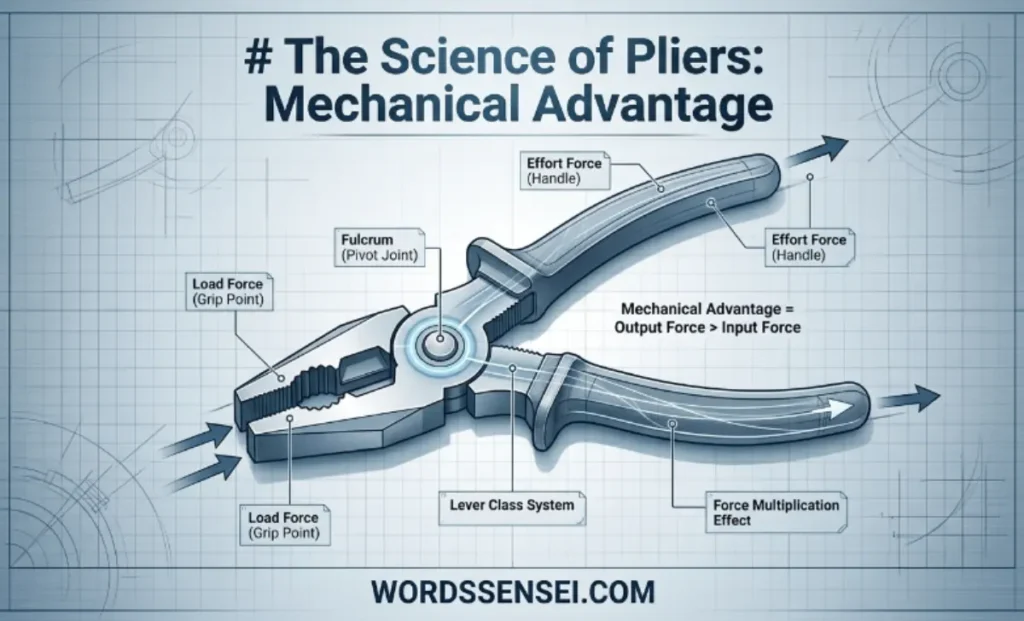
To truly understand this tool, you must understand the physics behind it. Pliers work on the principle of a first-class lever. The pivot or fulcrum is located between the handles and the jaws.
How Torque Works
When you squeeze the long handles, the force is multiplied at the short jaws. This is called torque. Because the handles are much longer than the jaws, a small amount of hand pressure turns into a very strong grip. This mechanical advantage is what allows you to bend thick steel or pull out stubborn nails that your fingers could never move.
Material and Durability
High-quality pliers are usually made from chrome vanadium or hardened steel. These materials ensure that the serrated jaws do not wear down quickly and that the tool does not bend under high pressure.
Different Types of Pliers and Their Uses
Not all pliers are the same. Each type is designed for a specific task.
Needle Nose Pliers
These have long, thin jaws that come to a point. They are perfect for electrical work where you need to reach into small spaces. They are also great for jewelry making and small repairs.
Combination Pliers
These are the most common type found in a toolbox. They have a flat gripping area at the front and a cutting area near the pivot. They are the “jack of all trades” in the tool world.
Diagonal Cutters
Sometimes called “dikes,” these are not for gripping. Their only job is to cut wire. The jaws are set at an angle to allow you to cut wire flush against a surface.
Locking Pliers (Vise-Grips)
These pliers have a mechanism that allows them to be locked onto an object. Once locked, you don’t have to keep squeezing the handles. They are excellent for removing stripped bolts or holding two pieces of metal together for welding.
Slip Joint Pliers
These have a pivot point that can be moved into two different positions. This allows the jaws to open wider to grip larger objects. They are a staple in basic home toolkits.
Which Spelling Should You Use?
You should always use the version with the “i.” There is no professional or academic setting where “plyers” is accepted.
US Audience
In the US, the “i” version is the only one taught in schools and used in technical manuals.
UK Audience
In the UK, the “i” version is standard. The British Standards Institution (BSI) uses pliers in all its documentation.
International Writing
For global trade and engineering, pliers is the universal term. Using the wrong spelling could lead to confusion in international orders.
Academic Writing
If you are writing a paper on engineering or history, “plyers” will be marked as a spelling error.
Social Media Usage
Even in casual posts, using pliers shows that you know your tools. It helps you connect with the DIY and maker community more effectively.
Common Mistakes with Pliers
Avoid these frequent errors to keep your writing sharp.
Frequent Errors
- The “Y” Trap: Writing “plyers” because it sounds like “flyer.”
- Singular vs. Plural: Saying “a plier.” Like “scissors,” it is usually referred to as “a pair of pliers.”
- Spelling the Noun: Forgetting the “s” at the end. The tool is always pliers, even if you only have one.
Corrected Examples
- Incorrect: “I need a plyer.”
- Correct: “I need a pair of pliers.”
- Incorrect: “The plyers are on the table.”
- Correct: “The pliers are on the table.”
Pliers in Everyday Examples
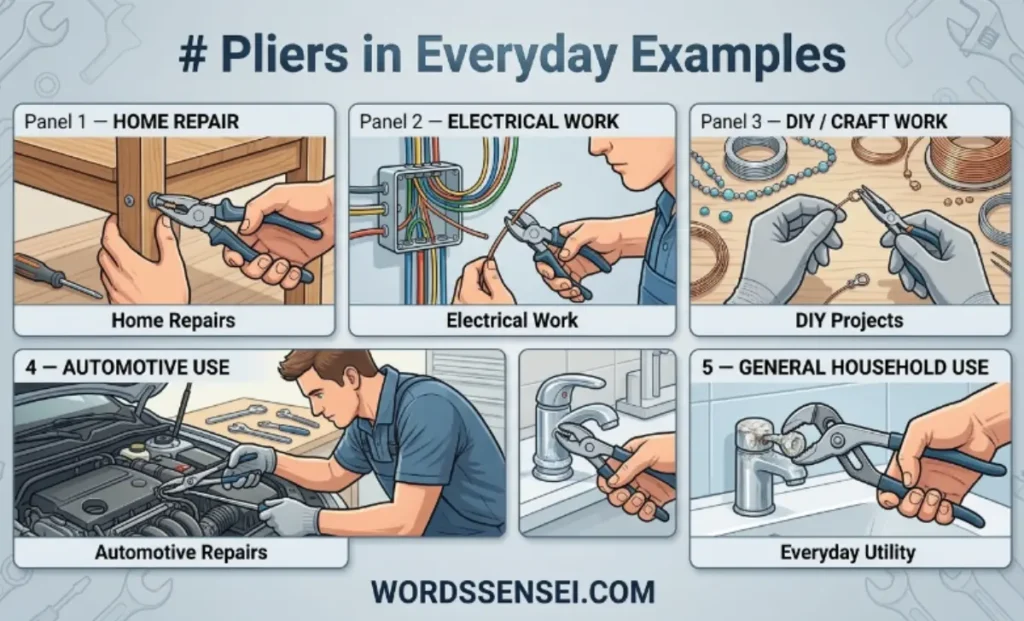
Let’s see how to use the word in different types of communication.
Emails
“Hi team, please ensure the new shipment of lineman’s pliers is checked for insulated handles before being sent to the site.”
Social Media
“Just finished my first DIY project! Couldn’t have done it without my trusty combination pliers. 🛠️ #DIY #Tools”
News Writing
“The fire department used heavy-duty locking pliers to gain access to the building during the emergency.”
School Writing
“The invention of the pivot joint allowed for the creation of tools like pliers, which revolutionized metalworking.”
Business Writing
“Our new line of chrome vanadium pliers offers 20% more torque than the previous model.”
Google Trends & Usage Data
The data shows that people are constantly searching for the right tool and the right spelling.
Popular Countries
- United States: Highest volume for “types of pliers.”
- United Kingdom: Frequent searches for “best pliers for electricians.”
- India: Large number of searches for “pliers price and quality.”
- Australia: Common searches for “heavy-duty pliers for construction.”
- Canada: High search volume for “pliers in winter conditions.”
Why People Search This Keyword
Most searches are from people trying to fix something. They want to know which specific type of tool they need for a job, such as plumbing or electrical repair. The spelling search usually happens when someone is writing a blog post or a product description.
Related Grammar Rules
Spelling is easier when you see the patterns.
Similar Spelling Mistakes
- Hammer: Sometimes confused as “hamer.”
- Chisel: Often misspelled as “chizzel.”
- Wrench: Sometimes written as “rench.”
Helpful Grammar Tips
Always treat pliers as a plural noun. You would say “The pliers are heavy,” not “The pliers is heavy.” If you want to use it as a singular unit, always say “a pair of pliers.”
FAQs
Is it pliers or plyers?
The correct spelling is pliers. “Plyers” is an outdated and incorrect spelling.
What are pliers used for?
They are used for gripping, bending, and cutting wires, nails, and other small objects.
Can I say ‘a plier’?
It is grammatically better to say “a pair of pliers,” similar to how you say “a pair of scissors.”
Why are they called pliers?
The name comes from the French word plier, which means “to bend.”
What are the best pliers for electrical work?
Needle nose pliers and lineman’s pliers with insulated handles are best for electrical tasks.
Are all pliers the same?
No, there are many types like slip joint, locking, and diagonal cutters, each for a different job.
How do I maintain my pliers?
Keep them clean, oil the pivot occasionally, and don’t use them on tasks they aren’t designed for.
What material is best for pliers?
Chrome vanadium and hardened steel are the best materials for long-lasting tools.
Conclusion
In summary, the journey to mastering the word pliers is about more than just a single letter. While the mistake of writing “plyers” is common due to its phonetic sound, the standard English spelling with an “i” is what you must use to be correct and professional.
Throughout this guide, we have seen that pliers are not just a simple tool but a marvel of engineering that uses mechanical advantage and torque to help us perform difficult tasks. From the needle nose pliers used in delicate electrical work to the heavy-duty locking pliers used in mechanics, this tool is a vital part of every toolbox.
Remember, your writing reflects your expertise. By using the correct spelling and understanding the different types of hand tools available, you show that you are a knowledgeable and careful communicator.
Whether you are a student, a professional, or a hobbyist, keeping the “i” in pliers and understanding the pivot and jaws of the tool will serve you well. Keep your tools clean, your spelling accurate, and your projects will always be a success. Your commitment to using the right words is the first step toward high-quality work in any field!
Read More Blogs:
- Beemer or Beamer? The BMW Nickname Most People Get Wrong
- Dysregulated or Disregulated? Most Writers Get This Wrong

Gerald Nelson is a contributing writer at Wordssensei.com, covering English grammar, vocabulary, and commonly confused words.