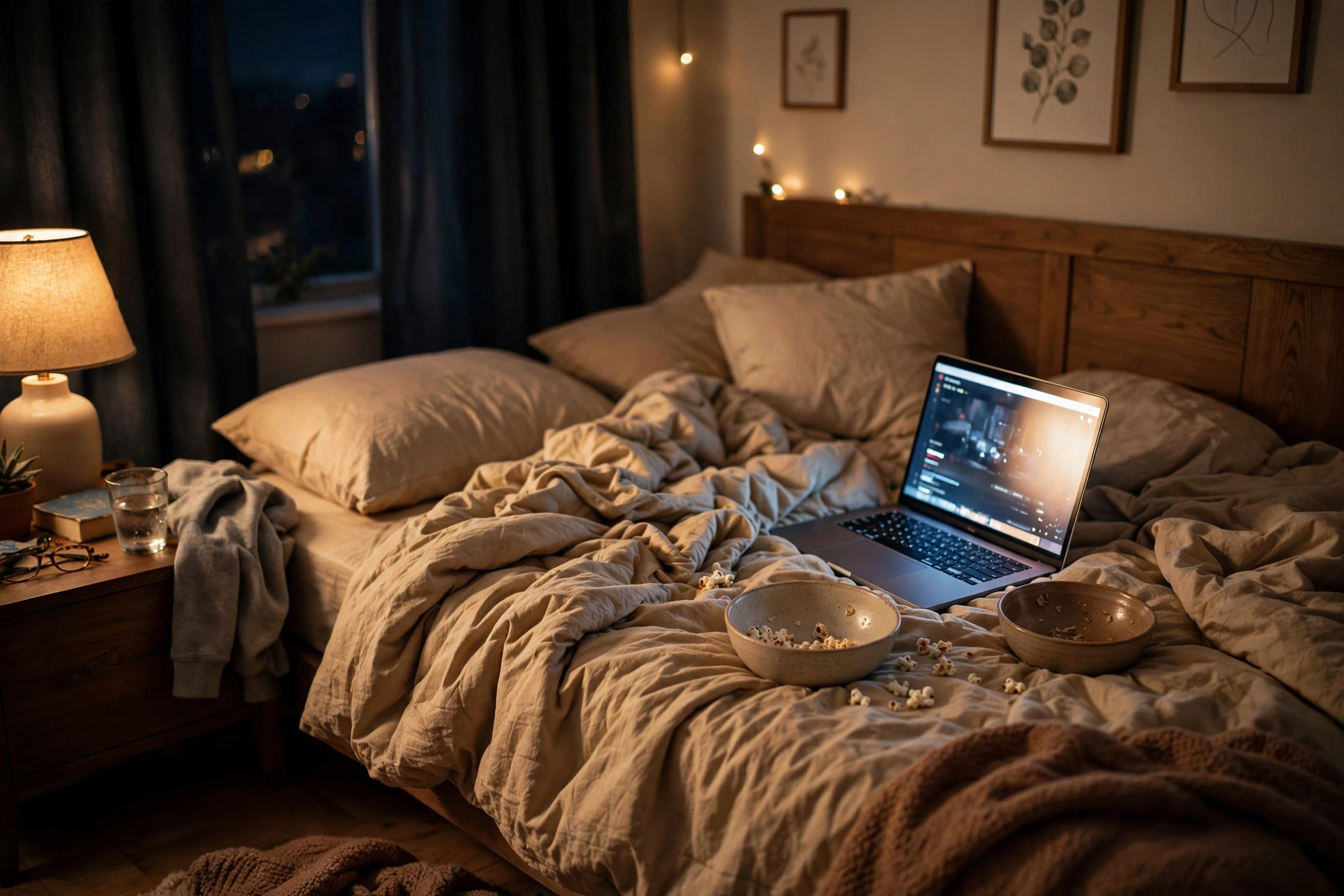
You wake up on a Saturday with no plans, and plans are exactly what you don’t want. You order takeout for the second night in a row, ignore the laundry, let the dishes pile up, and watch six episodes of a show in the same sweatpants. No shame. No apology. That state has a name now — and in 2022, it was voted the most important word of the year.
Goblin Mode: The Short Answer
“Goblin mode” means a state of being unapologetically lethargic, slovenly, and prone to odd, self-indulgent behavior (Wiktionary). Oxford Languages named it their Word of the Year for 2022 — the first time the choice was made by public vote — defining it as “a type of behaviour which is unapologetically self-indulgent, lazy, slovenly, or greedy, typically in a way that rejects social norms or expectations.” You don’t call a person goblin mode; you go goblin mode.
What Does “Goblin Mode” Mean?
At its core, goblin mode is the deliberate, cheerful rejection of polish. It’s eating cereal straight from the box at 2 a.m., binge-watching instead of “doing something productive,” leaving the bedroom in what experts might call chaos and calling it comfort. The dictionary’s phrasing — “unapologetically lethargic, slovenly, and prone to odd and self-indulgent behaviour” — captures three ingredients: low energy, low tidiness, and a total refusal to feel guilty about either.
Two nuances matter. First, Oxford defines goblin mode as a type of behaviour, not a type of person. It’s something you do or enter, like a mode on a washing machine, not a label stamped on someone. Second, the word carries a knowing, humorous tone. Nobody uses “goblin mode” to describe a genuinely dark time in a solemn way; it’s self-deprecation with a wink — the joke being that you’ve given up on performing “togetherness” for a while and you’re fine with it.
Like brain rot, another internet-era behavior label, goblin mode names something millions of people were already doing long before the word arrived. And if you’ve ever felt a strange, performative pressure to seem effortlessly composed online, main character energy is its opposite — the curated highlight reel goblin mode cheerfully refuses to be.
The Origin of “Goblin Mode”
The word is older than its fame. The first known use appeared on Twitter in 2009 — a passing reference that sat largely unnoticed for over a decade. Then, in February 2022, it went viral. The timing wasn’t accidental: after two years of pandemic-era lockdowns, remote work, and relentless social-media performance, the idea of abandoning the act entirely hit a nerve. Saying you were in goblin mode was a way to name the sweatpants, the snacks, and the unbothered attitude without defending them.
The culmination came late in 2022, when Oxford Languages put its Word of the Year to a public vote for the first time. More than 340,000 people voted, and goblin mode won with a staggering 93 percent — a landslide that confirmed it wasn’t just a meme but a word that had captured the mood of the moment. Wiktionary’s entry collected dated quotations from The Guardian, The New York Times, The New York Post, and NBC, tracing the term’s journey from throwaway tweet to mainstream vocabulary within a single year.
Oxford’s win also cemented the word’s spelling and definition in the record. Lexicographers track words before crowning them; goblin mode had earned its place through genuine, sustained public use, not a one-week joke.
How to Use “Goblin Mode”
Goblin mode is almost always used about oneself or a willing group — “we,” “I,” “the weekend” — never as an accusation. The sentence pattern is simple: subject + go/went/enter/into + goblin mode.
- “After that deadline week, I went full goblin mode and didn’t leave the couch until Monday.”
- “Snow day. Ordered pizza twice. Goblin mode: activated.”
- “She put her phone on Do Not Disturb and entered goblin mode — three seasons, one blanket, zero regrets.”
- “The group chat went goblin mode last night: memes, junk food, and nobody pretending to be productive.”
Notice the tone: cheerful, voluntary, and temporary. It’s a mode, which implies you come out of it. Nobody says “I’ve been in goblin mode for six years” — the word lives in the weekend, the snow day, the post-exam collapse. That built-in temporariness is part of the humor: even the laziest version of you has an exit plan.
In writing, it behaves like a noun phrase used as a complement (“go goblin mode,” “in goblin mode”). You don’t need articles — “a goblin mode” sounds off. Some writers intensify it with “full”: “full goblin mode” is probably the most common collocation you’ll see online.
An Important Caveat: What Goblin Mode Is Not
Here’s where the laughter needs a footnote. In 2022, an NBC piece raised a genuine concern: the term could be weaponized as a label for people struggling with mental-health conditions or disabilities — turning something real into a punchline. Oxford’s own definition is carefully scoped to behaviour — voluntary, short-term, self-aware slovenliness — and the word works best when it stays in that lane.
The rule is simple: goblin mode is a costume you choose, not a diagnosis you hand to someone else. Describing your own Sunday of takeout and naps as goblin mode is the intended, humorous use. Applying it to a person with depression, chronic illness, or a disability who isn’t choosing the state — that’s not slang; that’s cruelty with a meme attached. The self-deprecating frame is the whole point: the joke lands because you chose it and you can unchoose it.
If you find the word sliding toward someone else’s situation, reach for plain, kind language instead. Words are tools; this one is built for volunteered weekends, not other people’s lives. For more internet-era emotional vocabulary that deserves the same care, the Sunday scaries capture pre-Monday dread without mocking anyone in the process.
Why Did It Catch On?
Every era gets the slang it deserves, and the early 2020s produced a whole family of words for the gap between performed perfection and private reality. Goblin mode sat alongside “touch grass,” “bed rotting,” and the romanticizing of doing nothing. Its genius is the fantasy framing: a goblin isn’t just lazy, it’s a creature of hoards, burrows, and unapologetic appetite. Calling your weekend goblin mode turns the guilt into lore.
There’s also a linguistic trick at work. “Goblin mode” is a noun-noun compound that reads like a device setting — silent mode, airplane mode — which makes the behavior feel switchable and under control. That built-in off-switch is what keeps it affectionate rather than bleak. You’re not lost; you’re just in a mode.
Frequently Asked Questions
It means being unapologetically lethargic, slovenly, and prone to odd, self-indulgent behavior (Wiktionary). Oxford Languages’ definition: “a type of behaviour which is unapologetically self-indulgent, lazy, slovenly, or greedy, typically in a way that rejects social norms or expectations.” It’s the word for deliberately ignoring productivity and polish — eating snacks in bed, ignoring the mess — with zero guilt.
Oxford Languages made 2022’s Word of the Year the first ever chosen by public vote, and goblin mode won in a landslide: over 340,000 votes, with 93 percent for goblin mode. The win reflected the post-lockdown mood — after years of performing “togetherness” online, the word captured a collective urge to abandon the act.
The first known use appeared on Twitter in 2009, though it stayed obscure for over a decade. It went viral in February 2022 and exploded into mainstream use that year, with dated quotations in The Guardian, The New York Times, The New York Post, and NBC.
It isn’t meant to be. It’s normally used self-deprecatingly — you say you went goblin mode. But critics (notably an NBC 2022 piece) have warned against applying it to people with mental-health issues or disabilities. Keep it as a voluntary, humorous label for your own behavior, never as a label for someone else’s condition.
No. It’s used as an uncountable state: “go goblin mode,” “in goblin mode,” “full goblin mode.” Adding an article or pluralizing it sounds wrong — the same way “airplane mode” doesn’t take an article.
They’re cousins, not twins. “Bed rotting” (or “bedrotting”) specifically means spending the day in bed doing nothing — often framed positively as rest. Goblin mode is broader: it covers the snacks, the mess, the chaos, the rejection of all social norms, anywhere in the house. Bed rotting is a subset; goblin mode is the whole lifestyle.